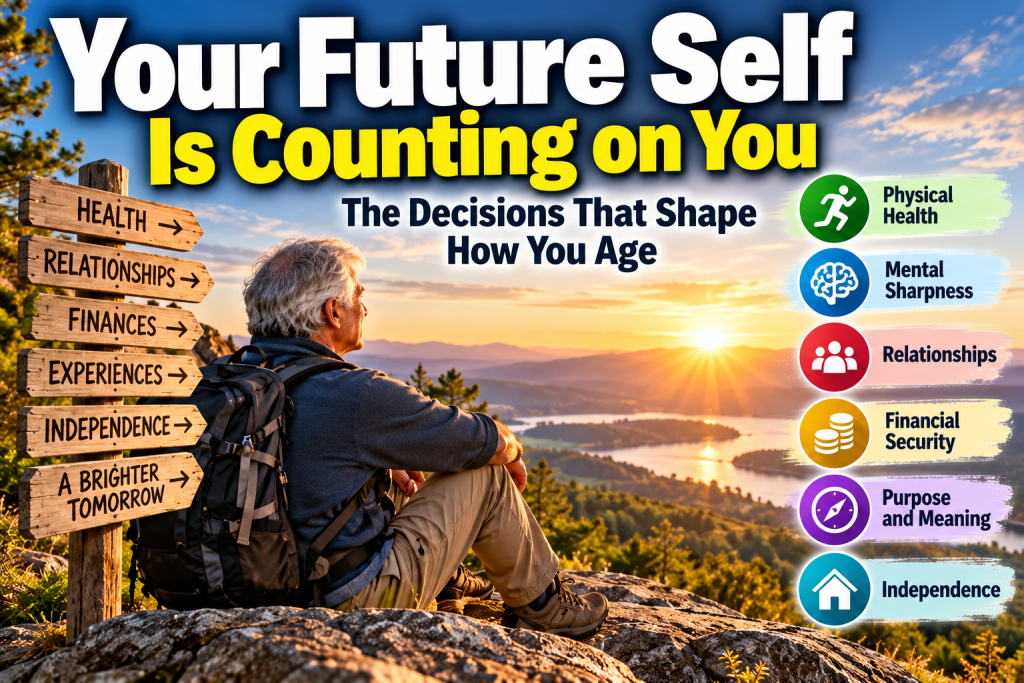
There is someone depending on you today.
Someone whose health, independence, finances, friendships, mobility, and quality of life will be influenced by the decisions you make right now.
That person is not your spouse.
Not your children.
Not your doctor.
It is your future self.
The person you will be five years from now.
Ten years from now.
Maybe twenty years from now.
We usually think of aging as something that simply happens to us.
The calendar moves.
Birthdays accumulate.
Hair changes color.
Joints complain a little more loudly when we get out of bed.
Eventually, we look in the mirror and wonder who invited our father into the bathroom.
But there is another way to think about aging.
Instead of asking:
“What is going to happen to me as I get older?”
Ask:
“Who am I becoming?”
That may be one of the most important questions of Elderhood.
At Elderhood.info, our philosophy is simple:
Stay Young. Die Old.
That does not mean pretending we are 30 when we are 70, 80, or 90.
Nobody needs to see us squeezing into skinny jeans to prove a philosophical point.
It means protecting the things that keep us fully alive for as much of life as possible:
Our strength.
Our mind.
Our curiosity.
Our relationships.
Our independence.
Our sense of purpose.
And perhaps most importantly, our ability to continue participating in our own life.
Aging Is Not a Single Event
Most people do not suddenly “become old.”
It happens gradually.
A little less walking.
A little less socializing.
A little more television.
A little less curiosity.
A missed hearing test.
An appointment postponed.
A muscle that stops being used.
A friend we meant to call but didn’t.
A financial matter we decide to “take care of later.”
None of these decisions seems particularly important when it happens.
But life has an interesting accounting system.
Small choices compound.
That works both ways.
Ten minutes of walking doesn’t look like much.
Neither does one healthy breakfast.
Or one phone call to an old friend.
Or five minutes of balance practice.
Or learning how to use a new piece of technology.
But repeated over months and years, small choices can become capability.
The reverse is also true.
Inactivity becomes weakness.
Isolation becomes loneliness.
Avoidance becomes dependence.
“I’ll do it tomorrow” eventually becomes “I wish I had done it sooner.”
This is why the idea of a future self matters.
The person you become later inherits what you repeatedly do today.
Your Future Body Is Listening
One of the most obvious examples is physical health.
Muscle is remarkably democratic.
Use it, and the body receives a message:
We still need this.
Stop using it, and the body receives another message:
Apparently we’re done with that.
Age-related muscle loss is real, but inactivity can accelerate the problem.
The National Institute on Aging notes that physical activity supports healthy aging and that aerobic activity, muscle-strengthening exercise, and balance work can help older adults maintain physical ability and independence.
That word—independence—is important.
Exercise is not just about looking better.
At this stage of life, strength can mean:
Getting out of a chair without assistance.
Carrying groceries.
Walking through an airport.
Climbing stairs.
Getting off the floor.
Maintaining balance.
Continuing to live where you want to live.
That makes physical activity something more than exercise.
It becomes an investment in personal freedom.
We explore this distinction throughout The Science of Elderhood and in Aging Is Inevitable. Decline Is Not..
You cannot guarantee what your health will look like ten years from now.
Nobody can.
But you can make today’s body send tomorrow’s body a better inheritance.
Healthspan Changes the Question
For decades, people talked mainly about lifespan.
How long will I live?
Will I reach 80?
90?
100?
But there is a better question:
How much of that life will I be able to use?
That is where the idea of healthspan comes in.
Lifespan measures how many years you are alive.
Healthspan concerns how many of those years you remain reasonably healthy, capable, engaged, and independent.
The World Health Organization describes healthy aging in terms of maintaining the functional ability that enables well-being in older age. That includes the interaction between our physical and mental capacities and the world around us.
That is a much richer goal than simply staying alive.
We took a deeper look at this in What’s the Difference Between Healthspan and Lifespan?.
The question becomes:
Not merely, “How long can I live?”
But:
“How long can I remain me?”
Able to decide.
Able to move.
Able to connect.
Able to contribute.
Able to enjoy the ordinary things that make life worth having.
Your Future Mind Needs Exercise Too
Physical capability is only part of Elderhood.
There is another kind of aging that may be just as important:
The gradual narrowing of our world.
We stop learning new things.
We stop trying new technology.
We stop meeting new people.
We decide some subject is “for younger people.”
We begin every sentence with:
“I don’t understand all this new stuff.”
That is dangerous territory.
Curiosity keeps the world expanding.
The opposite of curiosity is not ignorance.
It is withdrawal.
There is a big difference between not knowing something and deciding you no longer want to know.
New technology provides a perfect example.
Artificial intelligence did not exist in daily life for most of us a few years ago.
Today it can help explain complicated subjects, translate languages, organize information, generate ideas, teach skills, and answer questions.
Tomorrow it will undoubtedly do more.
An older person can look at that and say:
“That isn’t for me.”
Or:
“Show me what this can do.”
Those two sentences lead to very different futures.
That is why Elderhood includes The Explorer as part of its philosophy.
An elder possesses something younger people cannot manufacture instantly:
elapsed experience.
Combine experience with curiosity, and age becomes an advantage rather than merely a number.
Protect Your Relationships Before You Need Them
Your future self will also need people.
This may be one of the easiest things to underestimate.
During working years, human contact often happens automatically.
Coworkers.
Clients.
Neighbors.
Children.
School activities.
Business meetings.
Community events.
Then retirement changes the structure.
Friends move.
Spouses die.
Families scatter.
Mobility changes.
Suddenly, connection requires effort.
The CDC says supportive social connections are associated with better mental and physical health, while social isolation and loneliness are associated with increased risks involving heart disease, stroke, depression, dementia, and earlier death.
Relationships are therefore not simply entertainment.
They are part of healthy aging.
That doesn’t mean you need 400 Facebook friends.
One real conversation may be worth more than 400 digital acquaintances.
Call somebody.
Have lunch.
Join something.
Volunteer.
Take a class.
Reconnect with an old friend.
Meet somebody new.
And yes, sometimes you have to be the person who makes the first call.
Your future self may be extremely grateful that you did.
Independence Has More Than One Meaning
When people hear the word independence, they often think:
“Can I still live by myself?”
But independence is larger than that.
Physical independence matters.
So does financial independence.
Mental independence matters.
Personal independence matters.
The ability to understand your own affairs.
To ask questions.
To make informed choices.
To recognize a scam.
To learn how technology works.
To participate in financial decisions.
To express how you want to live.
Eventually, almost everybody needs help with something.
Needing help is not necessarily losing independence.
The larger question is:
Do you still have a voice in the help you receive?
That is why healthy aging is not about stubbornly insisting:
“I can do everything myself.”
Sometimes that sentence is courage.
Sometimes it is foolishness wearing a cowboy hat.
Real independence means preserving as much agency as reasonably possible.
Accepting help when needed while remaining part of the decision.
Money Is Also a Health Issue
We tend to put finances in one box and health in another.
Life does not cooperate with those filing cabinets.
Financial stress affects choices.
Can you afford healthier food?
Can you repair the car?
Can you remain in your home?
Can you travel to see family?
Can you hire help if you need it?
Do you have emergency savings?
Have you organized important documents?
Does somebody trustworthy know where those documents are?
The future self needs more than investments.
It needs organization.
One of the best things you can give your future self is simplicity.
Fewer mysteries.
Fewer forgotten accounts.
Fewer stacks of paperwork nobody understands.
Fewer emergencies created by things that could have been handled years earlier.
Sometimes aging well is not glamorous.
Sometimes it is simply knowing where the paperwork is.
Don’t Wait for a Crisis to Become Interested
Human beings are terrific procrastinators.
We often act only when something finally hurts enough.
We start exercising after the fall.
We start saving after the emergency.
We address hearing after years of saying:
“Everybody mumbles.”
We call the friend after hearing someone else became ill.
We prepare legal documents when a crisis is already happening.
There is a better approach.
Ask occasionally:
“What problem would my future self wish I handled today?”
Maybe it is physical.
Maybe financial.
Maybe emotional.
Maybe practical.
Maybe relational.
You do not have to rebuild your life this afternoon.
Pick one thing.
That is enough.
Write a Letter to the Person You’re Becoming
Here’s an exercise worth trying.
Imagine yourself ten years from now.
Don’t picture an old person.
Picture you.
Same sense of humor.
Same memories.
Same personality.
Just ten years farther down the road.
Now ask that person:
“What do you wish I would start doing today?”
The answer might surprise you.
Maybe your future self says:
Walk more.
Save more.
Stop worrying so much.
Call your brother.
Lose the resentment.
Get the hearing checked.
Strengthen your legs.
Take the trip.
Learn the technology.
Stop putting off the dental work.
Make new friends.
Clean out the garage before I have to do it at 91.
Your future self probably won’t ask you to be perfect.
He or she may simply ask you to pay attention.
The Future Is Not Something That Happens All at Once
This is perhaps the most important idea.
Your future is being assembled right now.
Quietly.
One meal.
One walk.
One phone call.
One financial decision.
One medical appointment.
One friendship.
One book.
One new idea.
One good night’s sleep.
None of these things looks dramatic.
That’s why they are easy to dismiss.
But the ordinary things are often where life is actually decided.
If you’d like to explore the bigger distinction between merely adding years and protecting the quality of those years, read What’s the Difference Between Healthspan and Lifespan?.
And for a broader look at maintaining strength, mind, connection, and purpose, visit The Science of Elderhood.
Who Do You Want to Be When You Get There?
That may be the ultimate Elderhood question.
Not:
How old will I be?
But:
Who will I be?
Will I still be curious?
Will I still participate?
Will I still have people around me?
Will I still make my own decisions?
Will I still find something worth getting up for?
Will I still be learning?
Will I still laugh?
Nobody can control the entire answer.
Illness happens.
Loss happens.
Life happens.
But uncertainty is not an excuse to abandon the future.
It is a reason to prepare for it.
So take care of the person you are today.
But remember who else you are taking care of.
The person coming next.
Your future self.
One day, you are going to meet that person.
Try to arrive with something worth thanking yourself for.
Stay Young. Die Old.