
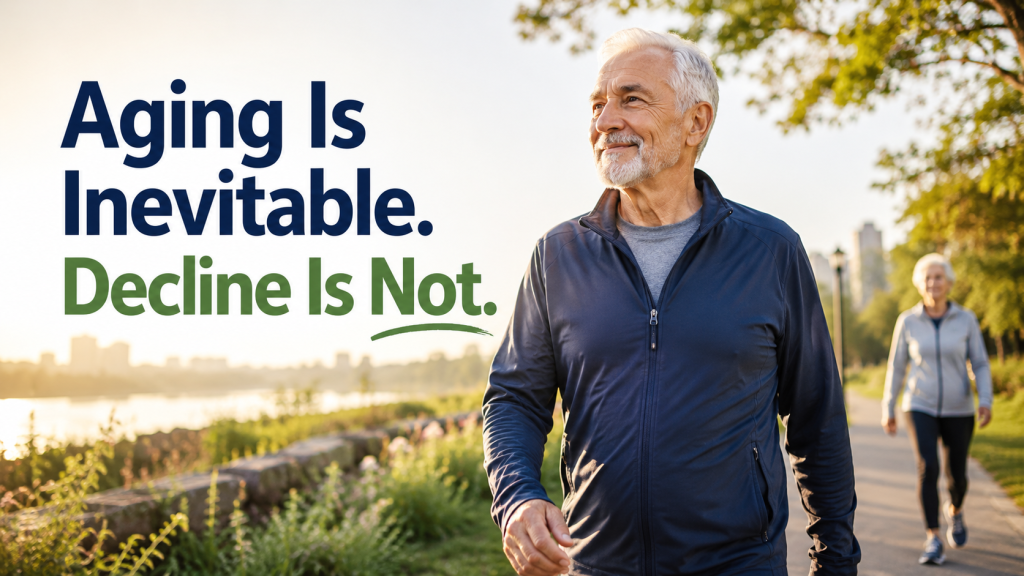
Aging is inevitable. Every birthday proves that the calendar is still doing its job.
But decline is a different matter.
For generations, people were taught to think of aging and decline as a package deal. You got older, became weaker, slowed down, lost your independence, and eventually surrendered your car keys, your social life, and possibly control of the television remote.
That may have been common. It was never a law of nature.
Getting older certainly brings physical changes. Recovery may take longer. Muscles can shrink when they are not used. Balance may become less reliable. Vision, hearing, sleep, and memory can change. Chronic conditions become more common.
But there is an important distinction between aging and neglect.
Aging happens automatically. Decline is often accelerated by inactivity, poor nutrition, isolation, unmanaged health conditions, outdated information, and the belief that improvement is no longer possible.
That belief may be one of the most damaging parts of growing older.
The Goal Is Not to Stay Young
Healthy aging is not about pretending to be 35 when you are 75.
Your knees know the truth, and they are not easily fooled.
The goal is not to remain young. The goal is to remain capable.
The World Health Organization defines healthy aging as developing and maintaining the functional ability that supports well-being in later life. In plain English, that means being able to do the things that matter to you: move around, make decisions, maintain relationships, meet your basic needs, continue learning, and participate in life.
This is the larger promise of Elderhood. We are not merely trying to add more candles to the birthday cake. We are trying to make sure we still have enough breath to blow them out.
Longevity without function is not the whole victory.
The better goal is a longer life with strength, curiosity, independence, purpose, and enough flexibility to adapt when life changes.
Muscle Loss Is Common, but Surrender Is Optional
One of the most important battles in later life is the preservation of muscle.
Muscle is not just something bodybuilders admire in the mirror. It helps you rise from a chair, climb stairs, carry groceries, stabilize your joints, protect your bones, maintain balance, and recover from illness.
The dangerous part is that muscle loss can happen gradually. You may not notice it until getting off the sofa begins to resemble a NASA launch sequence.
The good news is that older muscles can still respond to resistance training.
The Centers for Disease Control and Prevention recommends that adults 65 and older combine aerobic activity with muscle-strengthening exercise and activities that improve balance. The general target is at least 150 minutes of moderate activity each week, strength work on at least two days, and regular balance practice.
That does not mean you need to join a gym filled with people taking photographs of themselves between every exercise.
Strength work can include:
- Using resistance bands
- Lifting manageable hand weights
- Practicing repeated sit-to-stand movements
- Doing wall push-ups
- Carrying groceries
- Climbing stairs
- Performing supervised exercises in a pool
- Working with a physical therapist when necessary
The best exercise is not the fanciest one. It is the one you can perform safely and continue consistently.
For more on preserving function, read The Science of Elderhood: Four Pillars for Thriving in the Second Half of Life.
Movement Is Medicine, but It Must Be Taken Regularly
A long workout once a week does not completely cancel six days of sitting.
Our bodies were built to move regularly. That does not mean every older adult must run marathons, climb mountains, or suddenly become the oldest contestant on a reality survival show.
It means we should stop parking the body for hours at a time.
Walking after meals, standing during commercials, stretching while waiting for the coffee, tending a garden, dancing, swimming, cycling, and doing household tasks all contribute to daily movement.
The National Institute on Aging notes that it is never too late to become more physically active. Older adults can benefit from aerobic exercise, muscle strengthening, and balance activities, and many ordinary household or community activities can count toward weekly movement goals.
Movement helps support:
- Heart and lung health
- Blood sugar control
- Mobility
- Bone strength
- Mood
- Sleep
- Balance
- Independence
You do not have to become an athlete.
You do have to remind your body that it is still expected to work.
The Brain Also Needs Exercise
Some cognitive changes can occur with age, but significant mental decline is not an automatic consequence of every birthday.
The brain responds to stimulation. Learning, reading, problem-solving, conversation, music, movement, and new experiences all give it work to do.
Research summarized by the National Institute on Aging suggests that staying physically active, eating well, managing health conditions, continuing to learn, and remaining socially engaged may help support cognitive health.
This is where retirement can become either an opportunity or a trap.
Retiring from a job should not mean retiring from curiosity.
Learn how to use new technology. Study a language. Take a class. Play an instrument. Explore your family history. Volunteer. Read about science, history, art, or subjects you never had time to investigate while working.
Your brain does not care that you have reached retirement age. It still wants assignments.
It may complain, of course. Brains are very much like teenagers in that respect.
But continued learning is part of remaining adaptive, and adaptability may be one of the most important qualities of successful aging.
Explore this idea further in You’re Not Getting Old — You’re Entering Elderhood.
Eat to Protect the Future Version of Yourself
Nutrition becomes more important with age, not less.
Older adults may eat smaller meals, experience appetite changes, take medications that affect nutrition, or choose convenience foods because cooking feels like too much work.
Unfortunately, tea and toast are not a complete longevity program.
A healthy eating pattern generally emphasizes nutrient-dense foods such as vegetables, fruits, whole grains, legumes, nuts, seeds, healthy fats, and appropriate sources of protein while limiting excess salt, added sugars, and highly processed foods.
Protein deserves special attention because it helps support muscle maintenance and recovery. Useful choices may include eggs, fish, poultry, yogurt, cottage cheese, beans, lentils, tofu, and other foods appropriate for your medical needs.
Healthy fats, fiber, and adequate hydration also matter.
The question is not simply, “What do I feel like eating today?”
A better question is:
What does the future version of me need from this meal?
That does not mean every meal must look as though it was prepared for a medical conference. Food should still be enjoyable. Birthday cake is allowed to remain birthday cake.
But everyday choices create everyday results.
Healthy eating is not punishment. It is maintenance.
Social Connection Is a Health Habit
Many people think of friendship and social activity as pleasant extras.
They are more important than that.
Social isolation means lacking relationships, contact, or support, while loneliness is the feeling of being disconnected or not close to others. Both have been associated with serious mental and physical health risks.
An NIA-funded analysis reported an association between loneliness and a higher risk of dementia. That does not prove that loneliness alone causes dementia, but it reinforces the importance of maintaining meaningful human connection.
Later life can make connection more difficult. Friends move away. Spouses die. Families become scattered. Driving may become harder. Hearing loss can make conversation exhausting.
That means social connection may need to become intentional.
Consider:
- Calling someone instead of merely liking their social media post
- Joining a walking, dance, faith, art, or community group
- Volunteering for a cause you value
- Taking a local class
- Reconnecting with an old friend
- Inviting someone for coffee
- Participating in intergenerational activities
- Asking for help with hearing problems that make socializing difficult
You do not need a hundred friends.
You need enough genuine connection to feel seen, heard, useful, and involved.
Modern Medicine Changes the Aging Equation
Previous generations did not have access to today’s imaging, medications, minimally invasive procedures, wearable devices, genetic testing, remote monitoring, joint replacements, cancer treatments, and emerging regenerative technologies.
That changes what aging can look like.
We are among the first generations of older adults standing at the intersection of longer life expectancy and rapidly advancing medical technology.
But technology only helps when we use it wisely.
Keep up with preventive screenings. Review medications regularly. Pay attention to changes in hearing, vision, balance, sleep, mood, memory, and mobility. Learn your blood pressure, cholesterol, and blood sugar numbers. Ask questions when something does not make sense.
Do not dismiss symptoms simply because you are older.
“It’s probably just age” has delayed a great deal of necessary medical care.
At the same time, do not believe every miracle claim on the internet. The words “doctor recommended” in an advertisement are not the same as reliable medical evidence.
Stay informed, but remain skeptical.
Modern medicine is powerful. Marketing departments are also powerful. Try not to confuse the two.
Your Environment Can Either Protect or Defeat You
Decline is not caused only by what happens inside the body. It can also be accelerated by the environment around you.
Poor lighting, loose rugs, cluttered walkways, slippery bathrooms, unsuitable footwear, and frequently used items stored on high shelves can increase the risk of falls and injury.
Simple changes can preserve independence:
- Install grab bars where appropriate
- Improve lighting
- Remove tripping hazards
- Keep frequently used items within easy reach
- Have vision and hearing checked
- Wear supportive footwear
- Discuss dizziness or balance problems with a healthcare professional
- Ask about physical therapy before a small problem becomes a large one
Independence is not maintained through pride.
It is maintained through preparation.
Using a railing, hearing aid, walking stick, or grab bar is not “giving in.” It is using available technology to remain active and safe.
Purpose Is a Form of Strength
People need reasons to get out of bed.
That reason does not have to be a paid job or a grand mission to change the world. Purpose can come from caring for family, mentoring someone younger, creating art, volunteering, maintaining a garden, learning, teaching, participating in a community, or simply being the person others can count on.
Aging becomes especially dangerous when people begin to believe they are no longer needed.
You are not finished because your career ended.
You are not irrelevant because the culture worships youth.
Experience has value. Perspective has value. Survival itself teaches lessons that cannot be downloaded from an app.
The question is not, “What did I used to do?”
The question is, “What can I contribute now?”
Start Where You Are
The greatest enemy of healthy aging may not be age.
It may be the belief that it is too late.
Too late to begin walking. Too late to improve your diet. Too late to build strength. Too late to make friends. Too late to learn technology. Too late to sleep better. Too late to ask for medical help.
It is not too late.
You may not be able to reverse every condition. None of us receives guarantees. Genetics, illness, accidents, financial limitations, and circumstances all affect the aging process.
But healthy aging is not about guarantees.
It is about improving the odds.
Begin with one action:
Walk for ten minutes.
Do five careful chair stands.
Call someone.
Schedule the appointment you have been postponing.
Add a nutritious food to breakfast.
Practice balance beside a sturdy counter.
Learn something new.
Then repeat it.
Aging happens one day at a time, and so does strength.
The Elderhood Mindset
Aging is inevitable.
Decline is not always preventable, but it is often delayable, manageable, or reducible.
That distinction matters.
The future of aging will not belong only to people with perfect genes or unlimited money. It will belong to people who remain informed, active, adaptable, connected, and willing to use the tools now available to them.
We cannot stop the calendar.
But we can influence how we meet it.
Do not aim merely to live longer.
Aim to remain strong enough to participate, curious enough to keep learning, connected enough to care, and adaptable enough to welcome what comes next.
That is not denying age.
That is positive aging.
That is Elderhood.
Aging is inevitable. Decline is not.
A Final Word
Before beginning a new diet, exercise program, or major health routine, speak with a qualified healthcare professional, particularly if you have heart disease, balance problems, severe joint pain, recent surgery, or another medical condition.
For more practical information about staying healthy, independent, and prepared for the future, visit Elderhood.info.