The simple answer
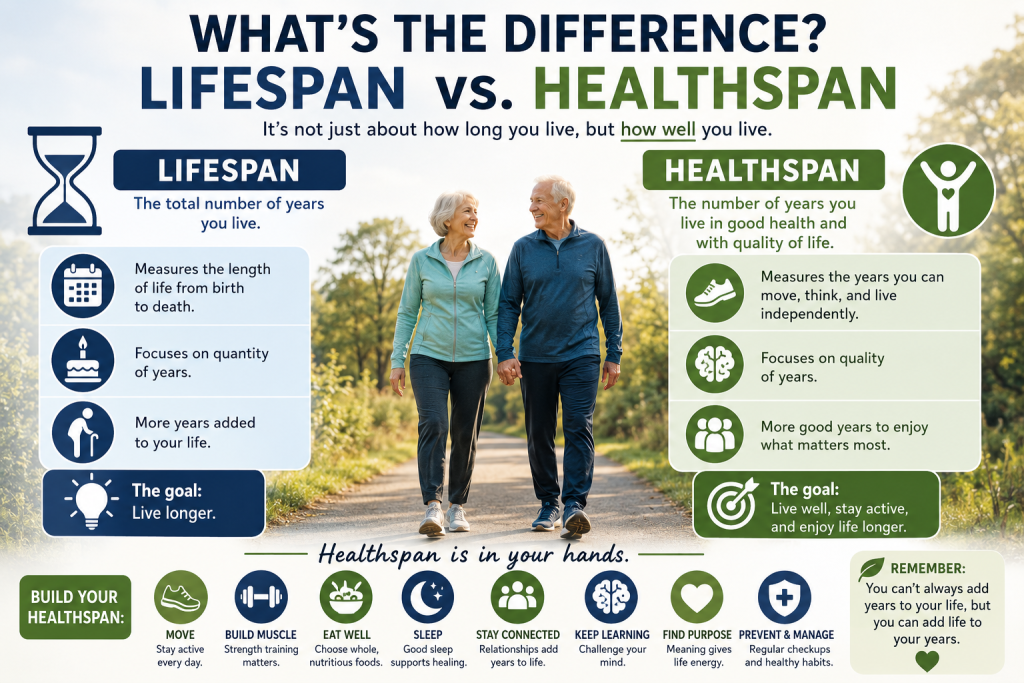
Lifespan is how long you live.
Healthspan is how long you live well.
That is the difference.
Lifespan counts the years on the calendar. Healthspan asks a deeper question: during those years, are you able to move, think clearly, make choices, maintain relationships, enjoy daily life, and stay involved in the world?
That distinction matters because most people do not simply want more birthdays. They want more good years. More useful years. More years where they can get up, go out, think, laugh, love, travel, dance, learn, contribute, and still feel like themselves.
Living longer is valuable. But living longer while feeling trapped in poor health, loneliness, weakness, confusion, or dependence is not the future most people are hoping for.
That is why the conversation around aging is changing. We are no longer talking only about “How do we extend life?” We are asking, “How do we extend the part of life that still feels like life?”
That is healthspan.
Lifespan: the number of years you live
Lifespan is the total length of a person’s life, usually measured from birth to death. If someone lives to 82, their lifespan was 82 years. If someone lives to 96, their lifespan was 96 years.
Simple enough.
Modern medicine has done a remarkable job increasing lifespan. Vaccines, antibiotics, surgery, emergency care, better sanitation, heart treatments, cancer care, and improved management of chronic disease have helped many people live longer than previous generations.
That is a great achievement.
But there is a catch.
Living longer does not automatically mean living better.
A person may live to 90 but spend the last 15 years struggling with severe disability, isolation, confusion, weakness, or constant medical appointments. Another person may live to 83 but remain active, independent, mentally engaged, and socially connected almost until the end.
Who had the “better” aging experience?
That is not answered by lifespan alone.
Lifespan tells us how long the book is. Healthspan tells us how many chapters are still worth reading.
Healthspan: the years lived in good function
Healthspan refers to the portion of life spent in relatively good health and function. It is not just about being disease-free. That is too narrow, especially in elderhood.
Many older adults have some diagnosis: high blood pressure, arthritis, diabetes, heart disease, hearing loss, vision changes, or joint pain. That does not automatically mean their healthspan is over.
A person can have a medical condition and still have a strong healthspan if they are able to function, participate, think clearly, maintain relationships, and enjoy meaningful life.
The World Health Organization defines healthy ageing as developing and maintaining the functional ability that enables well-being in older age. That includes being able to meet basic needs, make decisions, be mobile, build relationships, and contribute to society.
That is a beautiful way to think about it.
Healthspan is not about pretending we never age. It is about preserving the abilities that allow us to live with dignity.
Why healthspan matters more as we age
When we are young, lifespan sounds exciting. More years. More time. More runway.
But as we get older, the question becomes more practical.
Can I walk without fear of falling?
Can I carry groceries?
Can I climb stairs?
Can I remember appointments?
Can I drive safely?
Can I cook for myself?
Can I enjoy my family?
Can I keep my independence?
Can I still make choices?
Can I still be me?
That is healthspan.
For seniors, the goal is not simply to add years at the end. The goal is to protect the quality of those years. Nobody wants to become a full-time manager of pills, doctor visits, pain, confusion, and decline if some of that can be delayed or reduced.
This is why muscle, balance, brain health, nutrition, sleep, social connection, and purpose matter so much. They are not “nice extras.” They are part of the machinery of healthspan.
The gap between lifespan and healthspan
One of the biggest problems in modern aging is the gap between how long people live and how long they live in good health.
Mayo Clinic has described this as a global divide between longer life and good health. Based on WHO estimates, life expectancy increased from 2000 to 2019, but years lived in good health did not rise at the same pace. The average global gap between lifespan and healthspan was about 9.6 years in 2019.
That means many people are living nearly a decade with illness, disability, or reduced function.
That is the part we need to talk about honestly.
It is wonderful that people are living longer. But if the extra years are mostly years of frailty, confusion, pain, and isolation, we have not solved aging. We have only stretched it out.
The goal should be to narrow the gap.
Not just longer life.
Better longer life.
A simple example
Imagine two men, both age 80.
The first man is alive but has lost much of his mobility. He rarely leaves the house. He has little social contact. He eats poorly, sleeps badly, and spends most of his time watching television because he no longer feels capable of doing much else.
The second man is also 80. He has a few medical issues, but he walks daily, does light strength training, manages his medications, sees friends, learns new things, and still participates in life.
Both men have the same lifespan so far.
But they do not have the same healthspan.
That is the difference.
Healthspan is the difference between merely surviving and still participating.
Healthspan does not mean perfect health
This is important, especially for older adults.
Healthspan does not mean you wake up every morning feeling like you are 35 and ready to run up a mountain. Let’s not get carried away. At a certain age, getting out of a chair can sound like a small construction project.
Healthspan means you still have enough physical, mental, and emotional capacity to live meaningfully.
You may have arthritis and still have healthspan.
You may take medication and still have healthspan.
You may need glasses, hearing aids, or a cane and still have healthspan.
You may move slower and still have healthspan.
The question is not whether your body is perfect. The question is whether your body, mind, and environment still allow you to live with agency.
Agency is the key.
Can you still make decisions? Can you still participate? Can you still shape your day? Can you still enjoy people and purpose?
That is healthspan.
Why modern medicine often focuses on lifespan
Traditional medicine has been excellent at saving lives. If you have a heart attack, stroke, infection, cancer, broken hip, or emergency condition, modern medicine can be extraordinary.
But the healthcare system is often built around treating disease after it appears. It is less effective at helping people preserve long-term function before decline becomes obvious.
That is slowly changing.
The National Institute on Aging notes that research has shown people can help preserve health and mobility as they age by adopting or continuing healthy habits and lifestyle choices.
That statement may sound simple, but it is powerful. It means healthspan is not only about genetics or luck. Those matter, of course. But daily choices matter too.
The boring things matter.
Movement.
Food.
Sleep.
Relationships.
Purpose.
Preventive care.
Not smoking.
Managing blood pressure.
Protecting muscle.
Keeping your brain engaged.
It is not glamorous. Nobody is selling a miracle there. But it works better than most magical thinking.
The pillars of healthspan
1. Movement
Movement is one of the strongest tools for preserving healthspan.
Walking supports circulation, heart health, blood sugar, mood, balance, and independence. Strength training helps preserve muscle and bone. Balance training helps reduce fall risk. Stretching and mobility work help maintain range of motion.
Movement is not only exercise. It is independence practice.
Every walk says, “I am still in the game.”
2. Muscle
Muscle is not just for athletes. Muscle is a survival organ in elderhood.
It helps you stand up, climb stairs, carry groceries, recover from illness, and avoid frailty. Low muscle mass and weakness are strongly tied to loss of independence.
This is why protein and resistance training become more important with age, not less.
A senior who protects muscle is protecting freedom.
3. Nutrition
Food can either support healthspan or quietly sabotage it.
A healthspan-focused diet usually emphasizes protein, vegetables, fiber, healthy fats, hydration, and fewer ultra-processed foods.
This is not about vanity dieting. It is about giving the body the raw materials it needs to maintain strength, repair tissue, support the brain, and manage inflammation.
In elderhood, nutrition is not punishment. It is maintenance.
Like putting good oil in an old but beloved car. And let’s be honest, by now some of us are classics.
4. Sleep
Sleep is when the body repairs, the brain processes information, and hormones reset. Poor sleep can affect memory, mood, appetite, blood sugar, blood pressure, and fall risk.
A healthspan plan that ignores sleep is missing a major piece.
Seniors should take sleep seriously, especially if they snore heavily, wake up gasping, feel tired during the day, or suspect sleep apnea.
5. Brain engagement
The brain needs challenge, novelty, and connection.
Reading, learning music, dancing, conversation, puzzles, writing, travel, volunteering, and meaningful work can all help keep the mind engaged.
The goal is not to become a genius at 80. Though if you do, congratulations. The goal is to keep the brain participating in life.
6. Social connection
Loneliness is not just sad. It can be unhealthy.
Humans are social creatures. We need conversation, touch, laughter, shared meals, belonging, and purpose. Social isolation can worsen mental and physical health.
This is why activities like Argentine Tango, walking groups, churches, clubs, classes, volunteering, and community events matter. They are not fluff. They are part of healthspan.
A person connected to others often has more reason to keep going.
7. Purpose
Purpose gives direction to the day.
It does not have to be grand. Purpose can be caring for a spouse, helping grandchildren, writing, teaching, gardening, mentoring, creating videos, volunteering, learning tango, or simply becoming the kind of elder others can trust.
Purpose is medicine without a prescription bottle.
Healthspan is not only personal — it is environmental
Here is something people often miss: healthspan is not only about individual willpower.
Your environment matters.
Can you afford healthy food?
Is your neighborhood walkable?
Do you have transportation?
Do you have access to doctors?
Can you understand your Medicare plan?
Do you have safe housing?
Do you have people around you?
Do you have access to exercise, community, and meaningful activity?
WHO’s healthy ageing framework includes the abilities people need to be and do what they value, including mobility, relationships, decision-making, and contribution. That means healthy aging is not just about the body. It is also about the world around the body.
A person can have motivation but still struggle if the environment is working against them.
That is why elderhood should be built around support, dignity, access, and practical tools.
Lifespan asks, “How long?”
Healthspan asks, “How well?”
This is the cleanest way to remember it.
Lifespan asks:
How many years did you live?
Healthspan asks:
How many of those years could you truly live?
Lifespan is quantity.
Healthspan is quality.
Lifespan is the length of the road.
Healthspan is how much of the road you can still walk with strength, clarity, and joy.
Can healthspan be improved?
Yes, often.
Not perfectly. Not magically. Not with some miracle pill advertised by a man in a lab coat who looks like he sells vitamins out of his garage.
But healthspan can often be improved through consistent, practical actions.
Start with the basics:
Walk regularly.
Do strength training.
Eat enough protein.
Eat more fiber.
Limit ultra-processed foods.
Protect sleep.
Treat hearing and vision problems.
Stay socially connected.
Manage blood pressure, blood sugar, and cholesterol.
Review medications.
Prevent falls.
Keep learning.
Maintain purpose.
These may sound ordinary, but ordinary done consistently becomes powerful.
The goal is not perfection. The goal is compression of decline — keeping people strong and engaged for as long as possible, then reducing the period of serious disability near the end of life.
That is the dream: not just a longer life, but a longer life with a shorter period of suffering.
The Elderhood view
At Elderhood.info, the goal is not to chase youth. That is a losing game. Nobody beats the calendar. The calendar is undefeated.
The goal is to build a stronger, wiser, more meaningful elderhood.
That means we stop asking only, “How do I live longer?”
We ask:
How do I stay useful?
How do I stay connected?
How do I keep my mind alive?
How do I keep my body capable?
How do I protect my dignity?
How do I keep participating?
How do I live fully while I am alive?
That is the real healthspan conversation.
Final takeaway
Lifespan is the number of years you live.
Healthspan is the number of years you live with strength, function, clarity, connection, and meaning.
Both matter. But for most people, healthspan is the part they actually feel.
A long life is a blessing. But a long life with movement, purpose, relationships, and independence is the greater prize.
So do not only count your years.
Build your years.
Protect your healthspan.
Because the real goal is not merely to stay alive.
The real goal is to remain fully in your life for as long as possible.