For generations, aging was described as though it were one long downhill slide.
You grew up, built a career, raised a family, retired—and then supposedly began the slow process of becoming less useful, less capable, and less connected to the world.
That old story is overdue for retirement.
We are entering a new era in which millions of people may live for 20, 30, or even 40 years beyond traditional retirement age. Those years should not be treated as an uncomfortable waiting room between work and death.
They are a distinct stage of life.
That stage is Elderhood.
Elderhood does not deny that the body changes. Knees complain, sleep can become unpredictable, and remembering why you walked into the kitchen occasionally turns into a small detective story.
But aging is not only about what we lose. It is also about how we adapt, what we preserve, what we learn, and how deliberately we choose to live.
The science of healthy aging increasingly supports a broader goal than merely adding years to life. The real goal is preserving the ability to move, think, connect, decide, contribute, and enjoy life for as long as possible.
The World Health Organization describes healthy aging as maintaining the functional ability that allows well-being in older age. In plain English, it means remaining able to do the things that matter to you.
That is the heart of Elderhood.
It is not a desperate attempt to become young again. It is the practical work of staying capable, curious, connected, and purposeful.
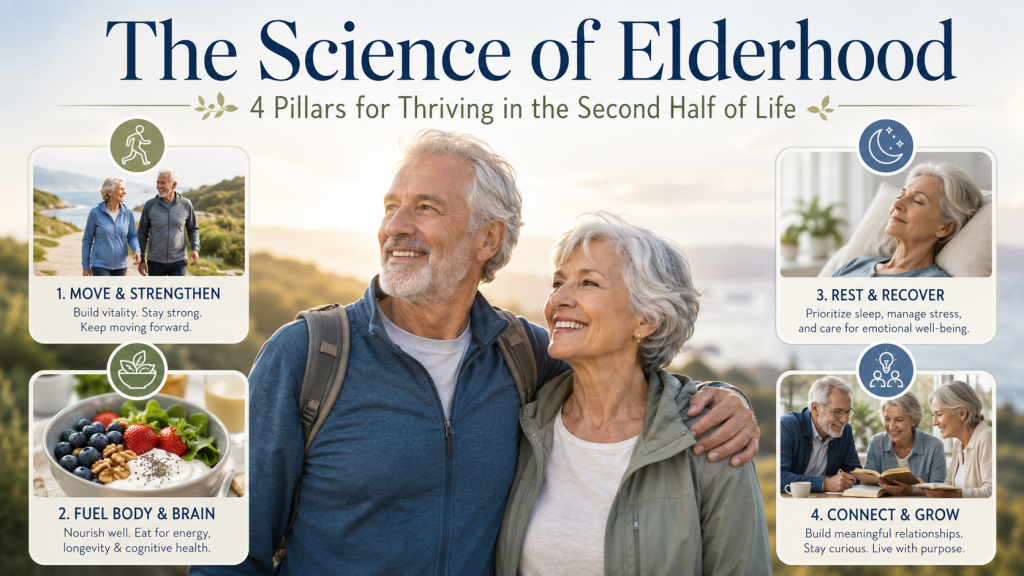
Here are the four essential pillars.
Pillar One: Protect Your Physical Capability
The first pillar of Elderhood is not thinness, athletic perfection, or looking good in exercise clothes.
It is physical capability.
Can you rise from a chair without assistance?
Can you carry groceries?
Can you walk through an airport?
Can you climb a flight of stairs?
Can you regain your balance when you stumble?
These ordinary abilities determine how independently you can live. That makes muscle, movement, mobility, and balance far more important than many people realize.
Muscle Is Independence Insurance
Beginning in midlife, adults can gradually lose muscle mass and strength, especially when they are inactive. The medical term for serious age-related muscle loss is sarcopenia.
The problem is not that your arms will look smaller in the mirror. The real problem is that weakened muscles can make everyday life harder and increase vulnerability during illness, hospitalization, or recovery.
Muscle helps you:
- Get out of chairs and beds
- Stabilize your joints
- Maintain balance
- Carry objects safely
- Regulate blood glucose
- Recover after illness
- Remain independent
This is why we describe muscle as a survival organ in our article, The Muscle Loss Trap After 60 Most People Never See Coming.
Walking is excellent, but walking alone may not provide enough resistance to preserve all your strength. Adults in Elderhood should consider safe forms of strength training such as resistance bands, light weights, wall push-ups, chair stands, or professionally supervised exercises.
The National Institute on Aging reports that physical activity can produce immediate benefits, including reduced anxiety, lower blood pressure, and improved sleep, while consistent activity can help reduce the risk of several chronic diseases.
The Centers for Disease Control and Prevention also emphasizes aerobic activity, muscle strengthening, and balance work for older adults.
You do not need to become a bodybuilder. Nobody is asking you to lift a refrigerator or develop biceps large enough to require their own ZIP code.
You simply need to keep giving your muscles a reason to stay.
Balance Deserves Its Own Training
Balance is frequently ignored until someone falls.
That is like buying a smoke detector after the kitchen has already burned down.
Balance can be practiced through heel-to-toe walking, controlled chair stands, tai chi, dance, gentle yoga, or standing on one foot while holding a stable counter for safety.
Activities such as dancing can also combine movement, balance, memory, social connection, and enjoyment. Our article Tango—The Dance of Elderhood explores why dancing can offer far more than recreation.
The goal is not to perform circus tricks.
The goal is to remain upright, confident, and free to move through the world.
Pillar Two: Nourish the Body and Brain
The second pillar is nutrition—but not dieting in the old-fashioned sense.
Elderhood requires nutritioning.
Dieting is often about restriction, guilt, scales, and temporary rules. Nutritioning means deliberately giving your changing body the materials it needs to maintain muscle, energy, digestion, bone health, and brain function.
You have to eat for the age you are, not the age you were.
At 25, a person might skip breakfast, survive on coffee and a doughnut, and still function reasonably well. After 60 or 70, the body is usually less amused by that arrangement.
Prioritize Protein
Protein helps provide the amino acids needed to maintain and repair muscle. It can come from foods such as:
- Eggs
- Fish
- Chicken
- Greek yogurt
- Cottage cheese
- Beans
- Lentils
- Tofu
- Lean meat
- Milk or fortified alternatives
Protein powder may be useful for some people, but it is not magic dust. Protein works best when paired with physical activity, particularly resistance exercise.
Eating a large serving of protein while remaining planted in a recliner will not cause muscles to appear out of gratitude.
Eat More Fiber and Real Food
Fiber supports digestion and can contribute to healthier cholesterol and blood-glucose patterns. Good sources include oats, berries, vegetables, beans, lentils, nuts, seeds, and whole grains.
A practical breakfast might include oatmeal, Greek yogurt, blueberries, and cinnamon. It is affordable, high in useful nutrients, and does not require a celebrity chef or a kitchen torch.
Real food does not have to be exotic.
Frozen berries count. Canned beans count. Eggs count. Plain yogurt counts. Vegetables do not lose their dignity merely because they came from the freezer.
The goal is not dietary perfection. Perfection usually lasts until someone brings out the cheesecake.
The goal is a pattern that gives your body more of what it needs and less of what quietly works against it.
Protect Your Brain Through the Whole Body
Brain health is not limited to crossword puzzles.
The brain depends on circulation, sleep, hearing, movement, glucose control, emotional health, and social engagement. Protecting the heart and blood vessels also helps protect the brain.
That means paying attention to:
- Blood pressure
- Blood sugar
- Hearing changes
- Sleep apnea
- Physical activity
- Medication side effects
- Depression
- Excessive alcohol use
- Social isolation
The brain does not rent a separate apartment from the body. It lives in the same building.
Pillar Three: Defend Sleep, Recovery, and Emotional Health
Sleep is often treated as leftover time—the portion of the day that remains after television, chores, worrying, and checking the news one final time.
That is a serious mistake.
Sleep is biological maintenance.
It supports memory, mood, metabolism, immune function, appetite regulation, and physical recovery. Poor sleep can make pain feel worse, movement less appealing, food choices less sensible, and ordinary problems feel much larger.
The CDC describes healthy aging as maintaining physical, mental, and social well-being and emphasizes that positive changes can still matter later in life.
Adults who struggle with persistent sleep problems should not simply dismiss them as “part of getting older.”
Possible causes include:
- Sleep apnea
- Pain
- Medication effects
- Restless legs
- Depression or anxiety
- Nighttime urination
- Irregular sleep schedules
- Caffeine consumed too late
- Excessive daytime napping
Our guide, What Role Does Sleep Play in Longevity?, explains why sleep should be treated as one of the foundations of healthspan rather than a luxury.
Emotional Health Is Physical Health
Elderhood often includes changes that younger people do not fully understand.
Friends move away or die. Careers end. Family roles change. Physical limitations may appear. A person who once felt essential can begin wondering where they fit.
These are not minor concerns.
Loneliness and social isolation have been associated with increased risks involving heart health, depression, and cognitive decline.
Emotional health therefore deserves the same seriousness as blood pressure or cholesterol.
That may mean joining a class, calling a friend, volunteering, seeking counseling, attending religious or community activities, adopting a pet, or simply getting out of the house consistently.
It may also mean accepting that grief, anxiety, or depression sometimes requires professional help. “Toughing it out” is not always strength. Sometimes it is merely suffering without assistance.
Your health includes how you feel about waking up tomorrow.
Pillar Four: Maintain Connection, Curiosity, and Purpose
The fourth pillar is the one traditional medicine sometimes overlooks.
People need a reason to participate in life.
A person can have acceptable laboratory results and still feel empty, isolated, and unnecessary. That is not thriving.
Purpose does not have to mean launching a company, writing a bestseller, or solving world peace before breakfast.
Purpose can be:
- Helping care for grandchildren
- Teaching someone a skill
- Making videos
- Volunteering
- Gardening
- Creating art
- Learning a language
- Dancing
- Helping a neighbor
- Recording family history
- Supporting a community organization
- Caring for an animal
- Encouraging another senior
The activity itself matters less than the sense that your presence still has meaning.
As discussed in Elderhood Is Not Decline: It Is the Art of Staying Capable, capability is not purely physical. It includes the ability to adapt, make decisions, stay engaged, and continue contributing.
Curiosity Keeps Life Expanding
One of the greatest threats in later life is not simply physical decline. It is the gradual shrinking of the world.
A person stops traveling.
Then stops driving at night.
Then stops attending gatherings.
Then stops calling people.
Then stops learning.
Eventually, life becomes one chair, one television, and the same four walls.
Some limitations are unavoidable, but retreat should not become automatic.
Learning something new challenges the mind and creates forward momentum. It reminds you that your story is still being written.
Try a new recipe. Learn to use a new device. Study family history. Take a class. Visit somewhere unfamiliar. Read about a scientific discovery. Learn a dance step.
You are not too old to be a beginner.
In fact, Elderhood may be the perfect time because you are finally old enough to stop worrying about looking foolish.
The Difference Between Lifespan and Healthspan
Lifespan is how long you live.
Healthspan is how long you remain reasonably healthy, functional, and able to participate in life.
The two are not automatically the same.
A person can live many years while experiencing severe disability, isolation, or preventable loss of independence. That is why the goal cannot simply be more birthdays.
We want more usable life.
Our article What’s the Difference Between Healthspan and Lifespan? explains why muscle, sleep, nutrition, brain health, connection, and purpose all contribute to the quality of the years ahead.
You cannot guarantee perfect health. Genetics, accidents, disease, and plain old bad luck still exist. Anyone promising total control over aging is probably preparing to sell you an expensive bottle.
But you can put the odds more firmly in your favor.
A Simple Daily Elderhood Plan
Healthy aging does not require rebuilding your entire life by Monday morning.
Start with a few repeatable actions:
Walk or move your body every day.
Perform safe strength exercises two or three times a week.
Include protein in your meals.
Eat more fiber-rich, minimally processed foods.
Protect your sleep schedule.
Stay current with medical and dental care.
Address hearing and vision problems.
Call or meet someone regularly.
Learn something new.
Have one meaningful reason to get up each morning.
Small habits may appear unimpressive, but habits compound.
The same way financial investments can grow over time, repeated health choices accumulate. A short walk seems small. One balanced breakfast seems small. Ten wall push-ups seem small.
But repeated for months and years, these choices can become the foundation of capability.
Stay Healthy Until the Future Gets Here
Medical science is moving rapidly.
Researchers are exploring better treatments for cardiovascular disease, obesity, diabetes, cancer, dementia, joint damage, and conditions once dismissed as inevitable consequences of aging.
That gives us reason for hope—but not permission to ignore the present.
As we explain in Stay Healthy Until the Future Gets Here, future medical advances will be most valuable to people who remain healthy and functional enough to benefit from them.
Hope is useful.
Hype is not.
Be curious about new science, but remain skeptical of miracle cures, secret supplements, “anti-aging” injections, and anyone who demands immediate payment before you have time to ask questions.
Good science welcomes questions.
Hype reaches for your credit card.
Welcome to the New World of Aging
Elderhood is not about pretending to be young.
It is about becoming exceptionally good at being the age you are.
It means protecting muscle because muscle protects freedom.
It means eating for nourishment rather than merely habit.
It means treating sleep as maintenance.
It means guarding your brain, relationships, curiosity, and emotional health.
It means walking away from what cannot be changed, living in the present, and preparing for the future.
You are not finished because you crossed an arbitrary birthday.
You are entering a stage of life that previous generations rarely had the opportunity—or the scientific knowledge—to fully explore.
So keep moving.
Keep learning.
Keep questioning.
Keep connecting.
Keep building strength.
The greatest retirement asset is not your portfolio.
It is your health.
Welcome to Elderhood.