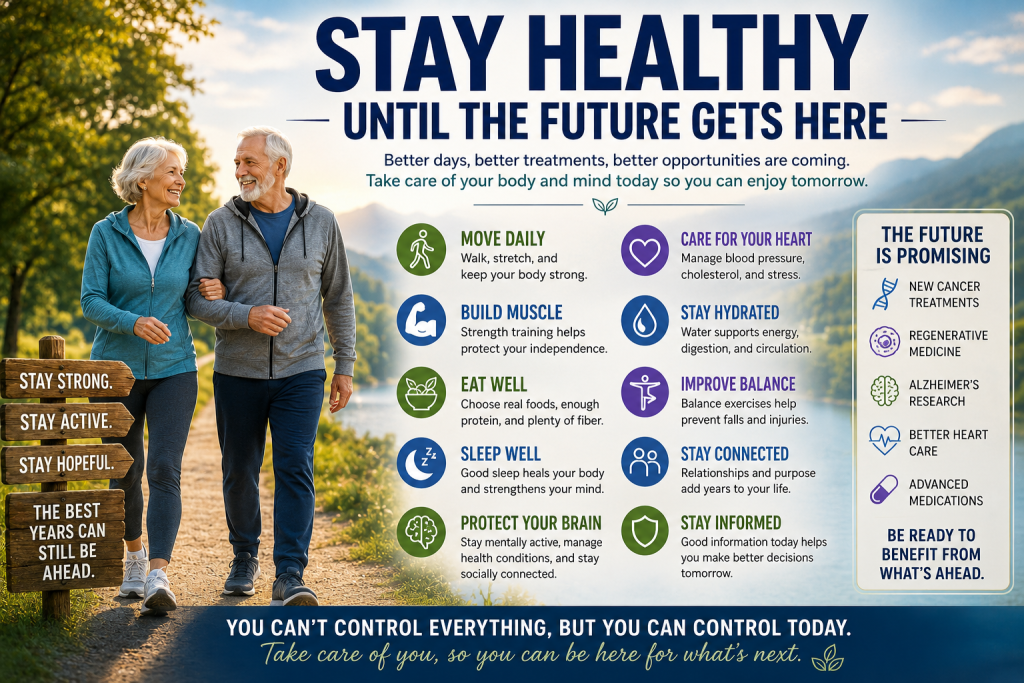
There is a simple idea that may become one of the most important messages for people in Elderhood:
Stay healthy until the future gets here.
That may sound a little dramatic, but it is not. It is practical.
Modern medicine is changing fast. Treatments that sounded impossible years ago are now being studied, tested, approved, or brought closer to real patients. Scientists are learning how to target cancer mutations, use GLP-1 medications for more than weight loss, explore regenerative medicine, improve heart care, detect Alzheimer’s earlier, and treat diseases that once looked hopeless.
But here is the catch.
The future does not help you much if you are too weak, too sick, too isolated, or too discouraged to benefit from it.
That is why healthy aging is not about vanity. It is not about trying to look 35 when your knees remember Eisenhower. It is about staying strong enough, mobile enough, mentally alert enough, and hopeful enough to still be in the game when better medicine arrives.
The Future Is Coming, But You Still Have to Meet It Halfway
There is a dangerous misunderstanding in health.
Some people think, “Science will save me, so I can ignore my health.”
That is a mistake.
Science may be coming, but it is not coming with a magic wand and a marching band. Medicine works best when the body still has something to work with.
A stronger heart responds better.
Stronger muscles protect independence.
Better balance prevents falls.
Better sleep supports the brain.
Better nutrition helps healing.
Better glucose control protects nerves, kidneys, eyes, and blood vessels.
Better mental health keeps a person engaged with life.
The future of medicine may be extraordinary, but your everyday habits are still the foundation. The boring things still matter. Walking. Eating real food. Sleeping. Staying connected. Taking your medicine properly. Going to the doctor before the small problem becomes a five-alarm fire.
The CDC recommends that older adults aim for at least 150 minutes of moderate-intensity physical activity each week, plus muscle-strengthening activities at least two days a week and balance activities to help reduce fall risk. That is not glamorous, but it is one of the most reliable health tools we have.
Health Is Your Ticket to Tomorrow
Think of your health like a ticket.
Not a guarantee. A ticket.
You cannot control everything. Nobody can. Genetics, accidents, illness, family history, stress, and plain old bad luck all play a role. Anyone who tells you that you can control every part of aging is selling something, and it is probably expensive.
But you can influence the odds.
You can give your body a better chance.
That is the real meaning of “stay healthy until the future gets here.”
It means preserving enough function to remain eligible for life.
Eligible for travel.
Eligible for relationships.
Eligible for new treatments.
Eligible for second opinions.
Eligible for better drugs.
Eligible for physical therapy.
Eligible for surgery, if needed.
Eligible for joy.
That last one matters. Health is not only about avoiding death. It is about having enough life left in your life.
The Three Cornerstones of Elderhood Health
For people in Elderhood, health is not one thing. It has three major parts:
Physical health.
Mental health.
Emotional health.
If one collapses, the others suffer.
You can have a strong body but a lonely heart. That is not healthy.
You can have a sharp mind but a body too weak to carry you through the day. That is not freedom.
You can have decent medical numbers but no purpose, no joy, and no reason to get out of bed. That is not living.
The goal is not perfection. At our age, perfection packed its bags a long time ago. The goal is function.
Can you move?
Can you think clearly enough to make decisions?
Can you adapt?
Can you enjoy something?
Can you still participate in life?
That is the goal.
Muscle Is Medicine
One of the biggest mistakes older adults make is focusing only on weight.
Weight matters, but muscle may matter more.
Muscle is not just for bodybuilders who admire themselves in mirrors like they are looking at a long-lost relative. Muscle is survival equipment.
Muscle helps you get out of a chair.
Muscle helps you climb stairs.
Muscle helps regulate blood sugar.
Muscle protects joints.
Muscle reduces fall risk.
Muscle helps you recover after illness.
Muscle helps you stay independent.
After a certain age, losing muscle can become one of the quietest threats to freedom. You may not notice it day by day. Then one morning the grocery bags feel heavier, the stairs look steeper, and the chair seems to have developed a personal grudge against you.
The solution is not complicated, but it does require consistency.
Walk.
Lift light weights.
Use resistance bands.
Practice standing from a chair without using your hands.
Carry groceries safely.
Do wall push-ups.
Do gentle squats if your body allows.
Work with a physical therapist if you need guidance.
And yes, eat enough protein. But protein alone is not magic. Recent research continues to reinforce a common-sense point: supplements do not replace strength training. Muscle needs a reason to stay.
Balance Is Independence
A fall can change everything.
One fall can turn an independent senior into someone afraid to move. That fear leads to less movement. Less movement leads to weakness. Weakness leads to more risk. That is the nasty little merry-go-round nobody wants to ride.
Balance training is not optional in Elderhood. It is protection.
Simple balance exercises can include standing near a counter and lifting one foot, walking heel-to-toe, practicing slow turns, or doing supervised tai chi or gentle yoga. The CDC includes balance activities as part of its recommendations for older adults because falls are such a serious threat to independence.
The goal is not to become a circus performer. Nobody is asking you to juggle flaming torches while standing on one leg.
The goal is simpler:
Stay upright.
That is a perfectly respectable goal.
Food Is Information for the Body
Food is not just calories. Food is information.
What you eat tells your body what kind of world it is living in.
A steady diet of ultra-processed foods, sugar, low protein, low fiber, and poor hydration tells the body, “We are under attack.”
Real food tells the body, “We are trying to repair.”
This does not mean you need a perfect diet. Perfect diets usually last until someone brings out the cheesecake.
But you do need a better pattern.
More protein.
More fiber.
More vegetables.
More beans, oats, lentils, berries, nuts, fish, eggs, yogurt, or cottage cheese if tolerated.
Less junk.
Less sugary drinks.
Less mindless snacking.
Less pretending that a cookie shaped like a leaf counts as a vegetable.
Fiber is especially important. It helps digestion, supports the gut microbiome, and may help with cholesterol and glucose control. Protein helps preserve muscle. Hydration helps circulation, kidneys, digestion, and energy.
The body does not need perfection.
It needs repeated acts of respect.
Sleep Is Not Laziness
Sleep is repair time.
For years, many people bragged about not sleeping. That was foolish. Sleep is not wasted time. It is maintenance.
During sleep, the brain and body perform essential work. Poor sleep can affect memory, mood, blood sugar, blood pressure, immune function, appetite, and pain.
For older adults, sleep can be complicated. Pain, nighttime urination, medications, stress, sleep apnea, and irregular schedules can all interfere.
But poor sleep should not be ignored. Especially if you snore heavily, wake up choking, feel exhausted during the day, or have known sleep apnea.
A body that is not sleeping well is like a phone that never fully charges. You can still use it, but by lunchtime it is begging for mercy.
Sleep is one of the most important ways to stay ready for the future.
Protect Your Brain Like It Is Your Most Valuable Property
Because it is.
Brain health is not only about avoiding dementia. It is about staying yourself.
Your judgment.
Your memory.
Your humor.
Your ability to learn.
Your ability to adapt.
Your ability to make decisions.
Protecting the brain means protecting the whole body.
Control blood pressure.
Manage blood sugar.
Treat hearing loss.
Stay socially connected.
Keep learning.
Move daily.
Sleep well.
Avoid excessive alcohol.
Protect against falls.
Review medications that may affect memory or balance.
Do not ignore depression.
Mental sharpness is not just crossword puzzles. It is circulation, sleep, purpose, social connection, hearing, movement, and meaning.
The brain does not live in a separate apartment from the body. It is part of the same neighborhood.
Emotional Health Is Not Optional
A person can survive medically and still feel dead inside.
That is why emotional health matters.
Loneliness, grief, fear, disappointment, and loss can slowly shrink a person’s world. And once the world gets small, the body often follows.
This is one of the great dangers of aging.
Not just disease.
Withdrawal.
Apathy.
Giving up.
The larger truth of aging is adaptation. You lose some things. You change some things. You accept some things. But you must not let disappointment calcify your soul.
You still need connection.
You still need laughter.
You still need something to look forward to.
You still need purpose, even if that purpose is smaller than it used to be.
Purpose does not have to be grand. It can be helping a neighbor, calling a friend, caring for a pet, writing your story, planting herbs, learning tango, mentoring a younger person, or simply deciding that your life still has value because you are still here.
As long as you are here, you are still playing the game.
Do Not Confuse Hope With Hype
This is important.
The future of medicine is exciting, but excitement attracts vultures.
Whenever science advances, marketers show up with miracle claims. Stem cells for everything. Anti-aging injections. Secret supplements. Detox drinks. Brain cures. Fat-melting tricks. Creams that promise to reverse 40 years by Friday.
Be hopeful, but skeptical.
Ask:
Is this proven?
Is it FDA-approved for this exact condition?
Is there real clinical evidence?
What are the risks?
What does my doctor say?
Who is making money from this claim?
Is this treatment being sold with pressure?
Good science can stand up to questions. Hype hates questions.
Hope says, “Let’s follow the evidence.”
Hype says, “Buy today before the offer disappears.”
Big difference.
The Practical Elderhood Plan
Here is the simple plan.
Move your body most days.
Build muscle twice a week.
Practice balance.
Eat enough protein and fiber.
Drink water.
Sleep as well as possible.
Treat sleep apnea.
Manage blood pressure.
Manage blood sugar.
Keep your medical appointments.
Take medications correctly.
Get second opinions when something serious is involved.
Stay socially connected.
Keep learning.
Protect your mood.
Avoid miracle promises.
Stay curious about science.
Do not surrender your future before it arrives.
That is not fancy. But it works.
And frankly, fancy is overrated. Fancy is how people end up with a $900 kitchen gadget that makes one sad smoothie and then lives in the cabinet forever.
Final Takeaway
“Stay healthy until the future gets here” is not a slogan about fear.
It is a slogan about opportunity.
Modern medicine is moving. Science is learning. Treatments are improving. The future may bring better options for cancer, obesity, diabetes, heart disease, brain disease, joint damage, vision loss, and conditions we once thought were simply part of getting old.
But your job is to stay in the game.
Not perfectly.
Not obsessively.
Not like some 25-year-old fitness influencer who thinks a sore back is a personality flaw.
Just steadily.
Walk today.
Eat better today.
Sleep better tonight.
Call someone.
Ask questions.
Keep your appointments.
Build strength.
Protect your mind.
Choose hope, but keep your common sense.
Because the future may be coming faster than we think.
And when it gets here, you want to be healthy enough to open the door.