
For decades, diabetes treatment followed a fairly predictable script.
A person was told to improve their diet, exercise more, lose weight, take metformin, and return in a few months for another blood test. If blood sugar continued climbing, the doctor added another medication. Eventually, insulin might enter the picture.
That basic approach helped millions of people, but diabetes treatment is now undergoing a major transformation.
Today’s doctors are no longer looking only at the number on a glucose meter. They are increasingly considering the entire person: heart health, kidney function, body weight, risk of low blood sugar, mobility, cognitive health, medication cost, and quality of life.
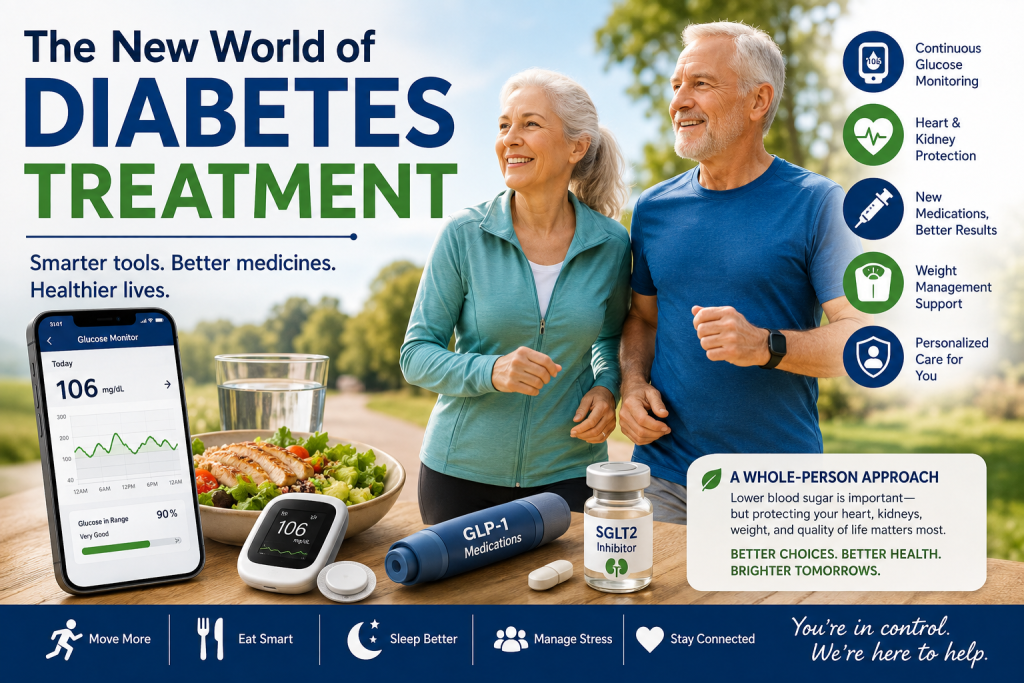
New medications can do more than lower glucose. Some may also protect the heart, slow kidney disease, support meaningful weight loss, and reduce the risk of certain diabetes-related complications.
Continuous glucose monitors can reveal what happens to blood sugar throughout the day without requiring constant finger sticks. Smart insulin pumps can automatically adjust insulin delivery. Researchers are even developing treatments designed to delay type 1 diabetes and preserve the body’s own insulin-producing cells.
We have entered a new world of diabetes treatment.
It is promising—but it is not magic.
Diabetes Treatment Is No Longer Just About A1C
The A1C test estimates a person’s average blood sugar over approximately two to three months. It remains an important part of diabetes care, but it does not tell the complete story.
Two people can have the same A1C while experiencing very different daily glucose patterns. One may have relatively stable readings, while the other swings between dangerous lows and very high levels.
Modern diabetes care therefore looks beyond a single laboratory number.
Doctors may consider:
- How often blood sugar becomes dangerously low
- How much glucose varies throughout the day
- Whether the patient has heart or kidney disease
- Whether weight loss would improve health
- How complicated the medication schedule is
- Whether the person can safely manage injections or monitoring
- The cost and availability of treatment
- What matters most to the patient
The American Diabetes Association’s 2026 Standards of Care emphasize individualized treatment, particularly for older adults. The recommendations use the age-friendly “4Ms” framework: mentation, medications, mobility, and what matters most.
That approach makes sense.
An aggressive glucose goal that is reasonable for a healthy 55-year-old may be inappropriate for an 85-year-old with frailty, memory problems, frequent falls, or multiple medical conditions.
The best diabetes treatment is not necessarily the treatment that produces the lowest possible A1C. It is the treatment that improves health without creating unnecessary danger or burden.
GLP-1 Medications Have Changed the Conversation
GLP-1 receptor agonists have become some of the most discussed medications in modern medicine.
This group includes medications such as semaglutide and dulaglutide. Tirzepatide works on both GIP and GLP-1 pathways and is sometimes described as a dual incretin medication.
These drugs help the body release insulin when glucose is elevated, reduce inappropriate glucagon production, slow digestion, and decrease appetite. For many people, they can substantially improve blood sugar while also supporting weight loss.
That is a major change from older diabetes medications that sometimes caused weight gain.
The importance of these treatments goes beyond appearance. Excess abdominal fat is closely connected with insulin resistance, fatty liver disease, sleep apnea, joint strain, cardiovascular disease, and reduced mobility.
For an older adult, losing excess fat while preserving strength may make it easier to walk, climb stairs, sleep better, and remain independent.
However, these medications are not harmless shortcuts.
Possible problems can include:
- Nausea and vomiting
- Constipation or diarrhea
- Dehydration
- Gallbladder problems
- Loss of appetite
- Excessive or rapid weight loss
- Loss of muscle along with fat
- High cost or insurance restrictions
Older adults must be especially careful about losing muscle. A lower number on the scale is not necessarily a victory when it comes with weakness, poor nutrition, dizziness, or reduced mobility.
Anyone using a weight-reducing diabetes medication should discuss adequate protein intake, hydration, and safe resistance exercise with an appropriate healthcare professional.
Our Elderhood guide, What Lifestyle Changes Have the Biggest Impact on Lifespan?, explains why preserving muscle and function matters as much as losing weight.
SGLT2 Inhibitors Protect More Than Blood Sugar
Another major class of modern diabetes drugs is known as SGLT2 inhibitors.
These medications help the kidneys remove some excess glucose through the urine. But their importance now extends far beyond glucose control.
Research and current treatment standards support the use of certain SGLT2 inhibitors for people with type 2 diabetes who also have chronic kidney disease, heart failure, or elevated cardiovascular risk. Modern guidelines increasingly select these medications because of their heart and kidney benefits, not simply because of their effect on A1C.
That represents a fundamental change in diabetes medicine.
The question is no longer merely, “Which drug lowers blood sugar?”
The better question may be, “Which treatment lowers blood sugar while also protecting the organs most threatened by diabetes?”
SGLT2 inhibitors also have risks. They can contribute to dehydration, genital infections, urinary symptoms, and, rarely, a serious condition called diabetic ketoacidosis even when glucose is not extremely high.
Older adults taking diuretics or blood-pressure medications may need careful monitoring because fluid loss can contribute to dizziness and falls.
No medication should be added simply because it is fashionable. The right choice depends on kidney function, other medications, medical history, affordability, and individual risk.
Metformin Still Has an Important Place
With all the excitement surrounding newer drugs, it would be easy to think that metformin belongs in a museum next to rotary telephones.
It does not.
Metformin remains a valuable and widely used treatment for type 2 diabetes. It is inexpensive, familiar to clinicians, generally does not cause low blood sugar when used alone, and may help improve insulin sensitivity.
However, metformin is no longer automatically the only logical first treatment for every patient.
A person with heart failure, chronic kidney disease, significant obesity, or established cardiovascular disease may benefit from an SGLT2 inhibitor, a GLP-1 medication, or another therapy selected partly for organ protection.
Long-term metformin use may also contribute to vitamin B12 deficiency in some people. Patients experiencing unexplained numbness, tingling, anemia, weakness, balance problems, or cognitive changes should ask whether their B12 level should be evaluated.
The goal is not to declare one medication “best.”
The goal is to choose the safest and most useful combination for the individual.
Continuous Glucose Monitors Are Revealing the Hidden Story
Traditional glucose meters provide a snapshot. You prick your finger, obtain a reading, and learn what your blood sugar is at that particular moment.
A continuous glucose monitor, commonly called a CGM, provides something closer to a movie.
A small sensor placed on the body measures glucose throughout the day and night. The user can see whether glucose is rising, falling, or remaining stable.
This can reveal patterns that an occasional finger stick may miss:
- Blood sugar rising overnight
- A sharp increase after a particular breakfast
- Glucose falling during exercise
- Dangerous lows during sleep
- The effect of stress, illness, or poor sleep
- Differences between apparently similar meals
In 2024, the FDA cleared the first over-the-counter continuous glucose monitor for adults who do not use insulin. In June 2026, the agency expanded over-the-counter availability of that system to eligible people age two and older who do not use insulin.
That does not mean everyone needs to wear a glucose sensor.
More information is useful only when it leads to better decisions. Constantly watching every minor fluctuation can create anxiety, and people without diabetes should not diagnose themselves based on consumer glucose data alone.
But for many people with diabetes, CGM technology can help them understand their bodies in a way that was previously impossible.
A person may discover that a short walk after dinner reduces a post-meal glucose increase. Another may learn that a supposedly “healthy” breakfast sends glucose soaring.
The body has been providing this information all along. The technology simply makes it visible.
Insulin Is Becoming Smarter
Insulin remains essential for people with type 1 diabetes and for some people with type 2 diabetes.
But insulin treatment has changed dramatically.
Modern options include:
- Longer-acting basal insulins
- Faster mealtime insulins
- Connected insulin pens
- Continuous glucose monitors
- Insulin pumps
- Automated insulin-delivery systems
Some automated systems connect a glucose monitor with an insulin pump. The system receives glucose data and adjusts insulin delivery according to an algorithm.
This is sometimes referred to as a hybrid closed-loop system or an artificial pancreas.
It is not a complete cure, and the person still needs education, supplies, follow-up, and proper device management. However, these systems can reduce some of the constant calculations that make insulin-dependent diabetes exhausting.
The future is moving toward treatment that responds to glucose changes rather than requiring the patient to manually chase every rise and fall.
Low Blood Sugar Deserves More Attention in Elderhood
For older adults, one of the most serious dangers of diabetes treatment is hypoglycemia—blood sugar that falls too low.
Low glucose can cause:
- Shaking
- Sweating
- Confusion
- Weakness
- Blurred vision
- Loss of coordination
- Falls
- Seizures
- Unconsciousness
In an older person, hypoglycemia may be mistaken for dementia, a stroke, intoxication, or ordinary frailty.
Medications such as insulin and sulfonylureas can increase the risk, especially when meals are skipped, kidney function declines, or the person accidentally takes the wrong dose.
This is why modern standards encourage clinicians to simplify or reduce treatment when the risks outweigh the benefits. Treatment should not become so complicated that the patient needs a small air-traffic-control tower on the kitchen table to manage it.
Sometimes better diabetes care means adding treatment.
Sometimes it means safely removing or reducing treatment.
Type 1 Diabetes Treatment Is Entering a New Era
Type 1 diabetes occurs when the immune system attacks the pancreatic beta cells that produce insulin.
For a century, treatment mainly meant replacing the missing insulin. Now researchers are beginning to intervene in the immune process itself.
Teplizumab, sold under the brand name Tzield, became the first FDA-approved treatment designed to delay the progression from stage 2 type 1 diabetes to stage 3 disease in eligible patients.
In 2026, the FDA expanded its approved use and also authorized it for certain children who had recently developed stage 3 type 1 diabetes, with the goal of slowing the decline of their remaining natural insulin production.
This does not cure type 1 diabetes.
But it changes the philosophy of treatment.
Instead of waiting until nearly all insulin-producing capacity is lost, medicine is beginning to ask whether the disease process can be slowed before further damage occurs.
Researchers are also studying beta-cell replacement, stem-cell-derived islet cells, immune-protection strategies, and other methods of restoring insulin production.
These treatments remain specialized and, in many cases, experimental. Headlines about a “diabetes cure” should therefore be treated with cautious optimism rather than unquestioning celebration.
Hope is valuable.
Hype is not.
Food and Movement Still Matter
New medications are powerful, but they do not make daily habits irrelevant.
Muscle uses glucose. Physical activity improves insulin sensitivity. Walking after meals can help the body handle glucose. Strength training can support mobility, balance, and metabolic health.
Food quality also matters.
A useful eating pattern often emphasizes:
- Vegetables
- Beans and lentils
- Adequate protein
- High-fiber foods
- Minimally processed carbohydrates
- Nuts and seeds
- Appropriate portions
- Fewer sugary drinks and heavily refined foods
This does not mean a person with diabetes can never eat bread, pasta, rice, or dessert again.
The internet loves dramatic rules because “never eat another potato” receives more attention than “learn how your portions, medications, activity, and individual metabolism work together.”
Modern diabetes care should be practical enough to continue for years.
The article The Science of Elderhood explores how movement, nutrition, sleep, and connection work together to protect long-term function.
The Future Must Also Be Affordable
A treatment does not help if a person cannot obtain it.
Some of the most effective new diabetes drugs and technologies can be expensive. Insurance formularies, prior authorization, deductibles, supply limits, and coverage changes may determine whether a patient can continue treatment.
People should ask:
- Is there a less expensive medication with similar benefits?
- Does my insurance require prior authorization?
- Is the medication on the plan’s formulary?
- Is there a preferred pharmacy?
- Is a 90-day supply less expensive?
- Does the manufacturer offer assistance?
- Will Medicare cover the glucose monitor or supplies?
- What will the entire year cost—not merely the first refill?
Patients should never ration insulin or quietly stop an important medication because of cost without contacting their doctor, pharmacist, insurance plan, or an appropriate assistance program.
The financial side of treatment is not separate from medical care. It is part of medical care.
The Elderhood Approach to Diabetes
Diabetes should be taken seriously, but it should not be allowed to take over a person’s entire identity.
You are not a glucose reading.
You are not an A1C.
You are not the number on a scale.
The real purpose of diabetes treatment is to protect your ability to see, think, move, heal, remain independent, and participate in life.
That means the treatment plan must fit the person—not force the person to spend every waking hour serving the treatment plan.
A thoughtful older adult might ask the doctor:
- What is my personal A1C goal?
- Am I at risk of low blood sugar?
- Would a CGM help me?
- Are my medications protecting my heart or kidneys?
- Could any medication be simplified?
- Should my vitamin B12 level be checked?
- Am I losing muscle?
- What should I do if I cannot afford my medicine?
- What matters most for my health over the next five years?
A doctor who welcomes these questions is practicing the kind of individualized care modern diabetes treatment requires.
Our guide, How Do I Find a Doctor Who Focuses on Living Longer and Healthier?, offers additional advice about finding a physician who looks beyond isolated laboratory numbers.
The Bottom Line
The new world of diabetes treatment is not based on one miracle medication.
It is based on better choices.
Better medications.
Better monitoring.
Better protection for the heart and kidneys.
Better recognition of the dangers of low blood sugar.
Better technology.
Better personalization.
And, perhaps most importantly, a better understanding that treating diabetes is not just about lowering glucose. It is about protecting the whole person.
We should remain skeptical of exaggerated promises. Diabetes has not been eliminated, and no medication replaces movement, nutrition, sleep, follow-up care, and common sense.
But we should also recognize how much has changed.
Treatments that did not exist a generation ago are now helping people control glucose, lose harmful excess weight, protect their organs, and manage diabetes with less daily guesswork.
As we explain in Stay Healthy Until the Future Gets Here, the goal of healthy aging is not perfection. It is staying strong, capable, and engaged long enough to benefit from the medical advances still arriving.
Prepare carefully, ask questions, and remain open to progress.
The cavalry may not be here yet.
But in diabetes treatment, you can already hear the horses coming.
This article is for educational purposes only and does not replace individualized medical advice. Diabetes medications can have serious side effects and interactions. Consult your physician, diabetes specialist, or pharmacist before beginning, stopping, or changing any treatment.