Reaching age 100 used to sound almost mythical.
Today, more people are asking a better question: not simply, “How can I live longer?” but, “How can I remain healthy, independent, and mentally sharp for as long as possible?”
That distinction matters.
Living to 100 while spending the final decades unable to move, think clearly, or participate in life is not the goal most people have in mind. The real goal is a longer healthspan—the portion of life spent in reasonably good physical, mental, and social health.
There is no guaranteed formula for reaching 100. Genetics matter. Luck matters. Access to medical care matters. Accidents and illnesses do not always play fair.
But research increasingly suggests that our daily choices can influence not only how long we live, but how well we function as we age.
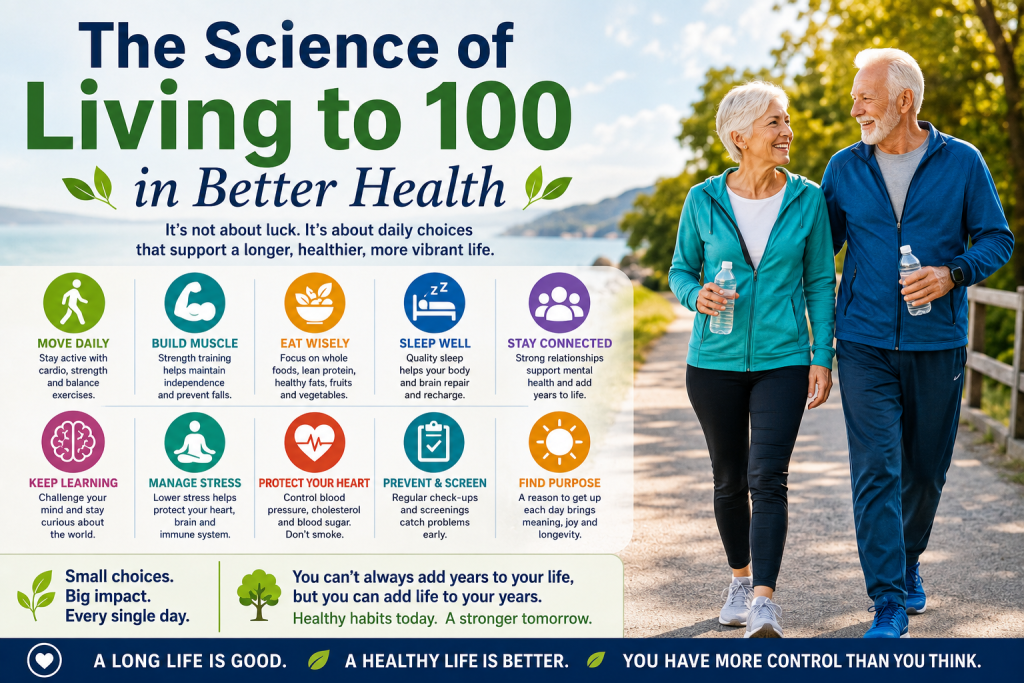
The science of longevity is not telling us to search for one magic pill. It is pointing toward a combination of movement, muscle, nutrition, sleep, prevention, mental engagement, social connection, and purpose.
In other words, the secret may not be one dramatic breakthrough.
It may be a stack of ordinary habits practiced consistently.
Living Longer Is Not the Same as Aging Well
The World Health Organization defines healthy aging as developing and maintaining the functional ability that allows well-being in older age. That includes being able to meet basic needs, learn, make decisions, remain mobile, maintain relationships, and contribute to society.
That definition is important because it shifts the conversation away from merely avoiding disease.
A person may have arthritis, high blood pressure, hearing loss, or another chronic condition and still live an active, satisfying, independent life. Healthy aging does not require a perfect body. It requires preserving enough physical and mental capacity to continue doing what matters.
This is the difference between lifespan and healthspan.
Lifespan asks, “How many years did you live?”
Healthspan asks, “How many of those years could you truly use?”
Genetics Load the Gun, but Lifestyle Often Pulls the Trigger
We sometimes talk about longevity as though our future were written entirely in our DNA.
Genes certainly influence the risk of many diseases and may help explain why some families contain unusually long-lived individuals. But genetics is not destiny.
The National Institute on Aging emphasizes that physical activity, nutritious food, sufficient sleep, limited alcohol use, mental stimulation, social involvement, and proactive medical care can all support healthier aging.
That does not mean a healthy lifestyle makes anyone bulletproof. It means our habits can move the odds.
You may not be able to choose every card you are dealt, but you can still play the hand intelligently.
Movement May Be the Closest Thing We Have to a Longevity Medicine
The human body was designed to move.
Yet modern life makes it remarkably easy to spend most of the day sitting—in the car, at the computer, at the dinner table, and finally in front of the television.
Regular physical activity helps protect the heart, muscles, bones, brain, balance, mood, and ability to perform everyday tasks. The Centers for Disease Control and Prevention notes that activity can provide immediate benefits, including better sleep, reduced anxiety, and lower blood pressure, while regular exercise helps reduce the risk of several chronic diseases.
Current guidance for older adults generally recommends at least 150 minutes of moderate-intensity aerobic activity each week, along with muscle-strengthening activity on at least two days and balance work when needed.
That may sound like a lot, but it can be divided into manageable portions.
Thirty minutes of brisk walking five days a week reaches the aerobic target. Gardening, dancing, swimming, bicycling, climbing stairs, household chores, and pickleball may also count when they raise your breathing and heart rate.
The best exercise is not necessarily the most fashionable one.
It is the exercise you can perform safely, enjoy reasonably well, and continue doing.
Muscle Is Retirement Insurance for the Body
Many people think of muscle as something for athletes, bodybuilders, or people trying to look impressive at the beach.
After 60, muscle becomes something much more important: protection.
Strong muscles help you rise from a chair, climb stairs, carry groceries, maintain balance, recover from illness, and remain independent.
Muscle loss with age can contribute to weakness, falls, frailty, and loss of mobility. That is why strength training deserves a permanent place beside walking and other aerobic activity.
Strength work does not have to mean lifting huge barbells.
It can include:
- Rising repeatedly from a sturdy chair
- Wall push-ups
- Resistance bands
- Light hand weights
- Heel raises
- Step-ups
- Carrying groceries
- Supervised gym exercises
The National Institute on Aging recommends combining aerobic exercise, muscle strengthening, and balance activities because each type protects a different part of physical function.
Think of walking as keeping the engine running.
Strength training helps keep the frame from falling apart.
Balance Is Easy to Ignore—Until You Lose It
Falls are not a normal requirement of aging, but the consequences of a fall can be serious.
A fractured hip, head injury, or fear of falling can quickly reduce independence. Once someone becomes afraid to move, they may move less, grow weaker, and become even more vulnerable.
Balance can be trained.
Standing on one foot near a sturdy counter, practicing heel-to-toe walking, tai chi, certain yoga movements, and targeted physical therapy can all help.
Vision checks, medication reviews, supportive shoes, adequate lighting, and removing household tripping hazards are also part of longevity.
Living longer is not only about preventing heart disease or cancer. It is also about avoiding the ordinary accident that changes everything.
Eat for Strength, Not for a Smaller Dinner Plate
Nutrition advice becomes unnecessarily complicated.
One expert attacks carbohydrates. Another attacks fat. Someone on social media announces that one particular fruit, seed, powder, or mushroom is the answer to human aging.
The broader evidence is less exciting but far more useful.
A healthy eating pattern usually emphasizes vegetables, fruits, legumes, whole grains, nuts, healthy fats, and appropriate sources of protein while limiting heavily processed foods, excess sugar, and excessive sodium.
The National Institute on Aging describes nutritious eating as a cornerstone of healthy aging.
Older adults should pay particular attention to protein because maintaining muscle becomes harder with age. Protein needs vary depending on body size, kidney function, activity, health conditions, and medical advice.
Good options may include:
- Fish
- Eggs
- Greek yogurt
- Cottage cheese
- Chicken or turkey
- Beans and lentils
- Tofu
- Nuts and seeds
The goal is not to become obsessed with food.
It is to give the body enough building material to preserve muscle, support healing, and maintain energy.
Protect the Heart to Protect the Brain
What is good for the heart is often good for the brain.
High blood pressure, diabetes, smoking, inactivity, and abnormal cholesterol can damage blood vessels throughout the body, including those supplying the brain.
The National Institute on Aging advises managing chronic conditions, staying physically active, sleeping well, eating nutritiously, remaining socially engaged, and reviewing medications as part of protecting cognitive health.
This is encouraging because it means brain health is not entirely separate from the rest of the body.
A walk is not only exercise for your legs.
It is also support for your circulation, mood, sleep, balance, blood sugar, and brain.
Research supported by the National Institute on Aging has also continued examining how lifelong exercise may promote brain health and potentially reduce the risk of neurodegenerative disease.
No exercise program can guarantee that someone will avoid dementia. But movement appears to be one of the most useful tools we have for putting the odds in our favor.
Sleep Is When the Body Performs Maintenance
Sleep is sometimes treated as wasted time.
It is not.
Sleep supports memory, immune function, metabolism, emotional regulation, cardiovascular health, and physical recovery. Poor sleep can make it harder to exercise, eat wisely, think clearly, or manage stress.
For older adults, good sleep habits may include:
- Maintaining a regular bedtime and wake time
- Keeping the bedroom quiet, dark, and comfortable
- Avoiding large meals late at night
- Limiting late-day caffeine
- Avoiding alcohol as a sleep aid
- Reducing screens in the bedroom
- Exercising regularly, but not immediately before bedtime
The National Institute on Aging recommends a consistent sleep routine and advises avoiding late naps, late caffeine, alcohol, and large evening meals when they interfere with sleep.
Sleep disorders also matter. Loud snoring, gasping, severe daytime sleepiness, restless legs, or persistent insomnia deserve medical attention.
For a deeper discussion, read What Role Does Sleep Play in Longevity?.
Social Connection Is a Health Habit
Loneliness is not merely an unpleasant feeling.
Social isolation can affect mental health, physical activity, eating habits, medical care, and the motivation to keep participating in life.
The National Institute on Aging recommends staying connected through family, friends, community organizations, volunteering, classes, faith groups, hobbies, and other shared activities.
This does not mean everyone needs a packed social calendar.
Some people thrive with a few close relationships. Others enjoy larger groups. The important thing is to avoid disappearing from the world.
Make the phone call.
Invite someone for coffee.
Join the class.
Attend the gathering.
Ask for help.
Offer help.
A long life without human connection can feel far longer than anyone intended.
Keep Learning and Maintain a Reason to Get Up
The brain benefits from being used.
Reading, writing, learning technology, studying a language, playing music, dancing, taking classes, doing puzzles, traveling, volunteering, and having meaningful conversations can all help keep life mentally active.
But cognitive activity should not become another performance contest. You do not need to complete the Sunday crossword in record time or become a chess champion.
Curiosity is the important part.
Purpose also matters.
People need a reason to get out of bed that goes beyond taking medication and attending appointments.
Purpose may come from family, work, faith, creativity, caregiving, volunteering, teaching, gardening, community service, or sharing what you have learned.
Retirement from a job should not mean retirement from usefulness.
Preventive Care Is Part of Longevity
Healthy habits are powerful, but they do not replace medical care.
Blood pressure checks, cholesterol testing, cancer screening, vaccinations, dental care, hearing evaluations, vision exams, bone-health assessments, and medication reviews can identify problems before they become crises.
Hearing loss is particularly easy to dismiss, yet untreated hearing difficulty can interfere with communication, social connection, safety, and quality of life.
The same is true of vision.
Longevity is not only about avoiding death. It is about protecting the senses and abilities that make life enjoyable.
Beware of Longevity Hype
Longevity has become a booming business.
There are supplements, hormone programs, expensive testing packages, unproven injections, extreme diets, and clinics promising to reverse biological age.
Some emerging treatments may eventually prove useful. Others are mostly hope wearing an expensive lab coat.
Be skeptical of anyone promising:
- Guaranteed life extension
- Rapid reversal of aging
- A cure-all supplement
- Secret knowledge doctors supposedly hide
- Testimonials instead of controlled research
- A treatment that requires you to ignore your physician
There is exciting research involving cellular aging, inflammation, gene therapy, senolytics, regenerative medicine, and metabolic drugs. But exciting research is not the same as a proven treatment for healthy people.
The wisest strategy is to stay healthy enough to benefit from future discoveries without becoming a laboratory experiment for every new trend.
As we explain in Stay Healthy Until the Future Gets Here, medical science may bring remarkable advances, but it still helps to meet that future with a functioning heart, brain, and body.
The Real Formula Is Consistency
Most people already know the broad outline of healthy living.
Move.
Build strength.
Eat reasonably well.
Sleep.
Stay connected.
Do not smoke.
Limit alcohol.
Control blood pressure and blood sugar.
Use preventive healthcare.
Keep learning.
Have a purpose.
The problem is not usually a lack of information.
The problem is consistency.
One walk will not transform your health. Neither will one healthy meal, one night of good sleep, or one strength-training session.
But repeated over months and years, those actions can reshape the direction of aging.
You do not have to perform every habit perfectly.
Perfection is usually the enemy of longevity because it makes people quit.
Walk ten minutes if thirty feels impossible.
Lift light weights if heavy ones are unsafe.
Improve one meal instead of rebuilding your entire diet overnight.
Call one person.
Make one medical appointment.
Go to bed thirty minutes earlier.
Small choices count because small choices become routines, and routines become lives.
The Bottom Line
No scientist can promise that you will live to 100.
But the science does offer a practical path toward improving your chances of living longer with strength, clarity, mobility, and independence.
The goal is not simply to stay alive.
The goal is to remain engaged in life.
You want to be able to walk into your own future, recognize the people you love, make your own decisions, enjoy your mornings, and continue contributing something to the world.
That is the real science of living to 100 in better health.
It is not about chasing immortality.
It is about protecting your healthspan, one ordinary day and one better choice at a time.
Aging is inevitable. Decline is not always inevitable.
And while none of us controls the future completely, we can still do a great deal to arrive there stronger.