
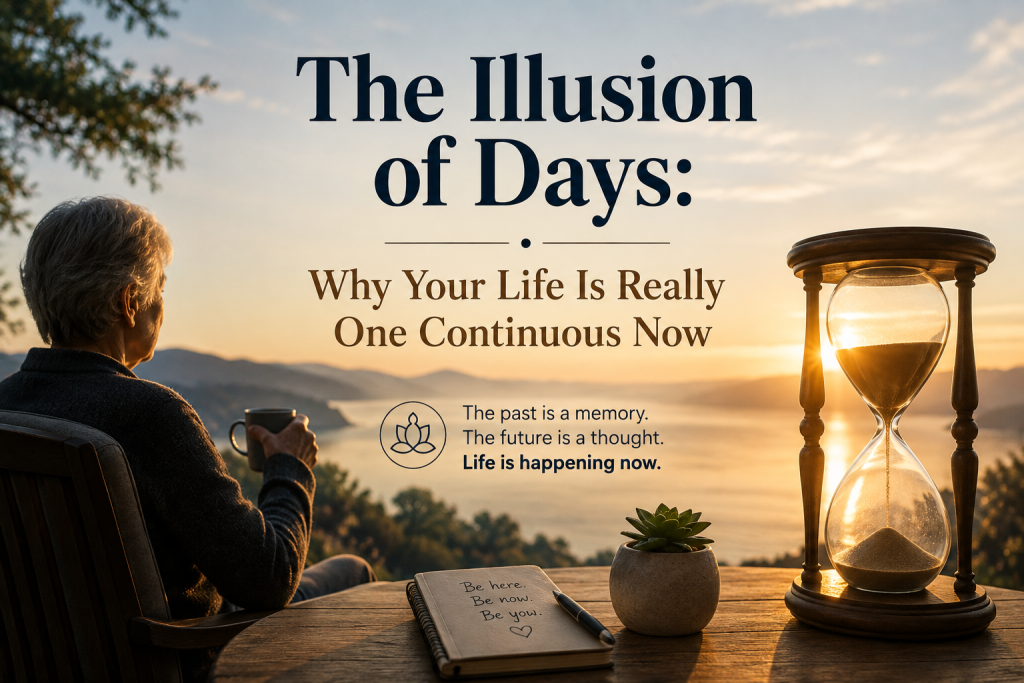
We speak of life as though it were divided into neat little boxes.
Yesterday is finished. Today is happening. Tomorrow is waiting around the corner.
We mark birthdays, anniversaries, holidays, Mondays, Fridays, beginnings, endings, good years and bad years. We hang calendars on the wall and allow those calendars to organize nearly everything we do.
But a calendar is a human invention.
The sun rises and sets. The Earth rotates. Seasons change. Our bodies follow cycles of sleeping and waking. Those things are real.
But nature does not stop at midnight and announce, “That day is over. A brand-new one has begun.”
Nothing actually starts over when the clock reaches 12:00.
Life continues.
One moment flows into the next without a visible border between them.
In that sense, the separate days we experience are partly an illusion. They are useful divisions created to help human beings organize continuous time.
Your life is not truly a collection of separate days.
It is one continuous experience—and it is always happening now.
The Calendar Is a Tool, Not Reality
Calendars are enormously useful.
Without them, we would miss doctor appointments, forget birthdays, arrive at weddings three weeks late and probably file our taxes whenever the spirit moved us.
We need clocks and calendars to coordinate life with other people.
But the map is not the territory.
A calendar describes time. It does not create time.
Imagine drawing lines across the ocean and calling one section Tuesday and another section Wednesday. The labels may help us navigate, but the water does not know the difference.
It simply continues moving.
Our lives work much the same way.
The person you were yesterday did not disappear at midnight. The person you will become tomorrow does not suddenly arrive in the morning.
Your body continues breathing.
Your heart continues beating.
Your thoughts continue moving.
Your life continues unfolding.
The divisions between days exist mainly in the mind.
That may sound philosophical, but it has practical importance—especially as we grow older.
When we believe life is made of separate days, we may begin postponing life.
“I’ll begin tomorrow.”
“I’ll make the call next week.”
“I’ll start exercising Monday.”
“I’ll enjoy myself when things calm down.”
“I’ll be happy when I lose weight, retire, pay off the house, finish the project or finally get everything organized.”
Tomorrow becomes a storage unit where we place all the living we do not feel prepared to do today.
Unfortunately, tomorrow is never where life occurs.
Whenever tomorrow arrives, it arrives as now.
You Have Never Experienced Anything Except Now
Think about your entire life.
Your childhood happened in the present moment.
Your first day of school happened in the present moment.
Your first love, first job, wedding, children, accomplishments, mistakes, losses and celebrations all happened as a present experience.
Even when you remember the past, you remember it now.
Even when you imagine the future, you imagine it now.
You have never directly experienced yesterday.
You have experienced memories appearing in the present.
You have never directly experienced tomorrow.
You have experienced expectations, worries and plans appearing in the present.
The only place life has ever touched you is now.
That does not mean the past is unimportant.
The past has shaped us.
It has taught us, wounded us, strengthened us and given us the people and experiences we treasure.
Nor does it mean we should ignore the future.
Planning matters. Saving money matters. Taking medication matters. Preparing for future health needs matters.
But remembering and planning are activities taking place now.
The danger begins when we become so absorbed in the past or future that we overlook the only moment in which we are actually alive.
Why Time Seems to Move Faster as We Age
Many older adults say the same thing:
“The years go by faster now.”
A year at age eight seemed enormous. Summer vacation felt like a lifetime. Waiting two weeks for a birthday appeared almost unbearable.
At age seventy or eighty, an entire season can seem to disappear between visits to the pharmacy.
Part of this difference may come from proportion. One year is a large percentage of an eight-year-old’s remembered life. One year is a much smaller portion of an eighty-year-old’s life.
Routine may also play a role.
New experiences receive more attention and can create richer memories. Repeated routines may blend together. When weeks look almost identical, the brain may store fewer distinctive landmarks.
This is one reason novelty matters in later life.
A new walking route, a class, a friendship, a book, a hobby, a conversation or even a different breakfast can interrupt automatic living.
We discuss this need to remain adaptable in Modern Science Is Challenging What We Were Told About Aging. Aging does not have to mean becoming a spectator while time speeds past. It can mean becoming more intentional about where we place our attention.
Attention makes a moment feel alive.
Without attention, we may pass through an entire day while barely noticing that we were there.
The Mind Is Rarely Where the Body Is
The body is always in the present.
The mind is a different story.
You may be sitting peacefully at breakfast while mentally arguing with someone from 1997.
You may be walking through a beautiful park while worrying about a medical appointment scheduled for next month.
You may be surrounded by people you love while thinking about an email, a bill or something foolish you said five years earlier.
The body is drinking coffee.
The mind is holding a committee meeting.
This constant mental travel is normal. The brain remembers, predicts, compares and prepares. Those abilities helped human beings survive.
But they can also prevent us from experiencing our own lives.
Mindfulness is the practice of deliberately returning attention to what is happening in the present moment. Harvard Health describes it as focusing on immediate experience rather than becoming lost in distractions, worries and mental noise. Research involving older adults suggests that mindfulness-based practices may support emotional well-being and help reduce stress, although they are not miracle treatments. Harvard Health offers a practical introduction to mindfulness and present-moment attention.
Mindfulness does not require sitting cross-legged on a mountain while wearing expensive linen.
It can be as simple as noticing the taste of your food.
Listening carefully when another person speaks.
Feeling your feet touch the ground.
Watching light move through a window.
Taking one slow breath without trying to be somewhere else.
The practice is not about stopping all thought.
That is nearly impossible.
The goal is to notice when the mind has left the present and gently bring it back.
Now Is Not Always Pleasant
Talking about the present moment can sound unrealistic when life is difficult.
What about pain?
What about grief?
What about illness, loneliness, financial strain or fear?
Some moments are genuinely hard.
Living in the present does not mean pretending everything is wonderful.
It does not mean placing a smile over suffering or telling a grieving person to “think positively.”
It means meeting the reality of the moment without adding every possible future disaster to it.
There is the pain we are experiencing now—and then there is the pain created by imagining that it will never end.
There is the problem we must face today—and then there are fifty imaginary versions of the problem that may never happen.
The mind can take one difficult moment and stretch it across the rest of our imagined life.
Present-moment awareness narrows the task.
What is happening right now?
What can I do right now?
Do I need to make a call?
Take a medication?
Ask for help?
Rest?
Move my body?
Accept that this moment is painful without declaring that every remaining moment will be the same?
Research with older adults has found that present-focused attention and an accepting attitude are associated with lower reported stress and better emotional well-being. That does not prove mindfulness removes hardship. It suggests that how we relate to the moment may influence how heavily we carry it. A PubMed-indexed study of older adults found mindfulness and proactive coping were associated with lower stress.
The Past Can Become a Residence
Memory is one of life’s greatest gifts.
Through memory, people we have lost remain part of us. We can revisit a childhood kitchen, hear a parent’s voice, remember the birth of a child or smile at an adventure that happened fifty years ago.
But memory can also become a place where we hide.
Some people live mostly in regret.
They replay the marriage that ended, the opportunity they missed, the argument they wish they could take back or the years they believe they wasted.
Others live almost entirely in nostalgia.
Everything valuable appears to be behind them.
The music was better.
People were kinder.
Families were closer.
The country made more sense.
Their bodies were stronger.
Their possibilities were larger.
The past may indeed contain wonderful things.
But the past is no longer available for residence.
It is available for remembrance, gratitude and learning.
The danger of believing that the best part of life is over is that we stop recognizing what remains.
A cup of coffee with someone you care about is still life.
A telephone conversation is still life.
A walk, a meal, a new idea, a song, a joke, a sunrise and a quiet afternoon are still life.
They may not resemble earlier chapters.
That does not make them empty.
Elderhood is not an imitation of youth. It is its own chapter, with different losses, freedoms, insights and possibilities.
The Future Can Become a Threat
If some people live in the past, others live in the future.
They worry about becoming sick.
They worry about running out of money.
They worry about losing independence, losing memory, losing loved ones or becoming a burden.
These concerns are not foolish.
Aging brings real uncertainty.
But the future has a remarkable ability to frighten us before it arrives.
We can suffer an event hundreds of times in imagination and then discover that it never happens—or that when it does happen, we handle it better than expected.
Preparing for the future is wise.
Living there is exhausting.
There is an important difference between planning and worrying.
Planning produces an action.
Worrying often produces another round of worry.
Planning says, “I should review my insurance, make an appointment, update my legal documents or begin exercising.”
Worrying says, “Something terrible is probably coming, and I must mentally rehearse it all afternoon.”
One prepares the future.
The other sacrifices the present.
You Do Not Need a New Day to Begin Again
One of the most useful consequences of seeing life as continuous is realizing that you do not have to wait for a symbolic beginning.
You do not need Monday.
You do not need January 1.
You do not need your birthday.
You do not need the start of a new month.
You do not need a perfect morning.
You can begin at 2:37 on an ordinary Thursday.
You can take a walk after years of inactivity.
You can call someone after months of silence.
You can apologize.
You can drink a glass of water.
You can make the doctor’s appointment.
You can turn off the television and step outside.
You can choose a better dinner even if breakfast was a disaster.
The next moment does not ask what you did with the last one.
It simply arrives.
This idea is closely connected to our Elderhood philosophy in Stay Healthy Until the Future Gets Here. We prepare for tomorrow through what we do now. The future is not separate from the present. It is being constructed from it.
Every walk happens now.
Every healthy meal happens now.
Every meaningful conversation happens now.
Every change begins now.
Stop Counting Life Only in Years
We often measure life by quantity.
How many years have we lived?
How many years might remain?
Will we reach ninety? One hundred?
There is nothing wrong with wanting a long life. Longevity can give us more time with the people and experiences we value.
But length is not the only measurement.
A long life lived mostly in distraction may feel strangely brief.
A single hour of full attention can feel rich and complete.
Perhaps life should also be measured by presence.
How often were you actually there for your own life?
Did you taste the food?
Hear the music?
Notice the person sitting across from you?
Feel gratitude while the thing you valued was still present?
Or did you recognize its value only after it became a memory?
The present moment appears ordinary because it is always available.
But it is not endlessly available.
This particular moment will never return.
That is not meant to be depressing.
It is meant to wake us up.
Life Is One Continuous Now
Your life did not happen yesterday.
Yesterday is the name you now give to a previous present moment.
Your life will not happen tomorrow.
Tomorrow is the name you give to a present moment that has not yet arrived.
Your life is happening here.
Not after you solve every problem.
Not when your body becomes younger.
Not when the world becomes calmer.
Not when everyone finally behaves the way you think they should.
Here.
Now.
This does not mean every moment must be dramatic, productive or joyful.
Some moments are for working.
Some are for healing.
Some are for grieving.
Some are for waiting.
Some are for doing absolutely nothing—and doing it without guilt.
The point is not to turn the present into another assignment.
The point is to notice that this is where you are.
This is where love is experienced.
This is where courage is practiced.
This is where health is protected.
This is where forgiveness is offered.
This is where change begins.
The days may be an illusion created by calendars, clocks and language.
But life is not an illusion.
Life is the continuous flow beneath those divisions.
We are born into the present.
We live in the present.
And when our final moment eventually arrives, it too will arrive as now.
So do not wait for another day to begin living.
There has only ever been this moment.
And this moment—ordinary, imperfect and temporary—is the greatest gift you will ever receive.