
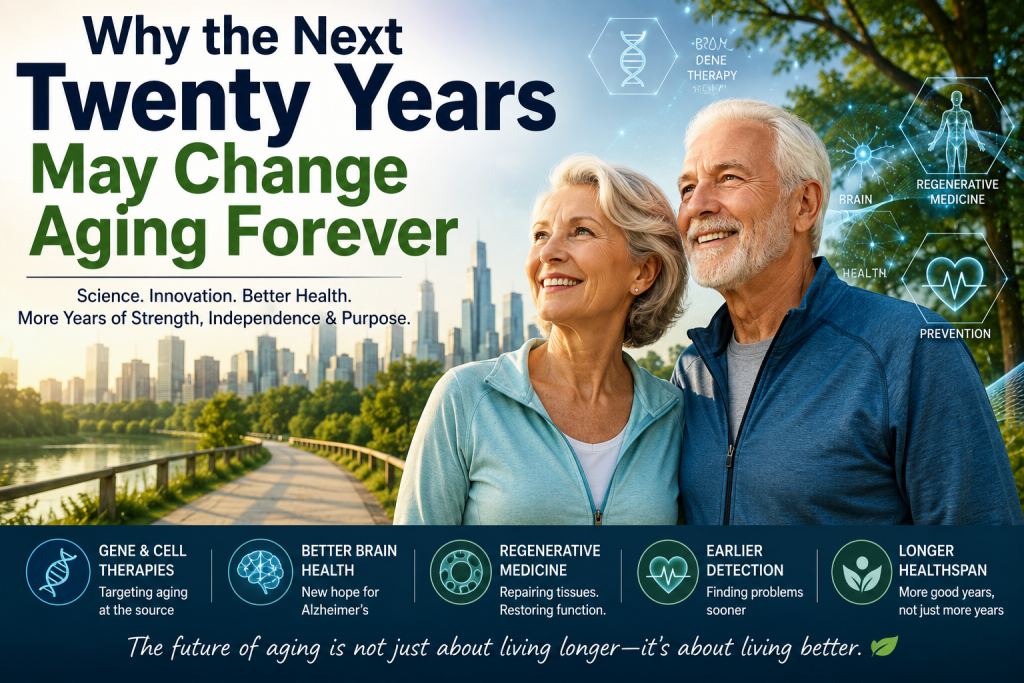
For most of human history, growing older followed a fairly predictable pattern.
The body weakened. Chronic disease accumulated. Vision, hearing, mobility, and memory often declined. Doctors treated each problem separately, usually after it had already become serious.
Aging itself was considered unavoidable, mysterious, and mostly beyond medicine’s reach.
That assumption is beginning to change.
Scientists are now studying aging not simply as the number of candles on a birthday cake, but as a collection of biological processes happening inside our cells, tissues, immune systems, and organs. At the same time, artificial intelligence, genetic medicine, regenerative therapies, advanced diagnostics, and faster drug development are beginning to work together.
No honest scientist can promise that aging will be cured in the next twenty years. Anyone selling that promise should be watched as carefully as a fellow offering oceanfront property in Nebraska.
But it is reasonable to believe that the experience of aging between now and 2046 could change more dramatically than it did during much of the previous century.
The goal may not be eternal youth.
The goal is something far more practical: more years of strength, mobility, memory, purpose, and independence.
Medicine Is Beginning to Study Aging Itself
Traditional medicine usually focuses on individual diseases.
Cardiologists treat heart disease. Neurologists treat brain disorders. Oncologists treat cancer. Endocrinologists treat diabetes and metabolic conditions.
That system has saved millions of lives, but researchers are increasingly asking a larger question:
Why do so many different diseases become more common as we age?
One major scientific framework is known as the “hallmarks of aging.” These include processes such as DNA damage, mitochondrial dysfunction, cellular senescence, altered nutrient sensing, loss of protein quality control, stem-cell exhaustion, and chronic changes in communication between cells. Scientists believe these processes interact and contribute to the body’s increasing vulnerability over time.
This does not mean aging has been reduced to one switch that scientists can simply turn off.
The body is considerably more complicated than a kitchen appliance.
However, identifying the biological mechanisms involved gives researchers specific targets to study. Instead of waiting for five separate age-related diseases to appear, future medicine may increasingly attempt to address some of the shared processes contributing to all five.
That represents a profound change in medical thinking.
As discussed in Modern Science Is Challenging What We Were Told About Aging, the body is not merely wearing out like an old automobile. It is constantly repairing, adapting, responding, and attempting to maintain balance.
The question is whether medicine can help those repair systems work better for longer.
Healthspan May Become More Important Than Lifespan
People often talk about living to 100, but reaching a large number is not the entire objective.
Living longer while spending many years weak, confused, isolated, or dependent is not the future most people are hoping for.
That is why scientists and physicians increasingly discuss healthspan—the portion of life spent in reasonably good health and functional independence.
You can explore that distinction further in What’s the Difference Between Healthspan and Lifespan?.
The next twenty years may bring treatments that delay certain diseases, detect others earlier, and help people recover function that would once have been permanently lost.
That would not necessarily add fifty years to the average lifespan.
But adding five or ten healthier, more capable years could transform retirement, family life, healthcare costs, caregiving, and the meaning of old age.
A person who remains strong and independent at 85 is living a very different life from someone who has survived to 85 but lost mobility at 72.
The future of aging will be measured not only by survival, but by function.
Senescent Cells Could Become Medical Targets
One of the most closely watched areas of aging research involves senescent cells.
These are sometimes nicknamed “zombie cells” because they have stopped dividing but have not been removed from the body. Some senescent cells serve useful roles, including wound healing. However, when they accumulate, they may release inflammatory signals and affect surrounding tissues.
Researchers are studying drugs called senolytics, which are designed to selectively remove certain senescent cells, as well as other treatments intended to modify their harmful effects.
Much of the strongest evidence still comes from laboratory and animal research. Human studies remain limited, and scientists face difficult questions about which cells to target, when to target them, and how to avoid eliminating cells that are still useful. A 2025 review described real translational progress but also emphasized the complexity and challenges facing senolytic therapies.
In other words, the science is promising, but the miracle bottle is not sitting on a supplement shelf.
Still, if safe treatments eventually reduce harmful cellular senescence, they could potentially influence multiple age-related conditions rather than treating only one disease at a time.
That possibility is one reason the next two decades could be so important.
Regenerative Medicine May Help the Body Repair Itself
For much of modern medicine, the answer to damaged tissue has been to remove it, replace it, support it, or manage the symptoms.
Regenerative medicine aims to do something more ambitious: help the body rebuild.
Researchers are investigating stem-cell therapies, tissue engineering, injectable materials, gene therapies, and biological signals that encourage damaged tissue to repair itself.
Potential applications include:
- Damaged cartilage
- Nerve injuries
- Heart tissue
- Retinal and optic-nerve damage
- Muscle loss
- Spinal injuries
- Skin and wound healing
This does not mean worn-out knees will be regenerated at the neighborhood pharmacy next year.
But research into cartilage biology, inflammation, and tissue repair is gradually changing the future of joint care. We discuss some of this progress in Arthritis Hope: What’s Coming for Knees, Hands, Hips, and Aging Joints.
If regenerative treatments become safe, scalable, and affordable, the medical response to aging may shift from managing deterioration to restoring function.
That would be revolutionary.
Cellular Reprogramming Could Change the Conversation
One of the boldest areas of research involves cellular reprogramming.
Scientists discovered that mature cells can be pushed back toward a more youthful biological state by activating certain genetic factors. Full reprogramming can be dangerous because it may cause cells to lose their identity or grow abnormally.
Researchers are therefore exploring partial reprogramming, which aims to reset some age-related cellular changes without turning a mature cell completely back into a stem cell.
Early laboratory and animal findings suggest that partial reprogramming may improve tissue repair and reverse some markers associated with aging. However, major safety questions remain, including cancer risk, control of gene expression, and whether benefits seen in animals will translate to humans.
This is not ready for ordinary clinical use.
It is also not nonsense.
It represents a serious scientific attempt to determine whether some aspects of biological aging can be reset rather than merely slowed.
Even limited success in restoring vision, nerve function, immune function, or organ repair could change millions of lives.
Alzheimer’s Treatment Has Crossed an Important Line
For decades, Alzheimer’s treatment largely focused on symptoms.
That has begun to change.
The FDA granted traditional approval to Leqembi, or lecanemab, for certain patients with early Alzheimer’s disease in 2023. In 2024, it approved Kisunla, or donanemab, for patients with mild cognitive impairment or mild dementia due to Alzheimer’s disease. These drugs target amyloid in the brain and can slow decline for some appropriately selected patients. They are not cures and carry significant risks, including brain swelling and bleeding, requiring careful screening and monitoring.
The importance of these treatments is not that they have solved Alzheimer’s.
They have not.
The importance is that disease-modifying treatment has moved from theory into real medical practice.
Over the next twenty years, researchers may develop better combinations of amyloid treatments, tau-targeting therapies, anti-inflammatory approaches, vaccines, gene-based treatments, and methods for detecting disease long before noticeable memory loss begins.
Today’s drugs may eventually look primitive compared with what follows.
That is how medicine often progresses.
The first airplane did not carry 300 passengers across the Atlantic. It proved that flight was possible.
Artificial Intelligence May Accelerate Discovery
Artificial intelligence is unlikely to replace every doctor, despite what some enthusiastic technology executives might imply.
But AI may become extremely valuable in medical research.
It can help scientists analyze enormous biological datasets, compare genetic patterns, identify potential drug targets, repurpose existing medicines, interpret medical images, and predict which patients may respond to particular treatments.
A 2025 network-medicine project analyzed thousands of longevity-related genes and thousands of existing or experimental compounds to identify drugs that might influence biological pathways associated with aging. The work remains investigational, but it illustrates how computational tools may narrow a search that would otherwise take decades.
The future may involve fewer treatments developed by trial and error and more treatments selected according to a person’s genetics, immune system, metabolism, and biological age.
That is the promise of precision medicine.
Instead of everyone receiving the same treatment because they share a diagnosis, doctors may increasingly ask why the disease developed in that particular person and which therapy is most likely to work for them.
Earlier Detection Could Be as Important as Better Treatment
A large portion of age-related disease begins silently.
Arteries narrow before a heart attack.
Bone weakens before a fracture.
Brain changes develop before memory symptoms.
Cancer grows before it is discovered.
Kidney disease advances before a person feels sick.
The next twenty years may bring blood tests, wearable sensors, home monitoring systems, retinal imaging, genetic screening, and AI-assisted scans that identify risks earlier.
A smartwatch already performs tasks that would have sounded futuristic a generation ago. Home devices can measure heart rhythm, oxygen levels, blood pressure, glucose, sleep patterns, and physical activity.
The technology is not perfect. False alarms, privacy concerns, uneven accuracy, and information overload are genuine problems.
Still, catching disease five years earlier can be more valuable than inventing a stronger treatment after major damage has occurred.
Future healthcare may become less reactive and more preventive.
Instead of waiting for the body to wave a white flag, medicine may notice trouble while the body is still whispering.
Better Drugs May Become Easier to Use
Medical progress is not only about discovering completely new treatments.
It is also about making effective treatment simpler, safer, and more affordable.
Over time, expensive biologic drugs may face competition from biosimilars. Treatments that once required hospital infusions may be delivered by injection at home. Complicated medications may become pills. Genetic testing may identify ineffective drugs before a patient wastes months taking them.
The FDA’s recent approval of a new at-home starting regimen for a subcutaneous form of Leqembi offers one current example of treatment gradually moving away from repeated medical-facility visits for eligible patients.
The first version of an innovation is often inconvenient and expensive.
The second version is usually better.
The twentieth version may become routine.
The Future Will Not Arrive Equally for Everyone
We should not turn optimism into fantasy.
New therapies may be expensive. Insurance coverage may lag behind the science. Rural areas may lack specialists. Some treatments will fail in clinical trials. Others will be overpromoted before the evidence is strong enough.
The benefits of longevity science must not become available only to wealthy people visiting luxury clinics.
We explored that concern in Is Longevity Medicine Just for Wealthy People?.
The real revolution will occur only when useful advances become safe, affordable, and available to ordinary people.
A $500,000 rejuvenation treatment may make headlines.
A $30 generic drug, reliable blood test, improved vaccine, or simple home-monitoring device may help far more people.
What Seniors Should Do Right Now
The future may be arriving, but nobody should sit on the couch waiting for scientists to repair twenty years of inactivity.
The proven foundations still matter:
- Maintain muscle through appropriate strength activity.
- Walk, cycle, dance, swim, or move regularly.
- Protect blood pressure, blood sugar, and cholesterol.
- Eat enough protein and nutritious whole foods.
- Get evaluated for hearing and vision problems.
- Treat sleep disorders.
- Stay socially connected.
- Avoid smoking.
- Keep vaccinations and preventive care current.
- Question miracle claims.
- Discuss new treatments with qualified healthcare professionals.
As we explain in Stay Healthy Until the Future Gets Here, today’s health is your admission ticket to tomorrow’s medicine.
The cavalry may be coming.
But it helps if you are still standing when it arrives.
The Bottom Line
The next twenty years may change aging because several powerful forces are converging at the same time.
Researchers are studying the biology beneath age-related disease. AI is accelerating discovery. Precision medicine is becoming more practical. Regenerative therapies are moving forward. Alzheimer’s treatment has crossed from symptom management toward disease modification. Home monitoring and early detection are becoming more sophisticated.
Some ideas will fail.
Some will be exaggerated.
Some will take longer than expected.
But others may become ordinary medical care before today’s 60-year-olds reach 80—or before today’s 80-year-olds reach 100.
That is why the future of aging is more hopeful than many people realize.
We may not eliminate aging.
But we may change what aging looks like.
The coming decades could produce a world in which people remain mobile longer, preserve memory longer, recover from injuries more successfully, receive treatment earlier, and spend fewer years trapped in severe illness or dependence.
That is not immortality.
It is something more useful.
It is a longer life that remains recognizably yours.
The future does not ask how old you are.
It asks whether you are prepared to adapt, stay informed, and remain healthy enough to meet it.
For more practical, science-based information about health, longevity, and life after 60, visit Elderhood.info.