
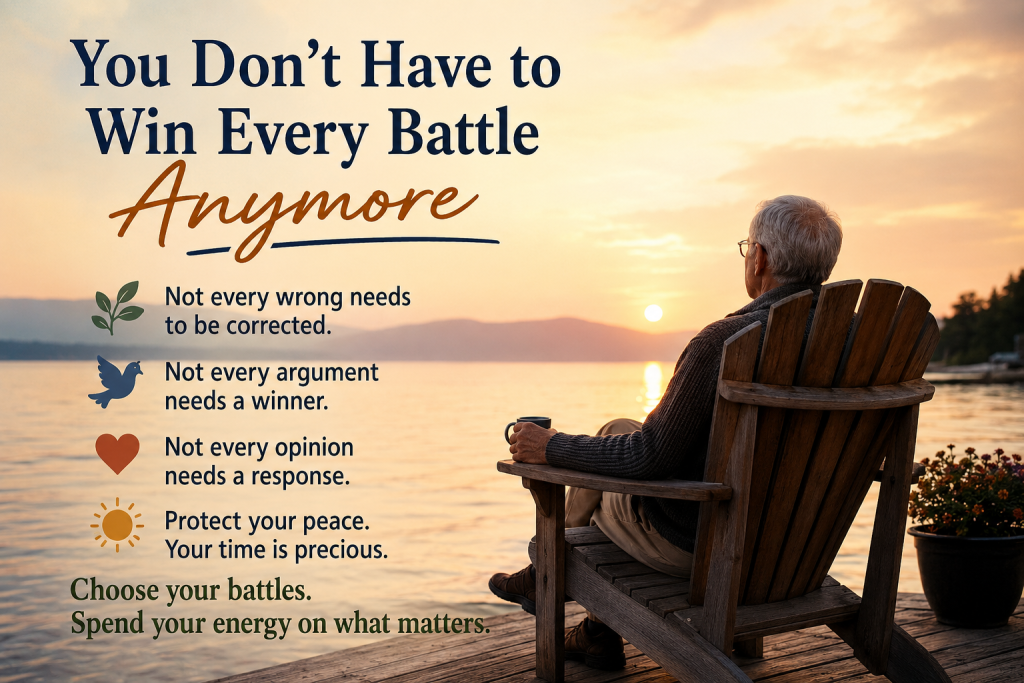
There comes a point in life when you begin to realize something rather liberating:
You do not have to win every battle anymore.
You do not have to correct every person who is wrong.
You do not have to attend every argument you are invited to.
You do not have to prove that your memory of what happened in 1987 is more accurate than someone else’s.
And you certainly do not have to spend Tuesday afternoon arguing with a customer-service representative over $3.47 unless that $3.47 has somehow become a matter of national principle.
When we are younger, winning can feel terribly important.
We want to establish ourselves.
Build careers.
Raise families.
Protect our reputations.
Defend our opinions.
Make our point.
Sometimes we fight because something genuinely matters.
Other times, if we are willing to admit it, we fight because we simply cannot stand the idea that someone else might walk away believing they were right.
Age can give us another option.
We can decide that peace is occasionally more valuable than victory.
That is not weakness.
It may actually be one of the great privileges of elderhood.
The Battles Change as We Get Older
Life does not suddenly become conflict-free because we have accumulated birthdays.
If anything, there can be plenty to argue about.
Adult children make decisions we would never make.
Friends develop opinions that make us wonder whether they have been secretly replaced by strangers.
Neighbors can annoy us.
Technology refuses to cooperate.
Organizations become bureaucratic.
Family members remember old events differently.
And sooner or later, somebody is going to explain something to us that we knew perfectly well 40 years before they were born.
The temptation to say, “Listen, young man…” can become overwhelming.
But perhaps wisdom lies in asking a different question:
Is this worth my energy?
That question becomes increasingly valuable as we age because time and energy become more precious.
When you are 25, wasting an afternoon on an argument may not seem particularly consequential.
Later in life, an afternoon begins to look different.
There are only so many beautiful afternoons available to any of us.
Why surrender one unnecessarily?
Not Every Wrong Needs to Be Corrected
This one can be difficult.
You know someone is wrong.
Not slightly wrong.
Spectacularly wrong.
Wrong enough that part of you wants to prepare a PowerPoint presentation.
But before beginning your closing argument, ask yourself:
What happens if I simply let this go?
Will anybody be harmed?
Will anything important change?
Will this matter next week?
If the answer is no, you may have discovered a battle that does not need a winner.
There is enormous freedom in allowing another person to be wrong.
You can even allow them to believe they won the argument.
This is one of those pleasures younger people rarely understand.
Sometimes the person who walks away believing he won is not actually the winner.
Sometimes the winner is the person who went home and enjoyed dinner.
Protecting Your Peace Is Not Surrender
There is a difference between avoiding necessary conflict and refusing unnecessary conflict.
Some things deserve a fight.
Your health.
Your dignity.
Your financial security.
The safety of someone you love.
Dishonesty that could cause real harm.
A medical decision that needs questioning.
An injustice that requires somebody to speak up.
Elderhood should never mean becoming passive.
In fact, experience often gives older people a stronger ability to recognize what truly matters.
The trick is learning to separate important battles from emotional clutter.
A useful rule might be:
Fight for principles.
Be careful about fighting for pride.
Pride can convince us that every disagreement is a challenge to our identity.
It usually isn’t.
Someone disagreeing with you does not erase your experience.
Someone failing to appreciate you does not reduce your worth.
And someone getting the last word does not automatically mean they were right.
Sometimes the greatest demonstration of confidence is not needing the last word at all.
Stress Has a Price
This is not only philosophy.
Constant stress affects us physically as well as emotionally.
The National Institute on Aging notes that chronic stress can affect memory, mood and overall health, and that finding ways to reduce stress and improve emotional stability may support healthier aging.
The American Psychological Association likewise points out that when stress becomes chronic, the body’s normal stress response can begin working against our physical and mental health.
That makes unnecessary conflict more than an annoyance.
It becomes an expenditure.
Every battle takes something.
Attention.
Sleep.
Energy.
Sometimes blood pressure.
Sometimes three days of replaying an argument in your head while the other person has completely forgotten it happened.
What a terrible bargain.
You win the argument on Monday and are still having it alone in the shower on Thursday.
At some point, the return on investment becomes questionable.
One of the Advantages of Age Is Perspective
By the time we reach our later years, most of us have survived things that once seemed enormous.
The job we thought we absolutely had to get.
The relationship we believed we could never live without.
The financial setback that kept us awake at night.
The insult we were certain nobody would ever forget.
The embarrassment that felt catastrophic.
Years later, some of those events barely qualify as footnotes.
That perspective is valuable.
We begin to recognize that today’s crisis may eventually become tomorrow’s amusing story.
Age can teach proportion.
Not automatically, unfortunately.
There are 80-year-olds still fighting arguments they began when they were 32.
But the opportunity is there.
We can look at a conflict and ask:
Will I care about this five years from now?
Will I care five months from now?
Will I care next Tuesday?
If not, perhaps Tuesday deserves something better.
You Are Allowed to Change Your Mind
Another battle we sometimes continue unnecessarily is the battle with our former selves.
Years ago, we made a decision.
Expressed an opinion.
Chose a political position.
Followed a tradition.
Maintained a friendship.
Believed something about ourselves.
Then life happened.
We learned something.
We changed.
And yet people often feel obligated to defend old positions simply because they once held them.
Why?
One of the great gifts of a long life should be the right to update ourselves.
At Elderhood.info, we often return to the idea that aging is really about adaptation.
You are not required to remain permanently loyal to every opinion you ever had.
Changing your mind does not necessarily mean you were foolish before.
It may mean you know more now.
That is not defeat.
That is growth.
Stop Trying to Win Arguments With Your Adult Children
This deserves its own section.
Adult children are a remarkable phenomenon.
You spend years trying to teach them everything you know.
Then one day they become adults and begin explaining life to you.
Nature apparently has a sense of humor.
There comes a moment when parents must accept something uncomfortable:
Your children are going to make decisions differently than you would.
You can offer experience.
You can provide perspective.
You can warn them.
You can tell them where the cliff is.
But eventually, you may have to let them drive the car.
Sometimes directly toward the cliff.
This is difficult because advice from parents is usually motivated by love.
Unfortunately, unsolicited advice is often received as criticism wearing a nice hat.
So perhaps the better question is:
Did they ask me?
If they did, wonderful.
If they did not, there may be wisdom in waiting.
You do not have to win every family debate.
Sometimes preserving the relationship matters more than proving the point.
Relationships Are More Valuable Than Scoreboards
Every long friendship, marriage and family relationship contains a hidden scoreboard.
Who called last?
Who apologized last time?
Who forgot the birthday?
Who made the insensitive comment?
Who always chooses the restaurant?
Who was right about what Uncle Charlie said at Thanksgiving in 1994?
We can keep these records indefinitely.
But why?
There are relationships worth leaving because they are harmful or destructive.
But many relationships are not destroyed by great betrayals.
They are slowly worn down by small victories.
One person must always be right.
One person must always have the final word.
One person must always remind the other of previous mistakes.
Eventually nobody remembers what they were fighting about.
They only remember that being together became exhausting.
As we grow older, perhaps we can become more generous scorekeepers.
Some games are better when nobody keeps score.
Resilience Is Not the Same as Toughness
We often think resilient people are those who keep pushing no matter what.
But resilience can also mean adapting.
The National Institute on Aging describes resilience broadly as the capacity to resist, recover from or successfully adapt to stressors.
Notice that word:
Adapt.
Sometimes resilience means fighting.
Sometimes it means recovering.
And sometimes it means deciding that a particular fight deserves no more of your life.
There is nothing heroic about repeatedly walking into the same wall because you are determined to prove that the wall should move.
At some point, wisdom says:
Walk around it.
Ask Three Questions Before Entering the Battle
The next time you feel yourself gearing up for an argument, try asking three simple questions.
1. Does this actually matter?
Not “Does this annoy me?”
Does it matter?
Those are very different questions.
2. Can anything useful come from this conversation?
If both people are capable of listening, perhaps yes.
If everyone is simply waiting for their turn to speak, probably not.
3. What will winning cost me?
You might win the point and damage the relationship.
You might win the complaint and ruin your afternoon.
You might prove someone wrong and spend the evening angry.
Some victories are simply too expensive.
There Is a Difference Between Letting Go and Giving Up
This distinction matters.
Giving up says:
“Nothing matters.”
Letting go says:
“This particular thing does not deserve any more of me.”
Those are completely different attitudes.
A person who chooses battles carefully may actually have more strength available when something important happens.
Energy saved on trivial conflicts can be spent on health, friendships, family, curiosity, travel, creativity and whatever gives life meaning.
That sounds like a pretty good trade.
We have explored similar ideas in Elderhood articles about being present and paying attention to the life happening now.
Because ultimately, every unnecessary battle steals attention from something else.
And attention is life.
The Freedom of Not Needing to Prove Yourself
Perhaps this is one of the greatest freedoms available later in life.
You already know who you are.
You have survived failures.
You have survived successes.
You have been admired and criticized.
You have made smart decisions and ridiculous ones.
You have probably been right when everyone thought you were wrong.
And wrong when you were absolutely certain you were right.
After enough years, the need to prove yourself can begin to loosen its grip.
What a relief.
You do not need everyone to understand you.
You do not need everyone to agree with you.
You do not even need everyone to like you.
You can listen.
Smile.
Consider their opinion.
And occasionally say:
“You may be right.”
Those may be four of the most peaceful words in the English language.
You don’t even have to believe them every time.
Choose the Battles Worth Winning
None of this means becoming indifferent.
There are still things worth standing up for.
Still causes worth supporting.
Still people worth protecting.
Still dreams worth pursuing.
Still injustices worth challenging.
Still adventures worth beginning.
Age should not shrink our courage.
It should improve our aim.
When we are young, we may swing at everything.
Elderhood offers the possibility of becoming more selective.
Not every disagreement deserves your anger.
Not every criticism deserves your response.
Not every insult deserves your attention.
Not every misunderstanding needs correction.
And not every battle requires a winner.
Sometimes you can simply walk away.
Make a cup of coffee.
Call a friend.
Take a walk.
Listen to music.
Play with the dog.
Watch the sunset.
Do something with the afternoon that the argument did not deserve.
Because one of the lessons a long life eventually teaches us is surprisingly simple:
You do not have unlimited time.
But you do have some control over what receives it.
Choose carefully.
You don’t have to win every battle anymore.
You only have to recognize which ones are worth fighting.