
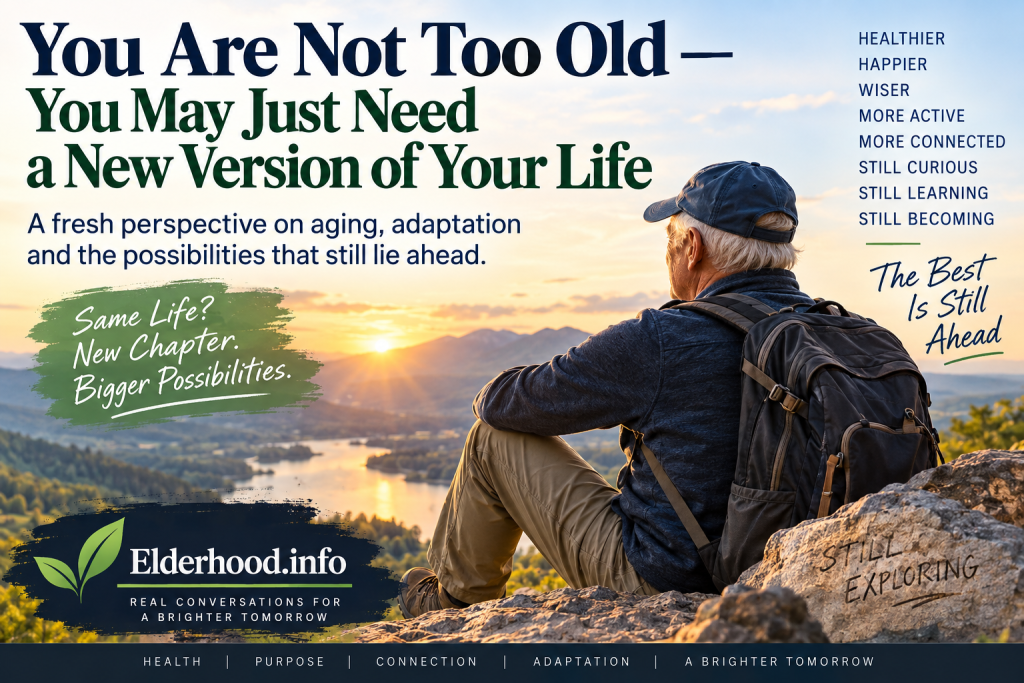
There is a strange thing that happens as we get older.
People begin speaking to us as if the important parts of life are behind us.
Retirement becomes the finish line.
Children are grown.
Careers wind down.
The house may get quieter.
Friends move away, get sick, or disappear from our lives.
And suddenly the world seems to be asking a question nobody prepared us for:
Now what?
For generations, growing older was treated almost like an extended waiting room.
You worked.
You raised a family.
You retired.
And then you were expected to slow down gracefully.
That model no longer fits.
People are living longer, staying healthier longer, working later, learning new technology, starting businesses, dating again, traveling, exercising, volunteering, creating, and reinventing themselves at ages that previous generations might have considered “old.”
The real challenge of modern aging may not be simply staying alive.
It may be learning how to keep becoming someone new.
Aging Is Inevitable. Becoming Old Is More Complicated.
Your birthday is automatic.
Your attitude is not.
Your circumstances will change whether you want them to or not. The question is whether you can change with them.
That is one of the great truths of elderhood:
The larger story of aging is adaptation.
Your body changes.
Your family changes.
Your finances change.
Technology changes.
Your neighborhood changes.
The people around you change.
Sometimes your entire identity changes.
At 45, you may have introduced yourself by your profession.
At 75, that job may have been gone for years.
So who are you now?
That can be frightening.
But it can also be liberating.
For perhaps the first time in your life, you may be free to ask a very different question:
Who would I like to become next?
We Were Trained for Careers, Not Elderhood
Most of us spent decades preparing for adulthood.
School prepared us for employment.
Employment prepared us for promotion.
Financial planning supposedly prepared us for retirement.
But almost nobody prepared us for the psychological reality of living another 20 or 30 years after our traditional working life ends.
We prepared financially for retirement.
We did not necessarily prepare emotionally for it.
Nobody handed us a manual explaining what to do when Monday morning no longer requires us to be anywhere.
At first, that freedom may feel wonderful.
No alarm clock.
No commute.
No demanding boss.
But eventually another feeling can creep in.
Am I still needed?
That may be one of the most important questions in later life.
Human beings do not stop needing purpose because Social Security checks start arriving.
We still want somebody to need us.
We still want something to look forward to.
We still want our days to matter.
Retirement Should Not Mean Retiring From Life
The problem may be the word itself.
“Retirement” sounds like withdrawal.
A machine is retired when it is no longer needed.
A ship is retired when its service is finished.
A jersey is retired because its playing days are over.
But human beings are not machinery.
Maybe we need a different idea.
Instead of retirement, perhaps we should think about reinvention.
You may retire from a career without retiring from contribution.
You may stop earning a paycheck without stopping meaningful work.
You may leave one identity behind while creating another.
That second identity does not need to impress anyone.
It simply needs to give you a reason to get up in the morning.
Curiosity May Be One of the Best Anti-Aging Tools We Have
Children ask questions constantly.
Why?
How?
What happens if?
Somewhere along the way, adults often stop.
We begin believing we are supposed to already know everything we need to know.
Then technology changes.
Culture changes.
Language changes.
The world changes faster than ever.
One of the easiest ways to become old psychologically may be to decide that nothing new is worth learning.
You hear it all the time:
“I don’t understand these new phones.”
“I don’t use the Internet.”
“Artificial intelligence isn’t for me.”
“I’ve never done that before.”
Those sentences can quietly become walls.
Try replacing them with one word:
Yet.
I don’t understand it — yet.
I’ve never tried it — yet.
I don’t know how — yet.
That small word keeps the door open.
At 70, 80, or 90, curiosity still belongs to you.
Your Next Chapter Does Not Need to Be Grand
Reinvention does not mean you need to climb Mount Everest or launch a technology company at 85.
Sometimes reinvention is much smaller.
You take a dance class.
You start walking every morning.
You learn to cook something you have never made.
You finally organize your family photographs.
You adopt a dog.
You volunteer at the library.
You take an online class.
You reconnect with someone you lost touch with 30 years ago.
You begin writing down the stories your grandchildren have never heard.
A new life can begin with surprisingly small decisions.
The mistake is assuming that change must be dramatic to matter.
It does not.
Sometimes changing Tuesday afternoon is enough to begin changing your life.
Loneliness Can Be a Warning, Not a Verdict
One of the most difficult changes in elderhood is the gradual shrinking of our social world.
Work once provided automatic contact with people.
Children brought activity into the home.
Neighbors may have known one another better.
Churches, clubs, civic organizations, bowling leagues, union halls, local stores, and neighborhood gathering places created casual connections.
Many of those structures have weakened.
We may have hundreds of online “friends” while spending entire days without having a meaningful conversation.
This makes social connection something we increasingly have to create intentionally.
That can feel awkward.
Especially for older adults who never had to deliberately build friendships before.
But there is no shame in beginning again socially.
Friendships at 75 will not necessarily look like friendships at 25.
You may not need 20 friends.
You may need two or three genuine relationships.
Someone to call.
Someone to have coffee with.
Someone who notices if you are missing.
Those relationships are worth cultivating.
Stop Waiting for Permission
Older adults sometimes begin unconsciously asking society for permission.
Am I too old to travel alone?
Too old to date?
Too old to dance?
Too old to learn Spanish?
Too old to start a YouTube channel?
Too old to buy a bicycle?
Too old to change careers?
Too old to fall in love?
There is a wonderfully simple answer to most of those questions:
Who says?
Age deserves respect.
It does not deserve surrender.
Obviously, our bodies impose limits.
Finances impose limits.
Health sometimes imposes limits.
But many of the limits we accept are cultural rather than physical.
Someone decided what a 70-year-old was supposed to look like.
Someone decided what an 80-year-old was supposed to do.
You are not required to follow their script.
The Goal Is Not to Pretend You Are Young
Healthy aging does not require pretending you are 35.
There is something almost tragic about spending old age desperately trying to erase every sign of having lived.
Wrinkles are not a personal failure.
Gray hair is not a diagnosis.
Needing reading glasses does not mean life is ending.
The goal should not be eternal youth.
The goal should be continued vitality.
That means using the body you have.
Protecting the health you still possess.
Maintaining strength.
Keeping your mind engaged.
Staying socially connected.
And continuing to participate in life.
You do not have to be young to be alive.
Your Experience Has Value — If You Keep Using It
Older adults possess something younger people cannot buy.
Perspective.
You have watched problems that once seemed catastrophic eventually pass.
You have survived disappointments you thought you could never survive.
You have seen fashions, politicians, technologies, investments, relationships, and social movements come and go.
You know that life is rarely as permanent as it feels in the moment.
That knowledge has value.
But wisdom is not simply accumulated experience.
Wisdom is experience that remains engaged with the present.
The danger is not becoming older.
The danger is allowing your experience to become a museum exhibit instead of a working tool.
Your past should inform your future.
It should not imprison it.
Ask Yourself One Question
Not:
“How much time do I have left?”
None of us knows.
Instead ask:
What do I want to do with the time that is still mine?
That question works at 40.
It works at 70.
And it works at 90.
You may have fewer years ahead than behind.
That does not make the remaining years less valuable.
If anything, scarcity can make time more precious.
At some point, we stop measuring life by how many years we have accumulated and begin measuring it by whether we are still participating.
Still curious.
Still connected.
Still moving.
Still learning.
Still laughing.
Still caring.
Still becoming.
The New Elderhood
We may be the first generation required to redefine what later life actually means.
Our parents often entered old age in a very different world.
Today, people can work remotely, talk to grandchildren across the world instantly, take university courses online, start businesses from a kitchen table, meet new friends through shared interests, and access more information from a phone than entire libraries once contained.
That creates challenges.
But it also creates extraordinary possibilities.
The old map of aging no longer tells us exactly where to go.
Perhaps that is not a problem.
Perhaps it is an opportunity.
Because if the old rules no longer apply, we get to write some new ones.
And maybe the first rule should be this:
You are allowed to keep becoming.
Not despite your age.
Because you are still here.
That alone means the story is not finished.
A Thought to Take With You
Growing older does not require becoming a smaller version of yourself.
Adapt.
Stay curious.
Protect your health.
Find people who make life richer.
Learn something you do not understand.
Try something you have never done.
And whenever you hear yourself saying, “I’m too old for that,” ask one more question:
Am I really — or have I simply stopped giving myself permission?
At Elderhood.info, we explore what it means to live longer without surrendering curiosity, independence, purpose, or possibility.
If this article made you think about aging differently, share it with someone who may need to hear it, and subscribe for more conversations about living well in the years ahead.
Aging is inevitable. Decline is not.