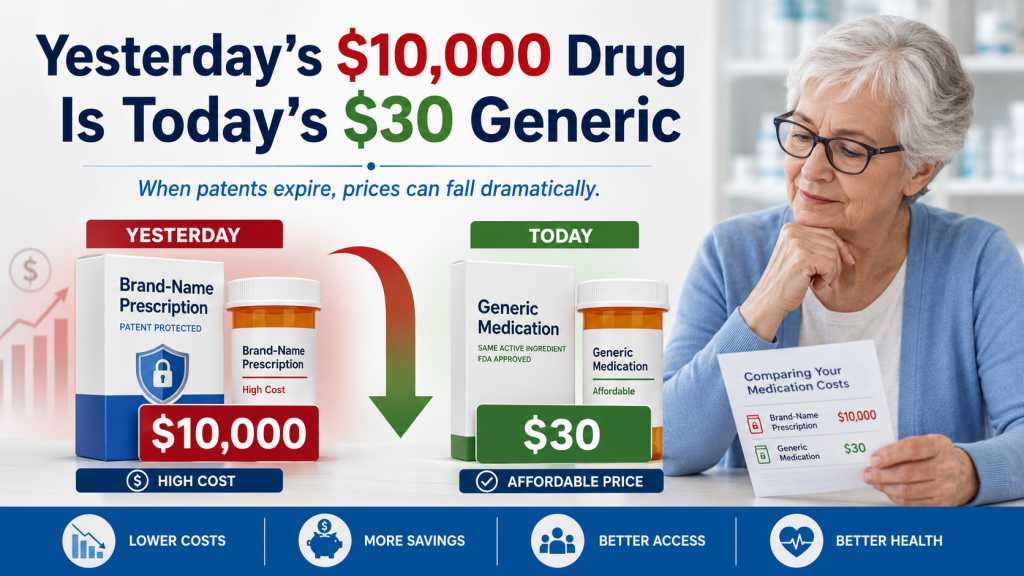
The medicine may not have changed. The marketplace did.
For much of modern life, we have been trained to believe that expensive means better.
A costly automobile must be better engineered. An expensive restaurant must serve better food. And a prescription carrying a shocking price tag must somehow be more powerful, more advanced, or more trustworthy than a medicine costing only a few dollars.
But pharmaceuticals do not always follow that logic.
A drug can begin its life as a medical breakthrough protected by patents and sold at an eye-watering price. Years later, after patents and exclusivity protections expire, competing manufacturers may enter the market.
The bottle changes.
The company name changes.
The price may collapse.
In some cases, a medicine that once cost hundreds or even thousands of dollars can eventually become available as a generic costing a fraction of the original price.
That does not mean every $10,000 drug literally becomes a $30 prescription. Drug prices vary according to dosage, pharmacy, insurance coverage, discounts, supply, and the number of competing manufacturers.
But the larger truth is real:
Yesterday’s medical luxury can become tomorrow’s ordinary medicine.
And that may be one of the most hopeful developments in modern healthcare.
Why New Drugs Cost So Much
Developing a new medication is expensive, uncertain, and time-consuming.
Drug manufacturers must identify promising compounds, perform laboratory research, conduct clinical trials, submit evidence to regulators, and manufacture the medication according to strict quality standards.
Many potential drugs fail long before reaching a pharmacy shelf.
When a company successfully introduces a new drug, patents and other forms of market exclusivity can temporarily limit direct competition. During this protected period, the manufacturer may charge a high price in an attempt to recover development costs, reward investors, fund future research, and maximize the commercial value of the product.
That is the official explanation.
The less comfortable reality is that drug prices are not determined only by the cost of research.
They are also influenced by market power, negotiations with insurers and pharmacy benefit managers, rebates, government rules, competition, and what the healthcare system is willing to pay.
A tablet does not cost $500 because the powder inside the tablet necessarily costs $500 to manufacture.
It may cost $500 because the company currently has the power to charge $500.
Once genuine competition arrives, that power can weaken dramatically.
What Happens When the Patent Expires?
Patents do not last forever.
When the relevant protections expire—and legal or regulatory barriers are resolved—other manufacturers may apply to sell generic versions of the medicine.
The United States Food and Drug Administration requires an approved generic drug to contain the same active ingredient as its brand-name counterpart and to have the same strength, dosage form, route of administration, quality, and intended clinical effect. The generic must also demonstrate bioequivalence, meaning it works in the body in essentially the same way as the brand-name drug.
The generic pill may have a different color, shape, coating, or inactive ingredients.
Its name will usually be less memorable.
Instead of a polished brand name created by a marketing department, the generic may carry a chemical name that sounds as though it was invented during a bad game of Scrabble.
But the active medication is not second-class medicine simply because the packaging is less glamorous.
In many cases, the generic is the same practical treatment without the expensive marketing costume.
Why Generic Prices Can Fall So Sharply
The first generic competitor does not always produce an immediate price collapse.
But when several manufacturers begin selling the same medication, competition can become powerful.
One company lowers its price to win pharmacy contracts.
Another company responds.
Large purchasers negotiate.
Discount pharmacies enter the picture.
Cash-price services publish comparisons.
Eventually, a medication that once carried a premium price may become an inexpensive commodity.
This is the same economic force that affects electronics.
The first flat-screen television cost a small fortune. Years later, a better model could be purchased during a holiday sale without applying for a second mortgage.
The science became established.
Manufacturing expanded.
Competition increased.
Prices fell.
Medicines can travel along a similar path—although the pharmaceutical market is much more complicated and far less transparent.
Generic Does Not Mean Inferior
Many older adults still feel uneasy when a pharmacist offers a generic.
They may think:
“The brand is what my doctor prescribed.”
“The cheaper one cannot possibly be as good.”
“I have taken this bottle for years. Why should I change?”
That hesitation is understandable. We place enormous trust in medications, particularly when they control blood pressure, prevent blood clots, manage seizures, reduce pain, or protect the heart.
But price alone is not evidence of quality.
The FDA states that approved generics are required to meet the same strict manufacturing standards as brand-name medications. They must deliver the same active ingredient and provide the same clinical benefit when used as directed.
There can be legitimate reasons for a patient or physician to prefer a particular manufacturer or formulation. Inactive ingredients may differ, and certain medications require especially careful monitoring.
No one should switch prescriptions casually or without appropriate medical guidance.
But the assumption that a $300 bottle must be medically superior to a $15 bottle is often wrong.
Sometimes you are paying for the name.
Generics and Biosimilars Are Not Exactly the Same
This is where the conversation becomes slightly more complicated.
Traditional chemical drugs are generally small, relatively straightforward molecules. When their protections expire, competitors may produce generic versions.
Biologic medicines are different.
Biologics are often large, complex products made using living cells. They include many injectable and infused treatments used for cancer, rheumatoid arthritis, psoriasis, inflammatory bowel disease, diabetes, and other serious conditions.
Because biologics are made through living systems, another manufacturer cannot create a perfectly identical copy in the same way it can reproduce a simple chemical tablet.
Instead, competing products are called biosimilars.
The FDA defines a biosimilar as a biologic medication that is highly similar to an existing FDA-approved biologic and has no clinically meaningful differences in safety or effectiveness.
Think of it this way:
A generic is like reproducing the same printed recipe.
A biosimilar is like growing two oranges from closely controlled orchards. No two oranges are molecularly identical, but regulators require evidence that the meaningful clinical result is the same.
Biosimilars can create major savings, but the price reductions are not always as fast or dramatic as they are with traditional generics.
Insurance formularies, rebate arrangements, prescribing practices, hospital purchasing contracts, and patient assistance programs can all affect which biologic is actually cheapest for a particular patient.
The Price on the Label Is Not Always Your Price
Prescription pricing is a hall of mirrors.
There is a list price.
There is an insurance-negotiated price.
There is a pharmacy cash price.
There is a preferred-pharmacy price.
There may be a discount-card price.
There may be a manufacturer assistance price.
And then there is the amount the patient actually pays.
These numbers may have surprisingly little relationship to one another.
A generic medication can sometimes cost less when purchased with cash than when processed through an insurance plan. In other situations, using cash may prevent the purchase from counting toward an insurance deductible or annual out-of-pocket limit.
The lowest price is not automatically the best financial choice.
You must consider the entire year.
That is why seniors should compare at least three numbers:
- The cost through their current insurance plan
- The cost at another preferred or in-network pharmacy
- The legitimate cash price from a reputable pharmacy or discount service
The answer can change from month to month and from one pharmacy counter to another.
Medication pricing has become so complicated that buying a bottle of pills sometimes feels like negotiating the purchase of a used automobile—except the automobile salesman is usually more willing to show you the final price.
Medicare Has Changed the High-Cost Drug Calculation
For Medicare beneficiaries, prescription costs changed significantly with the introduction of an annual Part D out-of-pocket limit.
In 2026, beneficiaries with Medicare Part D coverage have a $2,100 annual out-of-pocket cap for medications covered by their plan. Once the beneficiary reaches that limit, the plan pays the remaining covered Part D costs for the rest of the year.
Medicare drug plans may also charge a deductible of up to $615 in 2026, although some plans charge less or no deductible.
These protections are important, particularly for people taking high-cost cancer drugs, specialty medications, or expensive oral treatments.
But there is a catch.
The cap applies only to drugs covered under the beneficiary’s Part D plan. It does not automatically protect someone who purchases a non-covered medication entirely with cash, and it does not apply in the same way to medications covered under Medicare Part B, including many physician-administered injections and infusions.
So even in the age of a Medicare drug cap, the formulary still matters.
The pharmacy still matters.
And the chosen plan still matters.
For more guidance on adapting to the changing world of health and longevity, visit the Elderhood health and aging library.
The Medicare Negotiation Era Has Begun
The federal government has also begun negotiating prices for selected high-spending Medicare medications.
The first negotiated prices took effect in 2026. According to the Centers for Medicare & Medicaid Services, the first selected medicines accounted for approximately $56.2 billion in gross Medicare Part D prescription spending in 2023 and were used by about 8.8 million Medicare beneficiaries.
This is separate from generic competition.
A drug may remain protected from generic entry while Medicare negotiates a lower price. Later, generic or biosimilar competition may create additional pressure.
The pharmaceutical price story therefore has several chapters:
- The original breakthrough
- The patent-protected brand
- Insurance and government negotiation
- Patent expiration
- Generic or biosimilar competition
- Wider access at a potentially lower price
This is why an expensive medicine should never be viewed as permanently expensive.
Its price is a moment in time.
Why Your Doctor May Not Know the Cheapest Price
Doctors know medicine.
They do not necessarily know what your prescription will cost at Walgreens on Tuesday afternoon under your particular insurance plan.
Your physician may not know:
- Whether your plan prefers one manufacturer
- Which pharmacy has the lowest contracted price
- Whether a new generic recently entered the market
- Whether your plan moved the drug to another tier
- Whether a biosimilar replaced the original biologic
- Whether a cash price is lower than your insurance copayment
That is not necessarily a failure by the physician.
The system changes too quickly and contains too many hidden arrangements.
The important lesson is that medication cost should become part of the medical conversation.
Patients should not be embarrassed to say:
“I cannot afford this.”
“Is there a generic?”
“Is there a biosimilar?”
“Is there an older medicine that works almost as well?”
“Can you prescribe a 90-day supply?”
“Does another dosage or formulation cost less?”
A prescription that remains unopened because of price is not effective treatment.
Seven Questions Every Senior Should Ask
Whenever you receive a new prescription—or refill an expensive old one—ask these questions:
Is a generic available?
Do not assume the pharmacy will automatically make the least expensive choice.
Has a new generic recently entered the market?
Medication markets change. A drug that was brand-only last year may have competition today.
Is there an FDA-approved biosimilar?
This is particularly important for injected or infused biologic medications.
Which version does my insurance prefer?
The least expensive list price may not be the least expensive option under your plan.
Would another pharmacy charge less?
Preferred-network pricing can differ substantially.
Is the cash price lower?
Ask, but also find out how paying cash affects your deductible and Part D out-of-pocket tracking.
Is there an equally effective alternative?
A different medication in the same therapeutic class may be far less expensive.
Do not stop or replace a medication without discussing it with the prescribing clinician.
The Elderhood Lesson: Stay Curious
The deeper lesson is not merely about prescription drugs.
It is about adaptation.
In Elderhood, yesterday’s information may no longer be good enough.
The medicine you were prescribed five years ago may still be the right medicine—but the way you purchase it may be completely outdated.
The expensive brand may now have a generic.
The biologic may now have a biosimilar.
Your insurance plan may have changed its formulary.
A new Medicare rule may have reduced your exposure.
A competing pharmacy may sell the same approved medication for far less.
The future does not reward passive consumers.
It rewards people who ask questions.
That does not mean distrusting every doctor, pharmacist, insurer, or manufacturer. It means recognizing that none of them sees the entire financial picture from your side of the counter.
You are the only person who knows what the medication actually costs you.
Final Thoughts
A high drug price can feel permanent.
It is not.
Patents expire.
Competitors arrive.
Generics enter the market.
Biosimilars expand treatment choices.
Medicare rules change.
Negotiated prices take effect.
And yesterday’s astonishingly expensive breakthrough may eventually become an ordinary, affordable medicine.
That is good news—but only for the person who discovers that the price has changed.
So check the bottle.
Check the generic name.
Check the formulary.
Check more than one pharmacy.
And ask the question that could save hundreds or even thousands of dollars:
“Is there a less expensive version now?”
Because in modern medicine, the treatment may remain the same while the price changes completely.
And there is no prize for continuing to pay yesterday’s price.
This article is for general educational purposes and is not medical advice. Medication prices, insurance coverage, formularies, availability, and patient costs vary. Never stop, substitute, split, or change a prescription without consulting a qualified healthcare professional.