
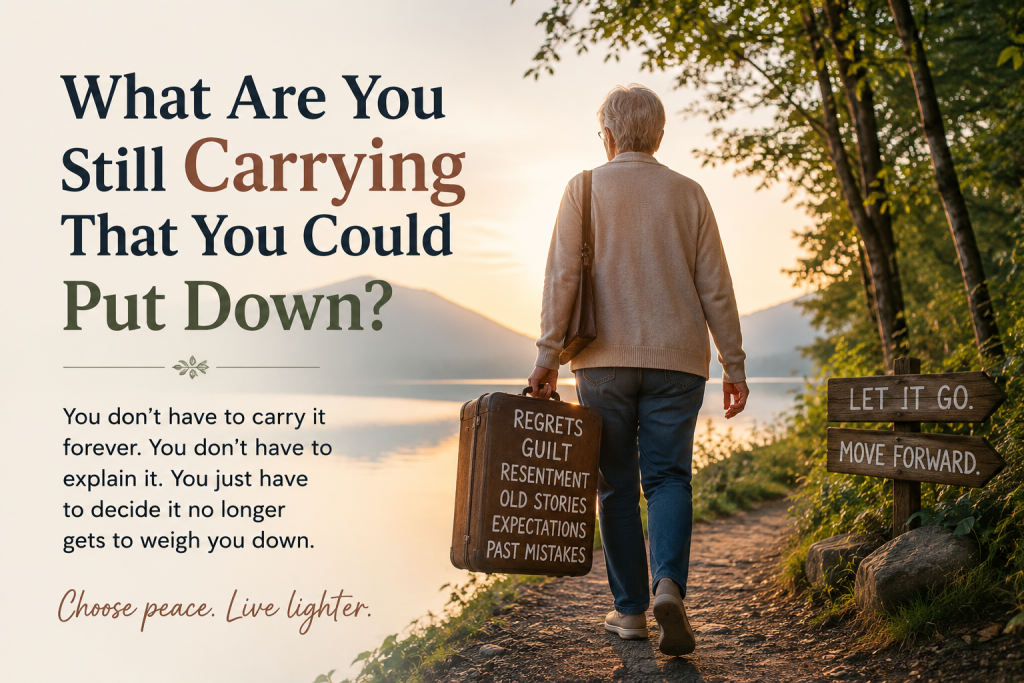
By the time we reach our 60s, 70s, or 80s, most of us have accumulated more than photographs, furniture, and old tax returns.
We have also accumulated emotional luggage.
Regrets.
Old arguments.
Disappointments.
Guilt.
Resentments.
Obligations we never really wanted.
Expectations we inherited from other people.
Stories about ourselves that may have been true 30 years ago but no longer fit the person we are today.
And unlike the clutter in the garage, we often don’t notice how much of this we’re still carrying.
We simply get used to the weight.
That may be one of the most important questions of later life:
What are you still carrying that you could finally put down?
Not because the past didn’t matter.
Not because you should pretend painful things never happened.
And certainly not because everyone deserves forgiveness or another chance.
Sometimes putting something down simply means deciding that it no longer gets to occupy so much space in your life.
Emotional Weight Is Still Weight
We tend to think of stress as something that happens in the present.
A medical problem.
A financial problem.
A family disagreement.
A difficult relationship.
But the mind can keep old stress alive long after the event itself has ended.
You may be sitting quietly at the kitchen table while replaying an argument from 1987.
The other person may have forgotten it completely.
They may not even be alive anymore.
But there you are, still having the argument.
That is one of the strange things about being human.
The event can end.
The emotional reaction can continue for decades.
Research has consistently connected chronic stress with effects on sleep, mood, cardiovascular health, and overall well-being. The American Psychological Association provides useful information about the impact of stress and healthier ways to manage it at APA.org.
Of course, knowing stress is harmful doesn’t automatically make it disappear.
If it did, we’d all be relaxed by lunchtime.
But awareness gives us somewhere to begin.
Regret May Be the Heaviest Suitcase
Almost everyone has regrets.
Things we should have done.
Things we shouldn’t have done.
Words we wish we had said.
Words we desperately wish we had not said.
Decisions that seemed reasonable at the time and ridiculous in hindsight.
The trouble with regret is that hindsight cheats.
You look back at a decision you made at 40 using the knowledge you have at 75.
That’s not a fair trial.
The 40-year-old version of you did not know everything the 75-year-old version knows today.
You were making decisions with the information, emotions, circumstances, and maturity you had at that particular moment.
Would you choose differently today?
Probably.
That’s called learning.
If we never looked back and thought, “I should have handled that differently,” it would mean we hadn’t grown very much.
Regret can teach us something.
But once the lesson has been learned, carrying the punishment forever serves very little purpose.
If you’re interested in this broader idea of making peace with your life rather than constantly judging it, you may also enjoy Are You Living or Just Passing Time?.
Guilt and Responsibility Are Not the Same Thing
There is an important difference between taking responsibility and carrying guilt forever.
Responsibility says:
“I made a mistake. I understand what I did. If possible, I will make it right. I will try not to repeat it.”
Permanent guilt says:
“I made a mistake, therefore I must continue punishing myself indefinitely.”
Those are not the same thing.
Healthy responsibility helps us grow.
Endless guilt can trap us in the past.
Sometimes an apology is appropriate.
Sometimes restitution is appropriate.
Sometimes the person is no longer available.
And sometimes there is simply nothing left to do except acknowledge what happened and decide what kind of person you want to be going forward.
The past can be a teacher without becoming a prison.
Some Resentments Have Expired
Resentment is another heavy object many people carry for years.
Someone betrayed you.
Someone treated you unfairly.
Someone took advantage of you.
Someone disappointed you when you needed them most.
Those feelings may be completely justified.
But here’s the uncomfortable question:
Is continuing to carry the resentment helping you now?
That’s a different question from whether the other person was wrong.
They may have been entirely wrong.
Putting down resentment does not require declaring them innocent.
It means deciding that their behavior will no longer dictate your emotional life.
Forgiveness, when appropriate, is often misunderstood.
It does not necessarily mean reconciliation.
It does not mean inviting someone back into your life.
It does not mean forgetting what happened.
It may simply mean, “I refuse to keep paying for what you did.”
That distinction can be liberating.
The Greater Good Science Center at UC Berkeley has published extensive material on forgiveness, emotional resilience, and well-being at Greater Good.
You May Be Carrying Someone Else’s Expectations
Many of us spend decades living by rules we never consciously chose.
A good father should do this.
A good mother should do that.
Successful people should own certain things.
Older people should behave a certain way.
You should stay in a marriage no matter what.
You should never change careers.
You should always put your children first.
You should never spend money on yourself.
You should dress your age.
You should act your age.
That’s a lot of “shoulds.”
Some are useful.
Some are outdated.
Some never made much sense in the first place.
One of the unexpected freedoms of elderhood is that you can begin asking:
“Who wrote this rule?”
And perhaps even more importantly:
“Do I still agree with it?”
You don’t have to rebel against everything.
But you are allowed to reconsider.
A life lived entirely according to other people’s expectations eventually stops feeling like your own.
You Don’t Have to Win Every Old Argument
There comes a point in life when being right becomes much less valuable than being at peace.
That doesn’t mean becoming passive.
It doesn’t mean allowing people to mistreat you.
But some battles simply aren’t worth carrying anymore.
Family disagreements can last for years because everyone is waiting for someone else to admit they were wrong.
Sometimes nobody does.
And eventually the argument becomes part of the family’s furniture.
Everybody knows where it is.
Nobody knows why it’s still there.
Ask yourself:
“If I won this argument tomorrow, what would actually change?”
That question can be revealing.
Some victories are not worth the energy they require.
Put Down the Need to Explain Yourself to Everyone
This is a big one.
As we get older, we may finally realize that not everyone is going to understand our choices.
And that’s okay.
Maybe you want to travel.
Maybe you want to move.
Maybe you want to date again.
Maybe you don’t want to date at all.
Maybe you want to keep working.
Maybe you want to retire completely.
Maybe you want to spend money your children expected to inherit.
Maybe you want to simplify everything.
You can listen to advice.
You can consider consequences.
But you do not need unanimous approval for your life.
At some point, adulthood includes accepting that someone somewhere will disagree with you.
They’ll survive.
And so will you.
Put Down the Version of Yourself That No Longer Exists
We also carry identities.
The athlete.
The executive.
The caregiver.
The spouse.
The breadwinner.
The person everyone depended on.
The person who always had the answers.
Life changes.
Bodies change.
Families change.
Careers end.
Relationships end.
Roles disappear.
Sometimes the hardest part isn’t losing the role.
It’s accepting that we are no longer the person who occupied it.
But identity doesn’t have to end simply because one chapter ended.
This is one reason the idea of elderhood can be more useful than simply thinking about “getting old.”
It asks:
Who are you becoming now?
Not:
Who were you 30 years ago?
We explored that idea further in You’re Not Getting Old — You’re Entering Elderhood.
Some Things Should Not Be Put Down
There is also a danger in taking this idea too far.
Not everything difficult should be discarded.
Some responsibilities matter.
Some relationships deserve work.
Some regrets contain important lessons.
Some grief cannot be rushed.
Some pain requires professional help rather than philosophical slogans.
If you’re dealing with persistent anxiety, depression, trauma, or overwhelming grief, talking with a qualified mental health professional can be valuable. The National Institute of Mental Health offers educational resources at NIMH.
“Let it go” is sometimes good advice.
It is also sometimes lazy advice.
The real question is not whether something feels heavy.
The question is whether carrying it is still useful.
A Simple Exercise: Name What You’re Carrying
You don’t need incense, a mountaintop, or three hours of meditation.
Take a piece of paper.
Write this sentence at the top:
What am I still carrying?
Then write whatever comes to mind.
Maybe it’s:
“I still resent my brother.”
“I still feel guilty about my divorce.”
“I still think I disappointed my father.”
“I’m still angry that I lost that business.”
“I’m afraid my children think I’m selfish.”
“I still haven’t forgiven myself for something I did 40 years ago.”
Then ask one more question:
What would happen if I put this down?
Not forget it.
Not erase it.
Put it down.
Would your life become lighter?
Would your relationships become easier?
Would you sleep better?
Would you finally have room for something new?
You may discover that some burdens are no longer obligations.
They’re habits.
Later Life Can Be a Time of Subtraction
Youth is often about accumulation.
We accumulate possessions.
Credentials.
Jobs.
Responsibilities.
Friends.
Experiences.
Money, if we’re fortunate.
Later life can become a different process.
Subtraction.
Removing what no longer serves us.
Unnecessary possessions.
Unnecessary obligations.
Unnecessary conflict.
Unnecessary guilt.
Unnecessary expectations.
There is something powerful about realizing that a meaningful life isn’t always built by adding more.
Sometimes it is created by carrying less.
That idea connects closely with another piece, The Freedom of Needing Less.
You Still Need Something to Carry
Of course, an empty life isn’t the goal.
If you put down resentment, carry curiosity.
If you put down guilt, carry wisdom.
If you put down old expectations, carry purpose.
If you put down an identity that no longer fits, carry the freedom to become someone new.
If you put down fear about the years ahead, carry interest in what might still happen.
The point isn’t to become detached from life.
The point is to stop giving your limited energy to burdens that have already taken enough from you.
The Question Worth Asking
There is an old tendency to think growing older is primarily about loss.
But there can also be release.
You can release the need to impress people.
You can release battles that no longer matter.
You can release old grudges.
You can release outdated versions of yourself.
You can release the belief that your past must determine your future.
And maybe that’s one of the quieter gifts of growing older.
You have enough history to know what matters.
And, if you’re willing, enough wisdom to recognize what doesn’t.
So ask yourself:
What are you still carrying that you could put down?
You don’t have to put everything down today.
Start with one thing.
One old argument.
One regret.
One expectation.
One burden you’ve been dragging behind you for years.
Maybe you don’t need to solve it.
Maybe you don’t need to understand it perfectly.
Maybe you simply need to decide:
I’ve carried this long enough.
And then keep walking.
A little lighter than before.