For most of history, growing old came with a fairly predictable script.
You worked.
You retired.
You slowed down.
You became less involved.
Eventually, the world moved on without you.
That was the expectation.
But something has changed.
People are living longer. Medicine is improving. Technology is giving older adults tools that previous generations never had. More people are staying physically active, mentally engaged, socially connected, and involved in work or creative pursuits well beyond traditional retirement age.
We may be witnessing the emergence of something genuinely new:
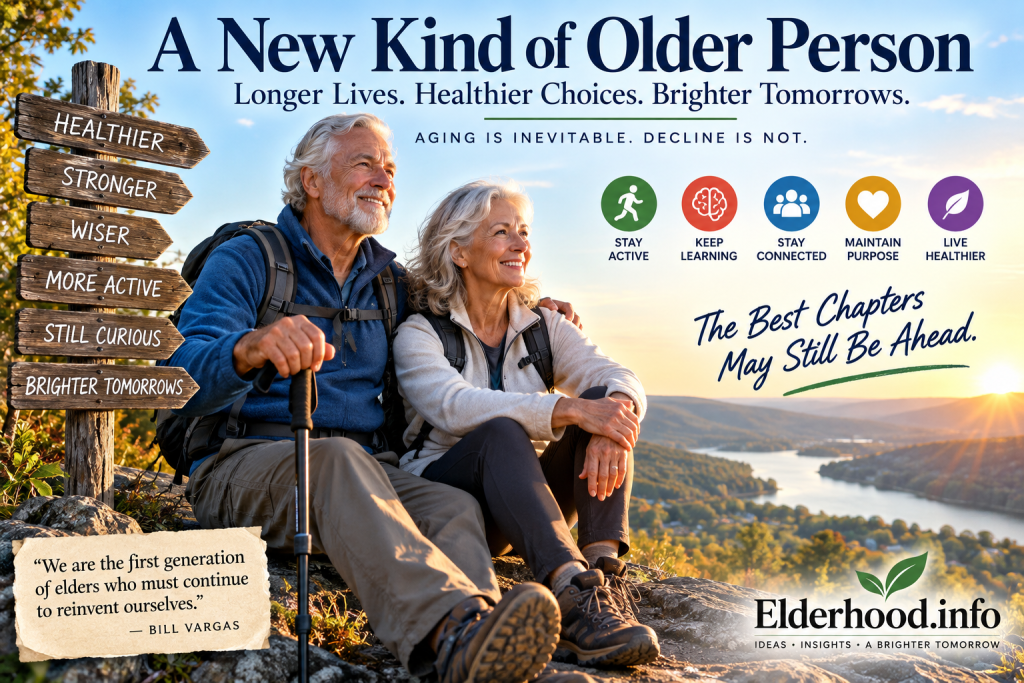
A new kind of older person.
Not someone pretending to be young.
Not someone desperately fighting the calendar.
But someone learning how to live differently in the decades after 60, 70, 80, and perhaps beyond.
That is what we mean by Elderhood.
The World Health Organization defines healthy aging around maintaining the functional ability that allows people to live well in older age. In other words, the goal is not eternal youth. It is remaining able to move, think, decide, connect, participate, and do the things that matter to you.
That is a very different goal from simply adding birthdays.
Our Parents’ Old Age Is Not Necessarily Our Old Age
Think about what being 80 looked like in 1950.
Healthcare was dramatically different.
Joint replacement was rare.
Heart surgery was far less advanced.
CT scans and MRI machines did not exist in ordinary medical practice.
There were no smartphones, video calls, GPS systems, wearable heart monitors, online banking, telemedicine, or artificial intelligence assistants.
Even cataract surgery, hearing technology, cancer treatment, and medications for chronic disease were far more limited.
The world an 80-year-old inhabits today is profoundly different.
That does not mean aging has suddenly become easy.
Bodies still wear down.
People still become ill.
Muscles weaken if we do not use them.
Friends and spouses die.
Some people experience dementia, disability, financial hardship, loneliness, or chronic pain.
We should never turn healthy aging into a fairy tale.
But we should also stop assuming the aging experience of previous generations defines what our experience must be.
As we discussed in You’re Not Getting Old — You’re Entering Elderhood, aging and decline are not exactly the same thing.
Aging happens automatically.
How we adapt to it does not.
The Real Goal Is Capability
The obsession with looking younger misses the larger point.
Suppose you could choose between two things:
Looking ten years younger.
Or being strong enough to carry groceries, walk independently, climb stairs, travel, think clearly, manage your own affairs, and get up from a chair without assistance.
Which one really matters?
That is why the idea of healthspan deserves more attention.
Lifespan is how long you live.
Healthspan is how long you remain reasonably functional and able to participate in your own life.
We explored that distinction in What’s the Difference Between Healthspan and Lifespan?.
A long life is valuable.
A long usable life is better.
Muscle May Be More Important Than We Realized
One of the biggest shifts in thinking about aging involves muscle.
For decades, exercise was often treated as something young people did to look good.
Older adults were frequently told to “take it easy.”
That advice has not aged particularly well.
The National Institute on Aging notes that regular physical activity can help older adults maintain function, improve balance, support sleep, reduce feelings of anxiety and depression, and potentially preserve aspects of cognitive function.
Muscle is not merely cosmetic.
Muscle helps you stand.
Walk.
Recover from illness.
Maintain balance.
Carry things.
Get off the floor.
Remain independent.
That is why the new elderhood mindset does not ask:
“Am I too old to exercise?”
It asks:
“What form of movement is appropriate for me now?”
That might be walking.
Resistance bands.
Chair stands.
Light weights.
Swimming.
Cycling.
Tai chi.
Balance work.
Or simply moving more often throughout the day.
The objective is not to become a bodybuilder at 82.
Though if that happens, congratulations.
The goal is to keep enough physical reserve to keep living your own life.
You can read more about this broader approach in The Science of Elderhood: 4 Pillars for Thriving in the Second Half of Life.
The New Older Person Is Still Learning
There was once an assumption that older people stopped learning.
That may have been partly because society stopped expecting them to.
But today, older adults can learn virtually anything from home.
Languages.
History.
Music.
Investing.
Nutrition.
Photography.
Computer skills.
Artificial intelligence.
YouTube alone contains more instruction than the largest library most of us had access to when we were young.
The new challenge is not lack of information.
It is figuring out which information deserves to be trusted.
That requires curiosity—and skepticism.
One of the most important abilities in Elderhood may therefore be the willingness to say:
“I don’t understand this yet. Show me.”
Those five words can keep a person engaged with a world that continues changing.
Technology Is Becoming an Independence Tool
Many older adults still think of technology as something designed primarily for younger people.
That is increasingly backward.
Technology may eventually matter even more to older adults because it can compensate for some of the limitations that come with age.
Consider what a smartphone already does.
It provides directions if you become lost.
It reminds you about appointments.
It can remind you to take medications.
It connects you to family by video.
It lets you order groceries.
It provides emergency communication.
It magnifies small print.
It reads text aloud.
It translates languages.
It lets you bank without driving.
And increasingly, artificial intelligence can help explain complicated subjects, organize information, draft questions for a physician, and help users prepare for decisions.
As we wrote in The Future Is Closer Than You Think, extraordinary technologies often become ordinary so quickly that we forget how revolutionary they are.
The goal is not to use every gadget.
Good grief, half of us still have devices in the house whose blinking lights we don’t understand.
The goal is to identify technology that increases independence.
Purpose Does Not Retire
Another outdated idea is that retirement should mean withdrawal.
Retirement can certainly mean leaving a job.
It does not have to mean leaving life.
One of the most important questions in later adulthood may be:
What gets me out of bed in the morning?
Purpose does not need to involve money.
It can mean volunteering.
Caring for family.
Mentoring.
Writing.
Gardening.
Making videos.
Learning music.
Helping a neighbor.
Serving on a community board.
Documenting family history.
Starting a business.
Teaching someone a skill.
The National Institute on Aging notes that meaningful social and productive activities may support well-being and can help people remain connected.
Purpose gives shape to time.
Without it, retirement can become an endless string of Saturdays.
And even Saturday gets boring if it lasts 20 years.
We explore this idea more deeply in Elderhood Is Not Decline: It Is the Art of Staying Fully Alive.
Social Connection Is Health Maintenance
One of the quiet dangers of aging is isolation.
Friends move.
Spouses die.
Children may live far away.
Driving may become more difficult.
Retirement removes the automatic social contact that work once provided.
Loneliness is not merely unpleasant.
The National Institute on Aging reports that loneliness and social isolation are associated with higher risks of health problems including depression, heart disease, and cognitive decline.
That means maintaining relationships deserves to be treated as part of health maintenance.
Call someone.
Join something.
Attend something.
Volunteer.
Take a class.
Walk with someone.
Have coffee.
Send the message.
Accept the invitation.
And sometimes—this may be the hardest part—make the first move.
Friendship after 70 may require more deliberate effort than friendship at 25.
Make the effort anyway.
Sleep Becomes More Important, Not Less
Many people wear poor sleep almost as a badge of honor.
“I only need five hours.”
Maybe.
But your brain may have a different opinion.
The National Institute on Aging notes that good sleep supports mental and physical health, quality of life, and safety, and recommends regular sleep schedules and other basic sleep habits for older adults.
Sleep affects mood.
Energy.
Thinking.
Appetite.
Physical recovery.
And willingness to exercise.
It is difficult to build a healthier life while running on fumes.
The new older person does not treat sleep as wasted time.
Sleep is maintenance.
Medicine Is Also Changing Faster Than Many Seniors Realize
One of the reasons to remain engaged with health is that medicine itself is changing.
Artificial intelligence is entering diagnosis.
New cancer therapies target specific genetic characteristics.
Drugs originally developed for one condition are being studied for others.
Researchers are exploring regenerative medicine.
Treatments for Alzheimer’s disease are changing.
Remote monitoring is becoming more sophisticated.
Genetic medicine is moving from science fiction toward ordinary clinical care for certain diseases.
No one should interpret this as a promise that aging will soon be cured.
It won’t.
At least we have no evidence of that.
But the next 10 or 20 years may produce medical options that today’s older adults could benefit from.
That is the logic behind our article Stay Healthy Until the Future Gets Here.
You do not have to predict the future.
You simply want to remain healthy enough to participate in it.
We Also Need Better Doctors for a Longer Life
Traditional medicine is very good at treating disease.
But aging often involves something broader.
Strength.
Mobility.
Nutrition.
Weight.
Sleep.
Medication management.
Hearing.
Vision.
Balance.
Cognition.
Emotional health.
A good aging strategy may therefore involve more than one physician.
Primary care.
Physical therapy.
Nutrition.
Cardiology.
Geriatrics.
Sleep medicine.
Pharmacy.
The right mix will differ for everyone.
Our article How Do I Find a Doctor Who Focuses on Living Longer and Healthier? discusses this in detail.
And there is an important warning.
The longevity field is attracting serious scientists—and serious salespeople.
Anyone promising to “reverse aging” deserves questioning.
Good medicine welcomes questions.
Miracle medicine usually wants your credit card.
The New Elderhood Requires Adaptation
Perhaps the central skill of aging well is adaptation.
You may not walk as fast.
Walk differently.
You may not lift as much.
Lift what you safely can.
Your hearing may weaken.
Use hearing technology.
Driving at night may become harder.
Change when you drive.
Your memory may require more support.
Use reminders and calendars.
Your social circle may shrink.
Build another one.
This is not surrender.
This is strategy.
Human beings have always survived by adapting.
Why would that suddenly stop at age 70?
Stop Measuring Yourself Against Your Younger Self
This may be one of the most liberating changes of all.
You do not need to be the person you were at 35.
You cannot be.
Neither can I.
And frankly, I would not want all of him back.
He made some questionable decisions.
The better question is:
How capable can I become at the age I am now?
That shifts aging away from loss and toward possibility.
Not unlimited possibility.
Realistic possibility.
You may improve strength.
Improve balance.
Improve nutrition.
Improve sleep.
Learn technology.
Repair relationships.
Make new friends.
Create something.
Teach something.
Travel somewhere.
Begin again.
The New Older Person Is Not Finished
This may ultimately be the defining difference.
The old model of aging treated older adulthood as an ending.
The new model treats it as another stage.
A stage with limitations, certainly.
But also one with knowledge.
Perspective.
Time.
Experience.
And increasingly, tools that previous generations never possessed.
As the World Health Organization emphasizes, healthy aging is not simply the absence of disease. It is about preserving the functional ability that allows well-being.
That may be the most useful way to think about growing older.
Not:
How many years do I have left?
But:
What can I still do with the years I have?
The Elderhood Takeaway
We are not our grandparents’ generation of older people.
We are aging with better medicine.
Better communication.
Better information.
Better mobility aids.
Better hearing technology.
Better surgical procedures.
Better access to learning.
Artificial intelligence.
Telemedicine.
Digital tools.
And a much deeper scientific understanding of how lifestyle affects health.
None of this guarantees an easy old age.
Nothing does.
But it gives us more tools.
And tools matter only if we use them.
So keep moving.
Keep learning.
Protect your strength.
Protect your sleep.
Stay connected.
Use technology instead of fearing it.
Question miracle claims.
Prepare for change.
Maintain purpose.
And above all, remain adaptable.
Aging is inevitable.
Becoming irrelevant is not.
We are not simply living longer.
We are learning how to become a new kind of older person.
And in many ways, we are only beginning to discover what that can mean.
For more ideas on living stronger, smarter, and more independently in later life, explore the Elderhood Framework, including Age Smarter, Live Smarter, Plan Smarter, and Prepare Smarter.