
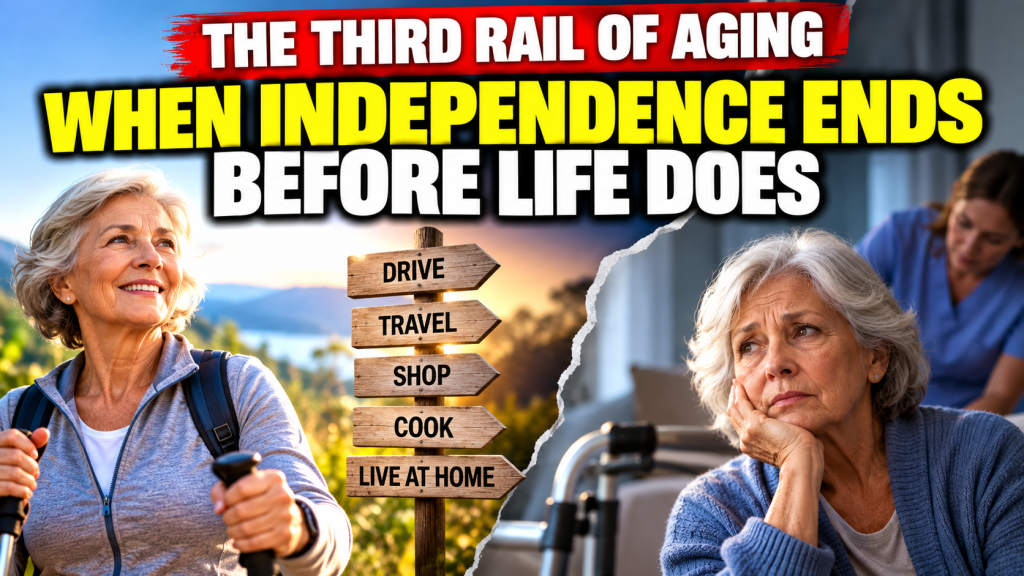
We talk a great deal about living longer.
We celebrate longevity.
We talk about retirement, Social Security, Medicare, travel, grandchildren, staying active, and enjoying the years we worked so hard to reach.
But there is another part of longevity that receives far less attention.
What happens when life continues, but independence does not?
That may be one of the most important questions facing an aging America.
And it is one of the subjects we often avoid until something happens.
A stroke.
A fall.
A serious illness.
A hospitalization.
A gradual decline in memory.
A loss of mobility.
Suddenly, a person who was living completely independently may need help with the most ordinary parts of daily life.
That is what I call the Third Rail of Aging.
It is the subject nobody particularly wants to touch.
But sooner or later, many families will have to.
Independence Can Disappear Very Quickly
Imagine someone who is living a perfectly normal life.
They get up in the morning.
Make coffee.
Take a shower.
Drive to the supermarket.
Pick up a prescription.
Pay the electric bill.
Meet a friend for lunch.
Come home and watch television.
Nothing remarkable.
And that is exactly the point.
Independence often feels so normal that we barely notice it.
Until it disappears.
One morning, that same person has a stroke.
Fortunately, they survive.
They go to the hospital.
Then rehabilitation.
Everyone is relieved.
But several weeks later, a new question appears.
Can this person safely return home?
Maybe they cannot walk without assistance.
Maybe they cannot use one arm.
Maybe they are confused about medications.
Maybe they cannot prepare meals.
Maybe they are frightened of falling.
Suddenly, the problem is no longer simply medical.
The problem is life.
Who helps them get dressed?
Who prepares food?
Who gets them to appointments?
Who makes sure medications are taken correctly?
Who pays the bills?
Who checks on them at night?
Who is there if something happens?
Those questions can be harder than the medical diagnosis itself.
We Have Planned for Retirement, But Not Always for Aging
For decades, financial planning has focused on one major question:
Will you have enough money to last throughout retirement?
That is certainly important.
But longevity is creating another question:
Will your independence last as long as your life?
And if it does not, what is the plan?
A person can have a house that is completely paid for, money in the bank, Social Security income, retirement accounts, and excellent health insurance.
Yet none of those automatically answers the question:
Who helps me if I cannot care for myself?
That is why aging requires more than financial planning.
It requires life planning.
Living Longer Changes the Equation
The Age of Longevity is one of the great accomplishments of modern civilization.
People are surviving illnesses that once would have ended their lives.
Heart disease is treated more effectively.
Cancer survival has improved for many types of cancer.
Joint replacements restore mobility.
Stroke rehabilitation can restore function.
Medicines control conditions that once shortened lives dramatically.
That is good news.
But living longer also means more people may spend part of those additional years needing some degree of assistance.
That is the side of longevity we do not celebrate in birthday cards.
We should not fear it.
But we should acknowledge it.
Planning does not mean expecting the worst.
Planning means preserving choices.
The Difference Between Medical Care and Daily Care
This distinction surprises many families.
Medical care and long term assistance are not the same thing.
A doctor can treat an illness.
A hospital can perform surgery.
A rehabilitation facility can help someone regain strength.
But eventually a person may no longer need intensive medical treatment.
They may simply need help living.
They may need assistance bathing.
Dressing.
Preparing food.
Using the bathroom safely.
Getting in and out of bed.
Remembering medications.
Shopping.
Cleaning.
Transportation.
Those needs may continue long after the immediate medical crisis has ended.
And that is often where families become confused.
They assume health insurance will take care of everything.
It may not.
The healthcare system is primarily designed to treat illness and injury.
It is not automatically designed to provide someone with daily personal assistance indefinitely.
Understanding that difference before a crisis can prevent a tremendous amount of confusion later.
“My Family Will Take Care of Me”
Maybe they will.
Families provide an enormous amount of care in America.
Spouses care for spouses.
Children care for parents.
Friends care for friends.
Neighbors help neighbors.
But there is a problem.
Families have changed.
Children often live hundreds or thousands of miles from their parents.
Adult children are working.
They may be raising children of their own.
They may have health problems.
A spouse may also be aging.
And increasing numbers of older adults live alone.
Having children does not automatically mean having caregivers.
A daughter in California may love her mother in New York deeply.
But love does not magically make her available Tuesday morning to help Mom take a shower.
That is not coldhearted.
It is simply reality.
And realities deserve plans.
Solo Aging Makes the Question Even Bigger
Some older adults have no spouse.
No children.
No close relatives nearby.
Others may technically have family, but no one who can realistically take responsibility during a crisis.
This growing group is sometimes described as solo agers.
Living alone does not mean being lonely.
Many people enjoy living independently.
They have friends, activities, hobbies, churches, clubs, neighbors, and full lives.
But living alone creates a special vulnerability.
If something happens, who notices?
Who receives the hospital call?
Who brings clothes to rehabilitation?
Who talks with the discharge planner?
Who checks the refrigerator?
Who feeds the dog?
Who brings someone home?
Who stays the first night?
These may sound like small details.
During a crisis, they become enormous.
Independence Usually Disappears in Pieces
Loss of independence is not always dramatic.
Sometimes it happens very slowly.
First, someone stops driving at night.
Then they stop using stairs.
Then grocery shopping becomes difficult.
Then cooking becomes inconvenient.
Then medication schedules become confusing.
Then bathing becomes risky.
Then managing bills becomes harder.
Each change seems small.
Families adjust.
Neighbors help.
Someone brings groceries.
Someone else drives to appointments.
Eventually, however, a life that once ran smoothly may be held together by a collection of favors and emergency arrangements.
That is why planning early matters.
Not because everyone will lose independence.
But because nobody knows who will.
What Does Independence Really Mean?
We often define independence as doing everything ourselves.
Maybe that definition needs to change.
Independence may not mean never needing help.
It may mean being able to decide how you receive help.
Choosing where you live.
Choosing who assists you.
Choosing your doctors.
Choosing how your money is handled.
Choosing who speaks for you.
Choosing what happens if you can no longer make decisions.
That is still independence.
In fact, asking for the right help at the right time may preserve independence longer than refusing help altogether.
The real loss of control often occurs when decisions must suddenly be made by other people because no plan exists.
Five Questions Every Older Adult Should Answer
You do not need a hundred page aging plan.
Start with five questions.
1. Where would I want to live if I needed help?
Would you want to remain home?
Move closer to family?
Choose assisted living?
Move to a smaller residence?
There is no correct answer.
But thinking about it now is better than deciding from a hospital bed.
2. Who would actually help me?
Not theoretically.
Actually.
Who would answer the phone?
Who could come to your house?
Who could take you to an appointment?
Who could manage paperwork?
Talk to those people.
Do not simply assume.
3. How would I pay for help?
Care costs money.
That may include savings, income, insurance, home equity, family assistance, public programs, or a combination.
The important thing is understanding the possibilities before you need them.
4. Who makes decisions if I cannot?
Who can speak with doctors?
Who can handle finances?
Who understands your wishes?
Legal documents such as powers of attorney, healthcare proxies, and advance directives can be enormously important.
Creating the documents is only half the job.
Someone must also know they exist and where they are.
5. What matters most to me?
Maybe remaining in your own home matters most.
Maybe staying near family.
Maybe preserving financial security.
Maybe avoiding burdening your children.
Maybe keeping your pets.
Maybe remaining near your church or community.
Those values should guide the plan.
Your Home May Need a Retirement Plan Too
Many people say:
“I am staying in this house forever.”
Maybe.
But ask whether the house can adapt if your body changes.
Are there stairs?
Can you reach the bedroom without climbing them?
Is there a full bathroom on the main floor?
Could a walker fit through the doors?
Could grab bars be installed?
Could groceries be delivered?
Could caregivers easily reach you?
Is transportation available if you stop driving?
Aging in place can be wonderful.
But successful aging in place usually requires planning.
Otherwise, aging in place can gradually become being trapped in place.
Those are very different things.
Create a Life File
One of the simplest things anyone can do is create a basic emergency file.
It should contain important information someone would need if you suddenly could not provide it.
Your doctors.
Medications.
Insurance.
Emergency contacts.
Legal documents.
Financial contacts.
Pharmacy.
Important accounts.
Pet information.
Home information.
Instructions for people you trust.
Nothing elaborate is required.
The goal is simple.
If you were unexpectedly hospitalized tomorrow, someone should be able to find the important information without searching through twenty drawers and forty years of paperwork.
That single folder could save your family enormous stress.
Have the Conversation Before the Crisis
Perhaps the most important step is also the simplest.
Talk.
Talk with your spouse.
Talk with your children.
Talk with close friends.
Talk with the people you expect to help you.
You may discover that what you assumed is very different from what they assumed.
That conversation may feel uncomfortable.
Have it anyway.
You are not predicting disaster.
You are planning for possibilities.
We insure homes we hope never burn.
We wear seat belts hoping never to crash.
We create wills hoping they will not be needed for many years.
Preparing for the possibility of needing help is no different.
The Goal Is Not Fear
The Third Rail of Aging is not about frightening older adults.
Quite the opposite.
Fear grows when we feel powerless.
Planning creates options.
The goal is to recognize that longevity has changed aging.
We may live longer.
We may remain active longer.
We may work longer.
We may travel longer.
We may enjoy grandchildren and even great grandchildren.
That is something worth celebrating.
But longer lives require better planning.
The question should not only be:
How long might I live?
We should also ask:
How do I want to live during those years?
And perhaps most importantly:
What happens if I need help?
The Conversation We Need to Have
For too long, aging discussions have focused almost entirely on retirement money and medical insurance.
Those things matter.
But they do not tell the whole story.
Independence is one of the most valuable assets we possess.
And unlike the balance in a retirement account, we rarely measure it until something happens.
The goal should not be to pretend that independence will last forever.
The goal should be to protect it for as long as possible and create a plan for what happens if it changes.
Because the worst time to begin planning for aging is during a crisis.
And the best time?
Probably while you are still convinced you do not need a plan.
That is The Third Rail of Aging.
The conversations nobody wants to have.
The questions families often postpone.
And the realities that become much easier to face when we prepare for them together.
At Elderhood.info, our goal is not to tell people how to grow old.
It is to help people understand the changing world of aging so they can make their own decisions with more knowledge, more confidence, and more control.
Because aging is inevitable.
But being blindsided does not have to be.