
There is an old idea about aging that goes something like this:
You get older, you settle into your ways, and eventually you stop changing.
That may sound harmless.
It is not.
One of the biggest risks of growing older is not simply losing strength, speed, or energy.
It is losing flexibility in the way we think.
The world changes.
Our bodies change.
Technology changes.
Relationships change.
Our neighborhoods change.
The people around us change.
And sooner or later, life asks every one of us the same question:
Can you adapt?
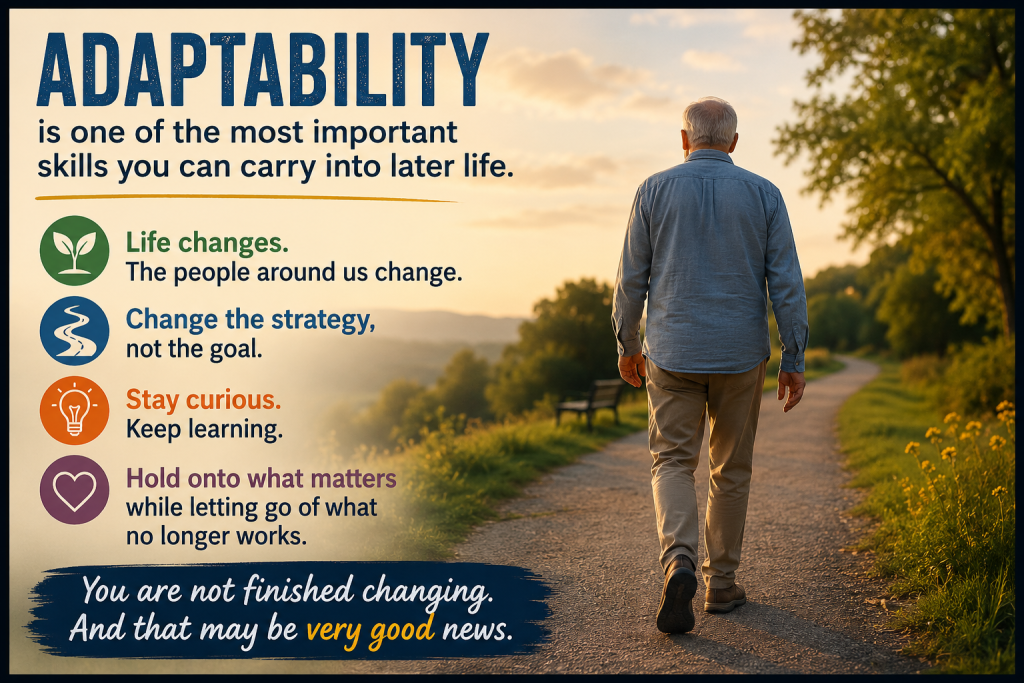
At Elderhood, we believe adaptability may be one of the most important skills a person can carry into later life.
Because aging is inevitable.
But becoming rigid is optional.
Life Does Not Ask Permission Before It Changes
Most of us like predictability.
We like our routines.
Our favorite restaurant.
Our doctor.
Our grocery store.
Our chair.
Our television programs.
The same route to the same places.
There is comfort in familiarity.
Nothing wrong with that.
The trouble begins when comfort turns into dependence.
The restaurant closes.
The doctor retires.
The neighborhood changes.
The spouse who handled the finances dies.
Driving at night becomes difficult.
A new phone replaces the one we finally figured out.
The bank wants us to use an app.
Suddenly we are standing there thinking:
“Why does everything have to change?”
Fair question.
But the world has never promised to stand still for us.
The people who seem to age best are often not the people who avoid change.
They are the people who learn how to respond to it.
“I’ve Always Done It This Way” Can Become a Trap
There is a sentence that becomes increasingly dangerous as we grow older:
“I’ve always done it this way.”
Sometimes that means experience.
Experience is valuable.
But sometimes it means we have stopped examining whether the old way still works.
Imagine somebody saying:
“I have been using the same road map since 1978.”
You would probably suggest that Interstate 95 has changed a little since then.
Yet we sometimes do exactly that with our lives.
We use old mental maps in a world that has moved on.
The way we communicated 30 years ago may no longer work.
The way we managed money may need updating.
The way we maintained friendships may need updating.
Even the way we think about retirement may need updating.
Retirement once suggested withdrawal.
Today, for many older adults, it can mean reinvention.
You may work differently.
Travel differently.
Learn differently.
Love differently.
Live differently.
That is not failure.
That is adaptation.
Adaptability Does Not Mean Giving Up Who You Are
Some people hear the word “adapt” and think it means surrender.
It does not.
Adaptability means holding onto what matters while changing what no longer works.
You can keep your values while learning a new technology.
You can preserve traditions while developing new routines.
You can remain independent while accepting help in areas where help makes sense.
That last one is especially important.
Many older adults confuse independence with doing absolutely everything themselves.
But independence can also mean making intelligent decisions that allow you to remain in control.
Using a walking stick when balance becomes uncertain is not surrendering independence.
It may preserve it.
Hiring someone to handle a dangerous home repair is not weakness.
It may keep you out of the emergency room.
Learning to order groceries online does not mean you have become incapable.
It means you have another option.
There is enormous strength in knowing when to change the method without abandoning the goal.
Technology Is a Perfect Example
Technology probably causes more muttering among seniors than almost anything else.
Just when we learn one password, they want another.
Just when we understand the phone, it updates itself overnight and moves everything around.
And now every company seems to want an app.
Sometimes I think there is a secret meeting somewhere where young engineers ask:
“How can we move this button just far enough to confuse Bill?”
But here is the reality.
Technology is increasingly how the modern world communicates.
Banking.
Healthcare.
Transportation.
Travel.
Entertainment.
Government services.
Family communication.
We do not have to love every piece of technology.
We certainly do not have to use all of it.
But refusing to learn any of it can gradually shrink our world.
That is the part worth paying attention to.
The goal is not to become a computer expert.
The goal is to remain capable.
Learn one thing at a time.
Ask questions.
Write down the steps.
Use larger text.
Use voice commands.
Ask your phone to remind you about appointments.
Video call your family.
Use technology as a tool.
Do not let it become a wall.
Physical Adaptation Matters Too
Our bodies also change.
That does not mean we should stop moving.
It means the way we move may need to change.
Maybe you once ran five miles.
Now you walk two.
Walk them.
Maybe tennis became difficult on your knees.
Try swimming.
Cycling.
Resistance training.
Dancing.
Chair exercises.
Walking with friends.
The mistake is believing that because you cannot exercise exactly the way you did at 40, exercise is finished.
That is all-or-nothing thinking.
And all-or-nothing thinking is a lousy retirement plan.
The body often responds very well to reasonable activity throughout life.
The objective is not to prove that you are still 35.
You are not.
Neither am I.
The objective is to keep using the abilities you have.
Because the body has a very simple rule:
Use it, or it starts sending out eviction notices.
Social Life Requires Adaptation
Friendship changes with age too.
People retire.
Move away.
Get sick.
Become caregivers.
Lose spouses.
Some friendships simply fade.
That can leave older adults waiting for social life to return to what it used to be.
It may not.
Sometimes we have to build something new.
That can feel awkward.
Especially after decades of having relationships formed automatically through work, children, neighbors, and family obligations.
Later life may require more deliberate effort.
Join something.
Take a class.
Volunteer.
Dance.
Attend community events.
Call somebody instead of waiting for them to call.
Invite somebody to lunch.
Try something that makes you slightly uncomfortable.
You do not need 100 friends.
You need connection.
And connection rarely knocks on the front door and says:
“Hello, I noticed you were lonely.”
We usually have to participate in creating it.
Adaptation After Loss
Some changes are far more serious than learning a new phone.
Loss may be the ultimate test of adaptability.
A spouse dies.
A close friend dies.
A career ends.
Health changes.
We lose roles that once defined us.
That can leave a person asking:
“Who am I now?”
There is no quick answer.
Grief deserves time.
But there is an important difference between remembering the life we had and refusing to build any life beyond it.
We can carry the people we loved with us while still moving forward.
The next chapter does not erase the previous one.
A book would be rather disappointing if every chapter after chapter ten simply repeated chapter ten.
Life works the same way.
Curiosity Is the Fuel of Adaptability
If I could prescribe one attitude for aging, it might be curiosity.
Curious people keep asking:
“What is that?”
“How does that work?”
“Could I learn this?”
“What happens if I try?”
Curiosity keeps the world larger.
It also protects us from one of the great enemies of later life:
The belief that we have already seen everything worth seeing.
We have not.
There are books you have not read.
People you have not met.
Foods you have not tasted.
Places you have not visited.
Ideas you have not considered.
Skills you have not learned.
And versions of yourself you have not met yet.
That last one may be the most interesting.
You Are Allowed to Change Your Mind
Another benefit of age should be permission to reconsider things.
You are allowed to change your mind.
About where you live.
About how you spend your money.
About what relationships you want.
About what really matters.
You may discover that something you chased for 40 years no longer seems particularly important.
Good.
That is not inconsistency.
That may be wisdom.
The person you were at 30 made decisions with the information, responsibilities, fears, and ambitions you had at 30.
You are not required to remain loyal to every decision that person made.
You are allowed to update yourself.
Even your computer gets an update once in a while.
Surely you deserve one.
Small Changes Are Often Enough
Adaptability does not require turning your entire life upside down.
Sometimes it means small adjustments.
Move your bedroom downstairs.
Add better lighting.
Use hearing aids.
Change your exercise routine.
Ask somebody to teach you how to use video calling.
Try a different grocery store.
Join one activity.
Take one trip.
Make one new friend.
Change one habit.
The remarkable thing about small changes is that they often create options.
And options are one of the foundations of independence.
The Future Belongs to People Willing to Adjust
We are living longer than previous generations.
That means many of us may spend 20 or 30 years in what we casually call “old age.”
That is too much life to spend looking backward.
We need a different model.
A model where older people continue to learn.
Continue to contribute.
Continue to experiment.
Continue to change.
Continue to become.
That may be one of the defining ideas of modern elderhood.
We are not simply extending old age.
We are creating a new stage of life.
And nobody has handed us the instruction manual.
So we will have to write some of it ourselves.
The Elderhood Takeaway
You do not have to chase every trend.
You do not have to become somebody else.
And you certainly do not have to pretend that aging brings no limitations.
It does.
But limitations are not the whole story.
The larger story is adaptation.
When circumstances change, change the strategy.
When the body changes, change the activity.
When relationships change, build new connections.
When technology changes, learn enough to remain involved.
When life closes one door, do not spend the next ten years standing in the hallway staring at it.
Look around.
There may be another door you never noticed.
The older we become, the more important adaptability becomes.
Because chronological age tells us how long we have been here.
It does not tell us what we are still capable of becoming.
At Elderhood, we believe the future belongs to older adults who remain curious, engaged, and willing to adapt.
You are not finished changing.
And that may be very good news.