There comes a time in life when many people begin to believe the story is already written.
The career is mostly behind them.
The children are grown.
The house may be quieter.
The mirror is less forgiving.
The knees may have started filing complaints with management.
And somewhere along the way, a dangerous little thought can creep in:
“Maybe the best part is over.”
That thought may seem harmless. It may even feel realistic. But it can quietly become one of the most damaging beliefs a person carries into elderhood.
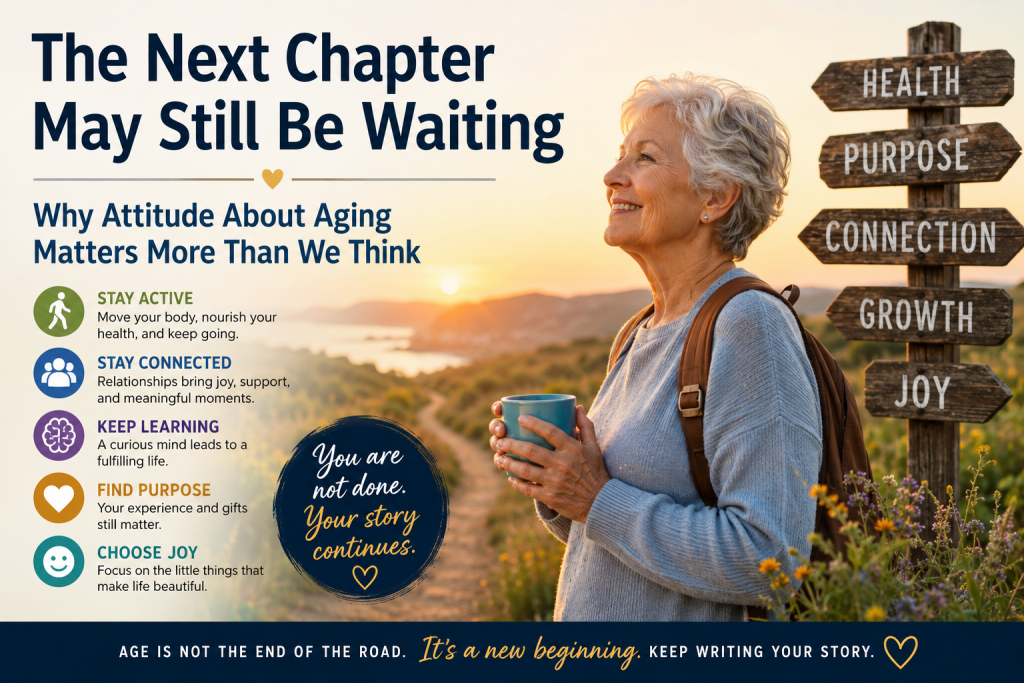
Because the truth is this: your next chapter may still be waiting.
Not the same chapter you lived at 25. Not the same chapter you lived at 45. Not the chapter where you ran around trying to prove yourself, raise children, build a career, pay the mortgage, and keep the washing machine from sounding like a helicopter taking off.
This is a different chapter.
But different does not mean worthless.
Different does not mean finished.
Different does not mean invisible.
And it certainly does not mean you should sit down, surrender your curiosity, and act like life handed you a rocking chair and a resignation letter.
Aging is real. No honest person should pretend otherwise. Bodies change. Energy changes. Responsibilities change. Losses happen. Health challenges appear. Friends move away or pass away. Some dreams need to be adjusted. Some doors close.
But here is the part we do not talk about enough:
Some doors also open.
And often, the person most likely to keep those doors closed is not the doctor, the government, the adult children, the insurance company, or society.
Sometimes it is us.
Sometimes it is the attitude we carry into aging.
Aging Is Not Just a Medical Event
We often talk about aging as if it is only a physical process.
Blood pressure. Cholesterol. Joint pain. Memory. Medication. Lab work. Appointments. More appointments. And then appointments to discuss the appointments.
All of that matters. Health matters. Medical care matters. Prevention matters. Exercise matters. Nutrition matters. Sleep matters. Staying on top of your Medicare plan matters, too, because nobody wants to discover a coverage surprise after the bill shows up wearing tap shoes.
But aging is not only medical.
Aging is also emotional.
Aging is psychological.
Aging is social.
Aging is spiritual.
Aging is personal.
How we think about aging affects how we behave.
If a person believes, “I’m too old to change,” they may stop trying.
If a person believes, “There’s no point in exercising now,” they may sit more.
If a person believes, “Nobody wants to hear from me,” they may withdraw.
If a person believes, “Technology is not for people my age,” they may avoid tools that could make life easier.
If a person believes, “My useful years are over,” they may stop looking for purpose.
And once those beliefs become habits, they can shape the rest of life.
That is why attitude about aging is not some fluffy motivational poster you hang above the toaster.
Attitude becomes behavior.
Behavior becomes routine.
Routine becomes health.
Health becomes independence.
Independence becomes quality of life.
And quality of life is not a small thing.
At 70, 75, 80, or 85, quality of life may be the whole ballgame.
The Quiet Danger of “I’m Too Old”
Few phrases do more damage than “I’m too old.”
Now, let’s be fair. Sometimes “I’m too old” is common sense.
You may be too old to join the Olympic gymnastics team. You may be too old to help your grandson move a piano up three flights of stairs. You may be too old to eat chili at 11 p.m. and expect a peaceful night. Some lessons come with age, and one of them is knowing when not to be foolish.
But many times, “I’m too old” is not wisdom.
It is fear wearing a sensible hat.
People say:
“I’m too old to learn the computer.”
“I’m too old to start exercising.”
“I’m too old to make new friends.”
“I’m too old to date.”
“I’m too old to travel.”
“I’m too old to change how I eat.”
“I’m too old to improve my health.”
“I’m too old to start over.”
And once that phrase becomes automatic, the world gets smaller.
Not all at once. Little by little.
First, you stop going places.
Then you stop calling people.
Then you stop trying new things.
Then you stop caring how you look.
Then you stop planning.
Then you stop imagining.
And one day, you look around and realize you did not get old overnight.
You surrendered in installments.
That is the danger.
Aging will take some things from us. That is unavoidable.
But we must be careful not to hand it things it did not ask for.
Do not hand aging your curiosity.
Do not hand aging your dignity.
Do not hand aging your sense of humor.
Do not hand aging your willingness to participate.
Do not hand aging your right to still be surprised by life.
The Next Chapter Does Not Have to Look Like the Last Chapter
One reason people struggle with aging is that they compare the present to the past.
They say, “I can’t do what I used to do.”
That may be true.
But the better question is:
“What can I do now?”
This is where many people get stuck. They think if they cannot do something the way they did it at 40, then it is not worth doing at all.
That is nonsense.
If you used to run and now you walk, walk.
If you used to travel across Europe and now you take shorter trips, take the shorter trip.
If you used to lift heavy weights and now you use resistance bands, use the bands.
If you used to host twenty people for dinner and now you meet two friends for lunch, meet the two friends.
If you used to dance all night and now you dance for three songs, dance for three songs.
Life does not have to be performed at the same speed to still have value.
A slower life can still be a rich life.
A smaller circle can still be a meaningful circle.
A quieter season can still have music in it.
The next chapter may not be about proving anything.
It may be about noticing things you were too busy to see before.
It may be about wisdom.
It may be about connection.
It may be about health.
It may be about finally taking care of yourself instead of running yourself into the ground for everyone else.
It may be about becoming more honest.
It may be about giving something back.
It may be about learning that your value was never only in your job title, your income, your physical strength, or how many people needed you.
That is a hard lesson for many older adults, especially men who built their identity around work.
When the job ends, the business card goes away. The phone stops ringing. Nobody asks for your opinion as often. And suddenly, a person can feel like a retired appliance.
Still in the house, but nobody is sure what to do with it.
That is when attitude matters.
Because retirement is not just leaving work.
It is rebuilding identity.
And that takes effort.
Attitude Is Not Denial
Let’s get something straight.
Having a better attitude about aging does not mean pretending everything is wonderful.
That kind of fake positivity is exhausting. Nobody needs to walk around saying, “My arthritis is a blessing,” while their knee sounds like popcorn every time they stand up.
Pain is real.
Grief is real.
Money worries are real.
Loneliness is real.
Health challenges are real.
Age discrimination is real.
A good attitude does not deny reality.
A good attitude asks, “What can I still do with the reality I have?”
That is the difference.
Denial says, “Nothing is wrong.”
A healthy attitude says, “Something is wrong, but I am not finished.”
Denial says, “I am just as young as I used to be.”
A healthy attitude says, “I am not young, but I still have choices.”
Denial says, “I do not need help.”
A healthy attitude says, “I will accept help where I need it, but I will not give up my independence unnecessarily.”
Denial says, “Everything will magically work out.”
A healthy attitude says, “I will do my part.”
That is not fantasy. That is responsibility.
And frankly, it is also common sense.
If the roof leaks, you do not fix it by singing inspirational songs to the shingles. You call someone, make a plan, and deal with it.
Aging is the same.
You do not beat aging by pretending it does not exist.
You age better by responding to it intelligently.
The Stories We Tell Ourselves Matter
Every person carries an inner story.
Some people tell themselves:
“I am declining.”
“I am a burden.”
“I am invisible.”
“I am too old.”
“I am not needed anymore.”
Others tell themselves:
“I am changing.”
“I am adjusting.”
“I still matter.”
“I still have something to contribute.”
“I can learn what I need to learn.”
“I can take better care of myself.”
These stories influence daily decisions.
The person who believes they are declining may stop moving.
The person who believes they are adjusting may look for a safer way to move.
The person who believes they are a burden may stop asking for connection.
The person who believes they still matter may make the phone call.
The person who believes they are too old may never try.
The person who believes they can learn may take the class, watch the video, ask the question, or try the new device.
Same age. Different story.
And that story can change the direction of life.
This does not mean attitude cures disease. It does not.
But attitude often determines whether we participate in our own health.
And participation matters.
You can have the best doctor in town, but the doctor cannot walk for you.
You can have the best nutrition advice, but the vegetables will not jump into your mouth by themselves.
You can have the best physical therapy plan, but the exercises will not do themselves while you watch television.
You can have the best Medicare plan, but you still have to read the notices, ask questions, and understand your choices.
Aging well is not passive.
It is participation.
The First Generation With This Much Information
One of the most important things about aging today is that older adults now have access to information previous generations never had.
Think about it.
Many of our parents and grandparents did not have the same knowledge about nutrition, exercise, smoking, sleep, stress, blood pressure, cholesterol, brain health, social connection, or preventive care.
They did not have YouTube videos explaining exercises for balance.
They did not have wearable devices tracking steps and heart rate.
They did not have easy access to medical research summaries.
They did not have online communities.
They did not have telehealth.
They did not have the same treatments, screenings, medications, or health tools available today.
Now, does that mean everything online is true? Absolutely not.
The internet is a library, a circus, and a pickpocket convention all in one building. You need judgment.
But the point remains: we know more now.
We know that movement matters.
We know that muscle matters.
We know that protein matters.
We know that sleep matters.
We know that loneliness can harm health.
We know that purpose matters.
We know that hearing loss can affect social connection.
We know that nutrition can affect energy and brain health.
We know that chronic inflammation, inactivity, poor diet, and isolation are not harmless.
We know enough to make better choices.
That does not mean perfect choices.
Perfect is not required.
Better is enough.
This is where attitude becomes powerful.
A person with a defeated attitude hears new information and says, “Too late for me.”
A person with a growth attitude hears new information and says, “What small change can I make?”
That one question can change everything.
You Are Not Too Old to Improve
Many people secretly believe improvement belongs to the young.
Young people go to gyms.
Young people learn technology.
Young people start projects.
Young people reinvent themselves.
Young people make plans.
That is a terrible way to think.
Improvement is not reserved for the young.
Older adults can build strength.
Older adults can improve balance.
Older adults can learn new skills.
Older adults can change eating habits.
Older adults can make new friends.
Older adults can start creative projects.
Older adults can become more confident with technology.
Older adults can find new purpose.
Will progress look different? Yes.
Will it take patience? Yes.
Will the body complain? Probably. The body likes to complain. Sometimes it complains just because you bent down to pick up a sock.
But progress is still possible.
The goal is not to become 25 again.
The goal is to become better than you were yesterday.
That is a much more useful goal.
Can you walk five more minutes?
Can you add one healthier meal?
Can you call one person?
Can you learn one new app?
Can you stretch in the morning?
Can you schedule the appointment you have been avoiding?
Can you clean up one room?
Can you get dressed instead of staying in old clothes all day?
Can you step outside for sunlight?
Can you ask for help without feeling ashamed?
These are not dramatic actions.
But life often changes through small actions repeated over time.
Nobody claps when you choose oatmeal instead of a doughnut.
Nobody throws a parade when you walk around the block.
Nobody gives you a trophy for going to bed on time.
But your body notices.
Your mind notices.
Your future notices.
Purpose Is Not Optional
One of the biggest dangers in later life is not just illness.
It is emptiness.
Many people spend decades being needed. They raise children. They work. They solve problems. They manage households. They care for spouses, parents, customers, employees, neighbors, and everyone else who shows up needing something.
Then one day, the noise quiets down.
At first, that can feel like relief.
No alarm clock.
No boss.
No school lunches.
No commute.
No deadlines.
Wonderful.
For about three weeks.
Then the question arrives:
“What now?”
That question is serious.
Human beings need purpose. Not necessarily a grand purpose. Not everyone needs to start a foundation, write a book, or climb a mountain.
Purpose can be simple.
Helping a neighbor.
Volunteering.
Mentoring someone younger.
Taking care of a garden.
Learning music.
Joining a walking group.
Sharing family history.
Creating videos.
Teaching a skill.
Helping at church, a senior center, a library, or a community group.
Being the person who calls others and checks in.
Purpose gives structure to time.
Without purpose, days can melt into each other.
Monday feels like Thursday. Thursday feels like Saturday. Saturday feels like the waiting room at a tire shop.
Purpose gives you a reason to get dressed.
That matters.
Do not underestimate the power of having something to do and someone expecting you.
The Problem With Society’s View of Aging
Part of the problem is that society often sends older people terrible messages.
It worships youth.
It sells anti-aging products.
It jokes about being “over the hill.”
It treats older adults as slow, confused, cranky, helpless, or out of touch.
It tells people to retire, then acts surprised when they feel useless.
It tells seniors to stay healthy, then makes healthcare confusing.
It tells older adults to use technology, then designs half the technology like it was built by raccoons with engineering degrees.
And after all that, people wonder why aging feels intimidating.
But society’s attitude does not have to become your attitude.
You do not have to accept every label placed on you.
You do not have to disappear because advertisers prefer younger faces.
You do not have to become a stereotype.
You can be older and curious.
Older and active.
Older and funny.
Older and stylish.
Older and useful.
Older and romantic.
Older and creative.
Older and still planning.
Older and still learning.
Older and still very much alive.
The world may underestimate older adults.
Do not help it.
Staying Engaged Is a Health Strategy
Engagement is not just entertainment.
It is a health strategy.
When you stay engaged with life, you give your brain, body, and emotions something to work with.
Social connection challenges your mind.
Movement supports your body.
Learning stimulates your brain.
Creative activity gives emotional expression.
Routine gives structure.
Purpose gives meaning.
Laughter gives relief.
These things are not luxuries.
They are part of healthy aging.
A person who withdraws from life may become weaker, lonelier, more anxious, and less confident. Then those feelings make it even harder to rejoin life.
That cycle is dangerous.
The way out is not usually one giant heroic move.
It is one small act of re-entry.
Take the class.
Call the friend.
Walk into the senior center.
Go to the library.
Volunteer one hour.
Ask your doctor about physical therapy.
Join the exercise group.
Learn the phone feature.
Visit the museum.
Go dancing, even if your knees negotiate the terms.
You do not need to become a social butterfly.
You just need to avoid becoming a houseplant.
Confidence Can Be Rebuilt
Many older adults lose confidence quietly.
A fall can do it.
A diagnosis can do it.
The death of a spouse can do it.
Retirement can do it.
A scam attempt can do it.
A confusing piece of technology can do it.
A family member saying, “Don’t worry, I’ll handle it,” can do it.
Sometimes help is loving. But too much help can shrink a person.
When others take over everything, the older adult may slowly believe, “Maybe I can’t do anything anymore.”
That is why confidence must be protected.
Confidence comes from doing.
Not from speeches.
Not from people saying, “You can do it.”
Confidence comes from proving to yourself that you can still take action.
Even small action.
You figured out the new remote control.
You made the appointment.
You walked farther than last week.
You cooked a healthy meal.
You asked a good question at the doctor’s office.
You compared your Medicare plan.
You cleaned out the closet.
You learned how to send the photo.
You went out even though you did not feel like it.
That is how confidence comes back.
One completed action at a time.
Aging can make people feel like life is happening to them.
Action reminds them they still have a vote.
The Body Listens to the Mind
We should be careful here. The mind does not control everything. Nobody should be told they got sick because they had the wrong attitude. That is cruel and foolish.
But the mind does influence behavior, and behavior influences health.
If you believe movement is pointless, you are less likely to move.
If you believe healthy food cannot help, you are less likely to improve your eating.
If you believe you are doomed to loneliness, you are less likely to reach out.
If you believe your future matters, you are more likely to protect it.
That is the key.
Attitude matters because it changes what we do next.
It changes whether we try.
It changes whether we ask.
It changes whether we continue.
It changes whether we recover after setbacks.
In later life, setbacks will happen.
The question is not whether you will face difficulty.
The question is what difficulty does to your identity.
Do you say, “This is proof I am finished”?
Or do you say, “This is a problem I need to respond to”?
That difference is enormous.
One attitude closes the door.
The other looks for the handle.
A Better Attitude Starts With Better Language
The words we use about aging matter.
Some words weaken us.
“I’m falling apart.”
“I’m useless.”
“I’m just old.”
“I can’t do anything.”
“My life is over.”
Now, nobody is saying you must talk like a motivational calendar. You do not have to wake up every morning shouting, “Today I shall conquer elderhood!” Your neighbors may call someone.
But you can become more careful with the words you repeat.
Try replacing:
“I’m too old” with “I may need a different way.”
“I can’t” with “I need help learning.”
“It’s over” with “This part is changing.”
“I’m useless” with “I need a new role.”
“I’m falling apart” with “I need to take better care of myself.”
“I don’t matter” with “I need connection.”
This is not word games.
This is mental direction.
The brain listens to repeated messages.
If you keep telling yourself you are done, eventually you may act like it.
So do not lie to yourself.
But do not insult yourself either.
The Next Chapter Needs a Plan
A better attitude is powerful, but attitude without action is just a nice thought taking a nap.
The next chapter needs a plan.
Not a complicated plan. Not a 200-page binder with charts and tabs, unless you enjoy that sort of thing. Some people do. They usually own label makers.
A practical aging plan should include a few basic areas.
1. Physical Health
Ask yourself:
How can I move safely and regularly?
How can I maintain strength?
How can I improve balance?
What appointments am I avoiding?
Am I sleeping well?
Am I eating enough protein and real food?
Am I drinking water?
Do I understand my medications?
You do not need perfection.
You need consistency.
2. Mental Stimulation
Ask:
What am I learning?
What am I reading?
What puzzles, hobbies, classes, or conversations challenge me?
Am I using my brain or just feeding it television leftovers?
The brain likes a job.
Give it one.
3. Social Connection
Ask:
Who do I call?
Who calls me?
Where do I belong?
Where could I show up regularly?
Who would notice if I disappeared for a week?
That last question matters.
If the answer is “nobody,” that is not a reason for shame.
It is a reason to build connection.
4. Purpose
Ask:
Who benefits from my presence?
What do I still care about?
What problem can I help solve?
What experience can I share?
What do I want my days to mean?
Purpose does not have to impress anyone.
It just has to matter to you.
5. Financial and Practical Reality
Ask:
Do I understand my income and expenses?
Have I reviewed my insurance?
Do I know what my Medicare plan covers?
Have I prepared important documents?
Do my loved ones know my wishes?
Avoiding reality does not make it kinder.
Planning reduces fear.
6. Joy
Ask:
What still makes me smile?
What music do I love?
What places do I enjoy?
What food, hobbies, people, pets, or routines bring pleasure?
What did I stop doing that I might start again in a new way?
Joy is not childish.
Joy is fuel.
Do Not Confuse Acceptance With Surrender
Acceptance is important.
At some point, we all have to accept that life changes. Bodies change. Families change. Energy changes. The world changes.
But acceptance is not surrender.
Acceptance says, “This is where I am.”
Surrender says, “Nothing can be done.”
Those are not the same.
If you need a cane, use the cane.
That is acceptance.
If you stop going anywhere because you need a cane, that may be surrender.
If you need hearing aids, get help.
That is acceptance.
If you stop talking to people because hearing is harder, that may be surrender.
If you need to change your diet, change it.
That is acceptance.
If you say, “I ate badly for 40 years, so why bother now?” that is surrender.
If you need help with technology, ask.
That is acceptance.
If you decide the modern world is impossible and refuse to learn anything, that may be surrender.
Acceptance helps you adapt.
Surrender makes your world smaller.
Choose adaptation.
The Power of Looking Forward
One of the most underrated forces in healthy aging is having something to look forward to.
A visit.
A project.
A trip.
A class.
A lunch.
A holiday.
A garden.
A video.
A goal.
A book.
A family event.
A new recipe.
A better health number.
A future version of yourself you still want to meet.
Looking forward pulls you into life.
Without it, people can drift.
This is why retirement should not be only about rest.
Rest is good. But endless rest becomes emptiness.
Human beings need anticipation.
You need something on the calendar besides doctor appointments.
If the only future events you have are medical, life can start to feel like one long waiting room.
Put better things on the calendar.
Even small things.
Coffee with a friend.
A walk in the park.
A movie.
A haircut.
A dance class.
A volunteer shift.
A phone call.
A day trip.
A museum visit.
Something.
Life feels different when tomorrow has a reason.
Aging With Humor Helps
Let’s not ignore humor.
Aging without humor is a rough ride.
Because the body does strange things.
You walk into a room and forget why. You bend over and make a noise you did not approve. You need reading glasses to find your reading glasses. Your medicine cabinet starts looking like a small pharmacy. You make a sound getting out of a chair that reminds everyone of an old screen door.
You can either laugh a little or become permanently offended by gravity.
Humor does not erase difficulty.
But it gives you breathing room.
It reminds you that you are still human.
It keeps you from becoming bitter.
It helps other people connect with you.
And it makes the daily inconveniences of aging less powerful.
There is dignity in humor.
There is strength in being able to say, “Well, that was ridiculous,” and keep moving.
The Myth That It Is Too Late
“It’s too late” is one of the most dangerous myths in aging.
Too late for what?
Too late to become younger? Yes.
Too late to become healthier? Often no.
Too late to become stronger? Often no.
Too late to apologize? Maybe not.
Too late to reconnect? Maybe not.
Too late to learn? No.
Too late to contribute? No.
Too late to laugh? Absolutely not.
Too late to matter? Never.
The question is not whether you can recover every opportunity you missed.
You cannot.
None of us can.
The question is whether there is still something worth doing with the time ahead.
And for many people, the answer is yes.
Maybe the next chapter is not about becoming famous, rich, or impressive.
Maybe it is about becoming awake.
Awake to your health.
Awake to your choices.
Awake to your relationships.
Awake to the fact that time is valuable.
Awake to the possibility that your remaining years deserve respect.
That is not a small thing.
The Practical Side of a Better Aging Attitude
So how do we actually build a better attitude about aging?
Not by pretending.
Not by chanting slogans.
Not by buying every miracle product advertised by a man in a white coat who is probably an actor.
A better attitude comes from daily practice.
Start with one honest inventory.
Ask yourself:
Where have I given up too soon?
Where have I let fear make decisions?
Where am I using age as an excuse?
Where do I need help?
Where do I still want improvement?
What do I miss?
What am I willing to try?
This may be uncomfortable.
Good.
Comfort is not always the goal.
Growth often begins with an honest look.
Choose one small health action.
Do not redesign your entire life by Tuesday.
Pick one thing.
Walk ten minutes.
Add protein to breakfast.
Drink more water.
Stretch.
Call the doctor.
Schedule the screening.
Go to bed earlier.
Small actions build trust with yourself.
Choose one connection action.
Call someone.
Text someone.
Invite someone.
Join something.
Show up somewhere.
Loneliness often tells people, “Nobody cares.”
Sometimes the answer is to make the first move.
That may feel unfair.
Make it anyway.
Choose one learning action.
Learn one feature on your phone.
Watch one tutorial.
Read one article.
Ask one question.
Take one class.
The world keeps changing.
Refusing to learn does not stop the change.
It only leaves you behind with stronger opinions and fewer tools.
Choose one purpose action.
Help someone.
Share knowledge.
Create something.
Volunteer.
Encourage someone younger.
Tell your story.
Purpose grows when used.
The Role of Family
Families also need to rethink aging.
Adult children sometimes mean well, but they can accidentally make older parents feel useless.
They take over too quickly.
They speak too loudly.
They explain too slowly.
They assume confusion where there is only unfamiliarity.
They treat aging parents like fragile museum pieces.
That can damage confidence.
Older adults may need support, but support should not automatically erase independence.
A better family question is:
“How can I help you keep doing what matters?”
Not:
“Let me take over everything.”
Respect matters.
Autonomy matters.
Choice matters.
Older adults should be included in decisions about their own lives as much as possible.
Nobody wants to feel managed like an old filing cabinet.
The Role of Community
Communities also matter.
Aging well is harder in isolation.
Communities can help by creating places where older adults are not just served, but included.
Not just entertained, but valued.
Not just protected, but respected.
Senior centers, libraries, faith communities, volunteer groups, walking clubs, adult education programs, and local organizations can all help older adults stay connected.
But older adults must also walk through the door.
The program cannot help if you stay home and complain that nothing happens.
Sometimes the next chapter begins with showing up.
Awkwardly.
Imperfectly.
Maybe even reluctantly.
That still counts.
A Personal Challenge
Here is a challenge.
For the next seven days, stop saying “I’m too old.”
Just stop.
Catch yourself.
Replace it with:
“I need a different way.”
That one sentence changes the whole conversation.
“I’m too old to exercise” becomes “I need a different way to exercise.”
“I’m too old to learn technology” becomes “I need a different way to learn technology.”
“I’m too old to make friends” becomes “I need a different way to meet people.”
“I’m too old to travel” becomes “I need a different way to travel.”
“I’m too old to matter” becomes “I need a different way to contribute.”
That is not denial.
That is adaptation.
And adaptation is one of the great survival skills of aging.
Your Next Chapter May Be Smaller, But It Can Be Deeper
Not every next chapter is loud.
Some are quiet.
Some happen in kitchens, gardens, libraries, walking paths, churches, senior centers, doctor’s offices, family rooms, and small conversations.
Some happen when a person finally decides to take care of themselves.
Some happen when a widower joins a group instead of sitting alone.
Some happen when a grandmother learns video calling.
Some happen when an 80-year-old starts walking daily.
Some happen when a retired man finds purpose mentoring younger people.
Some happen when someone changes their diet and feels better than they have in years.
Some happen when a person stops apologizing for being alive.
The next chapter does not have to impress the world.
It only has to bring you back into your own life.
That is enough.
Final Thought: The Door May Still Be Open
Aging is not easy.
Anyone who says it is easy is either very young, selling something, or has never tried getting out of a low sofa after age 75.
But aging is not only loss.
It can also be perspective.
It can be freedom.
It can be wisdom.
It can be a chance to stop living by other people’s expectations.
It can be a chance to focus on what matters.
It can be a chance to become more honest, more grateful, more courageous, and more intentional.
But that does not happen automatically.
It begins with attitude.
Not a fake attitude.
Not a denial-based attitude.
A practical, stubborn, life-respecting attitude that says:
“I am older, but I am still here.”
“I have changed, but I am not finished.”
“I have limitations, but I still have choices.”
“I have lost things, but I can still build something.”
“I do not know how much time I have, but I know this time matters.”
That is the attitude that opens the next chapter.
And who knows?
The next chapter may still be waiting.
Not because life owes it to you.
But because you are willing to show up for it.