There is a strange thing about getting older.
Some of the things that seemed terribly important at 50 matter less.
And some of the things we barely noticed become enormously important.
At 50, you may think mostly about work.
Income.
Mortgage payments.
Children.
Career.
Retirement savings.
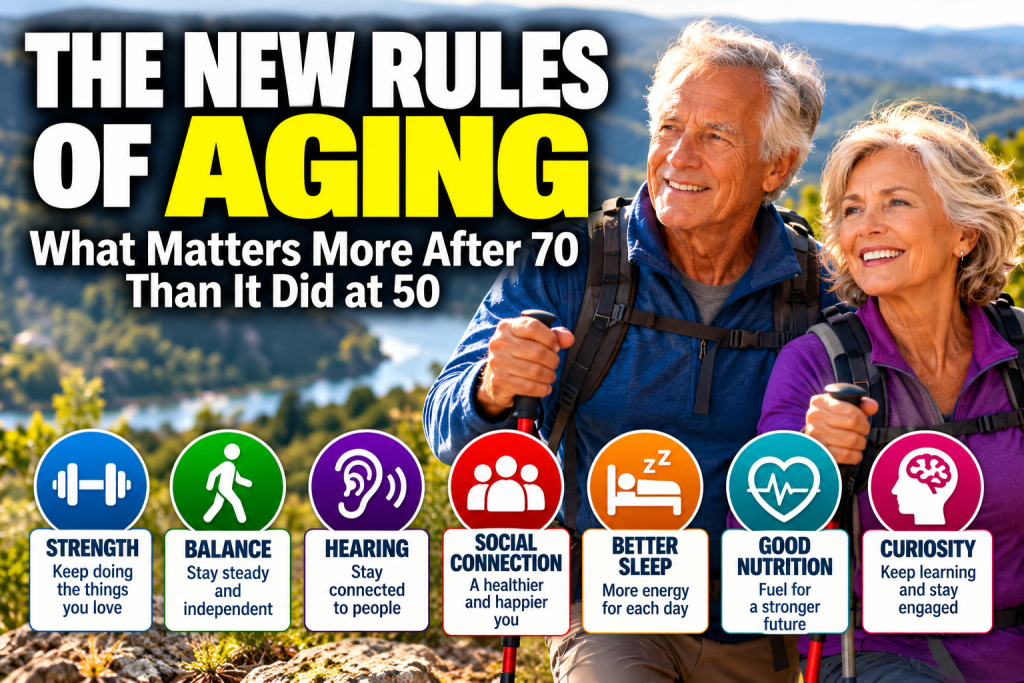
At 70, 80, and beyond, the priorities begin to shift.
Mobility matters more.
Balance matters more.
Hearing matters more.
Strength matters more.
Social connection matters more.
Sleep matters more.
And independence may matter more than almost anything.
That is not decline.
It is simply a different stage of life.
And it deserves a different strategy.
At Elderhood.info, we call this Elderhood.
Not simply old age.
A stage of life with its own challenges, opportunities, and priorities.
The Body Changes the Rules
When we are younger, the body is forgiving.
Miss a few workouts.
Stay up too late.
Eat poorly for a week.
You recover.
As we age, the margin for error gets smaller.
Muscle mass can decline.
Balance can change.
Reaction time can slow.
Hearing and vision can change.
Recovery from illness can take longer.
That means the habits that once seemed optional can become essential.
A walk is no longer just exercise.
It is mobility insurance.
Strength training is no longer about appearance.
It is about getting out of a chair.
Balance work is not glamorous.
But it may help prevent the fall that changes everything.
This is one of the biggest shifts in Elderhood.
The goal is no longer simply fitness.
The goal is function.
Strength Becomes More Important Than Appearance
At 40, someone may lift weights because they want to look better.
At 75, strength has a different value.
Can you carry groceries?
Can you climb stairs?
Can you get off the floor?
Can you open a heavy door?
Can you recover from a stumble?
Can you get out of a chair without using both arms?
These are not athletic questions.
They are independence questions.
That is why preserving muscle may be one of the smartest investments in aging.
You do not need a gym full of equipment.
Simple movements can help.
Wall pushups.
Chair squats.
Heel raises.
Resistance bands.
Light dumbbells.
Walking uphill.
The goal is not perfection.
The goal is maintenance.
Think of muscle like money in the bank.
You may not notice its value every day.
But when you need it, you are very glad it is there.
Balance Is a Hidden Superpower
Most people do not think about balance until it becomes a problem.
But balance is one of the quiet abilities that supports independence.
You use it when you step off a curb.
Turn quickly.
Get into the shower.
Stand up at night.
Climb stairs.
Reach for something overhead.
A fall can change a life in seconds.
That is why balance deserves attention long before someone starts falling.
Simple balance exercises can help.
Standing on one foot near a counter.
Heel to toe walking.
Slow controlled turns.
Tai chi.
Strength work.
Good footwear.
Better lighting.
The point is not to become a gymnast.
The point is to remain steady.
Hearing Is More Important Than Most People Realize
Hearing loss is often treated like a minor inconvenience.
It is not.
When hearing becomes difficult, people may withdraw from conversations.
Restaurants become frustrating.
Meetings become tiring.
Phone calls become harder.
People may avoid social events because they cannot follow what is being said.
Then isolation begins.
That is why hearing is not only a sensory issue.
It can become a social issue.
And social connection matters enormously in Elderhood.
If you are missing half the conversation, do not simply shrug and say, “People mumble now.”
Maybe they do.
But maybe your hearing needs attention too.
Social Connection Is Part of Health
We often think of health in terms of blood pressure, cholesterol, weight, and exercise.
But social connection belongs on the list.
Friends matter.
Neighbors matter.
Family matters.
Community matters.
As people age, social circles can shrink.
People move.
People die.
Driving becomes more difficult.
Hearing changes.
Mobility changes.
Little by little, social life can narrow.
That can happen so gradually that people barely notice it.
This is why staying connected should be intentional.
Call someone.
Join something.
Volunteer.
Attend a class.
Walk with a neighbor.
Go to church.
Join a senior center.
Talk to people.
The point is not to fill every hour.
The point is to remain part of the world.
Sleep Becomes More Valuable
Sleep is another area people often dismiss.
“I only need five hours.”
Maybe.
But poor sleep can affect memory, mood, balance, metabolism, blood pressure, and energy.
Sleep also becomes more complicated with age.
People may wake more often.
Use the bathroom at night.
Take medications that affect sleep.
Deal with pain.
Experience sleep apnea.
That is why good sleep hygiene matters.
Regular bedtime.
Reduced late caffeine.
Less screen exposure.
A cool dark room.
Medical evaluation when needed.
Sleep should not be treated as wasted time.
It is maintenance.
Recovery Takes Longer
One of the realities of aging is that bouncing back may take more time.
A cold that once lasted three days may linger.
A surgery may take longer to recover from.
A few days in bed can lead to noticeable weakness.
That means avoiding inactivity becomes more important.
When illness strikes, rest is necessary.
But once it is safe, movement matters.
Even short walks.
Gentle stretching.
Standing up regularly.
Muscle disappears faster than most people think.
This is why rehabilitation after illness is so important.
Recovery is not automatic.
It often needs to be encouraged.
Food Becomes More About Function
At younger ages, people often think about food in terms of weight.
In Elderhood, food becomes more about function.
Protein helps preserve muscle.
Fiber supports digestion.
Hydration supports blood pressure and kidney function.
Calcium and vitamin D support bone health.
Whole foods support metabolic health.
That does not mean every meal has to be perfect.
It means the body needs useful building materials.
And the older body may be less forgiving of long periods of poor nutrition.
Weight Is Not the Only Number That Matters
People can become obsessed with the scale.
But weight alone does not tell the whole story.
A person can lose weight and also lose muscle.
That is not always progress.
Body composition matters.
Strength matters.
Waist circumference matters.
Mobility matters.
Energy matters.
A number on the scale can be useful.
But it should not become the only measure of health.
The real question is:
Can you do the things you want to do?
That is a much better measure of successful aging.
Independence Requires Planning
One of the biggest mistakes people make is assuming independence will continue automatically.
It might.
Hopefully it will.
But independence is supported by systems.
Transportation.
Housing.
Technology.
Finances.
Health.
Social network.
If one of those systems fails, independence can shrink quickly.
That is why planning matters.
What happens if you stop driving?
What happens if stairs become difficult?
What happens if you need help for a month?
What happens if you live alone?
Who has access to your medical information?
Who can make decisions if you cannot?
These are not depressing questions.
They are practical questions.
Technology Can Extend Independence
Technology may become one of the most useful tools for older adults.
Smart watches.
Medication reminders.
Fall detection.
Telehealth.
Video calls.
Voice assistants.
Artificial intelligence.
Transportation apps.
Home monitoring.
Technology cannot replace human care.
But it can fill gaps.
And in Elderhood, filling gaps can make the difference between living independently and needing more help.
The mistake is assuming technology is “not for me.”
That attitude can cost independence.
You do not need to understand how the technology works.
You only need to understand how to use it.
Curiosity Is a Form of Health
One of the most underrated qualities in aging is curiosity.
People who keep learning stay connected to change.
They adapt.
They ask questions.
They try new tools.
They remain engaged.
That matters because the world is changing quickly.
Medicine is changing.
Technology is changing.
Transportation is changing.
Housing is changing.
Artificial intelligence is changing.
The person who says, “I am too old to learn that,” may unintentionally give up options.
The better attitude is:
Show me how.
You do not need to become an expert.
You just need to stay open.
Purpose Matters More Than Busyness
One of the strange transitions after retirement is the loss of structure.
Work gives people a schedule.
A reason to get up.
A role.
Then retirement arrives.
At first, that can feel wonderful.
No alarm clock.
No meetings.
No commute.
But eventually, some people feel something missing.
Purpose.
Purpose does not have to mean work.
It can mean family.
Volunteering.
Mentoring.
Gardening.
Creating.
Writing.
Helping neighbors.
Learning.
Building something.
Teaching.
The human mind seems to do better when it has a reason to engage.
Aging Is Not a Straight Line
Some years are better than others.
Some people are healthier at 75 than they were at 65.
Someone may recover from a difficult period and become stronger again.
Someone may change medications and feel dramatically better.
Someone may begin walking and regain confidence.
That is why aging should not be treated as a one way slide downhill.
There are setbacks.
There are recoveries.
There are plateaus.
There are improvements.
Aging is complicated.
And that is actually encouraging.
Because it means the future is not completely predetermined.
The Goal Is Healthspan
Lifespan gets attention because it is easy to measure.
How old did you live?
Healthspan is more meaningful.
How many years were you able to live with mobility, independence, mental clarity, social connection, and purpose?
That is the better goal.
Nobody wants simply more years.
We want usable years.
Enjoyable years.
Independent years.
Connected years.
That is what healthspan means.
The Bottom Line
The rules change as we age.
Strength matters more.
Balance matters more.
Hearing matters more.
Sleep matters more.
Social connection matters more.
Independence matters more.
Planning matters more.
And curiosity may matter more than ever.
The goal is not to deny aging.
The goal is to work with it intelligently.
At Elderhood.info, that is the conversation.
Not anti aging.
Not fear.
Not pretending that decline is inevitable.
But learning how to protect what matters most.
Your mobility.
Your independence.
Your relationships.
Your choices.
Your purpose.
Because aging is inevitable.
Decline is not always inevitable.
And the more we understand about how to live well in Elderhood, the better chance we have of adding not just years to life, but life to those years.