
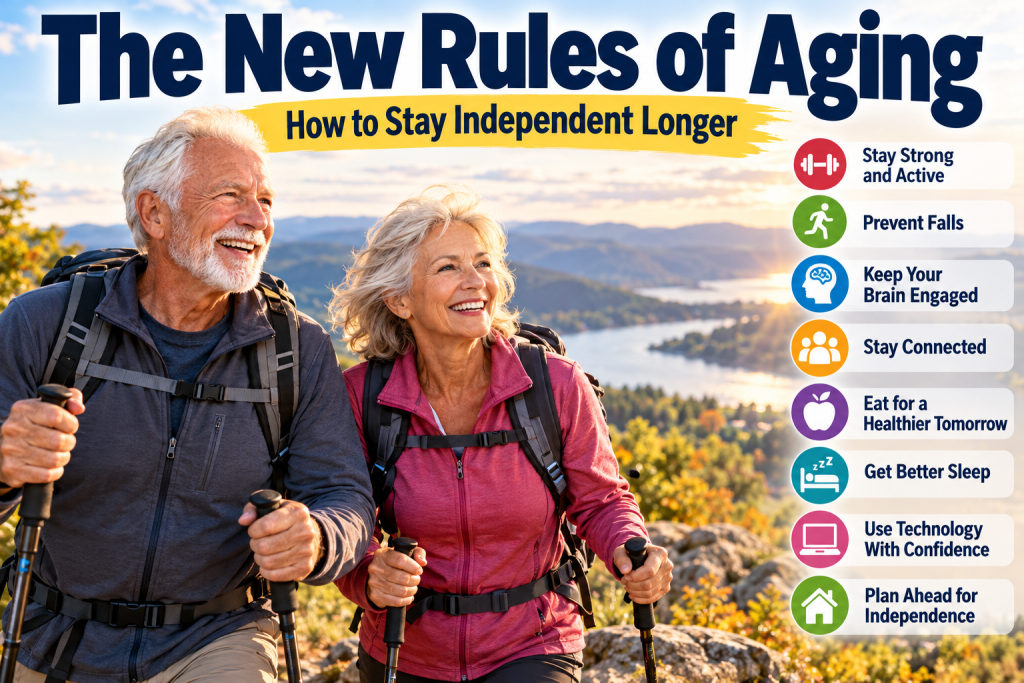
For generations, getting older came with a fairly predictable script.
You worked. You retired. You slowed down. Eventually, other people started doing things for you that you once did for yourself.
But something interesting is happening.
A growing number of older adults aren’t following that script.
They’re exercising. They’re traveling. They’re starting businesses. They’re learning new technology. They’re using artificial intelligence. They’re dating. They’re volunteering. They’re taking classes. They’re changing what they eat and paying attention to sleep, strength and brain health.
Some are doing all of those things in their 70s and 80s.
Maybe we’ve been thinking about aging the wrong way.
Perhaps the objective isn’t to remain young.
Perhaps the objective is to remain capable.
At Elderhood.info, that’s an important distinction.
Aging is inevitable.
But how we adapt to aging can make an enormous difference in how we experience the years ahead.
Independence May Be the Real Measure of Healthy Aging
Ask someone in their 30s what they’re worried about when they think about getting older and you may hear answers such as wrinkles, gray hair or retirement money.
Ask someone in their 80s and the answers can become considerably more practical.
Can I still walk where I want to go?
Can I drive—or otherwise get around independently?
Can I get out of a chair without assistance?
Can I manage my own affairs?
Can I live in my own home?
Can I think clearly enough to make my own decisions?
Those aren’t cosmetic concerns.
They’re questions about independence.
The National Institute on Aging provides extensive information about healthy aging, exercise, cognitive health and maintaining independence as we grow older.
But there’s also a simple idea worth remembering:
Independence is rarely one thing.
It’s usually the result of many small abilities working together.
And that means preserving independence often involves working on several areas at the same time.
Rule #1: Strength Becomes More Important With Age, Not Less
When younger people exercise, they often think about appearance.
Older adults have another reason.
Function.
You need strength to climb stairs.
You need it to carry groceries.
You need it to get out of a chair.
You need it to lift something from the floor.
You even need muscular strength to recover your balance when you stumble.
According to the Centers for Disease Control and Prevention, older adults should generally include muscle-strengthening activity as part of their regular physical activity, along with aerobic and balance activities as abilities and health permit.
That doesn’t mean every 75-year-old needs to become a bodybuilder.
It means we should stop treating strength as something reserved for young people.
Simple activities can matter.
Walking.
Resistance bands.
Appropriate weight training.
Chair exercises.
Heel raises.
Wall push-ups.
Balance exercises.
The appropriate activity depends on your health and physical condition, and someone with medical or mobility limitations may need professional guidance.
But the larger principle remains:
Muscles are useful retirement assets.
Unlike your 401(k), however, you can’t preserve them by leaving them untouched.
For more ideas about maintaining physical ability later in life, explore the healthy aging and exercise articles on Elderhood.info.
Rule #2: Stop Treating Falling as an Inevitable Part of Aging
Falls are not funny when you’re 80.
A small trip that a 25-year-old might shake off can become a major medical event for an older adult.
The CDC maintains a substantial older-adult fall prevention program because falls represent an important health risk for older Americans.
But fall prevention isn’t only about installing grab bars.
Think more broadly.
How is your balance?
How strong are your legs?
Can you see properly?
Are you wearing appropriate shoes?
Are there loose rugs around your home?
Is the hallway dark when you get up at night?
Could any medications contribute to dizziness or balance problems?
Can you comfortably get up from a chair without using your hands?
Healthy aging sometimes comes down to remarkably ordinary things.
Nobody makes an exciting television commercial about removing a loose rug.
But preventing one serious fall can potentially matter far more than buying the latest miracle anti-aging supplement.
Rule #3: Your Brain Needs a Life Too
People often talk about keeping the brain active by doing crossword puzzles.
There’s nothing wrong with crossword puzzles.
But the human brain wasn’t designed exclusively to remember seven-letter words for “large African mammal.”
Learning something genuinely new may be more interesting.
Learn a language.
Try artificial intelligence.
Take a class.
Learn photography.
Study history.
Play music.
Learn to dance.
Figure out how to make a YouTube video.
Teach somebody else something you know.
The National Institute on Aging’s cognitive health resources discuss several factors associated with brain health, including physical health, activity and social engagement.
No single activity guarantees protection against dementia.
Be skeptical of anyone promising otherwise.
But maintaining an intellectually engaged life gives us something else that’s valuable even if it never prevents a single disease:
A reason to remain curious.
Curiosity doesn’t have an expiration date.
We explore this subject further in our brain health and dementia prevention articles at Elderhood.info.
Rule #4: Loneliness Is Not the Same as Being Alone
Some people enjoy solitude.
Others can be surrounded by people and still feel lonely.
The distinction matters.
As we age, social circles can change.
Friends move.
People retire.
Spouses or partners die.
Mobility becomes harder.
Adult children may live hundreds or thousands of miles away.
The U.S. Surgeon General and other public-health organizations have drawn attention to social connection as an important component of health and well-being.
That doesn’t mean everyone needs a packed social calendar.
It means relationships require maintenance just like muscles do.
Call somebody.
Join something.
Volunteer.
Have coffee with a neighbor.
Take a class.
Go dancing.
Join a walking group.
Participate in a faith or community organization if that’s meaningful to you.
And don’t dismiss technology.
Video calls aren’t the same as sitting across the table from someone, but they’re considerably better than disappearing from one another’s lives.
Rule #5: Eat for the Body You Want Ten Years From Now
Nutrition advice has become a circus.
One expert tells you carbohydrates are killing you.
Another tells you fat is killing you.
Another wants you fasting for 18 hours.
Someone on social media is putting butter in coffee.
And somebody else is selling a powder that supposedly fixes everything.
For older adults, we can begin with something much less glamorous:
Are you getting enough useful nutrition?
Protein becomes particularly important when the goal is maintaining muscle.
Fiber matters.
Fruits and vegetables matter.
Hydration matters.
Food quality matters.
The exact diet that works for one individual may not be appropriate for another, especially when medical conditions, medications or weight-loss treatments are involved.
The USDA’s MyPlate resources for older adults provide practical nutrition guidance without requiring you to buy a $79 jar of something advertised by a shirtless 24-year-old fitness influencer.
At Elderhood.info, our approach to nutrition and healthy aging is similarly practical: look for sustainable habits rather than miracle foods.
Rule #6: Sleep Isn’t Wasted Time
When you’re young, staying awake until 2 a.m. can feel like you’re squeezing more life out of the day.
Eventually the body sends a strongly worded memo.
Sleep plays an important role in physical and mental health.
Persistent sleep problems shouldn’t simply be dismissed as “getting old.”
The National Institute on Aging provides information about sleep and older adults, including common changes in sleep patterns and reasons to discuss persistent problems with a healthcare professional.
Healthy aging isn’t about seeing how much discomfort you can tolerate.
It’s about identifying problems that may have solutions.
Rule #7: Technology Is Becoming Part of Independence
This may become one of the biggest changes in elderhood.
Technology used to be optional.
Increasingly, it’s becoming part of independent living.
Online banking.
Telemedicine.
Prescription refills.
Transportation apps.
Video calls.
Online shopping.
Patient portals.
Navigation.
Artificial intelligence.
And soon, increasingly capable autonomous transportation.
For an older adult who no longer drives, technologies such as autonomous vehicles could eventually mean something much bigger than convenience.
They could mean mobility.
Artificial intelligence may also help older adults understand complicated information, formulate questions for doctors, translate unfamiliar terminology and learn new subjects.
But technology brings risks too.
Scams.
Phishing.
Fake websites.
Impersonation.
Fraudulent phone calls.
AI-generated misinformation.
So the new elder needs two seemingly contradictory qualities:
Be willing to try new technology.
Be skeptical of what technology tells you.
Those two ideas can coexist.
Our technology and AI articles at Elderhood.info explore how older adults can use these tools without surrendering common sense.
Rule #8: Adaptation Beats Denial
Perhaps this is the most important rule.
You aren’t 35 anymore.
Neither am I.
Pretending otherwise isn’t healthy aging.
But neither is assuming that reaching 70, 80 or 90 automatically means surrendering the activities that give life meaning.
The better question is:
How do I adapt?
Can’t run anymore?
Walk.
Can’t walk five miles?
Walk one.
Can’t travel the way you once did?
Change how you travel.
Can’t read small print?
Use technology to enlarge it.
Hearing isn’t what it used to be?
Investigate hearing assistance.
Can’t remember everything?
Use calendars, reminders and digital tools.
Aging presents problems.
Humans invent tools.
That’s been our arrangement for thousands of years.
There’s no reason to stop now.
Rule #9: Prepare Before You Need Help
Many aging decisions are made too late.
People think about modifying the house after the fall.
They discuss transportation after driving becomes unsafe.
They organize financial documents after someone becomes ill.
They discuss healthcare wishes during a crisis.
Planning ahead isn’t pessimism.
It’s preparation.
Consider questions such as:
Could I live on one floor if stairs became difficult?
Who knows where my important documents are?
Do I have appropriate legal and healthcare directives?
Could I manage financially if my circumstances changed?
How would I get groceries if I couldn’t drive?
Who would I call if I needed help?
You don’t have to solve every hypothetical problem.
But having a plan is considerably better than having a panic.
Rule #10: Stop Measuring Your Life Against Your Younger Self
This may be the hardest adjustment of all.
At 80, you’re probably not going to run as fast as you did at 30.
You may not recover as quickly.
You may need medications you didn’t need before.
You may need hearing aids or reading glasses.
So what?
The goal isn’t to defeat your 30-year-old self.
The goal is to make the 80-year-old version of you as capable as possible.
That’s an entirely different competition.
Instead of asking:
“Why can’t I do what I did 30 years ago?”
Try asking:
“What can I do today that helps me remain independent tomorrow?”
That question is much more useful.
The New Older Person
Maybe we’re witnessing the emergence of something genuinely different.
Previous generations often entered old age with fewer medical treatments, less information and far fewer technologies available to help compensate for declining abilities.
Today’s older adult has access to tools that previous generations couldn’t have imagined.
Wearable health devices.
Modern hearing aids.
Joint replacements.
Improved cataract surgery.
Advanced cardiovascular treatments.
Telemedicine.
Smartphones.
Artificial intelligence.
And medical research that continues to advance.
None of these technologies makes aging disappear.
Nor should we pretend that everyone has equal access to them or that healthy habits guarantee a long life.
Disease happens.
Genetics matter.
Accidents happen.
Luck matters too.
Healthy aging isn’t about controlling everything.
It’s about improving the things we can influence.
Aging Is Inevitable. Decline Is Not a Schedule.
At Elderhood.info, we don’t believe the objective should be pretending we’re young.
We’ve already been young.
The interesting challenge is figuring out how to be old well.
Keep moving.
Keep learning.
Maintain relationships.
Eat reasonably.
Protect your sleep.
Use technology.
Question miracle claims.
Plan ahead.
Adapt when circumstances change.
And keep something in your life that makes tomorrow worth getting up for.
Because perhaps the great opportunity of modern elderhood isn’t adding years merely for the sake of accumulating birthdays.
It’s preserving enough health, independence, curiosity and purpose to use those years.
You cannot stop the clock.
But you can decide what you’re going to do while it’s running.
Aging is inevitable. Decline is not.