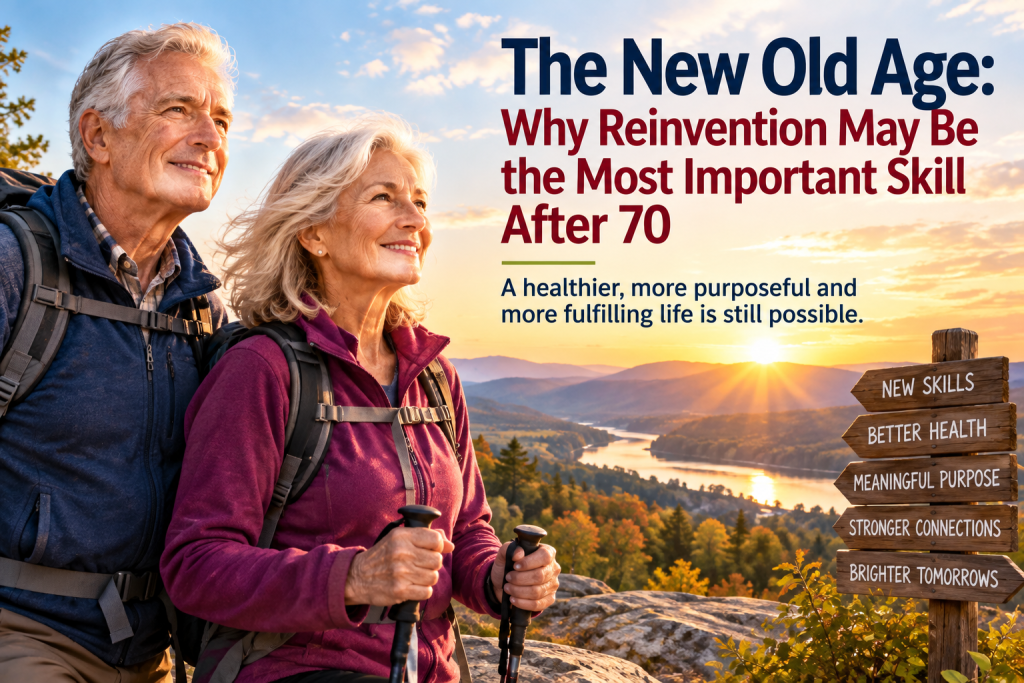
For most of human history, getting old meant slowing down.
You retired.
You stepped aside.
You watched the next generation take over.
And, if we’re being candid about it, society didn’t expect very much from you after that.
That model is becoming obsolete.
Millions of people are reaching their 70s, 80s and even 90s with something earlier generations rarely had:
Time.
Not merely months.
Potentially years — even decades.
That raises an entirely new question.
What are we supposed to do with them?
Maybe the answer is not simply to “age gracefully.”
Maybe it is to keep reinventing ourselves.
At Elderhood.info, we believe one of the larger truths of aging is this:
Aging is adaptation.
Your body changes.
Your family changes.
Your relationships change.
Your work changes.
Technology changes.
The world changes.
And the people who continue adapting may experience old age very differently from those who decide their useful years are behind them.
We May Need a New Definition of “Old”
Think about what being 70 looked like in the 1950s.
Now think about a 70-year-old today.
There is no comparison.
People in their 70s are running businesses.
Traveling.
Dating.
Learning languages.
Using artificial intelligence.
Going back to college.
Starting YouTube channels.
Taking care of grandchildren.
Volunteering.
Exercising.
And occasionally arguing with a smartphone that insists it knows where they want to go.
The calendar may say 75.
Your life doesn’t necessarily have to behave like it.
This isn’t about pretending we’re 40.
We’re not.
A knee that has been carrying you around since the Eisenhower administration deserves a little respect.
But accepting reality and surrendering to it are two different things.
The National Institute on Aging says many common beliefs about aging are misconceptions. Older adults can continue learning new skills and forming new memories, and dementia is not an inevitable part of aging.
That alone should change how we think about elderhood.
The Fourth Quarter Can Be a Long Quarter
I sometimes think of this stage of life as the fourth quarter.
That phrase can sound a little ominous.
But consider this.
If someone reaches 70 and lives to 90, that’s another twenty years.
Twenty years is longer than childhood.
It’s long enough to build a career.
Long enough to raise a child.
Long enough to start a business.
Long enough to become very good at something you currently know absolutely nothing about.
Yet we often behave as though life after retirement is merely an extended waiting room.
Sit down.
Watch television.
Take your medications.
Try not to fall.
That’s not much of a life strategy.
There is another possibility.
Use the fourth quarter.
Reinvention Doesn’t Have to Be Dramatic
When people hear the word “reinvention,” they sometimes imagine selling the house, moving to Tuscany and opening a vineyard.
That sounds lovely.
It also sounds exhausting.
Reinvention can be much smaller.
Learn to use AI.
Start walking every morning.
Take up photography.
Volunteer.
Learn to dance.
Write down your family history.
Join a discussion group.
Take a class.
Change how you eat.
Reconnect with an old friend.
Create something.
Teach someone what you know.
Start a small business.
Travel somewhere you’ve never been.
The point isn’t what you choose.
The point is that you are still choosing.
That distinction matters.
One of the quiet dangers of aging is that life gradually becomes something that happens to us rather than something we participate in creating.
Reinvention reverses that.
Your Body Still Needs a Vote
There is, of course, an inconvenient partner in all of this.
Your body.
At 25, you could abuse it and often get away with it.
At 75, your body keeps receipts.
Physical activity becomes particularly important as we age.
The National Institute on Aging notes that regular physical activity can support strength, balance, energy, mood and independence. Federal guidelines generally recommend at least 150 minutes of physical activity each week for adults, although what is appropriate for an individual depends on health and ability.
That doesn’t mean everyone needs a gym membership.
Walk.
Garden.
Dance.
Ride a bicycle.
Use resistance bands.
Climb stairs if you’re able.
Do something that requires your muscles to remember they still have a job.
The goal isn’t necessarily to build the body you had at 30.
The goal is to preserve enough strength, balance and mobility to keep living the life you want at 80.
That is a very different objective.
And perhaps a more important one.
Health Is an Appreciating Asset
We usually think of assets as money.
Stocks.
Real estate.
Savings.
But by the time we reach elderhood, another asset may become even more valuable.
Health.
A healthy year at 80 can be worth more than a larger bank account accompanied by an inability to enjoy it.
That doesn’t mean illness can always be prevented.
It can’t.
Genetics matter.
Accidents happen.
Disease happens.
But lifestyle still matters.
The National Institute on Aging says healthy habits and lifestyle choices can help preserve health and mobility as we get older.
So perhaps we should think about health the way we once thought about retirement savings.
Make deposits.
A walk is a deposit.
Strength training is a deposit.
A decent meal is a deposit.
A good night’s sleep is a deposit.
Keeping medical appointments is a deposit.
Maintaining friendships is a deposit.
No single deposit guarantees anything.
But over time, they may improve the balance sheet.
The Brain Needs Work Too
Retirement can create an unexpected problem.
For decades, work forced us to solve problems.
Remember appointments.
Deal with people.
Learn new systems.
Make decisions.
Then one day we retire and much of that stimulation disappears.
The brain may appreciate a vacation.
A permanent vacation is another matter.
Research reviewed by the National Institute on Aging suggests that older adults can continue learning and that mentally demanding activities may support cognitive health, although scientists are still studying exactly which activities provide lasting protection against cognitive decline.
So give your brain something difficult to do.
Learn technology.
Play an instrument.
Write.
Study history.
Take a course.
Learn chess.
Learn Spanish.
Try photography.
Use artificial intelligence.
Do something badly.
That last one matters.
Adults tend to avoid activities we’re not good at.
Children don’t.
Children spend half their lives being terrible at things until they become competent.
Maybe elderhood requires rediscovering that willingness.
Technology May Become One of the Great Dividing Lines of Aging
We are entering a period unlike anything previous generations experienced.
Artificial intelligence is no longer something coming someday.
It’s here.
That creates an enormous opportunity for older adults.
AI can help explain complicated information.
Generate ideas.
Help write letters.
Research subjects.
Teach new skills.
Assist with travel planning.
Help someone understand technology.
Translate languages.
And provide a starting point for learning about almost anything.
It isn’t always correct.
It shouldn’t replace physicians, attorneys, financial professionals or our own judgment.
But refusing to learn modern technology because “I’m too old for that stuff” may eventually become the equivalent of refusing to learn how to use a telephone.
The world isn’t going backward to make us comfortable.
Adaptation means moving with it.
That may be one of the defining skills of modern elderhood.
Loneliness Is More Than an Emotional Problem
There is another part of healthy aging that doesn’t get enough attention.
Other people.
As we age, our social world can shrink.
Friends die.
A spouse dies.
People move.
We stop working.
Driving becomes harder.
Children may live hundreds or thousands of miles away.
Before long, someone who once interacted with dozens of people every day may spend most days alone.
That is not merely unpleasant.
The National Institute on Aging and the CDC both report that social isolation and loneliness are associated with increased risks of several health problems, including depression, heart disease and cognitive decline.
Social connection belongs in the healthy-aging toolbox.
Call somebody.
Have coffee.
Join something.
Volunteer.
Go to a class.
Walk with somebody.
Dance badly with somebody.
Argue about politics with somebody — preferably someone you still want to have lunch with afterward.
Humans are social animals.
We do not age particularly well in isolation.
Purpose May Matter More Than Retirement
One of the strangest questions society asks older people is:
“What do you do now that you’re retired?”
As though employment was the only reason we ever had to get out of bed.
Retirement from a job should not mean retirement from purpose.
Purpose can take many forms.
Helping grandchildren.
Mentoring someone younger.
Volunteering.
Caring for a spouse.
Building something.
Teaching.
Writing.
Gardening.
Creating art.
Running a business.
Helping a neighbor.
Participating in your community.
The National Institute on Aging encourages older adults to stay involved in meaningful activities, hobbies, volunteer work and social connections as part of healthy aging.
Purpose doesn’t need to impress anybody.
It simply needs to matter to you.
Stop Measuring Life Only by Years
We hear constantly about lifespan.
How long will I live?
Eighty-five?
Ninety?
One hundred?
It’s a reasonable question.
But perhaps there is another number that matters more.
How many of those years will remain usable?
How many years can you walk independently?
Think clearly?
Travel?
Enjoy dinner with friends?
Participate in your family?
Work if you want to?
Create something?
Laugh?
Fall in love?
Learn?
That is closer to what people mean when they talk about healthspan.
Living longer is good.
Living longer well is better.
None of us controls that completely.
But we may be able to influence it.
Aging Is Inevitable. Decline Is Not a Schedule.
We should be careful here.
Aging changes us.
Pretending otherwise is just another form of denial.
We lose some speed.
Recovery takes longer.
Illness becomes more common.
People we love disappear.
There are genuine losses.
But decline does not arrive on a predetermined birthday.
You do not wake up at 75 and receive an official letter saying:
“Congratulations. You are now obsolete.”
There is enormous variation in how people age.
And that gives us room to act.
To adapt.
To learn.
To move.
To connect.
To participate.
To reinvent.
The New Elderhood
Perhaps this generation of older adults has a job that previous generations didn’t have.
We may have to invent what modern elderhood looks like.
We are living longer.
We have access to technology that didn’t exist five years ago, much less fifty.
Medical science continues to evolve.
Many of us have more education, mobility and access to information than earlier generations could have imagined.
So why should we use an outdated model of old age?
Maybe elderhood is not primarily about withdrawing.
Maybe it’s about adapting.
Maybe wisdom and curiosity can exist together.
Maybe experience doesn’t have to become nostalgia.
Maybe you can be 75, 80 or 90 and still ask:
What comes next?
That may be one of the healthiest questions we can ask.
Because the larger truth of aging isn’t that everything stays the same.
It doesn’t.
The larger truth is that human beings have always survived by adapting.
There is no reason that should stop simply because our hair turned gray.
We are the first generation of elders who may have to keep reinventing ourselves.
And perhaps that isn’t a burden.
Perhaps it’s the opportunity.
Continue Exploring Elderhood
At Elderhood.info, we explore healthy aging, longevity, brain health, relationships, technology, purpose, retirement, healthcare and the realities of growing older in a rapidly changing world.
Because getting older is inevitable.
How we respond to it is still being written.