
For generations, heart disease has often been treated after trouble becomes obvious.
A blocked artery.
Chest pain.
A heart attack.
A stent.
By then, medicine may be fighting a battle that has been developing quietly for decades.
But a new generation of cholesterol-lowering drugs raises a much more interesting possibility:
What if we could become far more aggressive about preventing the heart attack in the first place?
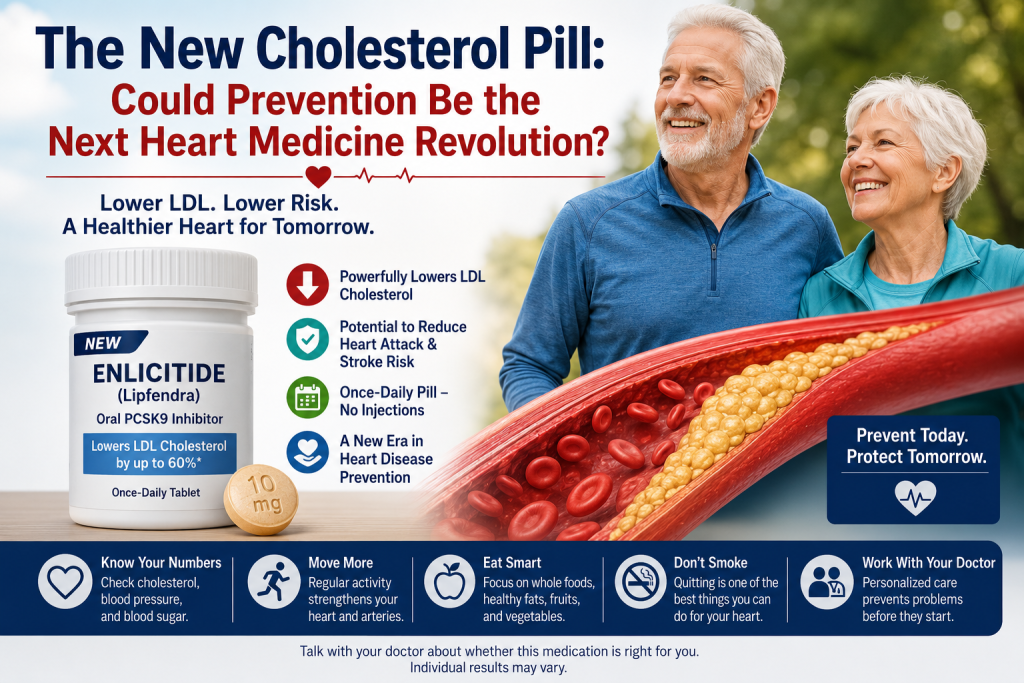
That possibility moved another step forward in July 2026 when the U.S. Food and Drug Administration approved Lipfendra, also known as enlicitide, the first oral PCSK9 inhibitor for lowering LDL cholesterol.
That is significant because PCSK9 inhibitors have already demonstrated an extraordinary ability to lower LDL cholesterol, but until now this class of medication has largely meant injections.
Now we have a pill.
And that could potentially change who is willing—and able—to use this kind of treatment.
But before we declare another medical revolution, there are some important questions we need to ask.
What does the pill actually do?
Who might benefit?
How much does lowering LDL really matter?
And most importantly:
Will taking this medication actually prevent more heart attacks and strokes over the long term?
Let’s break it down.
First, What Exactly Is LDL Cholesterol?
LDL stands for low-density lipoprotein.
Most people simply know it as “bad cholesterol.”
That description isn’t perfect, but it is useful.
LDL particles transport cholesterol throughout the body. When too much LDL circulates in the bloodstream over many years, cholesterol can become deposited in artery walls.
That process contributes to atherosclerosis—the buildup of plaque inside the arteries.
Over time, those plaques can narrow arteries or rupture, potentially triggering heart attacks and strokes.
The problem is that you usually don’t feel this happening.
You can feel perfectly healthy while the process quietly develops.
That’s why cholesterol management is fundamentally about prevention.
For seniors taking cholesterol medications, prescription coverage can also become an important part of the financial picture. Our guide to what Medicare Part D drug plans cover explains why formularies, tiers, deductibles, and pharmacy choices can affect what beneficiaries actually pay.
Statins Changed Heart Medicine
Any discussion about cholesterol treatment has to begin with statins.
Medications such as atorvastatin and rosuvastatin have become some of the most commonly prescribed medicines in the world.
And for good reason.
Statins lower LDL cholesterol and have extensive evidence showing reductions in cardiovascular events among appropriate patients.
They work primarily by reducing cholesterol production in the liver.
For millions of people, they are effective, inexpensive, and available as generics.
So the arrival of a new cholesterol pill does not mean statins suddenly became obsolete.
Quite the opposite.
For many patients, statins will likely remain the foundation of cholesterol treatment.
But not everyone reaches the LDL level their doctor wants with a statin alone.
Some people cannot tolerate higher statin doses.
Others begin with extremely high cholesterol because of genetics.
Still others already have cardiovascular disease and remain at significant risk even while receiving treatment.
That is where other cholesterol-lowering medications enter the picture.
What Is PCSK9?
PCSK9 is a protein produced primarily by the liver.
Its name is a mouthful:
Proprotein convertase subtilisin/kexin type 9.
Fortunately, nobody is going to quiz us on that at dinner.
What matters is what it does.
Your liver has LDL receptors that help remove LDL cholesterol from the bloodstream.
PCSK9 contributes to the destruction of those receptors.
Block PCSK9, and more LDL receptors remain available.
More receptors means the liver can pull more LDL cholesterol from the blood.
The result can be a dramatic reduction in LDL.
Existing injectable PCSK9 inhibitors demonstrated that this biological pathway could be targeted effectively.
The challenge was convenience.
Some patients simply don’t like injections.
Others may hesitate to start an injectable medication for a condition they cannot feel.
A daily pill could change that psychology considerably.
Enter Enlicitide
Enlicitide is unusual because it attempts to accomplish something scientists once found extremely difficult:
Create an oral medication capable of blocking PCSK9 in a way resembling injectable antibody therapy.
The FDA approved enlicitide under the brand name Lipfendra in July 2026 as an adjunct to diet and exercise for adults with high cholesterol, including adults with heterozygous familial hypercholesterolemia.
In Phase 3 testing, enlicitide lowered LDL cholesterol by roughly 57% to 60% compared with placebo when added to background therapy.
That is not a tiny improvement.
That is a substantial biological effect.
The medication also lowered other markers associated with atherosclerotic risk, including non-HDL cholesterol and apolipoprotein B.
This is why cardiologists and researchers are paying attention.
A Pill Could Change the Conversation
Imagine two conversations with a patient.
The first:
“Your cholesterol is still too high. I’d like you to begin giving yourself injections.”
The second:
“Your cholesterol is still too high. I’d like you to take another pill.”
For some people, those conversations feel very different.
Medicine only works when people actually take it.
Convenience matters.
Acceptance matters.
Adherence matters.
If an oral PCSK9 inhibitor allows substantially more people to achieve lower LDL levels consistently, its significance may extend beyond the laboratory numbers.
But convenience alone doesn’t make something revolutionary.
The bigger story is prevention.
How Low Should LDL Go?
For decades, there was understandable hesitation about driving cholesterol dramatically lower.
Could LDL become too low?
Would there be unexpected consequences?
The accumulation of data from intensive cholesterol-lowering studies has increasingly challenged the old idea that moderately elevated LDL should simply be accepted as an inevitable part of aging.
Modern cardiovascular medicine increasingly focuses on a person’s overall risk.
Someone who has already experienced a heart attack may be treated much more aggressively than a younger person with few other risk factors.
Diabetes, smoking history, blood pressure, kidney disease, genetics, age, and existing artery disease can all affect treatment decisions.
The point isn’t that everyone should chase the lowest cholesterol number possible.
The point is that the appropriate LDL target depends on the person and their cardiovascular risk.
This is an important distinction.
A medication should not be prescribed simply because a new pill exists.
Prevention May Be Where the Real Revolution Happens
Medicine has traditionally been excellent at rescue.
Heart attack?
Open the artery.
Severe blockage?
Insert a stent or perform bypass surgery.
Dangerous rhythm?
Implant a device.
These technologies save lives every day.
But prevention asks a more ambitious question:
Could we keep more people from getting to that point?
That is where aggressive LDL reduction becomes fascinating.
Atherosclerosis develops over years and often decades.
If cumulative exposure to LDL contributes to plaque formation, then reducing that exposure earlier could theoretically have substantial long-term consequences.
Think of LDL exposure almost like sunlight exposure.
One afternoon in the sun usually isn’t the problem.
The cumulative exposure over decades is what matters.
The same concept may apply to cholesterol.
Preventing years of excessive LDL exposure could be more effective than trying to undo advanced disease later.
We Already Have Evidence for the PCSK9 Concept
Enlicitide itself is new, but PCSK9 inhibition is not.
Injectable PCSK9 medications have already produced cardiovascular outcome evidence.
In 2025, for example, a large study of the injectable PCSK9 inhibitor evolocumab, sold as Repatha, reported a reduction in first major cardiovascular events among high-risk patients who had not previously experienced a heart attack or stroke.
That is particularly interesting because it moves the discussion beyond secondary prevention—preventing another event after someone has already had one—and toward primary prevention.
Preventing the first heart attack is a very different goal.
If oral therapies eventually demonstrate similar cardiovascular benefits, the potential population that might benefit could become much larger.
But Here Is the Important Catch
Lowering LDL is not exactly the same thing as proving that a particular drug prevents heart attacks.
This distinction matters.
Enlicitide has clearly demonstrated powerful cholesterol reduction.
But its large cardiovascular outcomes study is still ongoing.
The CORALreef Outcomes trial is specifically evaluating whether enlicitide reduces major cardiovascular events.
That means we should not get ahead of the evidence.
The drug lowers LDL substantially.
That is established.
Whether the oral medication ultimately translates that LDL reduction into the expected reduction in heart attacks, strokes, cardiovascular deaths, and other major outcomes is being studied.
This is exactly how medicine should work.
Excitement first.
Evidence second.
Conclusions after the evidence arrives.
Is This a Replacement for Statins?
Probably not for most people.
It is better to think of cholesterol treatment as a toolbox.
The toolbox may include:
- Lifestyle changes
- Statins
- Ezetimibe
- Bempedoic acid
- Injectable PCSK9 inhibitors
- Other newer therapies
- And now an oral PCSK9 inhibitor
Different patients may need different combinations.
A person whose cholesterol responds beautifully to an inexpensive generic statin may have little reason to move to a newer medication.
Someone with extremely high LDL despite treatment presents a different situation.
Someone with familial hypercholesterolemia presents another.
Someone who cannot tolerate sufficient statin therapy presents another.
Medicine is moving away from one-size-fits-all treatment.
That is a good thing.
Don’t Forget the Simplest Heart Medicine
When new medication arrives, it is easy to become fascinated with technology.
But we should not forget the basics.
Not smoking matters.
Physical activity matters.
Blood pressure matters.
Blood sugar matters.
Weight and metabolic health matter.
Sleep matters.
Nutrition matters.
And taking prescribed medications consistently matters.
A pill cannot erase every other cardiovascular risk factor.
Think of heart health as a team sport.
LDL may be an important player, but it isn’t the entire team.
What About Diet?
Diet remains important even in the era of highly effective cholesterol medication.
A heart-supportive eating pattern generally emphasizes minimally processed foods, vegetables, fruits, legumes, whole grains, nuts, fish, and healthier sources of fat.
Diet affects far more than cholesterol.
It can influence blood pressure, insulin sensitivity, weight, inflammation, and overall cardiovascular health.
The wrong message would be:
“I can eat anything because my pill lowers cholesterol.”
That is like saying:
“I installed airbags, so now I can drive into trees.”
Medicine reduces risk.
It does not repeal biology.
What Seniors Should Ask Their Doctors
If you are an older adult with elevated LDL, the important question isn’t:
“Should I take the new cholesterol pill?”
That skips several steps.
Better questions include:
What is my current LDL?
What is my overall cardiovascular risk?
Do I already have evidence of atherosclerosis?
What LDL level are we trying to achieve?
Am I getting the expected benefit from my current medication?
Would another medication meaningfully reduce my risk?
What are the side effects and costs?
Do we have outcome evidence for the treatment being considered?
These questions turn a medication discussion into a prevention discussion.
That’s far more useful.
Medicare Coverage Will Matter Too
A medical breakthrough that nobody can afford isn’t much of a breakthrough for the person standing at the pharmacy counter.
New branded medications can initially be expensive.
Coverage may vary by Medicare Part D plan, and plans may use formularies, tiers, prior authorization requirements, or other utilization-management rules.
That means seniors considering any new cholesterol medication should verify their actual plan coverage rather than assuming that FDA approval automatically means inexpensive access.
The official Medicare.gov Plan Compare system can help beneficiaries review prescription drug coverage, while individual plan formularies provide the most specific details about how a particular medication is covered.
This is another reason Medicare beneficiaries should review Part D coverage annually rather than choosing a plan once and forgetting about it.
Your medications can change.
And the drugs available to medicine can change too.
The Future May Be Earlier Intervention
The most exciting part of this story may not ultimately be enlicitide itself.
It may be what the drug represents.
Heart medicine is steadily shifting from:
Treat the catastrophe.
Toward:
Identify the risk earlier and prevent the catastrophe.
We are seeing similar thinking throughout medicine.
Detect cancer earlier.
Identify Alzheimer’s biology earlier.
Control diabetes earlier.
Treat high blood pressure earlier.
Preserve muscle before frailty develops.
And perhaps reduce atherosclerosis before the first heart attack announces that it was there.
That is a very different philosophy of aging.
Instead of waiting for disease to become obvious, medicine increasingly tries to identify the conditions that allow disease to develop.
Could This Really Be a Heart Medicine Revolution?
Possibly.
But the revolution is not simply that scientists created another cholesterol pill.
We already have plenty of pills.
The potentially revolutionary part is this:
Powerful cholesterol reduction that previously required injections may now be available as a once-daily oral medication.
If longer-term studies confirm that oral PCSK9 treatment meaningfully reduces cardiovascular events, and if patients can access and consistently take these medications, the impact could be substantial.
But we should keep our enthusiasm attached to evidence.
Enlicitide has shown that it can dramatically lower LDL cholesterol.
The cardiovascular-outcomes story is still being written.
That’s not a disappointment.
That’s science doing exactly what it is supposed to do.
The Bigger Lesson
For seniors, there is an even larger takeaway.
Growing older does not mean medicine has stopped improving.
Quite the opposite.
Treatments available to someone at 75 may be better than those available when that same person was 65.
And treatments available at 85 may be better still.
That is why staying healthy today matters.
Exercise.
Eat intelligently.
Control blood pressure.
Know your cholesterol.
Don’t smoke.
Get appropriate preventive care.
Take care of the body you have now.
Because medical progress keeps moving.
The objective is not merely to live long enough to need modern medicine.
It is to remain healthy enough to benefit from what medicine discovers next.
The new cholesterol pill may or may not become the next great heart-medicine revolution.
But the direction is becoming clear.
The future of cardiovascular medicine may increasingly be about stopping the heart attack before there is ever a heart attack to treat.