
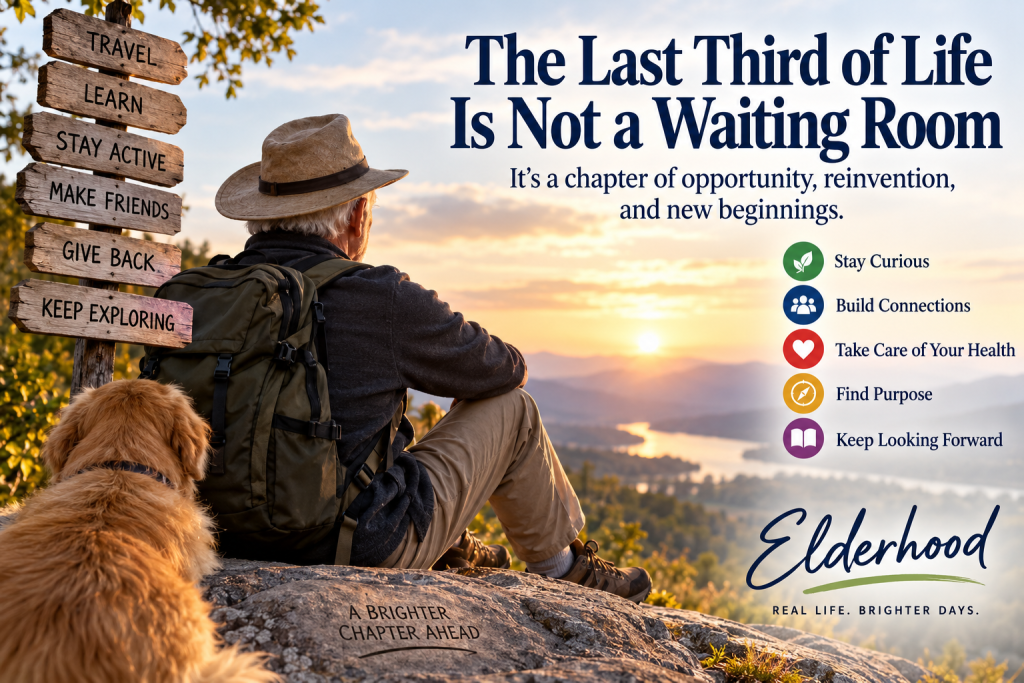
There is a strange cultural idea about aging that deserves to be challenged.
For most of our lives, we are expected to be moving toward something.
As children, we are becoming students. As students, we are preparing for work. We build careers, raise families, buy homes, save money, make plans, and spend decades thinking about what comes next.
Then one day, society quietly changes the question.
Instead of asking, “What are you becoming?” it begins asking, “How are you holding up?”
That is quite a demotion.
A person can spend 60 or 70 years becoming somebody and then suddenly be treated as though the main objective is simply to avoid falling apart.
But the later years of life do not have to become a waiting room.
They can be a chapter of reinvention.
Retirement Was Never Supposed to Mean Retirement From Life
The word retirement has always been slightly misleading.
You can retire from a job.
You can retire from running a company.
You can retire from commuting, meetings, deadlines, alarm clocks, neckties, office politics, and pretending to enjoy team-building exercises.
But you do not retire from being alive.
That distinction matters.
For many people, work provided more than income. It also provided structure, identity, purpose, social interaction, recognition, and a reason to get dressed before noon.
When work disappears, those things do not automatically replace themselves.
The first few months of retirement may feel wonderful.
No alarm clock.
No boss.
No rush-hour traffic.
Tuesday looks suspiciously like Saturday.
But eventually another question may appear:
Now what?
That question is not a crisis.
It may actually be the beginning of one of the most interesting periods of your life.
We May Be Living Longer Than Our Old Social Script Expected
A century ago, retirement often came relatively close to the end of life.
Today, many people can live 20, 25, or even 30 years after leaving full-time employment.
Think about that.
Thirty years is not an epilogue.
Thirty years is almost an entire adult lifetime.
A person could learn a language.
Start a business.
Travel.
Write a book.
Become a grandparent.
Become a great-grandparent.
Learn to dance.
Volunteer.
Teach.
Paint.
Take up photography.
Start exercising for the first time.
Fall in love.
Make new friends.
Change cities.
Change countries.
Change their mind about almost everything.
And yet we still often talk about retirement as though somebody has reached the end of the road.
They may have simply reached a different road.
The Danger of Shrinking Your World
One of the quiet risks of aging is not simply physical decline.
It is the gradual shrinking of your world.
You stop driving at night.
Then you stop going out as often.
A friend moves away.
Another friend dies.
You stop attending an organization.
You quit traveling.
You stop trying new restaurants because the old ones are familiar.
Then one day your entire world can become your home, the grocery store, the doctor’s office, and the television.
None of those changes may seem dramatic individually.
But together they can make life smaller.
That is why maintaining curiosity matters.
Curiosity keeps doors open.
It gives you reasons to leave the house.
It introduces you to new people.
It gives your brain something to work on besides remembering where you put your glasses.
And speaking of glasses, they are probably on top of your head.
Aging Requires Adaptation, Not Surrender
Growing older unquestionably brings changes.
Some things become harder.
Recovery takes longer.
The knees may start submitting formal complaints.
Technology updates itself just when you finally figured out where everything was.
You may lose people you love.
You may experience changes in health, finances, mobility, or independence.
Pretending these things do not happen is not positive aging.
It is denial.
But acknowledging difficulty does not require surrendering your entire future.
Aging is largely an exercise in adaptation.
Maybe you cannot run anymore.
Can you walk?
Maybe you cannot walk five miles.
Can you walk one?
Maybe you cannot travel across Europe carrying a backpack.
Can you take a comfortable river cruise?
Maybe you cannot dance for three hours.
Can you dance for thirty minutes?
The question changes from:
“Can I still do exactly what I did at 40?”
to:
“How can I continue doing what matters to me now?”
That is a much more useful question.
Something to Look Forward To Is More Important Than We Realize
Ask someone what they are looking forward to.
Their answer tells you a great deal.
A vacation.
A grandchild visiting.
A dance class.
A dinner.
A birthday.
A garden blooming.
A football season.
A book arriving.
A concert.
Even a good breakfast.
The event itself almost does not matter.
What matters is having a future event pulling you forward.
Anticipation gives shape to time.
Without anything ahead of us, the days can start blending together.
Monday.
Tuesday.
Wednesday.
Wait — is today Thursday?
At some point, you start identifying the day by which garbage container the neighbors put outside.
We need things on our calendars besides medical appointments.
That does not require spending a fortune.
Looking forward to something can be as simple as meeting a friend for coffee next Wednesday.
The size of the event is less important than the existence of one.
Purpose Does Not Have to Be Grand
People often hear the word “purpose” and imagine they need to start a foundation, write a masterpiece, or solve world hunger.
Purpose can be much smaller.
And much closer.
Helping a neighbor.
Taking care of an animal.
Calling somebody who is lonely.
Teaching a grandchild something.
Volunteering one afternoon a week.
Growing tomatoes.
Learning to cook.
Recording family stories.
Mentoring someone younger.
Creating something.
Sometimes purpose is simply knowing that somebody, somewhere, expects you to show up.
That can be powerful.
Your Experience Has Value — If You Use It
By the time someone reaches their 70s or 80s, they have accumulated something younger people cannot buy.
Perspective.
You have seen recessions.
Recoveries.
Technological revolutions.
Political scandals.
Fashion disasters.
Family arguments everyone eventually forgot.
Things you once believed were catastrophes that turned out to be minor inconveniences.
And things you thought were minor inconveniences that changed your life.
Experience does not automatically create wisdom.
But it gives you the raw material.
One of the most valuable things older adults can do is share what they have learned without insisting that younger people repeat the same life.
There is a difference between saying:
“You should do what I did.”
and saying:
“Here is what happened to me. Maybe it will help you.”
The second one is wisdom.
Friendship May Require More Effort Later in Life
Friendship was easier when we were young.
School put hundreds of people approximately our age in the same building.
Work did the same thing later.
Children introduced us to other parents.
Neighborhoods were often more social.
Later in life, those automatic meeting places can disappear.
That means friendship may require intention.
You may actually have to go somewhere.
Join something.
Take a class.
Attend an event.
Introduce yourself.
Invite someone to coffee.
Yes, this can feel awkward at 75.
It also felt awkward at 15.
We simply forgot.
Waiting for friendship to knock on the front door is not a very effective strategy.
Unless your UPS driver is unusually sociable.
The Body Still Matters
A meaningful later life is much easier when the body remains capable of participating.
That does not mean becoming an athlete.
It means protecting mobility, strength, balance, hearing, vision, sleep, and general health as much as possible.
Physical independence is one of the greatest forms of wealth in later life.
Being able to get out of a chair.
Carry groceries.
Walk through an airport.
Climb a few stairs.
Dance.
Travel.
Drive.
Visit friends.
Those abilities support everything else.
Exercise is not simply about living longer.
It is about being able to participate in the life you are living.
Stop Measuring Yourself Against Your Younger Self
This may be one of the hardest adjustments of aging.
You remember what you could do at 30.
Or 40.
Or 50.
And you compare today’s body with that memory.
That comparison is almost always unfair.
The better comparison is:
What can I do today that will make tomorrow better?
Walk a little farther.
Learn something new.
Call somebody.
Eat a little better.
Strengthen your legs.
Join something.
Make a plan.
Tiny improvements matter because aging tends to magnify habits.
Good ones and bad ones.
You Are Still Allowed to Change
There is another curious assumption about older people.
That by a certain age, you are finished becoming who you are.
Why?
You can change your opinions.
Your routines.
Your relationships.
Your home.
Your goals.
Your hobbies.
Your priorities.
You can decide you no longer like something you tolerated for 40 years.
You can become more patient.
Less patient.
More adventurous.
More selective.
More generous.
You can decide that time has become too valuable to spend with people who make you miserable.
Aging gives us one tremendous advantage:
We have less reason to pretend.
The Question Is Not How Old You Are
Chronological age matters.
Of course it does.
But it does not tell the entire story.
Two people can both be 80 and live completely different lives.
One may be traveling, exercising, learning, socializing, and making plans.
The other may have gradually withdrawn from almost everything.
Genes matter.
Health matters.
Money matters.
Luck matters.
But behavior matters too.
Adaptability matters.
Curiosity matters.
Relationships matter.
Purpose matters.
The most useful question may not be:
“How old are you?”
It may be:
“How engaged are you with your own life?”
The Last Third Can Still Contain Firsts
Your first trip to a new country.
Your first dance lesson.
Your first online business.
Your first painting.
Your first grandchild.
Your first podcast.
Your first garden.
Your first romantic relationship after losing a spouse.
Your first time learning another language.
Your first time doing something everyone told you that you were too old to do.
There can still be firsts at 65.
At 75.
At 85.
Maybe even at 95.
There is no rule requiring the last chapters of life to contain only repeats.
Do Not Turn the Future Into a Smaller Version of the Past
This may be the biggest challenge.
We often try to preserve life exactly as it was.
Same home.
Same routines.
Same friends.
Same activities.
Same habits.
But sometimes aging requires building something new rather than endlessly protecting something old.
A new kind of social life.
A new living arrangement.
A new exercise routine.
A new relationship.
A new purpose.
A new definition of independence.
Reinvention does not mean rejecting your past.
It means refusing to let the past be the only interesting part of your story.
The Bottom Line
The later years of life are real.
There are losses.
There are limitations.
There are medical appointments we would happily trade for almost anything else.
But there is also opportunity.
Time.
Perspective.
Freedom.
Curiosity.
Experience.
And, for many people, years they never expected to have.
The last third of life should not be treated like a waiting room where we sit quietly until our name is called.
It is still life.
And as long as life is still happening, the question remains:
What are you going to do with it?
Maybe the goal is not to stay young.
Maybe the goal is something better.
To keep becoming.
That is Elderhood.