
There was a time when a phone was attached to the kitchen wall, had a cord long enough to trip three relatives, and made you stand in one place while talking.
Today, that same phone fits in your pocket, takes pictures, gives directions, reminds you to take medicine, lets you talk face-to-face with grandchildren across the country, and occasionally listens to you when you accidentally call it names.
That is the point.
The future does not always arrive with trumpets. Sometimes it sneaks into the house quietly, sits on the counter, and becomes normal before we realize how amazing it is.
For older adults, this matters.
Because many seniors grew up in a world where medicine changed slowly, information was hard to get, and aging often meant accepting decline as unavoidable. But today, the pace of change is different. Science, medicine, artificial intelligence, digital health, and longevity research are moving faster than most people realize.
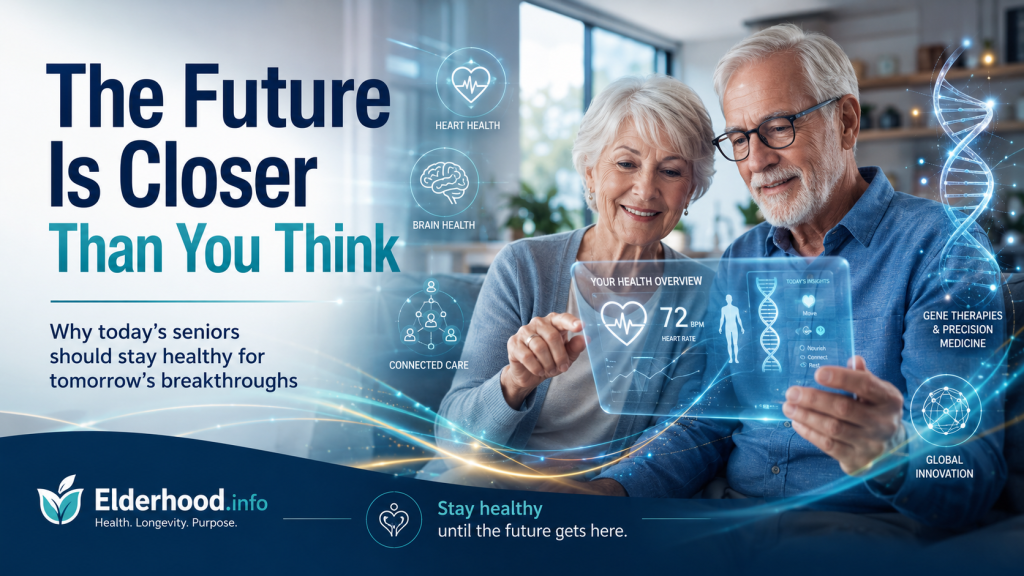
The future is closer than you think.
But here is the important part: you have to stay healthy enough to benefit from it.
Yesterday’s Miracle Becomes Today’s Normal
Think about what already happened in one lifetime.
Antibiotics became common. Cataract surgery became routine. Joint replacements became standard. Pacemakers became ordinary. MRI machines became part of normal diagnosis. Vaccines prevented diseases that once terrified families. Hearing technology improved. Telemedicine became real. Pills that once sounded impossible became everyday prescriptions.
Even something as simple as GPS would have seemed like science fiction not long ago. Now people get annoyed if the phone takes three seconds to reroute them around traffic.
That is how progress works.
First it seems impossible. Then it seems expensive. Then it seems normal.
Older adults have lived long enough to see this pattern again and again. That should give us perspective. When we hear about new research in Alzheimer’s disease, cancer, obesity, heart disease, arthritis, and healthy aging, we should not fall for every headline — but we also should not dismiss everything as fantasy.
The smart approach is hopeful skepticism.
Not gullible. Not cynical.
Hopeful, but with both feet on the ground.
Aging Research Is Changing
For many years, medicine mostly treated diseases after they appeared.
You had high blood pressure, so doctors treated blood pressure. You had diabetes, so they treated diabetes. You had arthritis, so they treated pain and inflammation. You had heart disease, so they treated the heart.
That still matters. But researchers are now paying more attention to aging itself — the biological processes that make the body more vulnerable over time.
In 2026, NIH-supported researchers announced a large-scale atlas of senescent cells, often called “zombie cells,” which are cells that stop dividing but do not die and may contribute to age-related diseases. The NIH said this kind of work could help inform future therapies for age-related conditions.
That does not mean a “cure for aging” is sitting at the pharmacy next Tuesday.
Let’s not get carried away.
But it does mean scientists are no longer only looking at one disease at a time. They are studying the machinery underneath aging: inflammation, cellular damage, immune decline, metabolism, muscle loss, brain changes, and tissue repair.
That is a major shift.
At Elderhood.info, this is exactly why healthy aging matters. The goal is not to pretend we can stop time. The goal is to improve the odds that we remain strong, clear-headed, and independent long enough to benefit from what science is bringing next.
The New Goal: Healthspan, Not Just Lifespan
Living longer is good only if those extra years are worth living.
Nobody wants twenty extra years of misery, weakness, confusion, and dependence. The better goal is healthspan — the number of years we live with good function, independence, and quality of life.
The World Health Organization’s healthy aging work focuses on maintaining intrinsic capacity and functional ability, meaning the abilities that allow people to live and participate in their communities. WHO’s ICOPE approach is designed to support person-centered, coordinated care for older adults.
That is the direction the world is slowly moving.
Not just “How long can we keep someone alive?”
But “How well can someone live?”
That is a better question.
Aging well is not about winning a beauty contest against your younger self. That contest is rigged anyway. Aging well is about strength, memory, mobility, purpose, energy, social connection, and independence.
It is about being able to get up, think clearly, move safely, make choices, and still participate in life.
AI May Speed Up Medical Discovery
Artificial intelligence is one of the most talked-about parts of the future, and yes, some of the hype is ridiculous.
Not every app with “AI” in the title is changing the world. Some are just making bad customer service more confusing.
But in medicine, AI may become genuinely important because it can analyze huge amounts of data faster than humans can. That matters in drug discovery, diagnosis, imaging, genetics, and research into existing medications that might be repurposed for new uses.
Researchers are already exploring network medicine and drug repurposing approaches for hallmarks of aging, using large biological datasets to identify compounds that may influence age-related pathways. Early research in this area is still experimental, but it shows how computing power could accelerate discoveries that once took much longer.
This is where seniors should be both excited and cautious.
AI is not magic. It can make mistakes. It can exaggerate. It can produce nonsense if used badly.
But when used carefully by researchers and doctors, it may help find patterns that were hidden in plain sight.
That could mean earlier diagnosis. Better drug matching. Faster clinical trials. More personalized treatment. And perhaps one day, better ways to slow or prevent age-related decline.
Alzheimer’s Research Is Moving
Alzheimer’s disease is one of the biggest fears of aging. Not because people are afraid of forgetting where they put the car keys — although that is annoying enough — but because dementia threatens identity, independence, and family life.
For decades, Alzheimer’s research was frustrating. There were many theories, many failures, and very few meaningful treatment options.
But the field is changing.
The National Institute on Aging’s 2025 dementia research progress report says NIH is making progress in identifying new biomarkers to detect pathologies related to Alzheimer’s and related dementias. Biomarkers matter because earlier and more accurate detection may eventually help doctors treat disease before it causes major damage.
New treatments have also started to appear, although they are not simple cures. Some amyloid-targeting drugs may slow decline in selected patients, but they come with strict eligibility requirements, monitoring needs, costs, and safety concerns. Reuters reported in 2025 that the FDA approved an injectable maintenance version of Leqembi for certain patients after 18 months of IV treatment, showing that delivery methods are also evolving.
That is progress, but not a miracle.
The real message for seniors is this: Alzheimer’s research is no longer standing still.
And while we wait for better tools, lifestyle still matters. The National Institute on Aging says healthy lifestyle choices may help address risk factors associated with Alzheimer’s disease and related dementias, even though no single behavior guarantees prevention.
That means walking, blood pressure control, healthy food, sleep, hearing care, social connection, and learning are not old-fashioned advice.
They may be part of keeping the brain resilient while science catches up.
Digital Health Is Coming Home
The future of health care is not only in hospitals. More of it is coming into the home.
Telehealth, remote monitoring, medication reminders, wearable devices, fall detection, digital blood pressure cuffs, glucose monitors, smart watches, and online patient portals are already changing care.
For seniors, this can be good — if the technology is simple, reliable, and respectful.
WHO has emphasized that age-friendly environments should help older adults live independently and participate fully in their communities, while also recognizing that digital health must not leave people behind.
That last part matters.
Technology should help older adults, not humiliate them. Nobody should need a PhD in button-pushing just to check a blood pressure reading.
The good version of digital health is simple: fewer unnecessary trips, better monitoring, earlier warnings, easier communication with doctors, and more support for aging in place.
The bad version is confusing apps, passwords nobody remembers, portals that look like they were designed by a committee of raccoons, and seniors being told, “Just go online,” as if that solves everything.
The future must be usable.
That is the standard.
New Medicines Are Arriving Faster
Another sign that the future is closer is the speed of new drug development.
The FDA reported that its Center for Drug Evaluation and Research approved 46 novel drugs in 2025 — drugs never before approved or marketed in the United States.
Not all of these are for aging. Not all will matter to every person. Some will be expensive. Some will help narrow groups of patients. Some will take years to prove their full value.
But the pipeline is real.
In 2026, the FDA’s novel drug approvals list included orforglipron for reducing excess body weight and maintaining long-term weight reduction in adults with obesity or overweight.
That kind of development matters because obesity, diabetes, heart disease, arthritis, sleep apnea, and mobility problems are deeply connected to aging.
Again, we should not pretend a pill replaces lifestyle. It does not.
But medicines are improving. Treatment options are expanding. And for many older adults, the combination of better medicine plus better habits may change what aging looks like.
The Catch: You Still Have to Do Your Part
This is where the conversation gets real.
The future may bring better drugs, better diagnostics, better technology, better surgery, better vaccines, better Alzheimer’s tools, better cancer treatments, better arthritis care, and better ways to monitor health at home.
Wonderful.
But none of that helps much if we ignore the body we are living in today.
You cannot sit on the couch for ten years, eat like a teenager, sleep like a college student during finals week, refuse to move, ignore blood pressure, avoid doctors, and then expect science to rescue you at the last minute like a helicopter in an action movie.
That is not a plan. That is a gamble.
The National Institute on Aging says research shows people can help preserve health and mobility as they age by adopting or continuing healthy habits and lifestyle choices.
That is the Elderhood message in plain English:
Stay healthy until the future gets here.
Eat better. Move more. Build muscle. Protect sleep. Check hearing. Watch blood pressure. Manage blood sugar. Stay socially connected. Learn new things. Keep your brain engaged. Ask questions. Review medications. Use preventive care.
Not because you are trying to become perfect.
Because you are trying to stay in the game.
The Small Choices Still Matter
The future may be high-tech, but many of the best things you can do are still simple.
Walk after meals.
Eat enough protein.
Choose berries, vegetables, beans, eggs, fish, yogurt, olive oil, and other real foods more often.
Reduce ultra-processed foods.
Protect your sleep.
Stay hydrated.
Keep your legs strong.
Take balance seriously.
Use hearing support if you need it.
Stay connected to people.
Learn something new.
See your doctor before small problems become big ones.
These habits may sound ordinary, but ordinary habits repeated daily are powerful.
Aging well is not usually one giant heroic act. It is thousands of small choices stacked over time.
And here is the encouraging part: you do not have to be perfect to improve.
You just have to start moving in the right direction.
Hope Is Not Denial
Some people hear optimism about the future and think it means ignoring reality.
No.
Hope is not denial.
Hope does not mean pretending arthritis does not hurt, memory problems are not scary, medications are not expensive, or the health care system is not confusing.
Hope means recognizing that change is happening and that your actions still matter.
Cynicism says, “Nothing will help.”
Gullibility says, “Everything is a miracle.”
Wisdom says, “Let’s pay attention, stay informed, use what is proven, question what is exaggerated, and keep ourselves as healthy as possible.”
That is the sweet spot.
That is Elderhood.
The Bottom Line
The future is closer than you think.
Medical research is changing. Aging science is becoming more serious. AI may speed up discovery. Alzheimer’s detection and treatment are evolving. Digital health is moving into the home. New medicines are arriving. Healthspan is becoming a major goal.
But the future is not just something scientists create.
It is something we prepare for.
The choices you make today — what you eat, how you move, how you sleep, whether you manage your blood pressure, whether you protect your muscles, whether you stay socially connected — may determine how ready you are for tomorrow’s breakthroughs.
You do not have to chase every headline. You do not have to buy every supplement. You do not have to believe every miracle claim.
But you should pay attention.
Because yesterday’s science fiction has a funny way of becoming today’s standard care.
And if the future is coming faster than we thought, then the smartest thing we can do is simple:
Stay healthy enough to meet it.
For more practical healthy-aging articles, visit Elderhood.info and keep learning how small choices today can protect your tomorrow.