
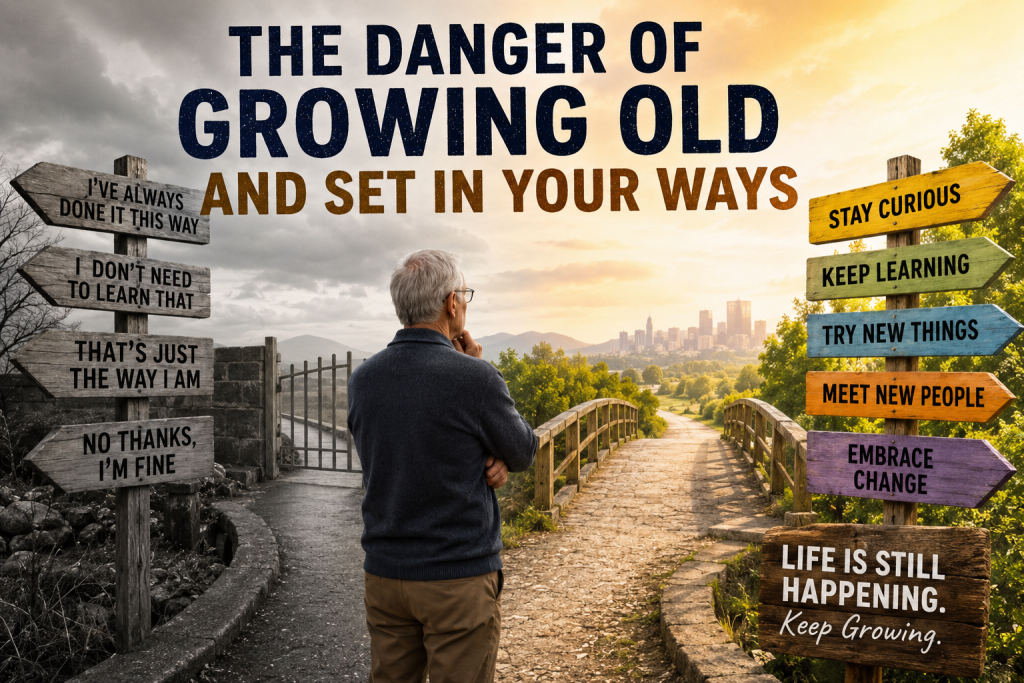
There is an old expression that says, “You can’t teach an old dog new tricks.”
It may be catchy, but it is also a terrible philosophy for growing older.
One of the greatest dangers of the senior years is not simply physical decline. It is the possibility that we gradually stop changing.
We stop trying new things.
We stop questioning old assumptions.
We stop learning.
We stop meeting new people.
We stop reconsidering beliefs we have carried for decades.
And little by little, life can become smaller.
The danger is not getting older.
The danger is becoming set in our ways.
Because the world keeps changing whether we participate in that change or not.
The World Is Not Going to Stop Changing for Us
Every generation experiences change, but today’s seniors have lived through an extraordinary amount of it.
Many people alive today grew up before computers, smartphones, streaming television, online banking, GPS navigation, artificial intelligence, and social media.
We have watched entire industries disappear and new ones appear almost overnight.
Something considered absolutely true 30 years ago may now be questioned.
Medical advice changes.
Nutrition advice changes.
Technology changes.
Relationships change.
Work changes.
Even the way we communicate with our own families changes.
The temptation as we grow older is to say:
“I don’t need any of that.”
Sometimes that’s perfectly reasonable.
Nobody is required to chase every new gadget or fashion.
But there is an important difference between consciously deciding something isn’t useful and automatically rejecting it because it is unfamiliar.
That distinction may determine whether we continue growing or begin slowly retreating from the world.
Familiarity Feels Safe
Human beings naturally like familiarity.
We develop routines because routines make life easier.
We know which grocery store we prefer.
We know where everything is in the kitchen.
We have our favorite chair.
Our favorite restaurant.
Our favorite television programs.
Perhaps even our favorite argument.
There is comfort in knowing what comes next.
And there is nothing wrong with routine.
In fact, good routines can be extremely useful.
The problem begins when routine becomes rigidity.
You begin saying:
“I’ve always done it this way.”
That sentence should occasionally set off a little alarm bell.
Because doing something for 40 years does not automatically make it the best way to continue doing it.
Sometimes the world has changed.
Sometimes the evidence has changed.
And sometimes we have changed.
The Courage to Change Your Mind
One of the most underrated forms of intelligence is the ability to say:
“I used to believe that. Now I think differently.”
That takes courage.
People sometimes treat changing one’s mind as weakness.
Actually, it can be the exact opposite.
Changing your mind because someone pressured you is one thing.
Changing your mind because better evidence appeared is wisdom.
Science itself works this way.
Researchers develop theories, test them, discover new evidence, and revise what they believed.
The scientific process depends on the willingness to admit:
“Perhaps we didn’t have the whole story.”
Harvard researchers have written about how learning and intellectually stimulating activity can help support cognitive health as people age. The brain continues to respond to experience throughout life. You can read more about maintaining cognitive health from Harvard Health Publishing.
That doesn’t mean we need to enroll in graduate school at 80.
It simply means the brain benefits when we continue asking it to do something besides replay yesterday.
Coffee Is a Perfect Example
Think about coffee.
For decades, many people were warned that coffee was something we should limit or avoid.
Today, the conversation is much more nuanced.
Researchers have found associations between moderate coffee consumption and various health outcomes, although coffee certainly isn’t appropriate for everyone and it isn’t a miracle medicine.
The point isn’t whether coffee is good or bad.
The point is that knowledge evolves.
What sounded like settled wisdom in 1985 may look very different in 2026.
The same thing has happened with dietary fat, eggs, exercise recommendations, hormone therapy, cholesterol treatment, sleep, and many other areas of health.
The National Institutes of Health regularly updates health information as new research emerges. Its National Institute on Aging provides an excellent example of how recommendations around healthy aging continue to evolve.
If our thinking never changes while knowledge changes around us, eventually we are not being consistent.
We’re simply being outdated.
Wisdom Is Not the Same as Stubbornness
Older people possess something younger people cannot instantly acquire:
experience.
You have seen ideas come and go.
You have watched booms and recessions.
You have seen relationships survive hardship.
You have probably made mistakes that once seemed catastrophic and later turned into useful lessons.
That experience has tremendous value.
But there is a trap.
Experience can quietly turn into certainty.
We begin believing that because something happened a certain way before, it must happen that way again.
That’s where wisdom can become stubbornness.
Wisdom says:
“I have seen this before, so I will use what I learned.”
Stubbornness says:
“I have seen everything worth seeing.”
Those are very different attitudes.
True wisdom keeps the door cracked open.
It leaves enough room for surprise.
Technology Is One of the Biggest Tests
Technology may be the clearest example of this challenge.
Many seniors understandably become frustrated with passwords, apps, updates, security codes, online accounts, QR codes, and devices that seem to change every six months.
You finally figure out where the button is.
Then somebody moves the button.
It can feel like the entire technology industry is engaged in a conspiracy against anyone over 65.
But there is another side to the story.
Technology can also help seniors:
- communicate with children and grandchildren,
- attend medical appointments remotely,
- monitor health,
- manage finances,
- learn almost anything,
- navigate unfamiliar places,
- hear better,
- translate languages,
- stay socially connected,
- and increasingly, use artificial intelligence to understand complicated information.
The goal isn’t to become a computer expert.
The goal is simply not to let frustration become surrender.
This connects directly to a larger idea we have explored in The Future Doesn’t Ask Your Age—It Asks Whether You Can Adapt.
Adaptability may become one of the most important skills of elderhood.
Being Set in Your Ways Can Shrink Your World
There is also a social cost to becoming rigid.
Imagine someone who says:
“I don’t like new restaurants.”
“I don’t travel anymore.”
“I don’t want to learn that.”
“I don’t like meeting new people.”
“I don’t listen to new music.”
“I don’t use technology.”
“I don’t go anywhere at night.”
“I don’t want to try that.”
Any one of those decisions may be perfectly reasonable.
But stack enough of them together and something happens.
Your world begins to shrink.
Not because the world rejected you.
Because you gradually stopped visiting it.
This becomes especially important after retirement.
Work used to automatically expose us to new people, new problems, new conversations, and new ideas.
When work disappears, that stimulation may disappear with it.
We often have to intentionally replace it.
That may mean joining a class, volunteering, traveling, learning a language, joining a discussion group, taking dance lessons, learning technology, or simply talking to someone you ordinarily wouldn’t.
The activity almost doesn’t matter.
The willingness does.
Your Identity Can Become a Prison
Another danger is becoming too attached to who we used to be.
For decades, people define themselves through careers, families, responsibilities, and social roles.
“I am a teacher.”
“I am a businessman.”
“I am a mother.”
“I am an engineer.”
“I am the person everyone depends on.”
Then retirement, widowhood, changing health, or children moving away can disrupt those identities.
The question becomes:
Who am I now?
Some people spend their senior years trying to preserve an identity that belonged to another chapter of life.
But elderhood offers something different.
You have the opportunity to reinvent yourself.
You can become interested in something you never had time for.
You can develop friendships with people you never would have met.
You can travel.
Create.
Teach.
Learn.
Write.
Dance.
Mentor.
Start a business.
Study philosophy.
Or simply become a more curious human being.
Age does not have to determine your decisions.
That idea is explored more deeply in Don’t Let Your Age Make Your Decisions for You.
Curiosity May Be One of the Best Anti-Aging Attitudes
Curiosity keeps life open.
Instead of saying:
“That’s ridiculous.”
Try:
“That’s interesting. Why do people believe that?”
Instead of:
“I don’t understand this technology.”
Try:
“Show me how it works.”
Instead of:
“I don’t eat that.”
Try:
“Maybe I’ll taste it.”
Instead of:
“People today are crazy.”
Try:
“The world is certainly different. I wonder what created that change?”
Curiosity does not require agreement.
You can understand an idea without adopting it.
You can learn about something and still reject it.
The difference is that you’ve made a decision based on knowledge rather than reflex.
That is a much stronger position.
The Brain Was Built to Keep Learning
Scientists once believed that the adult brain was relatively fixed.
Today we understand far more about neuroplasticity, the brain’s ability to reorganize and adapt in response to experience.
The concept does not mean aging disappears or that every cognitive change can be prevented.
But it reinforces an encouraging principle:
The brain remains responsive to what we do.
Learning new skills, physical activity, social engagement, and intellectually stimulating activities are all associated with healthier aging.
The National Institute on Aging discusses several factors connected with cognitive health, including physical activity, social connection, and managing overall health.
Once again, the message is not complicated.
Use your brain.
Give it something new to do.
Don’t let every day become an exact copy of the day before.
You Don’t Have to Change Everything
There is another extreme we should avoid.
Adaptability does not mean constantly changing everything.
Some things deserve to remain unchanged.
Your values may remain strong.
Your principles may remain strong.
Your loyalty to people may remain strong.
Your moral compass may remain strong.
Being adaptable doesn’t mean having no foundation.
A tree survives because it has both roots and flexibility.
If it had no roots, the wind would blow it away.
If it had no flexibility, the wind might break it.
People are not so different.
Keep the roots.
But allow the branches to move.
Try One New Thing
Perhaps the best way to avoid becoming set in your ways is surprisingly simple:
Periodically do something new.
Nothing dramatic is required.
Try a different restaurant.
Take another route home.
Listen to music from another generation.
Learn how an AI tool works.
Read a philosopher you’ve never read.
Take a class.
Try a different exercise.
Have lunch with someone younger.
Have lunch with someone older.
Travel somewhere unfamiliar.
Cook something you’ve never eaten.
Change your opinion when the evidence deserves it.
Even small acts of novelty remind us of something important:
Life is still happening.
And we are still participating in it.
Growing Older Should Not Mean Becoming Finished
Perhaps one of the saddest ideas about aging is that eventually a person becomes a completed product.
You reach a certain age and supposedly your personality, beliefs, habits, interests, and possibilities are permanently established.
Why?
Who made that rule?
If someone is 70 and lives to 95, that’s another 25 years.
Think about who you were 25 years ago.
Were you exactly the same person?
Probably not.
Why should the next 25 years contain less growth than the previous 25?
That question connects with another important elderhood principle discussed in Faith in the Future: Why Tomorrow Is Still Worth Showing Up For.
A future worth believing in is also a future worth preparing yourself to participate in.
The Real Danger
Growing old is unavoidable if we’re fortunate enough to live long enough.
Growing rigid is not.
The real danger is waking up one day and discovering that the world became unfamiliar, not because we were excluded from it, but because we stopped being curious about it.
There will always be new ideas.
New technology.
New discoveries.
New people.
New challenges.
And yes, some of them will be ridiculous.
Part of growing older is earning the right to recognize foolishness when we see it.
But we should be careful.
Sometimes what looks ridiculous today becomes ordinary tomorrow.
The senior years should not be a long defense of everything we already believe.
They can be something far more interesting.
They can be a continuing exploration of what we still don’t know.
So keep your experience.
Keep your values.
Keep the lessons you paid dearly to learn.
But leave one door open.
Because the moment we decide we already know everything worth knowing may be the moment we truly begin to grow old.
Chronological age is inevitable. Becoming set in your ways is a choice.
And perhaps one of the greatest secrets of elderhood is refusing to become finished before life is finished with us.