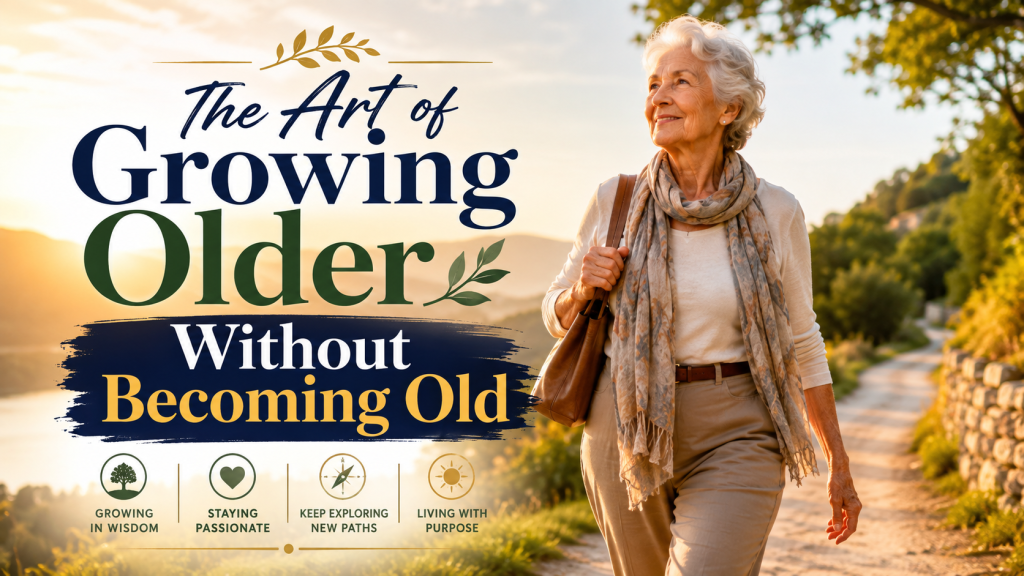
There is a difference between growing older and becoming old.
Growing older is unavoidable. The calendar takes care of that without asking our permission. Every birthday arrives right on schedule whether we are ready for it or not.
But becoming old?
That is more complicated.
You can meet someone in their 80s who is curious, involved, adaptable, interested in tomorrow, and still very much engaged with life. And you can meet someone twenty years younger who has already decided that their best years are behind them.
The difference isn’t the number on the driver’s license.
It is how we respond to the years we have been given.
Growing older happens to the body. Becoming old can happen in the mind long before the body gets the memo.
And perhaps one of the great challenges of elderhood is learning how to accept the first without surrendering to the second.
Your Age Is Information, Not Instructions
There is nothing wrong with knowing your age.
Your age is useful information.
It affects certain health risks. It may affect how quickly you recover. It can influence financial decisions, medical decisions, insurance choices, and how you plan for the future.
But somewhere along the way, many people begin treating age as a set of instructions.
“I’m too old for that.”
“People my age don’t do that.”
“I couldn’t possibly learn that now.”
“Why bother starting something new?”
Those sentences deserve to be questioned.
There are certainly things we should modify as our bodies change. Pretending to be 25 when you’re 75 isn’t wisdom. It’s denial.
But recognizing your limitations and allowing those limitations to define your entire life are two very different things.
The better question may not be:
How old am I?
It may be:
What am I still capable of doing, learning, enjoying, contributing, and becoming?
That’s a much more interesting conversation.
Don’t Let the World Shrink Around You
One of the quieter dangers of growing older is that life can gradually become smaller without our noticing it.
Work disappears.
Children build lives of their own.
Friends move away.
Some friends die.
Driving at night becomes less appealing.
Travel may become more difficult.
Going out takes more effort than it once did.
And modern conveniences make staying home remarkably easy.
You can have groceries delivered, meals delivered, prescriptions delivered, movies streamed, bills paid online, and practically anything you need dropped on your front porch.
Convenient?
Absolutely.
But convenience has an unintended consequence.
You can slowly eliminate many of the ordinary reasons you once had to interact with the world.
The National Institute on Aging warns that social isolation and loneliness are associated with greater risks of several health problems, including heart disease, depression, and cognitive decline.
That doesn’t mean everyone needs a packed social calendar.
It means we should pay attention when our world begins getting smaller.
We explored this same idea in Cultural Loneliness and Why We Don’t Bump Into People Anymore.
Sometimes staying young in spirit simply means continuing to participate.
Curiosity May Be One of the Best Anti-Aging Tools We Have
Children constantly ask questions.
Why?
How?
What happens if?
Somewhere along the road to adulthood, many of us stop.
We replace curiosity with certainty.
We know what foods we like.
We know what music we like.
We know what we believe.
We know which people we agree with.
We know how things should be done.
And eventually we can become prisoners of our own certainty.
That is why The Danger of Growing Old and Set in Your Ways may be about much more than stubbornness.
It is about whether we remain capable of changing our minds when the world gives us new information.
Curiosity keeps a window open.
Try a new restaurant.
Listen to music you normally wouldn’t choose.
Learn something about artificial intelligence.
Read a viewpoint you disagree with.
Talk to someone twenty years younger than you.
Ask them how they see the world.
You don’t have to agree.
That’s not the point.
The point is to remain interested.
The moment we believe there is nothing left worth learning, life becomes considerably smaller.
Keep Moving — But Not Because You’re Trying to Be Young
We sometimes talk about exercise as though its purpose is to make older people look younger.
That misses the larger point.
Movement helps preserve the ability to live independently and continue doing the things that matter to us.
The Centers for Disease Control and Prevention reports that regular physical activity in older adults helps improve physical function and can reduce the risk of falls and many chronic health problems.
That might mean walking.
Cycling.
Swimming.
Gardening.
Dancing.
Strength training.
Playing with grandchildren.
Or simply getting out of the chair more frequently.
The objective isn’t to win the Olympics.
It’s to preserve freedom.
The World Health Organization describes healthy aging not simply as the absence of disease, but as maintaining the functional ability that enables well-being in older age.
That is a powerful way of thinking about aging.
Can you still do the things that give your life meaning?
That’s a far more useful measurement than the number of candles on the cake.
Stop Comparing Today’s You With the Person You Were at 40
This may be one of the hardest adjustments of aging.
We remember ourselves at 30, 40, 50, or 60.
We remember what we could lift.
How fast we could run.
How late we could stay out.
How quickly we recovered.
How we looked in photographs.
Then we compare that person with the one staring back from the mirror today.
That’s an unfair competition.
The 40-year-old version of you had advantages you no longer have.
But today’s version of you possesses something the younger version didn’t.
Experience.
Perspective.
Patience.
A better understanding of what matters.
Perhaps fewer illusions.
And hopefully a better sense of humor about the whole thing.
The goal shouldn’t be to defeat your younger self.
The goal should be to make the most of the person you are now.
That idea connects directly with Stop Comparing Your Life to Someone Else’s.
Sometimes the person we’re comparing ourselves with is not another person at all.
It’s ourselves from thirty years ago.
Have Something Still Waiting for You
One of the most powerful questions we can ask ourselves in later life is very simple:
What am I looking forward to?
Not what did I enjoy.
Not what did I accomplish.
Not what did I used to do.
What am I looking forward to?
Tomorrow matters when something is waiting for us there.
It doesn’t have to be enormous.
A trip.
Dinner with a friend.
Learning something.
A project.
A dance class.
Planting a garden.
Starting a business.
Writing your story.
Seeing your grandchildren.
Meeting someone new.
Or simply waking up curious about what might happen next.
The National Institute on Aging notes that participating in enjoyable social and productive activities may contribute to better well-being as people age.
Purpose doesn’t require changing the world.
Sometimes purpose is simply having a reason to get up on Tuesday morning.
We explored that question more deeply in Are You Living or Just Passing Time? and What Makes a Life Worth Living?.
Keep People in Your Life
You don’t need fifty friends.
You need connection.
Someone to call.
Someone to laugh with.
Someone who knows your history.
And perhaps equally important, someone who doesn’t.
Older friendships give us continuity.
New friendships give us possibility.
Both matter.
The National Institute on Aging emphasizes staying connected with family, friends, neighbors, and community activities as one way to reduce isolation in later life.
And relationships do not have to look the way they did when we were younger.
Friendships change.
Families change.
Romantic relationships change.
Companionship can take different forms.
The important thing is not to close the door simply because the calendar says we should.
We’ve discussed this in Why Friendship Matters More as We Grow Older.
Human beings don’t outgrow the need for other human beings.
Adaptation May Matter More Than Age
The world we grew up in is disappearing.
That’s not pessimism.
That’s history.
The world our parents knew disappeared too.
And their parents before them.
Technology changes.
Language changes.
Culture changes.
Medicine changes.
Families change.
Work changes.
Communication changes.
Even dating changes.
Every generation eventually becomes an immigrant into a future it did not grow up in.
The temptation is to say:
“I don’t understand this new world.”
Fair enough.
But the dangerous next sentence is:
“And therefore I want nothing to do with it.”
Adaptation doesn’t mean loving every new development.
It means remaining willing to learn enough to function in the world that actually exists rather than wishing permanently for the one that disappeared.
As we discussed in The World Changed While We Were Living In It, the larger truth of aging may be adaptation.
Perhaps chronological age becomes less important than adaptability.
The future doesn’t ask how old you are.
It asks whether you can adapt.
Don’t Confuse Acceptance With Surrender
There are losses associated with age.
Pretending otherwise does seniors no favors.
Bodies change.
Energy changes.
People we love disappear.
Opportunities close.
Time becomes more valuable precisely because we understand that it isn’t unlimited.
Wisdom isn’t pretending those things aren’t happening.
Wisdom is acknowledging reality without surrendering unnecessarily.
There’s a difference between saying:
“I can’t do this the way I used to.”
and
“I can’t do anything anymore.”
Maybe you don’t run.
You walk.
Maybe you don’t travel for three months.
You travel for a week.
Maybe you don’t dance until midnight.
You leave at ten.
Maybe you don’t maintain the enormous house.
You move somewhere easier.
That’s not defeat.
That’s adaptation.
Aging well isn’t about refusing to change.
It’s about changing intelligently enough to keep living.
Protect Your Internal Vital Signs
We monitor blood pressure.
Heart rate.
Cholesterol.
Blood sugar.
Weight.
All important.
But there are other vital signs worth watching.
When did you last feel excited about something?
When did you last change your mind?
When did you last meet someone new?
When did you last laugh so hard you forgot how old you were?
When did you last make plans six months into the future?
When did you last try something you weren’t sure you could do?
These aren’t medical measurements.
They’re measurements of engagement.
And when those internal vital signs begin disappearing, pay attention.
Because sometimes the first sign of becoming old isn’t physical decline.
It’s losing interest in tomorrow.
Growing Older Is Inevitable. Becoming Old Is Negotiable.
None of us gets an exemption from aging.
If we’re fortunate, we’ll get a great deal of it.
There will be gray hair, wrinkles, stiff mornings, doctor appointments, hearing aids, reading glasses, and mysterious noises when we stand up.
That’s the price of admission.
But there is no rule saying curiosity must disappear.
No rule saying romance must disappear.
No rule saying purpose must disappear.
No rule saying humor must disappear.
No rule saying adventure must disappear.
And certainly no rule saying the future belongs exclusively to the young.
The art of growing older without becoming old isn’t about pretending age doesn’t exist.
It’s about refusing to let age make every decision.
Keep moving.
Keep learning.
Keep questioning.
Keep connecting.
Keep adapting.
And above all, keep something in front of you.
Because perhaps the real measure of youth was never how many years we’ve lived.
Perhaps it is whether we still believe there is something worth living for tomorrow.
Growing older?
If we’re lucky, that’s going to happen.
Becoming old?
We may have more say in that than we think.
Further Reading
For evidence-based information about healthy aging, visit the National Institute on Aging, the World Health Organization’s Healthy Ageing resources, and the CDC’s guidance on physical activity for adults 65 and older.