
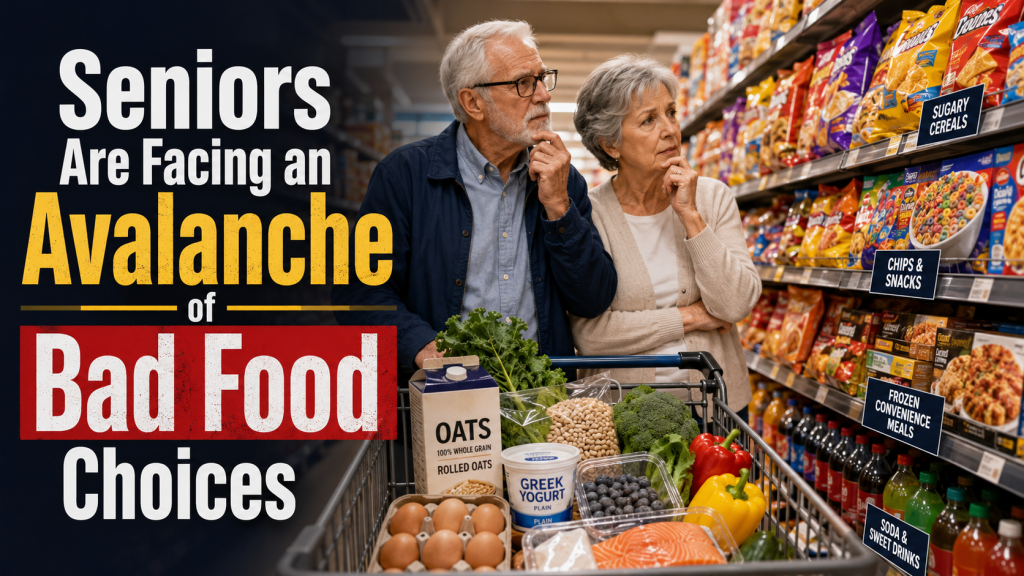
Aging does not happen in a quiet little room with a rocking chair and a bowl of oatmeal anymore. Aging now happens in the middle of a food hurricane.
Everywhere seniors turn, there is another bad food choice dressed up like convenience, savings, comfort, or a “limited time offer.” The grocery store is full of brightly colored boxes. The television is selling fast food. The pharmacy has candy at the checkout counter. The gas station has snacks bigger than some people’s lunch. And the freezer aisle is packed with meals that promise “homestyle cooking” but often taste like salt wearing a disguise.
This is not just about willpower. That is too easy, and frankly, it is not fair.
Seniors are facing an avalanche of bad food choices because the modern food environment is designed to make unhealthy eating easy, cheap-looking, convenient, and emotionally comforting. The problem is that older bodies often pay a higher price for those choices.
At Elderhood, we talk often about practical healthy aging, not perfection. You do not need to eat like a monk living on steamed kale and rainwater. But you do need to understand what is being done to you by the modern food system, because once you see it clearly, you can protect yourself from it.
That is especially important because healthy aging starts with the small choices you make every day. A single meal may not change your future, but your repeated meals become your pattern. And your pattern becomes your health.
The Modern Grocery Store Is Not Neutral
Years ago, food shopping was simpler. You bought meat, eggs, potatoes, vegetables, fruit, milk, bread, beans, soup ingredients, and maybe a treat. Today, the grocery store feels more like a casino with shopping carts.
Everything is designed to catch your eye.
The cereal boxes are bright. The chips are at the end of the aisle. The cookies are “family size,” even if the family moved out 30 years ago. Frozen meals promise comfort in six minutes. Protein bars pretend to be health food while tasting like candy bars with better public relations.
The problem is not that all packaged food is evil. That would be silly. Frozen vegetables are packaged food. Greek yogurt is packaged food. Canned sardines are packaged food. Oatmeal comes in a package. The issue is the rise of ultra-processed foods: products that are engineered to be easy to overeat, low in fiber, high in salt or sugar, and often low in the nutrients older adults need most.
Harvard’s Nutrition Source explains that highly processed foods are often associated with poorer health, especially when they are high in added sugars, sodium, and unhealthy fats. You can read more from Harvard here: Processed Foods and Health.
That does not mean you must panic every time you open a box. It means you should ask a better question: “Is this food feeding my body, or just entertaining my mouth?”
That one question can change a lot.
Seniors Need Fewer Calories, But Better Nutrition
Here is one of the cruel little tricks of aging: many older adults need fewer calories than they did when they were younger, but they still need plenty of nutrients.
That means the margin for error gets smaller.
When you are 25, you may get away with a questionable diet for a while. The body has more backup systems. At 70, 75, or 80, the body may be less forgiving. You may need protein to protect muscle, fiber to support digestion, calcium and vitamin D for bones, B vitamins for energy and nerve function, and healthy fats for the brain.
But many of the foods marketed hardest to older adults do not deliver much of that. They deliver calories, sodium, sugar, and convenience.
That is why nutrient-dense foods matter so much in elderhood. Eggs, Greek yogurt, cottage cheese, beans, fish, sardines, oatmeal, berries, frozen vegetables, olive oil, nuts, and simple home-cooked meals can do more for your future than another box of “crispy bites” with a smiling cartoon on the front.
For more on this simple approach, read Healthy Aging Starts With the Small Choices You Make Every Day.
The goal is not to become perfect. The goal is to stop wasting your limited appetite on foods that do not give much back.
Ultra-Processed Foods Are Designed to Win
This is where we need to stop blaming seniors and start blaming the system a little more.
Ultra-processed foods are not accidental. They are designed. They are tested. They are flavored, sweetened, salted, softened, colored, and packaged to make you want more.
Nobody accidentally makes a potato chip that is hard to stop eating. That is the business model.
The National Institutes of Health reported on a controlled study showing that people ate more calories and gained weight when eating ultra-processed foods compared with minimally processed foods, even when meals were matched for calories, sugar, fat, fiber, and macronutrients. You can read the NIH summary here: NIH Study Finds Heavily Processed Foods Cause Overeating and Weight Gain.
That is a big deal.
It tells us something many people already suspected from experience: these foods can push you to eat beyond what your body actually needs.
That is why “Why can’t I eat just one?” is not a silly question. It is the question. These foods are often designed so that one becomes three, three becomes ten, and suddenly the bag is looking at you like it has been robbed.
If you want to go deeper into that idea, read Why Can’t You Eat Just One?.
Once you understand that many snack foods are designed to work against you, it becomes easier to stop treating every craving like a personal failure.
Sometimes the food is not tempting because you are weak. Sometimes it is tempting because a team of food scientists made it that way.
Cheap Food Is Not Always Cheap
One of the biggest tricks in the modern food world is the idea that unhealthy food is cheap.
Sometimes it looks cheap. But look closer.
A bag of chips may cost several dollars and contain less actual potato than you imagine. A soda may look inexpensive, but it gives you sugar without nourishment. A fast-food meal may be convenient, but if it leaves you hungry again two hours later, how good a bargain was it?
Real food can also be affordable when you shop with a plan.
Oatmeal is still one of the great senior foods. Eggs are useful. Beans are inexpensive. Frozen vegetables do not spoil in three days like that bag of spring mix we all bought with good intentions. Sardines are rich in protein and omega-3 fats. Greek yogurt and cottage cheese can help with protein. Frozen berries can be cheaper than fresh and last longer.
This is not glamorous eating. This is practical eating.
And practical wins.
At this stage of life, the pantry matters. If the kitchen is full of cookies, crackers, sugary cereal, soda, and chips, you are going to eat them. Not because you are a bad person, but because you are human and they are there.
That is why one of the smartest healthy aging moves is not just to lose weight. It is to change your pantry.
You can read more here: Don’t Just Lose Weight. Change Your Pantry.
Your future self eats what your present self brings home.
Food Insecurity Makes the Problem Worse
We also have to tell the truth: not every senior has the same choices.
Some older adults are not choosing between salmon and sardines. They are choosing between food, medication, utilities, and rent. That is not a character flaw. That is a serious social problem.
The National Council on Aging notes that food insecurity among older adults is connected with lower intake of key nutrients, including protein, vitamins, magnesium, calcium, and iron. You can read more from NCOA here: Food Insecurity and Older Adults.
This matters because poor nutrition does not just show up as hunger. It can show up as weakness, fatigue, falls, poor healing, worsening diabetes, loss of muscle, and loss of independence.
That last word is important: independence.
For many seniors, nutrition is not about looking good in a bathing suit. It is about staying strong enough to live at home, climb stairs, carry groceries, recover from illness, and keep moving.
Good food is not vanity. It is maintenance.
A house needs maintenance. A car needs maintenance. A body that has carried you for 70 or 80 years certainly needs maintenance.
And unlike the old Buick, you cannot trade it in.
The Protein Problem
Many seniors do not get enough protein. Sometimes it is because of cost. Sometimes appetite goes down. Sometimes chewing becomes harder. Sometimes people are still eating the way they did 40 years ago, except now they eat less total food.
That can become a problem.
Muscle loss is one of the great enemies of aging. Less muscle can mean less strength, worse balance, more falls, slower recovery, and more dependence on others.
Protein helps protect muscle, especially when combined with movement. That does not mean everyone needs giant steaks or expensive powders. It means seniors should think about protein at each meal.
Good options may include eggs, Greek yogurt, cottage cheese, fish, chicken, beans, lentils, tofu, milk, and other simple foods. The right choice depends on your health, budget, appetite, and doctor’s advice, especially if you have kidney disease or another medical condition requiring a special diet.
But the larger point is simple: tea and toast is not a meal plan. It is a warning sign with butter.
Fiber Is Not Fancy, But It Works
Fiber may not sound exciting, but neither does a seatbelt. Both can save you trouble.
Fiber helps with digestion, fullness, cholesterol, blood sugar control, and gut health. Many ultra-processed foods are low in fiber because the natural structure of the food has been stripped away.
That is one reason whole foods matter.
Oatmeal, beans, lentils, vegetables, fruit, berries, whole grains, nuts, and seeds all bring fiber to the table. They also tend to take longer to eat and digest, which can help your body handle them better.
The modern food system loves speed. Fast food. Fast snacks. Fast meals. But older bodies often do better with slower food.
Food that takes a little chewing.
Food that looks like it came from a farm, not a laboratory.
Food your grandmother might recognize without needing a chemistry degree.
The Emotional Side of Food
Food is not just fuel. Anyone who says that has never smelled bread baking or watched someone defend their favorite pie.
Food is memory. Food is comfort. Food is childhood. Food is family. Food is reward.
That is why changing food habits later in life can be emotional.
Some people avoid healthy foods because of childhood memories. Maybe oatmeal was forced on them. Maybe vegetables were boiled into sadness. Maybe fish smelled terrible in the kitchen. Maybe beans were associated with hard times.
But elderhood requires adult decisions, not childhood reactions.
The food you rejected as a child may be the food your older body needs now.
That does not mean you must eat food you hate. It means you may need to try again with better preparation. Roasted vegetables are not the same as boiled vegetables. Greek yogurt with berries is not the same as sugary yogurt cups. Sardines on toast with mustard or lemon are not the same as some scary childhood memory from 1958.
Your taste buds can learn. Your habits can change. Your body can adapt.
That is the larger truth of aging: adaptation.
How Seniors Can Fight Back
The solution is not complicated, but it does require attention.
Start by improving the foods you eat most often. Do not worry about the birthday cake, the holiday meal, or the occasional restaurant dinner. Look at the daily pattern.
What is breakfast most days?
What is lunch most days?
What snacks are always in the house?
What do you eat when you are tired?
What do you eat when you are lonely?
What do you eat when you do not feel like cooking?
That last question is important. Every senior needs a “too tired to cook” plan that does not automatically become cookies, crackers, or drive-thru food.
That plan might be Greek yogurt and berries. Eggs and toast. Soup with beans. Tuna or sardines. Cottage cheese and fruit. A frozen vegetable omelet. Leftovers. A simple sandwich with real protein.
Healthy aging is easier when the better choice is already in the kitchen.
A Simple Elderhood Food Rule
Here is a simple rule:
Add before you subtract.
Add protein. Add berries. Add vegetables. Add beans. Add water. Add a short walk after meals. Add a better breakfast. Add frozen vegetables to the freezer. Add plain Greek yogurt instead of sugary yogurt. Add foods that help your body.
When you add enough good food, some of the bad food starts getting crowded out.
That is much easier than trying to live on guilt and restriction.
Restriction makes people miserable. Replacement makes people stronger.
Final Takeaway
Seniors are not failing because they lack willpower. Seniors are living in a food environment that is louder, faster, sweeter, saltier, and more processed than anything previous generations faced.
The avalanche is real.
But once you see it, you can step out of the way.
You do not need a perfect diet. You need a better pattern. More protein. More fiber. More simple foods. Fewer foods designed to make you overeat. Less panic. More planning.
Aging well is not about chasing every new diet trend. It is about making steady choices that protect your strength, your brain, your heart, your balance, and your independence.
The food industry has a plan for your appetite.
You need a plan for your health.
And that plan can start with the next meal.