
There was a time when aging came with a quiet instruction manual.
Slow down. Step aside. Let the younger people handle it. Sit in the chair. Watch the news. Complain about the price of eggs.
Well, that instruction manual is outdated.
Today’s elderhood is different.
People are living longer. Many are healthier, sharper, more active, and more informed than any older generation before them. We are not simply “getting old.” We are entering a new stage of life with its own purpose, challenges, opportunities, and responsibilities.
That is why one of the new rules of aging is this:
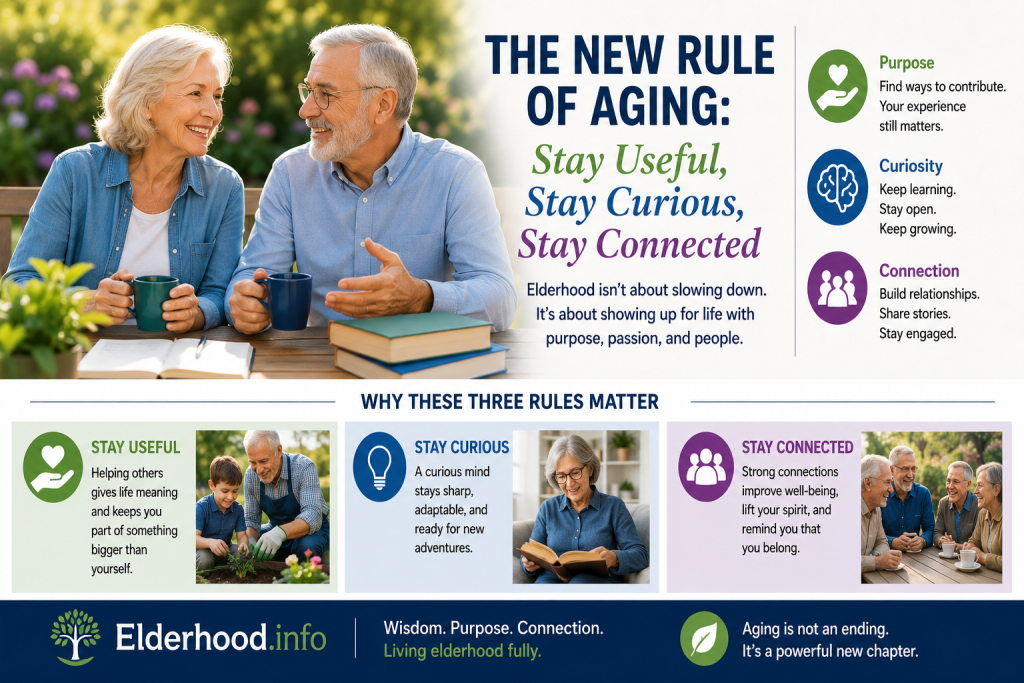
Stay useful. Stay curious. Stay connected.
Not because you have to prove anything.
Not because you should pretend to be young.
But because human beings are not built to disappear.
We are built to contribute, learn, love, laugh, teach, and remain part of the world.
Elderhood is not a waiting room.
It is a stage of life.
And it deserves to be lived with intention.
The Old Idea of Retirement Was Too Small
For many years, retirement was presented as the finish line.
You worked. You saved. You retired. Then the story got fuzzy.
Maybe you moved to a warm place. Maybe you played golf. Maybe you sat on the porch and explained to strangers how much better tomatoes used to taste.
Nothing wrong with golf. Nothing wrong with porches. And tomatoes probably were better.
But the deeper question is this:
What are we supposed to do with 20, 25, or 30 extra years of life?
That is the question earlier generations often did not have to answer.
Many people today are living long enough to need a second life plan. Not a career plan in the old sense. A purpose plan.
A reason to get up.
A reason to care.
A reason to keep learning.
A reason to stay in the game.
That is elderhood.
Stay Useful
Staying useful does not mean working full-time or exhausting yourself.
It means staying connected to contribution.
That contribution can take many forms.
Helping family.
Mentoring younger people.
Volunteering.
Teaching a skill.
Sharing stories.
Creating art.
Writing.
Starting a small project.
Supporting a community.
Helping another senior navigate something you already understand.
Being useful gives life structure.
It reminds us that our experience still matters.
And frankly, after decades of living, working, struggling, raising families, paying bills, surviving recessions, illnesses, disappointments, and bad haircuts, we know a few things.
The world should not waste that.
But here is the tricky part: sometimes older adults wait for someone to ask them to be useful.
Do not wait.
Offer.
Call.
Show up.
Write it down.
Make the video.
Share the lesson.
Start small.
Use what you know.
Elderhood is not about being needed by everyone.
It is about remaining available to life.
Usefulness Protects Dignity
One reason usefulness matters is because it protects dignity.
When people feel useless, they often begin to shrink emotionally.
They may stop speaking up. Stop trying new things. Stop making plans. Stop believing they have anything to offer.
That is dangerous.
A person who feels useless can start living like a guest in their own life.
Nobody should feel that way.
Usefulness does not have to be dramatic.
You can be useful by calling someone who is lonely.
You can be useful by teaching a grandchild how to cook.
You can be useful by sharing a practical warning about scams.
You can be useful by helping another senior understand Medicare, technology, transportation, grief, health, or money.
You can be useful by being kind when the world feels rude.
Small usefulness counts.
Sometimes small usefulness is the most powerful kind.
Stay Curious
Curiosity is one of the great anti-aging tools of the mind.
Not a pill.
Not a powder.
Not something advertised by a fellow in a white coat holding a clipboard.
Curiosity keeps the brain engaged.
It asks, “What is this? How does it work? What can I learn? What is changing? What did I miss? What can I still become?”
A curious person is not finished.
That is the key.
The brain needs stimulation. It needs novelty. It needs challenge. It needs conversation. It needs surprise. It needs problems to solve.
That does not mean you have to learn calculus at 75.
Unless you want to, in which case, God bless you and your calculator.
Curiosity can be simple.
Learn a new recipe.
Study a country you want to visit.
Try a new walking route.
Read about a medical discovery.
Learn how artificial intelligence works.
Take a class.
Ask better questions.
Listen to younger people without immediately saying, “In my day…”
Curiosity keeps the door open.
And as long as the door is open, life can still walk in.
Curiosity Also Protects Against Fear
The modern world changes fast.
Technology changes. Healthcare changes. Money changes. Medicare changes. Social life changes. Even grocery stores change. You walk in for eggs and somehow need an app, a card, a barcode, and the patience of a saint.
It is easy to become frustrated.
But curiosity gives us another option.
Instead of saying, “This is too much,” we can say, “Let me understand this.”
That small shift matters.
Fear closes the mind.
Curiosity opens it.
You do not have to love every change. Some changes are ridiculous. Let’s be honest, not every “innovation” deserves applause.
But learning enough to navigate the world helps preserve independence.
Curiosity is not just intellectual.
It is practical survival.
Stay Connected
Connection may be the most important rule of all.
Human beings are social creatures. We need other people. Not constantly. Not noisily. Not in our kitchen every morning touching the thermostat.
But we need connection.
Loneliness is one of the great challenges of elderhood.
People retire. Friends move away. Spouses pass. Families scatter. Health issues limit activities. Driving may become harder. Social circles shrink.
And slowly, a person’s world can become smaller.
That shrinking is dangerous.
Connection protects the heart, the mind, and the spirit.
It gives us witnesses to our lives.
Someone to laugh with.
Someone to remember with.
Someone to call when the sink makes a noise that sounds expensive.
Connection Requires Effort
Here is the part nobody likes:
Connection does not always happen automatically.
When we were younger, connection was built into life. School. Work. Children. Neighbors. Activities. Obligations. Noise.
Later in life, connection may require intention.
You may need to call first.
You may need to join the group.
You may need to invite someone for coffee.
You may need to learn video calls.
You may need to attend the class even when you do not feel like going.
You may need to build new friendships instead of only mourning old ones.
That does not mean replacing people you loved.
Nobody replaces them.
But the heart can make room for new connection without betraying old love.
That is one of the great lessons of elderhood.
The Three Rules Work Together
Usefulness, curiosity, and connection are not separate.
They feed each other.
When you stay useful, you often stay connected.
When you stay curious, you often find new ways to be useful.
When you stay connected, you often discover new things to learn.
This creates momentum.
And momentum matters.
A person with momentum does not feel like life is over.
They feel like life is still moving.
Maybe slower.
Maybe with better shoes.
Maybe with more doctor appointments than anyone requested.
But still moving.
That is the point.
What This Looks Like in Real Life
Here is what this new rule of aging might look like in ordinary life:
You join a walking group.
You teach someone how to make a family recipe.
You volunteer once a week.
You take an online class.
You write down your life stories.
You call a friend every Sunday.
You learn how to avoid online scams.
You start a small garden.
You mentor a younger person.
You go dancing.
You help another senior compare options.
You read about new science.
You start a project that gives your week shape.
None of this has to be grand.
But it has to be real.
Life gets better when it has rhythm, meaning, and people in it.
Do Not Wait Until You Feel Ready
A common mistake in elderhood is waiting.
Waiting until you feel more energetic.
Waiting until someone invites you.
Waiting until the weather is better.
Waiting until your knee improves.
Waiting until you lose weight.
Waiting until you feel confident.
Waiting until life becomes easier.
Sometimes waiting is wisdom.
But sometimes waiting becomes a very polite form of giving up.
Start small.
Make one call.
Take one walk.
Read one article.
Write one memory.
Join one group.
Help one person.
Learn one new thing.
Small steps count because small steps restart motion.
And motion changes mood.
Elderhood Is a New Responsibility
Living longer is a gift, but it is also a responsibility.
We have to learn how to live these extra years well.
That means taking care of the body, yes.
But also the mind.
The relationships.
The purpose.
The curiosity.
The courage to begin again.
The willingness to stay visible.
Older adults should not disappear from the story.
We are part of the story.
In some ways, we may be the people who understand the story best because we have seen more chapters.
That perspective matters.
Final Thought
The new rule of aging is not complicated.
Stay useful.
Stay curious.
Stay connected.
That is not a slogan.
It is a survival plan.
Usefulness gives dignity.
Curiosity keeps the mind alive.
Connection keeps the heart from closing.
Together, they help transform aging from decline into elderhood.
And elderhood, properly lived, is not about fading away.
It is about becoming wiser, more intentional, and more fully human.
You are not done.
You are not invisible.
You are not too old to begin again.
The world may not always say it clearly, so let Elderhood.info say it:
You still belong in the conversation.
And you still have something to give.

FAQ Section
What is the new rule of aging?
The new rule of aging is simple: stay useful, stay curious, and stay connected. Elderhood should not be treated as a time to disappear. It should be a stage of life filled with purpose, learning, relationships, and contribution.
Why is staying useful important as we age?
Staying useful helps protect dignity and purpose. It reminds older adults that their experience, wisdom, and presence still matter. Usefulness can be as simple as helping family, mentoring someone younger, volunteering, sharing stories, or checking in on a friend.
How does curiosity help seniors?
Curiosity keeps the mind active. Learning new things, asking questions, reading, taking classes, using technology, or exploring new interests can help seniors stay mentally engaged and more confident in a changing world.
Why is social connection so important in elderhood?
Connection helps protect emotional well-being. As people age, social circles can shrink because of retirement, loss, health changes, or distance from family. Staying connected helps reduce isolation and gives life more meaning, laughter, and support.
What are simple ways seniors can stay connected?
Simple ways include calling friends regularly, joining a walking group, attending community events, taking a class, volunteering, joining a faith or social group, using video calls, or inviting someone for coffee.
Does staying useful mean I have to keep working?
No. Staying useful does not mean working full-time or exhausting yourself. It means continuing to contribute in ways that fit your energy, health, skills, and interests.
What if I feel too old to start something new?
You are not too old. Starting small is the key. Make one call, take one walk, join one group, read one article, write one memory, or help one person. Small steps can restart momentum.
How can elderhood be different from old-fashioned retirement?
Old-fashioned retirement often focused on stopping work. Elderhood is broader. It includes purpose, health, relationships, curiosity, contribution, and living with intention during the later stage of life.
Can purpose improve quality of life for seniors?
Yes. Having purpose can give structure, motivation, and emotional strength. Purpose does not have to be grand. It can come from family, friendship, creativity, service, learning, faith, community, or personal growth.
What is the main message of this article?
The main message is that aging is not the end of participation. Seniors still belong in the conversation. Elderhood is a powerful stage of life where people can continue to learn, contribute, connect, and live fully.
Read Other Blog :- Read Now