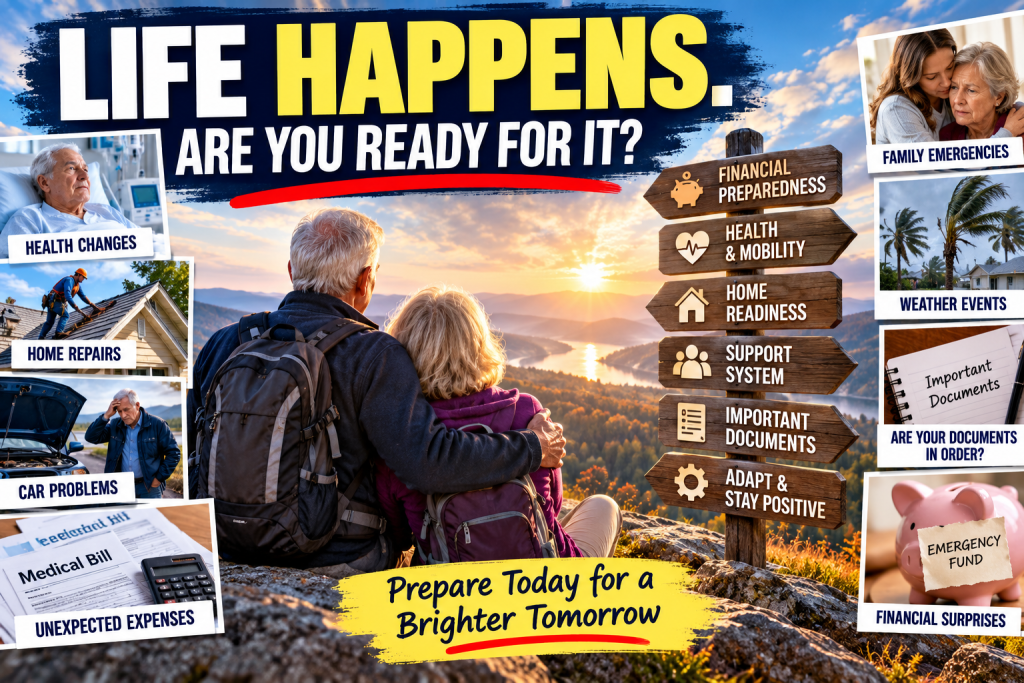
There comes a point in life when you realize something nobody bothered to mention when you were younger:
Life does not care about your schedule.
You can plan carefully.
You can save money.
You can take care of your health.
You can do almost everything right.
And then life walks through the front door carrying a surprise you did not order.
A medical bill.
A home repair.
A job loss.
A family emergency.
A storm.
A broken appliance.
A sudden move.
A spouse becoming ill.
A car that decides it has reached retirement before you have.
That is life.
The goal is not to eliminate surprises.
You can’t.
The goal is to become harder to surprise.
That may be one of the most important lessons of elderhood.
The Real Meaning of “Being Prepared”
When people hear the phrase “be prepared,” they sometimes imagine bunkers, canned beans, batteries, and enough bottled water to survive the fall of civilization.
That is not what I mean.
I mean having enough financial, emotional, practical, and physical flexibility that an unexpected event does not immediately knock your life off the rails.
Preparedness is not paranoia.
It is margin.
Margin in your bank account.
Margin in your schedule.
Margin in your health.
Margin in your relationships.
Margin in your thinking.
When life becomes difficult, margin gives you room to move.
Without it, even a relatively small problem can turn into a crisis.
The Six-Month Rule Still Makes Sense
Years ago, financial advisors frequently told people to build an emergency reserve before making investments.
The traditional advice was simple:
Keep enough cash available to cover several months of living expenses.
That advice may sound boring.
It is.
Boring can be beautiful when the furnace dies in January.
An emergency fund does not produce exciting returns.
It does something more important.
It buys time.
Time to think.
Time to make decisions.
Time to avoid using high-interest credit cards.
Time to avoid selling investments at the worst possible moment.
Time to avoid panic.
For older adults, this can be even more important because replacing lost income may be harder than it was at age 35.
If your retirement income is largely fixed, a sudden $5,000 or $10,000 expense is not just inconvenient.
It can alter your entire budget.
That is why cash reserves still matter.
Your House May Be Worth a Fortune and Still Leave You Cash-Poor
This is one of the great contradictions of modern retirement.
A person may live in a house worth hundreds of thousands of dollars and still struggle to come up with money for a new roof.
Homeowners sometimes forget that owning a house is not the same as having liquid money.
The house may be valuable.
But the plumber does not usually accept a bathroom wall as payment.
Older homeowners should know the major systems in their homes and roughly how old they are.
Roof.
Heating system.
Air conditioning.
Water heater.
Electrical system.
Plumbing.
Septic or sewer systems.
Appliances.
If several major items are nearing the end of their expected useful life, that is not bad luck waiting to happen.
That is a predictable future expense.
You may not know the exact date.
But you know the bill is eventually coming.
That is the difference between an emergency and poor planning.
Debt Changes Everything
Debt can turn a manageable problem into a dangerous one.
When interest rates are high, carrying credit card balances becomes especially expensive.
The Federal Reserve regularly publishes data showing consumer credit conditions and interest-rate trends. Older adults should pay attention to those numbers because high borrowing costs can quietly erode retirement security.
A person who has cash reserves can often pay for an emergency directly.
A person with no reserves may put the same expense on a credit card and then spend years paying interest.
That is why reducing expensive debt in later life can be just as important as increasing investment returns.
One dollar you do not owe is one dollar you do not have to find later.
Health Is Part of Financial Preparedness
People often separate health planning from financial planning.
That is a mistake.
Your health may be one of the largest financial variables in your later years.
The stronger and more mobile you remain, the more options you usually have.
That does not mean illness is always preventable.
Of course not.
But physical resilience matters.
Can you climb stairs?
Can you get up from a chair without using your arms?
Can you carry groceries?
Can you walk for 20 minutes?
Can you recover reasonably well from illness?
These are not just fitness questions.
They are independence questions.
Maintaining muscle strength, balance, cardiovascular fitness, and mobility can help preserve the ability to live independently.
The National Institute on Aging offers extensive guidance on exercise, healthy aging, balance, and fall prevention. It is worth exploring their resources if you want practical, evidence-based information.
At Elderhood, we keep returning to one central idea:
Aging is inevitable. Decline is not always inevitable.
Some decline may occur.
But adaptation can continue for a very long time.
Know Who You Would Call
Here is a simple question.
If you had an emergency tonight, who would you call?
Not 911.
I mean who would you call after that?
A child?
A neighbor?
A friend?
A sibling?
A trusted professional?
Many older adults underestimate the importance of having a dependable network.
Independence does not mean isolation.
In fact, people who insist they need nobody can become more vulnerable.
A good support system is a form of insurance.
You may not need it every day.
But when you need it, you really need it.
Make sure at least one trusted person knows where to find important information.
Insurance policies.
Medical information.
Financial contacts.
Legal documents.
House keys.
Emergency contacts.
You do not need to hand over control of your life.
You simply need a backup plan.
Documents Matter More Than People Think
There are several documents that become increasingly important as we age.
A will.
A healthcare proxy.
A durable power of attorney.
Beneficiary designations.
Property documents.
Insurance information.
Funeral wishes, if you have them.
A list of important accounts.
The details vary by state and individual circumstances, so legal questions should be discussed with a qualified attorney.
The purpose is not to dwell on death.
The purpose is to reduce chaos.
Good planning is one of the kindest gifts you can give your family.
It means they are not left trying to guess what you wanted during an already difficult time.
Technology Is Now Part of Emergency Preparedness
Thirty years ago, emergency planning meant keeping important phone numbers near the kitchen telephone.
Today, technology is woven into almost every part of life.
Banking.
Medical appointments.
Insurance.
Passwords.
Bills.
Communication.
Travel.
Transportation.
That creates convenience.
It also creates vulnerability.
What happens if your phone stops working?
What happens if you forget a password?
What happens if you are hospitalized and someone needs to access important information?
Older adults should have a sensible system for storing critical digital information securely.
Do not write every password on a piece of paper labeled “Passwords” and tape it to the computer.
That would be convenient for you and even more convenient for the burglar.
Consider a reputable password manager, multifactor authentication, and a secure way for a trusted person to access essential information if necessary.
The Federal Trade Commission also provides practical information about scams and identity theft, which is especially important because older adults remain frequent targets of fraud.
Being prepared today includes digital preparedness.
Transportation Deserves a Backup Plan
This issue sneaks up on people.
You have driven for 60 years.
Your car is in the driveway.
Everything seems fine.
Then suddenly the car needs a major repair.
Or you are temporarily unable to drive.
Or your eyesight changes.
Or you decide night driving is no longer comfortable.
What then?
Know the transportation options in your community before you need them.
Public transit.
Senior transportation programs.
Taxi services.
Rideshare services.
Friends and family.
Medical transportation.
Local volunteer organizations.
The best time to learn how these systems work is before your keys are temporarily unavailable.
Food, Medication, and Basic Supplies
There is nothing dramatic about keeping a few days of basic supplies at home.
In fact, it is just common sense.
Weather emergencies happen.
Power outages happen.
Stores close.
People get sick.
Keep enough food, water, medication, and basic household supplies to get through a short disruption.
The Federal Emergency Management Agency recommends maintaining emergency supplies and having a household emergency plan.
Again, this is not about preparing for the end of the world.
It is about avoiding a trip to the supermarket during an ice storm because you ran out of coffee.
Civilization may survive.
You might not survive the morning without coffee.
The Emotional Side of Preparedness
Financial and practical planning receive most of the attention.
But emotional resilience matters too.
How do you react when something goes wrong?
Some people immediately catastrophize.
“This is a disaster.”
“My life is ruined.”
“Everything is falling apart.”
Others pause and ask:
“What is the actual problem?”
“What can I control?”
“What is the next step?”
That difference matters.
The ability to remain reasonably calm during difficulty is a skill.
And like other skills, it can improve with practice.
One useful habit is to separate the problem from the story you tell yourself about the problem.
The car needs a new transmission.
That is the problem.
“My retirement is destroyed and I am doomed” is the story.
Deal with the problem first.
Save the Hollywood script for later.
Reinvention Is Part of Elderhood
One of the great myths about aging is that older people should spend their remaining years trying to preserve life exactly as it was.
That is impossible.
Life changes.
Families change.
Communities change.
Technology changes.
The economy changes.
Our bodies change.
The people who seem to age most successfully are often not the people whose lives remained unchanged.
They are the people who learned how to adjust.
That is why I believe the larger truth of aging is adaptation.
You may need to change how you exercise.
Change how you travel.
Change how you manage money.
Change where you live.
Change how you socialize.
Change the technology you use.
Change the way you think about retirement.
Adaptation is not surrender.
It is intelligence.
Ask Yourself These Questions
Take a few minutes and think through your own life.
If you had a major home repair tomorrow, could you pay for it?
If your income dropped temporarily, how long could you manage?
If you became ill, who would help you?
If your car stopped working, how would you get around?
If your phone disappeared, could you access your accounts?
Do your family members know where your important documents are?
Do you have enough basic supplies to remain home for several days?
Do you have expensive debt that would make an emergency worse?
Do you have a realistic plan for maintaining your health and mobility?
You do not need perfect answers.
You just need honest ones.
Preparedness Creates Freedom
This may be the most important point.
Preparation is not about living in fear.
It is about reducing fear.
When you know you have emergency savings, you sleep a little better.
When your documents are organized, you worry less.
When you have people you can call, you feel less alone.
When you are physically stronger, you have more confidence.
When you understand your finances, surprises are less frightening.
Preparedness creates options.
And options create freedom.
That is especially important in elderhood.
The goal is not merely to live longer.
The goal is to remain capable, independent, curious, and engaged for as long as possible.
Life will continue to happen.
That part is guaranteed.
The question is:
Are you ready for it?
At Elderhood.info, we believe aging is not simply something that happens to you.
It is something you can participate in.
Prepare.
Adapt.
Keep learning.
Stay connected.
Protect your health.
Protect your finances.
And keep moving forward.
Because the fourth quarter of life can still contain some very good plays.