
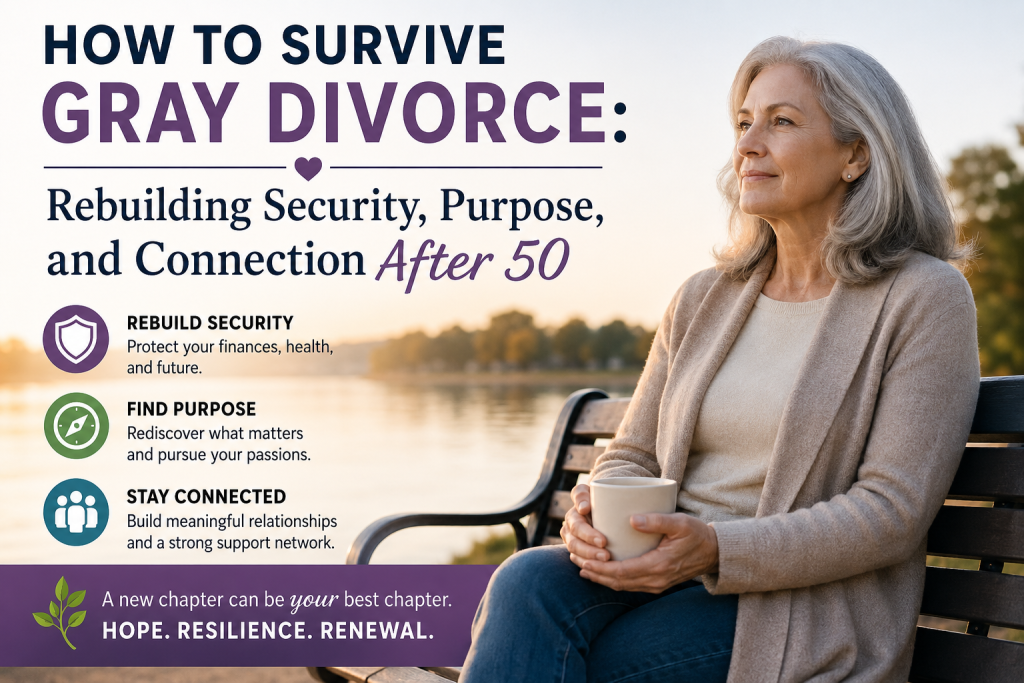
Divorce is difficult at any age. But divorce after 50—often called gray divorce—creates a different set of challenges.
You may not be arguing about child custody or who keeps the swing set. Instead, you may be dividing retirement accounts, deciding what happens to the family home, reconsidering your healthcare, and wondering who will be there if you become sick later in life.
After decades of marriage, divorce is not merely the loss of a spouse. It can feel like the loss of your history, your financial structure, your social identity, your daily routine, and the future you assumed you were building together.
That is the hard truth.
But it is not the whole truth.
Surviving gray divorce is not simply about enduring the end of a marriage. It is about creating a new definition of security, independence, purpose, companionship, and belonging.
Your old life may be ending, but your life is not over.
Gray Divorce Is Becoming More Common
Gray divorce is no longer unusual. Researchers at Bowling Green State University report that nearly 40% of people divorcing in the United States are now age 50 or older. The share of older adults who are divorced has also risen sharply since 1990. (Bowling Green State University)
There are many possible reasons.
People are living longer. Women are more financially independent than previous generations. Children leave home, retirement changes daily routines, and couples sometimes discover that they have spent decades managing responsibilities without maintaining a meaningful relationship.
A marriage that was held together by children, careers, mortgages, and schedules may begin to look very different when those structures disappear.
Some people remain in an unhappy marriage because they fear loneliness or financial insecurity. Others reach a point where they decide that spending another 20 or 30 years in an unhealthy relationship is a greater risk than beginning again.
There is no single explanation—and no single correct decision.
But when gray divorce happens, it requires more than an emotional response. It requires a plan.
First, Do Not Make Every Decision While Emotionally Wounded
Divorce can produce anger, grief, fear, embarrassment, relief, resentment, and confusion—sometimes before breakfast.
That emotional storm can lead people to make permanent decisions simply to stop temporary pain.
One person may insist on keeping the house because it represents victory, familiarity, or emotional security. Six months later, the taxes, maintenance, insurance, and repairs may become unaffordable.
Another person may accept a poor settlement because they want the conflict to end. Someone else may spend money recklessly because they feel newly liberated.
Pause.
You do not have to solve the rest of your life in one afternoon.
Before agreeing to anything significant, give yourself time to understand the consequences. Obtain professional legal and financial advice appropriate to your state and circumstances. Do not depend entirely on what your spouse says, what a friend experienced, or what someone confidently announces on social media.
A gut feeling can warn you that something is wrong. It cannot calculate taxes, pension values, healthcare costs, or how long your savings must last.
Understand Your Complete Financial Life
In a gray divorce, the financial stakes may be especially high because there is less time to recover from serious mistakes.
Someone divorcing at 35 may have another 30 working years to rebuild. Someone divorcing at 70 may be living primarily on Social Security, a pension, retirement savings, and investment income.
Begin by creating a complete inventory of your financial life. Include:
- Bank and investment accounts
- Retirement plans and pensions
- Social Security benefits
- Real estate
- Mortgages and other debts
- Life insurance
- Annuities
- Business interests
- Credit cards
- Vehicles and valuable personal property
- Regular household expenses
- Healthcare and long-term-care costs
Do not focus only on what an asset is worth today. Ask what it will cost to own, maintain, insure, sell, or withdraw from later.
A $500,000 retirement account is not necessarily equal to a $500,000 house. Retirement withdrawals may create taxes. The house may require repairs, property taxes, heating, insurance, and maintenance.
Equal numbers on paper do not always create equal financial security.
A financial professional experienced in divorce may help you compare possible settlements and understand what your income and expenses could look like afterward. AARP also provides a useful overview of steps people can take to protect their finances during divorce.
Be Careful With Retirement Accounts and Pensions
Retirement benefits are often among the largest assets in a long marriage.
Certain employer-sponsored retirement-plan benefits may need to be divided through a Qualified Domestic Relations Order, commonly called a QDRO. This is a specialized legal order directing a retirement plan to pay an approved share of benefits to a spouse or former spouse.
A divorce decree by itself may not always complete that process. The order must generally meet the retirement plan’s requirements and be accepted by the plan administrator. The IRS explains the basic rules in its guidance on QDROs and divorce.
Pensions require especially careful attention.
Questions may include:
- When can payments begin?
- Is the pension reduced if survivor protection is selected?
- What happens if the pension holder dies?
- Is a former spouse entitled to survivor benefits?
- Are cost-of-living increases included?
- Has the pension already entered payment status?
Do not assume these details will somehow work themselves out.
They usually do not.
Check Your Social Security Rights
Divorce does not necessarily eliminate every possible Social Security benefit connected to a former spouse.
Under current Social Security rules, a divorced person may qualify for benefits based on an ex-spouse’s work record when certain requirements are met, including a marriage lasting at least 10 years. Eligibility depends on age, marital status, personal benefit amounts, and other factors.
Receiving a divorced-spouse benefit generally does not reduce the ex-spouse’s own retirement benefit.
Survivor benefits may also be available after an ex-spouse dies under a separate set of requirements. The rules can change depending on when a person remarries.
The Social Security Administration provides information about spousal and divorced-spouse benefits and survivor benefits for former spouses. Before making a claiming decision, obtain an estimate based on your own record and circumstances.
Social Security rules are not the place for guesswork. A claiming mistake can affect income for the rest of your life.
Do Not Ignore Health Insurance
Health insurance can become an immediate concern when one spouse was covered through the other spouse’s employer or retirement plan.
Before the divorce becomes final, determine:
- When current coverage will end
- Whether COBRA or continuation coverage is available
- What the premiums will be
- Whether you qualify for marketplace coverage
- Whether you are eligible for Medicare
- How prescription coverage will change
- Whether your doctors and medications will remain covered
People approaching age 65 should also understand how divorce, retirement, employer coverage, Medicare enrollment periods, and Medigap eligibility may interact.
Do not wait until after coverage ends to investigate your choices.
Preparation reduces fear because it replaces vague anxiety with actual information.
Update Your Estate Plan and Beneficiaries
A divorce agreement does not automatically update every beneficiary designation or legal document.
Review your:
- Will
- Trust
- Power of attorney
- Healthcare proxy
- Life-insurance beneficiaries
- Retirement-account beneficiaries
- Bank-account transfer designations
- Property deeds
- Emergency contacts
- Advance healthcare instructions
Some beneficiary rights may be controlled by federal law, plan rules, court orders, or the divorce settlement. Do not simply assume that crossing out a name on an old form will solve the problem.
Work with an attorney who understands estate planning and divorce law in your state.
The purpose is not revenge. It is clarity.
You are deciding who can manage your money, make healthcare decisions, inherit your property, and protect your wishes if you become incapacitated.
That is not merely legal paperwork. It is part of rebuilding personal security.
Independence Must Not Become Isolation
One of the greatest challenges after gray divorce is not learning how to live alone.
It is learning how to remain independent without becoming isolated.
At first, solitude may feel peaceful. There is no argument, no tension, and nobody asking why the thermostat moved two degrees.
But over time, the world can quietly become smaller.
Couple friends may drift away. Adult children may be busy with their own families. Holidays may become awkward. Invitations may decline. A person can gradually move from enjoying privacy to experiencing isolation without recognizing when the change occurred.
That matters because loneliness and social isolation are associated with serious physical and mental health risks. The National Institute on Aging and the CDC have linked social disconnection with increased risks involving depression, anxiety, cardiovascular disease, cognitive decline, and other health problems. (National Institute on Aging)
Living alone is not the same as being lonely.
A person can live alone and have a rich, connected life. A person can also be married and feel painfully alone.
The goal is not necessarily to find another spouse immediately. The goal is to create dependable human connection.
That may include friendships, family, neighbors, volunteering, religious communities, dance classes, walking groups, senior centers, travel groups, continuing education, or online communities that eventually lead to real conversation.
Connection requires effort. Unfortunately, new friends rarely break into your house and announce themselves.
You must participate.
For more on building a meaningful later life, read Elderhood Is Not Decline: It Is the Art of Staying Fully Alive.
Redefine Companionship on Your Own Terms
After divorce, some people want to remarry. Others never want to see another wedding cake as long as they live.
Both choices are legitimate.
Companionship in later life does not have to follow the traditional pattern of dating, marriage, merging every dollar, and sharing every drawer.
Some older adults prefer committed relationships while maintaining separate homes and finances—sometimes called “living apart together.” Others create close networks of friends, family members, neighbors, and activity partners.
The important question is not:
“Am I living the way other people expect?”
The better question is:
“Does this arrangement provide connection while protecting my peace, dignity, and independence?”
New relationships should also be approached carefully.
Loneliness can make attention feel like love. A charming new companion may be completely sincere—or may recognize financial vulnerability.
Do not rush to combine accounts, change beneficiaries, lend money, co-sign debts, or add someone’s name to your home.
Optimism is healthy. Blindness is not.
Keep your heart open and your financial records closed until trust has been established over time.
Create a New Definition of Security
Before divorce, security may have meant a shared home, combined income, familiar routines, and the expectation that your spouse would be present in a crisis.
After divorce, security may need a new definition.
It may mean:
- Knowing exactly what you can afford
- Having an emergency fund
- Living in a manageable home
- Maintaining your health and strength
- Having updated legal documents
- Knowing who to call in an emergency
- Building a dependable circle of relationships
- Having transportation and healthcare plans
- Creating routines that keep your life organized
- Remaining capable of adapting when circumstances change
Security is not simply having another person in the house.
It is having systems that continue to work when life becomes unpredictable.
That is part of the larger truth of aging: adaptation.
As discussed in You’re Not Getting Old—You’re Entering Elderhood, aging well does not mean avoiding every loss. It means adjusting without surrendering your ability to live, decide, connect, and participate.
Find a Reason to Move Forward
Divorce can take away the future you expected, but it does not take away every possible future.
This is where many people become stuck.
They continue mentally living inside the marriage, replaying what happened, what should have happened, and what the other person did wrong.
Some reflection is necessary. Permanent residence in the past is not.
You need something ahead of you.
It does not have to be dramatic.
It may be improving your health, learning to dance, traveling, repairing family relationships, volunteering, adopting a pet, starting a business, joining a class, writing your story, or simply creating a peaceful home that finally feels like your own.
Purpose does not retire because a marriage ends.
Your next chapter may be different from the one you planned, but different does not automatically mean worse.
Elderhood is not about pretending that painful events are wonderful. It is about refusing to let one painful chapter define the rest of the book.
Read The Next Chapter May Still Be Waiting for more on rebuilding optimism and purpose later in life.
The Elderhood Takeaway
Surviving gray divorce is not just about dividing property and signing legal papers.
It is about rebuilding a life.
Protect your finances. Understand your retirement benefits. Review Social Security. Secure your healthcare. Update your estate plan. Create new routines. Maintain your health. Rebuild companionship. Stay connected without surrendering your independence.
Prepare carefully, because preparation reduces fear and brings peace of mind.
But do not become so focused on protecting yourself from everything that you close the door on life itself.
The future remains unpredictable.
Difficult things can happen. So can marvelous things.
New friendships can form. Love can return. Health can improve. Purpose can reappear. A quieter life can become a better life. Possibilities that were hidden inside an unhappy marriage may finally have room to emerge.
Hope for the best. Prepare for the worst. Protect your independence.
And remain open to miracles.
Gray divorce may end a marriage.
It does not have to end your belief in the future.
This article is for general educational purposes and is not legal, tax, investment, Social Security, or financial-planning advice. Laws and individual circumstances vary. Consult qualified professionals before making significant decisions.