
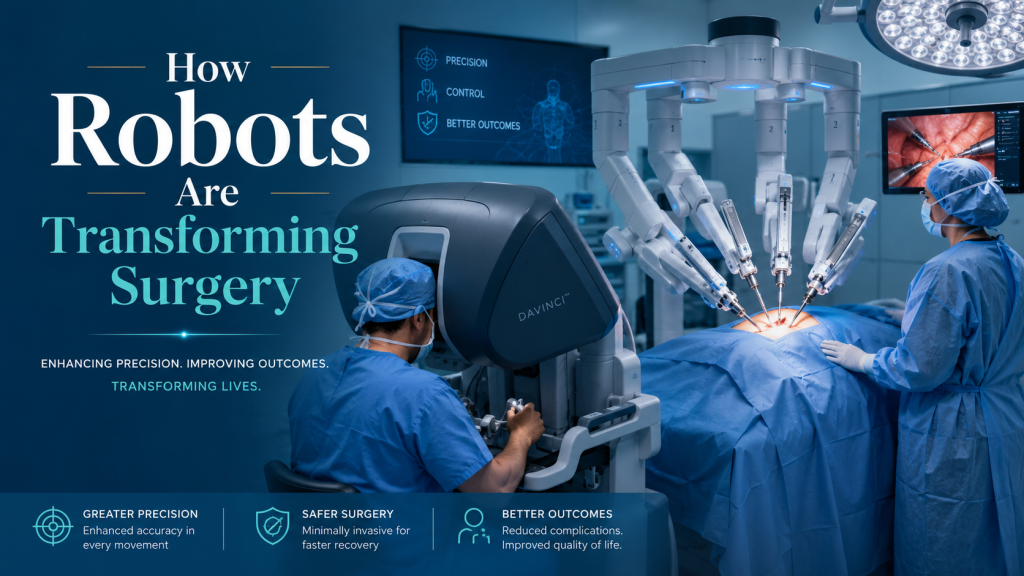
The phrase “robotic surgery” can make it sound as though a metal machine walks into the operating room, puts on a mask, and tells the surgeon to take the afternoon off.
That is not what happens.
In most robotic-assisted operations today, the surgeon remains completely in control. The robot does not independently decide where to cut, what to remove, or when the operation is finished. Instead, the robotic system acts as a highly sophisticated extension of the surgeon’s eyes and hands.
The surgeon sits at a nearby console, views the surgical area through a magnified three-dimensional image, and controls small instruments attached to robotic arms. The system translates the surgeon’s movements into smaller, steadier, and sometimes more precise movements inside the patient’s body.
For older adults, this technology matters because surgery often becomes more complicated with age. Recovery may take longer, muscle can be lost during extended hospital stays, and complications may have a greater effect on future independence.
Robotic surgery cannot eliminate those risks. However, for selected procedures and properly chosen patients, it may help surgeons operate through smaller incisions, reduce blood loss, shorten hospital stays, and allow patients to return to normal activity sooner.
Robots are not replacing surgeons. They are changing what skilled surgeons may be able to accomplish.
What Is Robotic-Assisted Surgery?
Robotic-assisted surgery is a form of computer-assisted surgery. The system commonly includes:
- A console used by the surgeon
- A high-definition, magnified camera
- Several robotic arms
- Small surgical instruments attached to those arms
- Computer software that translates the surgeon’s movements
The surgeon’s hand movements are transmitted to the instruments in real time. If the surgeon moves, the instruments move. If the surgeon stops, the instruments stop.
The U.S. Food and Drug Administration explains that robotic-assisted systems may be safe and effective for certain procedures when used appropriately and when the surgical team has received proper training.
That last part is important.
A sophisticated machine does not turn an inexperienced operator into an expert. The quality of the surgeon, the experience of the operating team, and the appropriateness of the procedure remain more important than the name printed on the robot.
Why Use a Robot Instead of Traditional Surgery?
Traditional open surgery may require a relatively large incision so the surgeon can see and reach the area being treated. Open surgery is sometimes necessary and may still be the safest option for certain patients.
Laparoscopic surgery, commonly called keyhole surgery, uses small incisions, a camera, and long instruments. It has allowed many operations to be performed with less disruption to the body than open surgery.
Robotic surgery builds on the laparoscopic approach.
Traditional laparoscopic instruments can be limited in how they bend and rotate. Robotic instruments may move in ways that resemble—or sometimes exceed—the range of motion of the human wrist. The system can also filter small hand tremors and scale large hand movements into tiny instrument movements.
The surgeon may gain:
- A magnified three-dimensional view
- Greater instrument flexibility
- Improved access to confined areas
- More stable instrument movements
- Better ergonomics during long procedures
Imagine trying to repair a wristwatch while looking through a magnifying glass and using ordinary kitchen tongs. Robotic surgery gives the surgeon better vision and much more maneuverable tools.
It still takes a skilled watchmaker to perform the repair.
Potential Benefits for Patients
The possible benefits of robotic surgery depend on the operation, the patient’s health, and the experience of the surgeon.
Compared with traditional open surgery, minimally invasive robotic procedures may offer:
- Smaller incisions
- Reduced blood loss
- Less postoperative pain
- Lower risk of some infections
- Shorter hospital stays
- Smaller scars
- Faster return to normal activity
The Cleveland Clinic’s overview of robotic surgery notes that these advantages are commonly associated with robot-assisted procedures when compared with open surgery.
However, robotic surgery should not automatically be described as better than every other approach.
A broad 2024 review of 165 systematic reviews found that the evidence for robotic surgery was generally positive or neutral compared with open and laparoscopic surgery. Robotic procedures tended to compare more favorably with open surgery, while operating times were frequently longer.
In plain English, robotic surgery can offer meaningful advantages, but the benefit is not identical for every procedure.
Why Faster Recovery Matters More as We Age
A shorter hospital stay is more than a matter of convenience.
Older adults can lose strength surprisingly quickly during illness, hospitalization, or prolonged bed rest. Time away from normal movement may contribute to muscle loss, reduced balance, confusion, sleep disruption, and a temporary or permanent loss of independence.
A surgery that allows a patient to begin walking sooner and return home earlier may help protect more than physical comfort. It may help preserve everyday function.
This connects to a larger Elderhood principle: aging successfully often depends on adaptation. New medical tools are valuable not because they allow us to pretend we are not aging, but because they may help us adapt to health challenges while maintaining as much strength and independence as possible.
The goal is not simply to survive surgery. The goal is to recover well enough to return to living.
What Operations Can Be Performed Robotically?
Robotic systems are now used in a growing range of specialties.
Prostate and urinary surgery
Robotic-assisted prostate removal has become one of the best-known robotic procedures. Robots may also be used for kidney surgery, bladder surgery, and certain urinary tract repairs.
The ability to work precisely in the confined pelvic area can be particularly valuable.
Gynecologic surgery
Robotic systems may be used for hysterectomy, fibroid removal, endometriosis treatment, pelvic reconstruction, and certain gynecologic cancer operations.
Colorectal and digestive surgery
Surgeons may use robotic assistance for colon resections, rectal surgery, hernia repair, gallbladder surgery, bariatric procedures, and operations involving the stomach or esophagus.
A 2024 meta-analysis comparing robotic and laparoscopic surgery for colon cancer evaluated differences including hospital stay, conversion to open surgery, complications, and operating time. The research illustrates an important point: outcomes must be evaluated procedure by procedure rather than assuming that one technology is always superior.
Heart and chest surgery
Selected heart valve repairs, coronary procedures, lung operations, and chest surgeries may be performed with robotic assistance.
These procedures can be complex and are not available at every hospital.
Orthopedic surgery
Robotic systems are increasingly used to assist with knee and hip replacements. In these cases, the robot may help the surgeon plan bone cuts, align the replacement joint, and position implants more precisely.
The surgeon still performs and supervises the procedure. The system provides guidance based on the patient’s anatomy and surgical plan.
Head, neck, and reconstructive surgery
Robotic tools may help surgeons reach areas that are difficult to access using conventional instruments. Research is also exploring extremely delicate microsurgery, including the repair of tiny blood vessels and lymphatic channels.
You can explore more medical innovations through Elderhood’s coverage of how the future of health care is arriving.
Does the Robot Ever Operate by Itself?
For the overwhelming majority of robotic surgeries currently performed on human patients, the answer is no.
Research published in 2024 examined FDA-cleared surgical robots and found that most were systems offering limited assistance rather than independent surgical autonomy. Most of the identified systems were categorized at the lowest level of autonomy, where the robot assists while the human surgeon controls the procedure.
Some newer systems may automate limited tasks. For example, a machine may help guide a tool along a preplanned path, maintain a camera position, identify anatomical structures, or prevent an instrument from moving beyond a designated boundary.
That is very different from a robot independently performing an entire operation.
The near-term future is more likely to involve collaboration between surgeons, robots, imaging systems, and artificial intelligence—not the disappearance of the human surgeon.
How Artificial Intelligence May Change Robotic Surgery
Artificial intelligence may eventually become the “co-pilot” of robotic surgery.
AI systems could help:
- Analyze medical images before surgery
- Create personalized surgical plans
- Identify blood vessels, nerves, or tumors
- Warn when instruments approach sensitive structures
- Monitor bleeding or changes in tissue
- Compare the procedure with thousands of previous operations
- Help surgeons review performance afterward
Researchers are also studying whether AI can recognize different stages of an operation and anticipate what instruments the surgeon may need next.
That sounds impressive, but caution is warranted.
AI can make errors. Medical data may be incomplete. Training data may not represent every patient population. Software performance may change depending on the hospital, equipment, and clinical situation.
An AI warning system should assist professional judgment, not replace it.
This is similar to the broader development of artificial intelligence as a doctor’s assistant. The most realistic and responsible future is not a computer practicing medicine alone. It is a qualified professional using better tools while remaining accountable for the patient’s care.
The Limitations of Robotic Surgery
Robotic surgery has real limitations that can disappear beneath enthusiastic marketing.
It may take longer
Setting up the robot, positioning the patient, attaching the instruments, and completing the procedure can require additional time.
Research comparing robotic and conventional approaches often finds that robotic operations take longer, particularly during a hospital’s or surgeon’s learning period.
It can be expensive
Robotic systems can cost hospitals millions of dollars. Maintenance, training, instruments, and disposable supplies add further expenses.
Whether those costs are balanced by shorter hospital stays or fewer complications depends on the procedure and the hospital’s volume of robotic cases.
Access is unequal
Large medical centers may offer several robotic systems, while rural and smaller hospitals may have none.
Patients should not assume that a non-robotic operation represents inferior care. An experienced surgeon performing a well-established conventional procedure may be a much better choice than an inexperienced team using the newest machine.
Equipment problems can occur
Robotic systems are mechanical and computerized devices. They can experience software errors, instrument failures, communication problems, or other malfunctions.
Hospitals should have procedures for converting to laparoscopic or open surgery when necessary.
Not every patient is a candidate
Previous operations, extensive scar tissue, the location of a tumor, severe obesity, heart or lung disease, an emergency situation, or other medical conditions may affect whether robotic surgery is advisable.
Sometimes open surgery provides the surgeon with the safest and fastest access.
Technology should serve the patient. The patient should not be selected merely to justify using the technology.
Cybersecurity Is Becoming a Medical Issue
Modern medical devices are increasingly connected to hospital networks and computer systems.
That connection allows devices to exchange information, receive software updates, and work with imaging and electronic health records. It also creates cybersecurity concerns.
The FDA warns that connected medical devices can face vulnerabilities that may affect their safety or effectiveness. Hospitals and manufacturers must manage software updates, network security, access controls, and emergency procedures.
This does not mean someone can casually sit in a parking lot and take control of a surgical robot as though it were a remote-controlled toy.
It does mean that cybersecurity is now part of patient safety, just like sterilization, staff training, and equipment maintenance.
The Surgeon Matters More Than the Robot
Patients sometimes ask, “Does the hospital have the newest robot?”
A better question is, “How experienced is the surgeon with my particular operation?”
Ask:
- How many of these procedures have you performed?
- How many were performed robotically?
- Why do you recommend this approach for me?
- What are the alternatives?
- How often do you convert to open surgery?
- What complications are most common?
- Who assists you during the operation?
- What recovery should I realistically expect?
A robot is a tool. It does not diagnose the patient, explain the tradeoffs, manage every complication, or replace years of surgical judgment.
The finest paintbrush in the world does not automatically produce a masterpiece.
Will Medicare Cover Robotic Surgery?
Medicare does not generally provide a special benefit simply because an operation uses a robot.
Coverage usually depends on whether the underlying surgery is medically necessary, performed by an eligible provider, and covered under Medicare rules. The use of robotic equipment is part of how the hospital and surgeon choose to perform the procedure.
Patients should still verify:
- Whether the surgeon accepts Medicare
- Whether the hospital is in the plan’s network
- Whether prior authorization is required
- Whether assistant surgeons or anesthesiologists are covered
- What deductibles and coinsurance may apply
- Whether rehabilitation or home health care will be needed afterward
People enrolled in Medicare Advantage should pay particular attention to network and prior-authorization requirements.
Never assume that because a surgeon recommends a procedure, every person involved in the operation is covered under the same insurance terms.
What Comes Next?
The next generation of surgical robotics will probably become smaller, more portable, and more specialized.
Instead of one large machine designed for many operations, hospitals may use different systems for joints, blood vessels, the spine, the lungs, or microscopic repair.
Robotic tools may also help specialists operate from a distance. Remote surgery could eventually extend expert care to rural hospitals, isolated communities, military locations, or even space missions.
However, reliable remote surgery requires extremely fast and secure communication. Even a brief delay between the surgeon’s movement and the robot’s response could be dangerous.
More autonomous functions are also being studied, but the scientific, legal, and ethical questions are enormous. Who is responsible when an automated system makes a mistake? How much control should software have? How should patients be informed? Will advanced robotic care be available to everyone, or mainly to wealthy hospitals and communities?
These questions are not reasons to stop progress. They are reasons to manage progress intelligently.
The Bottom Line
Robotic surgery represents one of the most important changes in modern operating rooms.
For selected patients, it may allow complex procedures to be performed through smaller incisions with less blood loss, shorter hospital stays, and faster recovery. For older adults, those advantages may help preserve strength, mobility, and independence.
But robotic surgery is not automatically the best surgery.
The results depend on the procedure, the patient, the surgeon’s experience, the hospital team, and whether the technology provides a genuine clinical advantage.
The future of surgery will not be humans versus robots. It will be skilled humans learning how to use increasingly intelligent tools.
At Elderhood, we believe the larger truth of aging is adaptation. New technology gives us more options, but wisdom still requires asking questions, comparing risks, and preparing carefully.
Preparation reduces fear and brings peace of mind. At the same time, we should remain optimistic. Medical progress is moving rapidly, and treatments that once sounded like science fiction are already entering today’s operating rooms.
The robot may hold the instrument, but human judgment still holds the responsibility.
This article is for general educational purposes and is not a substitute for personal medical advice. Patients should discuss the risks, benefits, alternatives, insurance coverage, and experience of the surgical team with qualified healthcare professionals.