
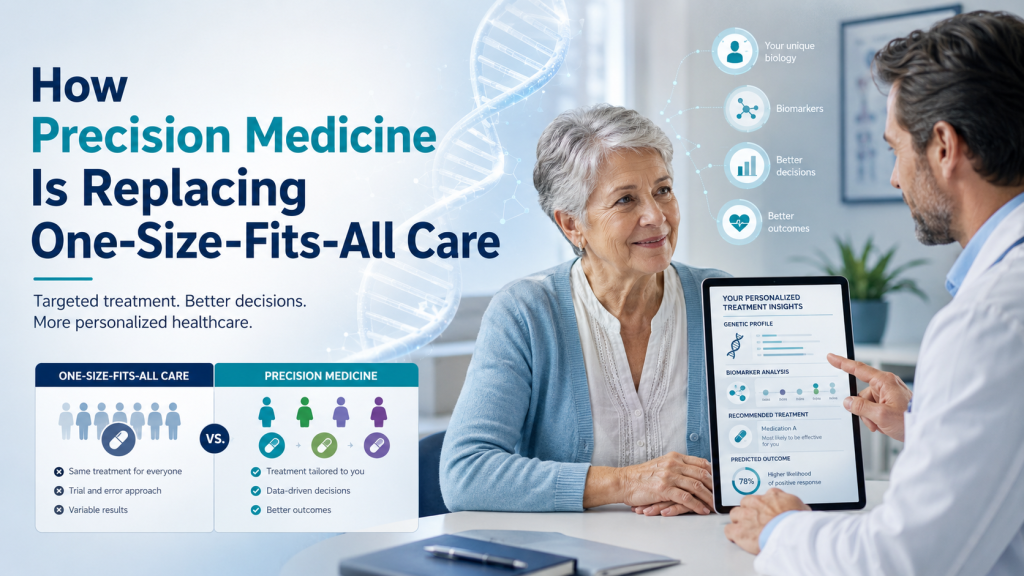
For most of medical history, treatment has followed a familiar formula:
A patient develops a condition. The doctor selects the treatment that works for the greatest number of people. If it does not work, another treatment is tried.
That approach has saved countless lives, but it has an obvious weakness: People are not identical.
Two patients can have the same diagnosis, take the same medication, and experience completely different results. One may improve. The other may receive no benefit. A third may develop serious side effects.
Precision medicine is beginning to change that trial-and-error system.
Rather than asking only, “What usually works for this disease?” doctors can increasingly ask:
“What is most likely to work for this particular person?”
That does not mean medicine is becoming perfectly personalized or that every patient will receive a treatment invented exclusively for them. It means doctors are gaining better tools to divide patients into more meaningful groups based on their genes, biology, medical history, lifestyle, environment, and the specific characteristics of their disease.
The result could be a major shift from one-size-fits-all medicine toward more targeted prevention, diagnosis, and treatment.
What Is Precision Medicine?
The National Cancer Institute defines precision medicine as care that uses information about a person’s genes, proteins, environment, and lifestyle to help prevent, diagnose, or treat disease. In cancer care, it can also use detailed information about a tumor to select treatment and evaluate how well that treatment is working.
Think of traditional medicine as buying a suit in three sizes: small, medium, or large.
Precision medicine is closer to having the suit altered to fit your measurements.
It may not be made entirely from scratch, but the fit should be better.
Doctors have always considered individual differences such as age, weight, allergies, kidney function, other medical conditions, and current medications. Precision medicine adds much more detailed biological information to that decision.
This can include:
- Genetic variations
- Proteins and other biomarkers
- The molecular features of a tumor
- Family medical history
- Environmental exposure
- Lifestyle and behavior
- Information from electronic health records
- Data collected from imaging, laboratory tests, and wearable devices
The National Human Genome Research Institute describes precision medicine as using large sets of information—including a person’s genome or electronic health record—to tailor care to that individual’s attributes.
In plain English, it recognizes something patients have known for years:
The treatment that helped your neighbor may not be the treatment that helps you.
Cancer Is Leading the Precision Medicine Revolution
Cancer treatment provides some of the clearest examples of precision medicine already being used.
In the past, cancer was primarily classified by where it began: breast cancer, lung cancer, colon cancer, or another organ.
Location still matters, but doctors can now examine the genetic and molecular changes driving some tumors.
Two people may both have lung cancer, but their tumors may contain different mutations. Those differences can help determine whether a targeted drug is likely to work.
Conversely, cancers beginning in different organs may share a similar molecular feature and respond to the same targeted treatment.
The National Cancer Institute explains that using genetic changes in a patient’s tumor to guide treatment is a central part of cancer precision medicine.
This approach is helping replace the old question—
“Which drug is normally used for this type of cancer?”
—with a more specific one:
“What is driving this person’s cancer, and do we have a treatment that targets it?”
This does not eliminate chemotherapy, radiation, or surgery. Instead, molecular testing may help doctors decide which treatment—or combination of treatments—is most likely to work.
The NCI continues studying targeted combinations through trials such as ComboMATCH, which matches treatment strategies to gene signatures and investigates ways to overcome resistance to individual targeted drugs.
You can learn more about this transformation in our Elderhood article, Cancer Treatment Is Becoming More Personal.
The Right Medicine for the Right Patient
Precision medicine is not limited to cancer.
One of its most practical applications is pharmacogenomics—the study of how genetic differences affect a person’s response to medication.
A drug must be absorbed, transported, broken down, and removed from the body. Genetic differences can affect each of those processes.
As a result, one person may process a medication rapidly, while another processes it slowly. The standard dose may be ineffective for the first person and excessive for the second.
Pharmacogenomic information may help a doctor determine:
- Whether a medicine is likely to work
- Whether the patient has an increased risk of side effects
- Whether a different medication may be preferable
- Whether the dose should be adjusted
The National Human Genome Research Institute describes pharmacogenomics as a growing field that uses genomic information to help healthcare providers select medications and doses predicted to work best for an individual patient.
The goal is not to perform a genetic test before prescribing every aspirin or antibiotic. It is to use testing when there is good evidence that genetic information can meaningfully improve a treatment decision.
The FDA maintains information about gene-drug relationships and pharmacogenomic biomarkers contained in medication labeling. However, the FDA also cautions that the appearance of an association in its tables does not automatically mean everyone should be tested before receiving that medicine.
That is an important warning.
Precision medicine is supposed to reduce guesswork—not replace it with unnecessary testing.
Companion Diagnostics: Testing Before Treatment
Some drugs now have a companion diagnostic.
This is a test considered essential for determining whether a corresponding drug or biological treatment can be used safely and effectively in a particular patient.
For example, a tumor might be tested for a particular biomarker. If the biomarker is present, the patient may be a candidate for a targeted drug. If it is absent, the drug may be unlikely to help.
This is very different from giving the medication to every patient with the diagnosis and waiting several months to see what happens.
It can spare patients from undergoing treatments that are unlikely to work while exposing them to side effects, expense, and lost time.
The FDA’s authorized companion diagnostic list now contains numerous laboratory and imaging tools paired with specific treatments, reflecting how deeply this approach has entered modern drug development.
That is one reason the future of medicine may involve more testing before treatment begins—but less wasted treatment afterward.
Precision Medicine and Rare Diseases
Precision medicine is also transforming the diagnosis of rare diseases.
A person with an unusual genetic condition may spend years visiting specialists, repeating tests, and receiving incorrect diagnoses. Genome sequencing can sometimes identify the underlying variation responsible for the illness.
That does not guarantee a cure. In many rare conditions, there may still be no approved treatment.
However, an accurate diagnosis can end years of uncertainty, help families understand inherited risks, connect patients with specialists, and identify appropriate clinical trials.
The NIH estimates that rare diseases collectively affect tens of millions of Americans, even though each individual condition may affect relatively few people. Precision-medicine programs are using genomic and clinical information to improve the diagnosis and study of these conditions.
As discussed in Gene Therapy: Treating Disease by Fixing the Gene, identifying the genetic cause of a disease may eventually make it possible to treat the cause rather than merely manage the symptoms.
Could Precision Medicine Prevent Disease?
The ultimate goal is not only better treatment after a person becomes sick.
Precision medicine may help identify risk earlier.
Genetic information, family history, blood biomarkers, imaging, lifestyle data, and electronic health records can sometimes reveal that a person has an elevated risk of developing a disease.
That might lead to:
- Earlier or more frequent screening
- Lifestyle changes
- Preventive medication
- Closer monitoring
- Treatment before serious symptoms appear
For example, a person with a strong inherited cancer risk may begin screening earlier than the general population. Someone with a genetic condition that raises cholesterol dramatically may require treatment long before symptoms develop.
This is not fortune-telling.
A higher genetic risk does not mean that a person will definitely develop the disease. Environment, lifestyle, chance, and other biological factors still matter.
Precision prevention should provide useful information—not convince healthy people that their DNA has already written their obituary.
Our article, Blood Tests That Can Detect Disease Years Earlier, explores how biomarkers may eventually help doctors identify diseases before symptoms become obvious.
Artificial Intelligence Will Help Interpret the Data
Precision medicine creates an enormous amount of information.
A human genome contains billions of DNA letters. Medical records may contain years of laboratory results, medications, diagnoses, imaging studies, physician notes, and hospital visits.
No doctor can mentally compare every piece of that information with every available medical study during a 20-minute appointment.
Artificial intelligence may help find patterns, identify treatment options, flag risks, and organize complex medical information.
AI could assist doctors in combining:
- Genetic test results
- Medical imaging
- Pathology findings
- Medication history
- Laboratory results
- Information from similar patients
- Current research and treatment guidelines
But AI should support medical judgment, not replace it.
A computer may detect a pattern that deserves attention. A qualified clinician must still determine whether that pattern is meaningful for the person sitting in the examination room.
Read Artificial Intelligence Is Becoming Your Doctor’s Assistant for a closer look at how AI may reshape healthcare without eliminating the need for human doctors.
Why Precision Medicine Is Not Yet Available Everywhere
The future may be arriving, but it has not arrived equally for everyone.
Precision medicine faces serious limitations.
Genetic and molecular testing can be expensive. Insurance coverage varies. Some community hospitals may not have access to the same testing or expertise available at major academic medical centers.
Researchers also need diverse data.
If medical databases contain information primarily from certain populations, tests and risk predictions may be less accurate for people who were underrepresented in the original research.
Privacy is another concern. Genetic information is deeply personal. Patients need clear explanations about who can access their data, how it will be stored, and how it may be used.
There is also the danger of overselling.
A commercially available genetic test may produce pages of interesting information without offering medically useful answers. Not every genetic variation is well understood, and not every association should change treatment.
More information is not automatically better care.
Sometimes it is merely a thicker folder.
What Precision Medicine Means for Older Adults
Older adults may have the most to gain—and some of the greatest challenges.
Many seniors take multiple medications and live with several chronic conditions. A treatment for one condition may worsen another. Drug interactions and side effects become increasingly important.
Precision medicine could help doctors select safer medications, identify more appropriate doses, and avoid treatments unlikely to help.
However, treatment decisions cannot be based on genetics alone.
A patient’s goals, mobility, independence, cognitive health, finances, caregiving responsibilities, and tolerance for side effects must all be considered.
Two 80-year-olds with the same diagnosis may make very different choices.
One may want the most aggressive available treatment. Another may value comfort, independence, and fewer hospital visits over a small possible extension of life.
True precision care must include the person’s preferences—not merely the person’s laboratory results.
Questions to Ask Your Doctor
Patients do not need to become genetic scientists, but they can ask better questions:
“Is there a biomarker or genetic test that could help choose my treatment?”
“Would the result actually change what you recommend?”
“Is this test covered by my insurance?”
“What are the privacy implications?”
“Does this treatment work only for patients with a particular mutation?”
“Is the test medically validated, or is it mainly informational?”
“Would genetic counseling help me understand the result?”
These questions can prevent patients from paying for tests that sound impressive but do not improve care.
The End of One-Size-Fits-All Medicine?
One-size-fits-all medicine is not disappearing tomorrow.
Many treatments work well for large groups of people and do not require genetic testing. A broken bone still needs to be stabilized. An infection may still need an antibiotic. High blood pressure still needs to be controlled.
Precision medicine will not replace the fundamentals of good care.
It will refine them.
The future is likely to combine standard medical knowledge with increasingly detailed information about the individual patient.
Instead of treating everyone identically, doctors may be better able to determine who needs treatment, which treatment is most likely to work, what dose is appropriate, and who may experience serious side effects.
That represents real progress.
But precision medicine must remain evidence-based, affordable, understandable, and available to ordinary people—not reserved for wealthy patients who can travel to elite medical centers.
The promise is not a magical treatment designed exclusively for every person.
The promise is smarter care with less guessing.
For older adults, that could mean fewer ineffective medications, fewer avoidable side effects, earlier diagnosis, more targeted treatment, and more healthy years of independence.
The era of one-size-fits-all care is not over.
But its replacement has already begun.
This article is for educational purposes only and is not medical advice. Genetic testing, biomarker testing, medication decisions, and cancer treatment should be discussed with qualified healthcare professionals. Coverage and availability vary by insurer, medical condition, and location.