
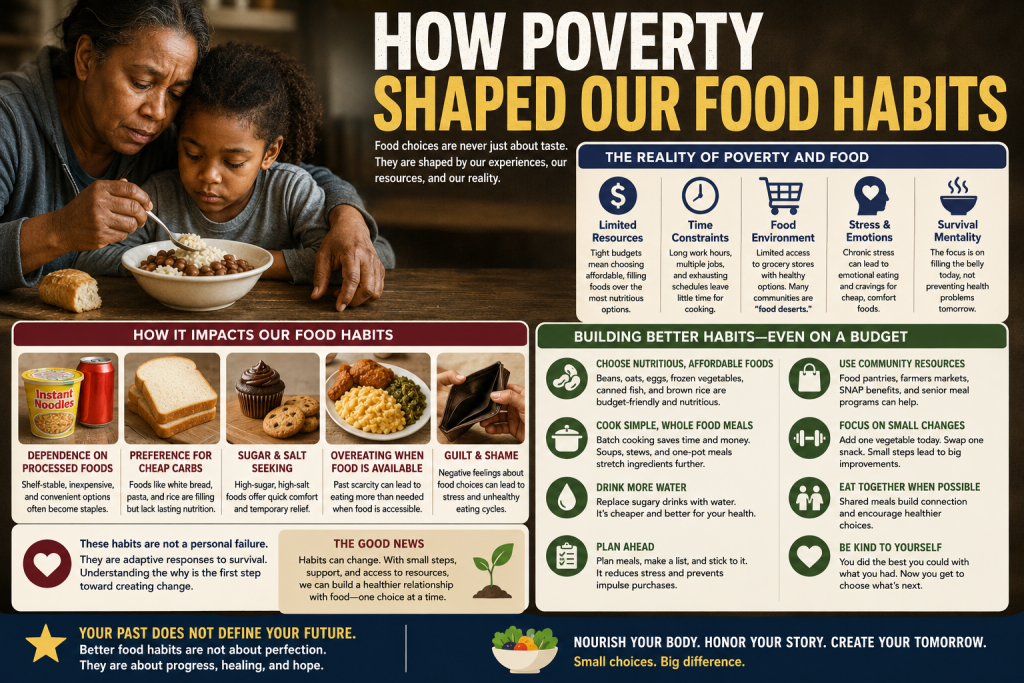
Food is never just food.
Food is memory. Food is culture. Food is comfort. Food is survival. And for many people, food is also the story of poverty.
When we talk about eating habits, we often hear the same advice: eat more vegetables, avoid processed food, cook at home, reduce sugar, stop snacking, buy better ingredients.
That advice may be true, but it often leaves out one very important question:
What if a person’s food habits were shaped by years of not having enough money?
That changes the whole conversation.
Because when people grow up with poverty, food is not always about nutrition. Sometimes food is about stretching the dollar. Sometimes it is about filling the stomach. Sometimes it is about getting through the week. Sometimes it is about giving children something that feels like a treat when life has not offered many treats.
And sometimes, long after the poverty improves, the habits remain.
Poverty Teaches the Body to Think Differently About Food
People who have never worried about food can make food decisions calmly.
They can say, “I think I’ll have salmon tonight,” as if salmon just walks into the kitchen wearing a little tuxedo and jumps on the plate.
But poverty changes the food decision.
The question becomes:
What can I afford?
What will fill me up?
What will last?
What will the children actually eat?
What can I make quickly after a long day?
What will not spoil before I get paid again?
That is not laziness. That is survival math.
According to USDA data, 13.7% of U.S. households were food insecure at some time during 2024, meaning millions of families had limited or uncertain access to enough food for an active, healthy life.
When food is uncertain, people do not just choose differently. They learn differently. They adapt. They create habits that make sense in difficult conditions.
Cheap Food Is Often Designed to Be Filling, Not Healing
One of the cruelest parts of poverty is that the cheapest foods are often the foods that do the least for long-term health.
Rice, pasta, white bread, instant noodles, sugary cereal, hot dogs, canned meals, chips, cookies, and fast food can be inexpensive, filling, convenient, and emotionally satisfying.
Fresh fish, berries, nuts, lean meats, quality olive oil, fresh vegetables, and whole foods often cost more, spoil faster, and require more planning.
That means poverty pushes people toward foods that solve today’s hunger but may create tomorrow’s health problems.
This is where we need to be honest. Poor nutrition is linked to chronic diseases such as obesity, type 2 diabetes, heart disease, depression, and some cancers. The CDC also notes that fewer than 1 in 10 children and adults eat the recommended amount of vegetables.
But scolding people does not fix that.
Telling someone to “just eat better” while they are trying to feed a family on limited money is like telling a man in a rowboat to “just buy a yacht.” Wonderful advice. Terrible timing.
Poverty Creates the “Fill the Belly” Habit
Many people who grew up poor learned one lesson early:
A full stomach means security.
That can stay with you for life.
If you grew up with food scarcity, you may have learned to finish everything on your plate because wasting food felt almost sinful. You may still feel uncomfortable throwing food away, even when you are full.
You may overbuy groceries when you have money because an empty refrigerator brings back old fear.
You may eat quickly because meals were rushed, crowded, or uncertain.
You may feel comforted by large portions because large portions once meant safety.
This is why food habits are not just about willpower. They are often emotional memories wearing a dinner jacket.
A person may not consciously think, “I grew up poor, so I need to eat this way.” But the body remembers. The body says, “Food is here now. Eat it before it disappears.”
That survival instinct may have protected you once. But later in life, it may work against your health.
Processed Food Became the Poor Person’s Convenience
For many low-income families, processed food is not a luxury. It is a tool.
It lasts longer. It is easy to prepare. It is predictable. Children like it. It does not require special cooking skills. It can be bought in bulk. It can be eaten quickly.
That matters when parents are working long hours, taking buses, holding multiple jobs, caring for children or older relatives, and trying to keep the lights on.
Ultra-processed foods are often more common in low-income populations, and research has connected high intake of these foods with greater risks of obesity and cardiometabolic disease.
Again, this is not about blaming people. It is about understanding the trap.
The food industry learned something very powerful: if you make food cheap, tasty, shelf-stable, salty, sweet, and easy, people under pressure will buy it.
And frankly, who can blame them?
When you are exhausted, nobody wants to come home and massage kale like it owes you money.
Poverty Shapes Taste
Taste is learned.
If someone grows up eating sweet drinks, salty snacks, fried foods, white bread, processed meats, and packaged meals, those foods become familiar. They taste like home.
Then later, when someone says, “Eat steamed broccoli,” the body may say, “Excuse me, where is the flavor?”
This is not because the person is weak. It is because the taste buds were trained.
The good news is that taste can be retrained. But it takes time.
A person who has eaten highly seasoned, sugary, salty, processed foods for decades may not suddenly enjoy plain vegetables overnight. That is not realistic. It is better to make gradual changes.
Add beans to rice. Add frozen vegetables to soup. Add Greek yogurt to oatmeal. Replace soda with flavored seltzer. Use spices instead of just salt. Choose roasted vegetables instead of boiled vegetables that taste like punishment.
Small changes work better than food lectures.
Poverty Makes Food Emotional
When money is tight, small treats become important.
A soda, a pastry, a bag of chips, a fast-food meal, or a dessert may be one of the few affordable pleasures in a hard life.
People sometimes judge this. They say, “Why would someone with limited money buy junk food?”
Because pleasure matters.
Because stress is real.
Because when life feels heavy, a sweet snack can feel like a tiny vacation.
The problem is that food can become the main comfort. And if food becomes the only affordable pleasure, it can become very hard to let go.
That is especially true for older adults who may be dealing with loneliness, grief, pain, fixed income, limited mobility, or boredom. Food becomes company. And unlike some people, the cookies do not argue with you.
Food Insecurity and Older Adults
For seniors, poverty and food habits can become even more complicated.
Some older adults have limited income. Some live alone. Some cannot drive. Some have dental problems. Some have trouble standing long enough to cook. Some take medications that affect appetite. Some choose between food, rent, utilities, and prescriptions.
Food insecurity among older adults has been linked with poorer health and chronic conditions such as diabetes, depression, hypertension, and arthritis.
That matters because healthy eating in Elderhood is not just about looking good in vacation photos. It affects strength, balance, blood sugar, heart health, brain health, immunity, and independence.
A poor diet can quietly take away a person’s future mobility.
That is why food support for seniors should not be treated like charity. It is health care. It is prevention. It is dignity.
Poverty Teaches “Stretching” Before Nutrition
Many traditional poor-family meals were built around stretching food.
A pot of beans. A pot of rice. Soup with whatever was available. Pasta with sauce. Bread with butter. Potatoes. Oatmeal. Cabbage. Lentils. Eggs. Leftovers turned into something new.
Some of these foods are actually healthy. Beans, lentils, oats, eggs, cabbage, and soups can be excellent.
The problem came when modern processed foods replaced traditional stretching foods.
Beans were replaced by chips. Oatmeal was replaced by sugary cereal. Homemade soup was replaced by instant noodles. Potatoes were replaced by fries. Water was replaced by soda.
So the answer is not to reject every old poverty food habit. Some of those habits were wise.
The better question is:
Which old habits helped us survive, and which ones are now hurting us?
That is the grown-up conversation.
The “Clean Plate Club” Problem
Many seniors were raised with the clean plate rule.
“You don’t leave food on your plate.”
That made sense when food was scarce. But today, portions are larger, restaurants serve enough food for a small construction crew, and many packaged foods are calorie-dense.
The clean plate habit can now lead to overeating.
A better rule is:
Respect food, but also respect your body.
You do not have to throw away food. You can save leftovers. You can use smaller plates. You can serve yourself less and go back if still hungry.
The goal is not waste. The goal is awareness.
Your stomach is not a garbage disposal with shoes.
The Poverty-Fasting Cycle
Another habit poverty can create is irregular eating.
Some people skip meals when money is tight, then overeat when food is available. Others eat very little during the day and then eat heavily at night.
This pattern can confuse appetite signals. The body starts to expect shortage and then feast.
In modern life, this can become a cycle of restriction, craving, overeating, guilt, and starting over.
That is why stable meals matter.
Protein at breakfast. Fiber during the day. Enough water. Simple planned meals. These boring little habits are not glamorous, but they work.
The body likes rhythm. It does not enjoy being treated like a confused casino machine.
The Shame Around Food Choices
One of the worst parts of poverty-shaped eating is shame.
People feel ashamed that they eat too much. Ashamed that they buy cheap food. Ashamed that they cannot afford better food. Ashamed that they do not know how to cook differently. Ashamed that they are overweight while also struggling with food insecurity.
But shame does not improve nutrition. Shame usually makes eating worse.
A better approach is curiosity.
Ask:
Where did this habit come from?
What problem did it originally solve?
Is it still helping me?
Can I replace it with something better without making my life harder?
That is how change begins.
Not with shame. With understanding.
How to Build Better Habits Without Spending a Fortune
Healthy eating does not have to mean shopping at expensive stores and buying foods with names that sound like they escaped from a yoga retreat.
Start with simple, affordable foods:
Beans
Lentils
Eggs
Oats
Frozen vegetables
Canned tuna or sardines
Cottage cheese
Plain yogurt
Brown rice
Sweet potatoes
Cabbage
Carrots
Apples
Peanut butter
Chicken thighs
Soups
Whole grain bread when affordable
Frozen vegetables are often just as practical as fresh vegetables and may reduce waste because they do not spoil as quickly.
Canned beans, canned fish, and eggs can be powerful foods for seniors because they provide protein without fancy preparation.
The goal is not perfection. The goal is improvement.
A bowl of oatmeal with yogurt is better than a sugary pastry. Beans and rice with vegetables is better than chips and soda. A tuna sandwich is better than skipping lunch and attacking the refrigerator at 9 PM like it insulted your mother.
Rebuilding Food Habits in Elderhood
If poverty shaped your food habits, you do not need to hate those habits. They helped you survive.
But now you can ask a new question:
What does my body need for the next chapter of life?
In Elderhood, food has a new job.
Food is not just fuel. Food is muscle protection. Food is brain support. Food is blood sugar management. Food is inflammation control. Food is balance protection. Food is energy. Food is independence.
That means the goal is not dieting. The goal is building a body that can carry you through the years ahead.
You do not need to become a different person overnight.
Start with one change:
Add protein to breakfast.
Drink more water.
Add one vegetable a day.
Replace one sugary drink.
Cook one simple soup each week.
Use a smaller plate.
Stop eating when satisfied, not stuffed.
Keep affordable healthy foods in the house.
One change becomes two. Two becomes a pattern. A pattern becomes a new identity.
The Bottom Line
Poverty shaped many of our food habits.
It taught people to stretch food, finish everything, choose filling foods, seek comfort in cheap treats, buy what lasts, and fear waste.
Some of those habits were wise. Some were necessary. Some were survival tools.
But survival habits are not always health habits.
The goal is not to blame ourselves or others. The goal is to understand the story behind the plate.
Because once we understand the story, we can begin to rewrite it.
Not with shame.
Not with perfection.
Not with expensive miracle foods.
But with small, steady changes that respect both our past and our future.
Poverty may have shaped our food habits, but it does not have to control the rest of our lives.