
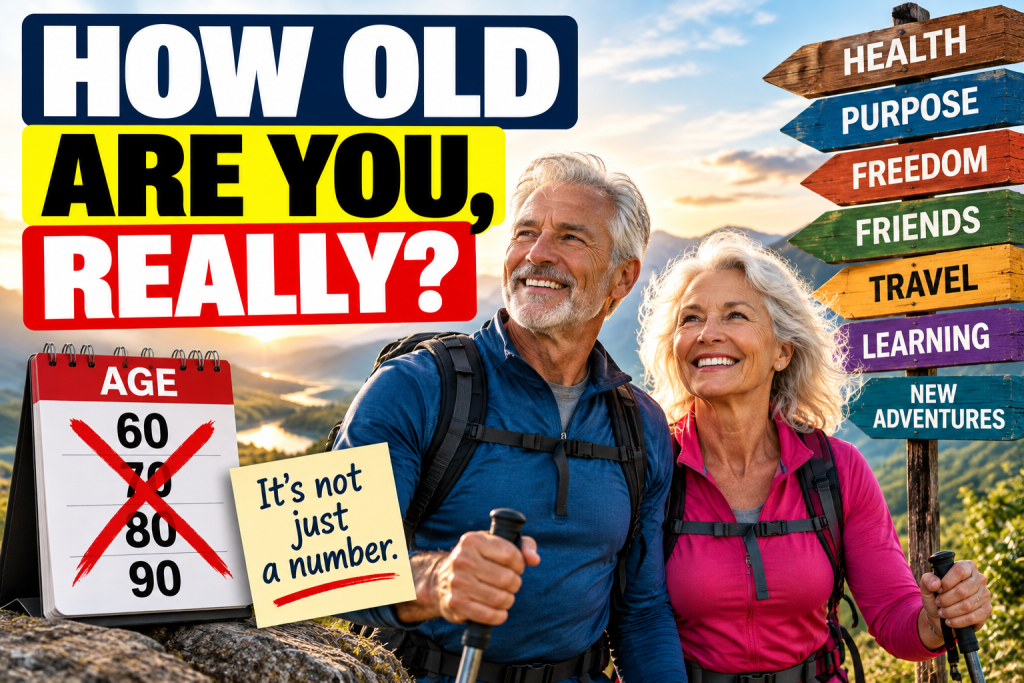
There was a time when turning 65 meant something very specific.
Retirement.
A rocking chair.
Slowing down.
Maybe a little gardening.
And, if we are being completely truthful, society quietly began treating you as though the interesting part of your life was already behind you.
That idea made a certain amount of sense when people did not expect to live much beyond retirement.
But that world is disappearing.
Today, someone who reaches 65 may still have twenty, thirty, or even forty years ahead of them.
That changes everything.
It changes how we think about work.
It changes relationships.
It changes money.
It changes health.
And perhaps most importantly, it changes the meaning of the word old.
The Calendar Is Not the Whole Story
We have traditionally measured aging with a calendar.
You are 60.
You are 70.
You are 80.
And from that number, people start making assumptions.
You must be slowing down.
You must be less capable.
You probably do not understand technology.
You probably do not want to travel.
You probably do not want to work.
You certainly should not be starting anything new.
Really?
Who wrote those rules?
A birth certificate tells us how long someone has been alive.
It does not tell us how alive they are.
Two people can both be 75 years old and live entirely different lives.
One may be active, curious, working, traveling, exercising, learning new technology and making plans for the next ten years.
The other may have allowed their world to become smaller year after year.
Chronologically, they are the same age.
Functionally, they may be decades apart.
That is why one of the most important questions of elderhood may be:
How old are you really?
Health May Be a Better Measure of Age
As we grow older, health increasingly determines the size of our world.
If you can walk comfortably, your world is larger.
If you can drive, your world is larger.
If you can hear conversations, your world is larger.
If you can see clearly, think clearly and remain physically independent, your world becomes larger still.
This is why health becomes one of the most valuable assets we possess as we age.
Money matters.
Housing matters.
Relationships matter.
But none of those things completely compensate for losing the ability to participate in your own life.
The goal is not to pretend aging does not happen.
Of course it happens.
Our bodies change.
Recovery takes longer.
Joints complain.
The mirror occasionally delivers information we did not request.
Gravity becomes increasingly confident.
But aging and decline are not exactly the same thing.
Some changes are unavoidable.
Others can be influenced by what we do.
Movement matters.
Nutrition matters.
Sleep matters.
Strength matters.
Social connection matters.
Mental stimulation matters.
Regular medical care matters.
The objective is not immortality.
It is maintaining function for as long as possible.
That is a much more realistic and useful goal.
We May Need a New Stage of Life
For most of human history, life was divided into a few simple stages.
Childhood.
Adulthood.
Old age.
That structure is becoming outdated.
There is now a large period between traditional retirement age and true frailty that did not exist for most people in earlier generations.
What should we call it?
Retirement does not quite describe it.
Senior citizen does not quite describe it.
Old age certainly does not describe everyone living through it.
Perhaps elderhood is a better word.
Elderhood can be a stage of life in which experience finally catches up with time.
You know things you did not know at 25.
You understand people better.
You understand yourself better.
You have made mistakes.
Hopefully, you learned from at least a few of them.
You have seen good times and bad times.
You have lost people.
You have survived things that once seemed impossible.
That experience has value.
The mistake is believing that because we have accumulated years, our role is now simply to watch everyone else live.
The New Elder May Still Be Working
Another old assumption deserves to be reconsidered.
Retirement.
For generations, retirement was presented as the ultimate goal.
Work hard.
Save money.
Then stop.
That may still be exactly what some people want.
There is nothing wrong with it.
But longevity changes the calculation.
Stopping work at 65 when life expectancy may extend many years beyond that can mean decades without the structure, purpose and social interaction that employment once provided.
Some older people work because they need the money.
Others work because they enjoy the work.
Some start businesses.
Some consult.
Some volunteer.
Some work part time.
Some finally attempt the career they were afraid to try when they were younger.
And some decide they never want to hear another alarm clock again.
The point is not that everyone should continue working.
The point is that we should stop assuming everyone should stop.
Relationships Change Too
Longevity has also changed relationships.
A generation ago, a person might reach their 60s and think:
Why change anything now?
Today, someone at 60 may realistically be looking at decades of life ahead.
That can lead people to reconsider marriages, friendships, living arrangements and even where they want to live.
This may be one reason we hear more about so called gray divorce.
People are asking a question that previous generations may not have had the luxury of asking:
Do I want to live this way for another twenty or thirty years?
That does not automatically mean leaving a relationship.
Sometimes it means repairing one.
Sometimes it means renegotiating one.
Sometimes it means building a completely new life.
Longevity does not guarantee happiness.
It gives us more time.
What we do with that time is another matter.
Living Alone Is Becoming Part of Elderhood
Another major change in modern aging is the number of people who spend significant portions of later life living alone.
That creates freedom.
It can also create vulnerability.
When you live alone, you become responsible for building your own support system.
Who checks on you?
Who would notice if something happened?
Who can help after surgery?
Who has access to important information in an emergency?
Who knows where your financial documents are?
Who knows which medications you take?
Independence is wonderful.
But independence works best when it is supported by preparation.
Living alone does not have to mean being isolated.
Those are two very different things.
Technology Has Changed Aging
Here is something our parents and grandparents could never have imagined.
A person in their 70s or 80s can now communicate instantly with family around the world.
They can attend a medical appointment from home.
They can learn almost anything through a phone or tablet.
They can manage finances without visiting a bank.
They can work from a kitchen table.
They can start a YouTube channel.
They can use artificial intelligence to explain something they do not understand.
That last one alone may become one of the largest changes in elderhood.
For the first time, older adults can have nearly unlimited access to information.
But access to information creates another responsibility.
We have to learn how to judge it.
Not everything online is true.
Not every confident person knows what they are talking about.
Not every viral video deserves to be believed.
Technology gives us power.
Wisdom tells us how to use it.
That may be one of the great advantages older adults bring to the digital age.
We have seen enough nonsense in our lives to know that nonsense can dress very well.
Reinvention Does Not Have an Expiration Date
Perhaps one of the most damaging ideas about aging is that eventually we are supposed to stop changing.
Why?
At 30, changing careers is called ambition.
At 45, it is called reinvention.
At 70, people sometimes call it strange.
It should not be.
If longevity gives us more years, then adaptation becomes part of survival.
The world around us keeps changing.
Technology changes.
Medicine changes.
Families change.
Communities change.
The economy changes.
Our bodies change.
The idea that we should remain exactly the same while everything around us changes makes very little sense.
The people who adapt best may be the people who age best.
Curiosity May Be One of the Best Anti Aging Tools
You do not have to understand everything new.
Nobody does.
But remaining curious is powerful.
Ask questions.
Learn something.
Try something unfamiliar.
Talk to younger people.
Talk to older people.
Read subjects you normally avoid.
Use new technology.
Take a class.
Travel somewhere new, even if it is only twenty miles away.
Change the routine occasionally.
Curiosity keeps the world large.
And one of the dangers of aging is allowing the world to become smaller.
First we stop going certain places.
Then we stop doing certain things.
Then we stop seeing certain people.
Eventually our lives can shrink without us realizing it.
Curiosity pushes in the opposite direction.
The Question Is Not How Long You Live
Longevity is often discussed as though the ultimate goal is simply adding years.
That misses the point.
Living longer matters most when those additional years contain life.
The more useful questions may be:
Can you remain independent?
Can you participate?
Can you contribute?
Can you maintain friendships?
Can you laugh?
Can you learn?
Can you still make plans?
Can you still look forward to something?
Those questions tell us much more about aging than the number of candles on a birthday cake.
Perhaps We Need to Stop Asking “How Old Are You?”
Maybe the question itself is outdated.
Instead of asking only:
How old are you?
Perhaps we should also ask:
How healthy are you?
How curious are you?
How independent are you?
How connected are you?
What are you working on?
What are you looking forward to?
What are you still learning?
Those answers may tell us far more about a person than their age.
Because old is not simply a number.
Old can be a condition.
And youth is not simply a number either.
Sometimes youth is curiosity.
Sometimes it is movement.
Sometimes it is purpose.
Sometimes it is the willingness to believe that there is still something worth doing tomorrow.
Welcome to Elderhood
We may be the first generation forced to rethink what later life actually means.
There is no perfect roadmap.
Our parents did not necessarily live this long.
Their careers were different.
Their technology was different.
Their families were different.
Their expectations were different.
So perhaps we have to write some of the rules ourselves.
That is what Elderhood is about.
Not pretending we are young.
Not being embarrassed that we are old.
But recognizing that a longer life has created a new stage of life.
A stage that requires planning.
Adaptation.
Health.
Curiosity.
Purpose.
And perhaps a little courage.
Getting older is inevitable.
What we do with those years is still very much up to us.
So the next time someone asks:
“How old are you?”
Maybe the better answer is:
“That depends. Are you asking about my birth certificate, or are you asking about my life?”