
Longevity medicine is one of the fastest-growing areas in health care. That sounds exciting — and in many ways, it is. Modern science is learning more about inflammation, muscle loss, metabolism, hormones, sleep, biological age, brain health, and how lifestyle choices affect the way we age.
But let’s be honest: whenever there is excitement, there is also opportunity for confusion. And whenever people are afraid of aging, there will always be someone willing to sell them hope in a bottle, a syringe, a membership package, or a fancy clinic with marble floors and a waiting room that smells like eucalyptus.
So the question is not whether longevity medicine is interesting. It is.
The real question is this:
How do you know if a longevity doctor is legitimate?
That is especially important for people in Elderhood, because seniors are often targeted by health promises that sound scientific, emotional, and urgent. The words may sound impressive — “regenerative,” “cellular repair,” “biohacking,” “age reversal,” “optimization,” “precision medicine” — but impressive words are not the same as good medicine.
A legitimate longevity doctor should help you live better, stronger, and more safely. A questionable one may simply help you spend money faster.
Start With the Basics: Are They a Real Licensed Physician?
Before you worry about advanced testing, supplements, peptides, hormones, or “biological age,” start with the simplest question:
Is this person actually licensed to practice medicine?
That may sound obvious, but in the longevity world, titles can get slippery. Some people call themselves “doctor” because they have a PhD, a chiropractic degree, a naturopathic title, or some kind of wellness certification. That does not automatically make them bad people. But it does mean you need to understand what kind of “doctor” they are.
A medical doctor should be licensed through a state medical board. You can usually search your state’s medical board website to confirm whether the doctor has an active license and whether there have been disciplinary actions.
Board certification is another important sign. The American Board of Medical Specialties says patients can use its Certification Matters service to check whether a physician is board certified. Board certification is not the same as a medical license, but it can show that the doctor completed specialty training and met professional standards in a recognized specialty.
A legitimate longevity doctor may be trained in internal medicine, family medicine, endocrinology, cardiology, geriatrics, preventive medicine, sports medicine, or another recognized specialty. What matters is that their training matches the kind of care they are offering.
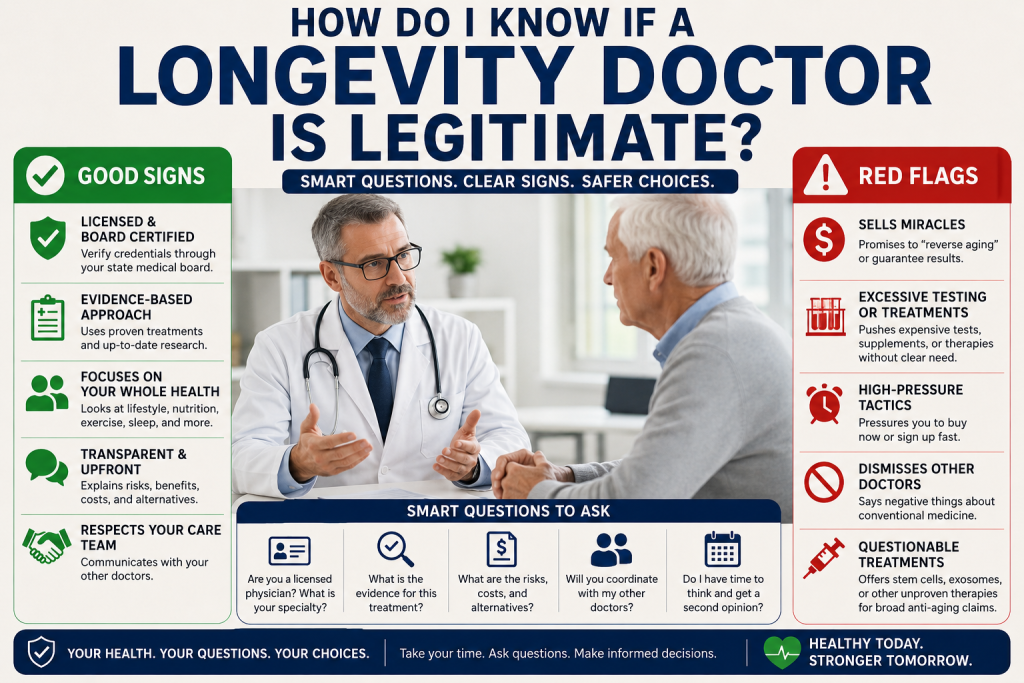
If someone is selling complicated medical treatments but cannot clearly explain their medical credentials, that is your first red flag.
Be Careful With the Phrase “Anti-Aging”
The phrase “anti-aging” sounds powerful, but it can also be misleading.
Aging is not a single disease. It is a complex biological process involving many systems of the body: muscles, bones, blood vessels, brain, hormones, immune function, metabolism, sleep, and more.
A legitimate doctor will usually talk about risk reduction, healthy aging, functional strength, metabolic health, prevention, mobility, sleep, nutrition, and quality of life.
A questionable clinic may talk about “reversing aging,” “turning back your biological clock,” or “restoring youth” as if they have discovered the fountain of youth behind the reception desk.
That is where skepticism becomes your best friend.
The goal should not be to become 35 again. That ship has sailed, and it did not leave a forwarding address.
The goal is to stay as strong, clear, mobile, independent, and engaged as possible.
That is real longevity.
A Legitimate Longevity Doctor Should Begin With Boring Things
Here is the strange truth: good medicine often starts with boring questions.
How is your blood pressure?
How is your blood sugar?
How is your cholesterol?
Are you sleeping?
Are you moving?
Are you losing muscle?
Are you taking medications that interact with each other?
Are you at risk for falls?
Are your kidneys, liver, heart, and bones being monitored?
Do you smoke?
Do you drink too much?
Are you lonely?
Are you eating enough protein?
Are you getting sunlight, strength training, and regular medical screenings?
A legitimate longevity doctor does not skip over these basics to sell you something exotic.
In fact, the more advanced the clinic sounds, the more important it is that they still respect the fundamentals.
If the first visit jumps straight to expensive infusions, hormone pellets, stem cells, exosomes, peptides, or a $5,000 testing package without a careful medical history, that is not “advanced medicine.”
That is a sales funnel wearing a lab coat.
Watch Out for Expensive Tests That Do Not Change Treatment
Longevity clinics often offer advanced testing: biological age tests, epigenetic clocks, full-body scans, micronutrient panels, hormone panels, genetic reports, inflammation markers, gut testing, food sensitivity tests, and more.
Some tests may be useful in the right setting. Others may be interesting but not very actionable.
The key question is simple:
Will this test change what we do next?
If the answer is no, you may be buying curiosity, not medical care.
A legitimate doctor should explain:
What the test measures.
Why it is being ordered.
What the limitations are.
Whether it is validated.
Whether insurance covers it.
What the plan will be if the result is abnormal.
What you would do differently based on the result.
If a doctor cannot explain that clearly, do not be dazzled by the technology.
A fancy lab report can look impressive. So can a restaurant menu in French. That does not mean the soup is worth $300.
Be Especially Careful With Stem Cells, Exosomes, and Regenerative Claims
This is one of the biggest danger zones in the longevity marketplace.
Stem cells, exosomes, and regenerative medicine are areas of serious scientific research. But serious research is not the same thing as proven treatment sold at a private clinic.
The FDA has warned consumers that regenerative medicine products, including stem cells and exosomes, are often marketed for conditions even though they have not been adequately studied to prove safety and effectiveness for those uses. The FDA has also warned that these products may carry safety risks and should not be confused with approved therapies.
The FDA has also stated that there are no FDA-approved exosome products for broad consumer treatment claims, and clinics offering them outside the proper review process may put patients at risk.
That does not mean all regenerative research is nonsense. It means you should be very careful when a clinic sells regenerative treatments as if they are already proven miracle therapy.
A legitimate doctor will be cautious and precise.
A questionable clinic may say things like:
“This regenerates your body.”
“This reverses aging.”
“This repairs damaged cells.”
“This treats arthritis, dementia, autoimmune disease, and aging.”
“This is safe because it is natural.”
Be careful. “Natural” does not automatically mean safe. Arsenic is natural. So are rattlesnakes. We do not invite either one to dinner.
Beware of Guaranteed Results
Good doctors do not guarantee miracles.
They can explain probabilities, risks, evidence, and reasonable goals. They can say, “This may help,” “This is supported by research,” “This is experimental,” or “This is not proven yet.”
But if someone guarantees that you will reverse your biological age, regain youth, prevent dementia, restore hormones safely, erase inflammation, or live decades longer, step back.
Medicine is complex. Human bodies are different. Aging is not a simple machine with one loose screw.
A legitimate longevity doctor should be honest about uncertainty.
That honesty is not weakness. It is a sign of professionalism.
Look at What They Sell
This is a big one.
Does the doctor make most of their money from medical care — or from selling expensive products and packages?
Some doctors recommend supplements. That is not automatically bad. But when every problem leads to the same clinic-branded supplement bundle, you should ask questions.
Be careful when a clinic sells:
Large prepaid packages.
Proprietary supplement stacks.
Expensive IV infusions.
Hormone programs for everyone.
Peptide programs with vague promises.
Memberships that pressure you to sign quickly.
Treatments not covered by insurance because they are “too advanced.”
Cash-pay medicine is not automatically illegitimate. Many legitimate preventive and functional medicine practices operate outside insurance because insurance often does not cover longer visits or lifestyle-focused care.
But cash-pay medicine needs more transparency, not less.
A legitimate clinic should clearly explain pricing, risks, alternatives, and whether the treatment is standard, off-label, experimental, or unsupported.
Ask About Evidence, Not Just Testimonials
Testimonials can be powerful. They can also be misleading.
“I feel 20 years younger” is not medical evidence.
A good doctor can point to research, clinical guidelines, published studies, or accepted medical reasoning. They should be able to explain what is known, what is promising, and what remains uncertain.
The Federal Trade Commission has taken action against companies accused of deceptive health-related claims, including stem cell marketing claims. In one 2025 case, the FTC announced that certain stem cell companies and co-founders were banned from marketing stem cell therapy and ordered to pay more than $5.1 million connected to allegedly deceptive practices.
That should tell us something very important: health marketing can sound convincing and still be legally and medically questionable.
If a clinic depends mostly on testimonials, celebrity endorsements, emotional videos, or before-and-after stories, be cautious.
Ask for evidence.
Not drama.
A Real Doctor Should Respect Your Primary Doctor
A legitimate longevity doctor should not tell you to abandon your regular physician, stop your medications suddenly, or distrust all conventional medicine.
Good care should be coordinated.
If you are taking medications for blood pressure, diabetes, cholesterol, thyroid disease, heart disease, kidney disease, depression, pain, or anything else, a longevity doctor should review those medications carefully.
They should also be willing to communicate with your primary care doctor or specialist when needed.
Be very careful with any practitioner who says:
“Your regular doctor knows nothing.”
“Mainstream medicine is useless.”
“Stop your prescriptions and use our protocol.”
“Doctors are hiding the cure.”
That kind of language may feel exciting because it makes you feel like you are getting secret knowledge. But medicine should not be a conspiracy club.
Yes, the health care system has problems. Yes, many office visits are rushed. Yes, prevention is often neglected.
But that does not mean every alternative claim is true.
A legitimate longevity doctor should be open-minded without being reckless.
Hormones Require Special Caution
Hormone therapy is common in longevity clinics. This may include testosterone, estrogen, progesterone, thyroid hormone, growth hormone-related claims, DHEA, or other hormone-related interventions.
Hormones are powerful. They are not casual wellness toys.
A legitimate doctor should order appropriate labs, review symptoms, discuss risks, monitor treatment, and avoid treating numbers alone.
For example, giving testosterone to someone who does not need it may create risks. Treating thyroid levels aggressively when thyroid function is normal can cause heart rhythm problems, bone loss, anxiety, or other issues.
If a clinic acts like every tired person needs hormones, be careful.
At a certain age, many people are tired because they sleep poorly, eat poorly, move too little, take multiple medications, feel lonely, or have untreated medical problems.
The answer is not always a hormone pellet.
Sometimes the answer is better sleep, resistance training, protein, medication review, or treating a real underlying condition.
Less glamorous? Yes.
More responsible? Often.
Good Longevity Medicine Should Include Muscle
One sign of a more legitimate approach is attention to strength, balance, mobility, and muscle preservation.
For people in Elderhood, muscle is not vanity. Muscle is independence.
A good longevity plan should ask:
Can you get out of a chair easily?
Are you losing grip strength?
Are you falling?
Are you doing resistance training?
Are you eating enough protein?
Are you walking?
Can you carry groceries?
Can you climb stairs?
That is real-world longevity.
A doctor who only talks about supplements, infusions, and lab scores but never asks how well you move may be missing the point.
The goal is not just to improve a number on a report.
The goal is to help you live your life.
Questions to Ask Before You Sign Up
Before starting with a longevity doctor or clinic, ask these questions:
Are you a licensed physician?
What is your medical specialty?
Are you board certified?
How do I verify your credentials?
What treatments do you offer that are considered standard medical care?
Which treatments are experimental or off-label?
What are the risks?
What are the alternatives?
What happens if I do nothing?
Do you coordinate with my primary care doctor?
Do you sell supplements, infusions, hormones, peptides, stem cells, or exosomes?
How much does everything cost?
Do I have to buy a package today?
Will you give me time to review this with my family or doctor?
That last question matters.
A legitimate clinic should not be afraid of a second opinion.
The Biggest Red Flags
Here are the biggest warning signs:
They promise age reversal.
They guarantee results.
They use fear to sell quickly.
They dismiss all conventional doctors.
They cannot clearly explain credentials.
They sell expensive packages before doing a full medical evaluation.
They offer stem cells or exosomes for broad anti-aging claims.
They rely more on testimonials than evidence.
They say a treatment is “FDA registered” as if that means FDA approved.
They pressure you to decide today.
They make you feel foolish for asking questions.
If you see several of these red flags together, walk away.
Your health deserves better than a high-pressure sales pitch.
The Bottom Line
A legitimate longevity doctor should not be selling fantasy.
They should be practicing careful, evidence-informed medicine aimed at helping you stay strong, clear, mobile, independent, and healthy for as long as possible.
The best longevity care usually combines old-fashioned wisdom with modern science:
Move your body.
Build muscle.
Eat enough protein.
Control blood pressure.
Protect your heart.
Sleep well.
Manage blood sugar.
Stay socially connected.
Review medications.
Prevent falls.
Screen for disease.
Use treatments carefully.
Ask better questions.
Yes, new science matters. But new science should make us wiser, not gullible.
A good longevity doctor helps you understand your body and make better decisions.
A bad one sells you the illusion that aging can be defeated with a credit card.
So before you trust a longevity clinic, remember this simple rule:
If they welcome your questions, explain the evidence, respect your safety, and do not pressure you — that is a good sign.
If they sell miracles, urgency, secrecy, and expensive packages — be careful.
In Elderhood, the goal is not to chase youth.
The goal is to protect your strength, your mind, your dignity, and your future.
That is real longevity.