For most of human history, getting older came with a fairly simple expectation.
You slowed down.
You retired.
Your world became smaller.
Your health gradually declined.
And eventually, you learned to accept that decline as the natural price of aging.
But as we enter 2027, that old picture is becoming harder to defend.
We are living through one of the most interesting periods in the history of aging.
Medicine is changing.
Technology is changing.
What we know about exercise, muscle, brain health, nutrition, sleep, loneliness, and chronic disease is changing.
And perhaps most importantly, our expectations about what later life can look like are beginning to change.
That does not mean old age has been cured.
Let’s not get carried away.
The knees can still complain.
The back may still send strongly worded letters to management.
And walking into a room and forgetting why you went there remains one of life’s great mysteries.
But something important is happening.
We are learning that aging and decline are not exactly the same thing.
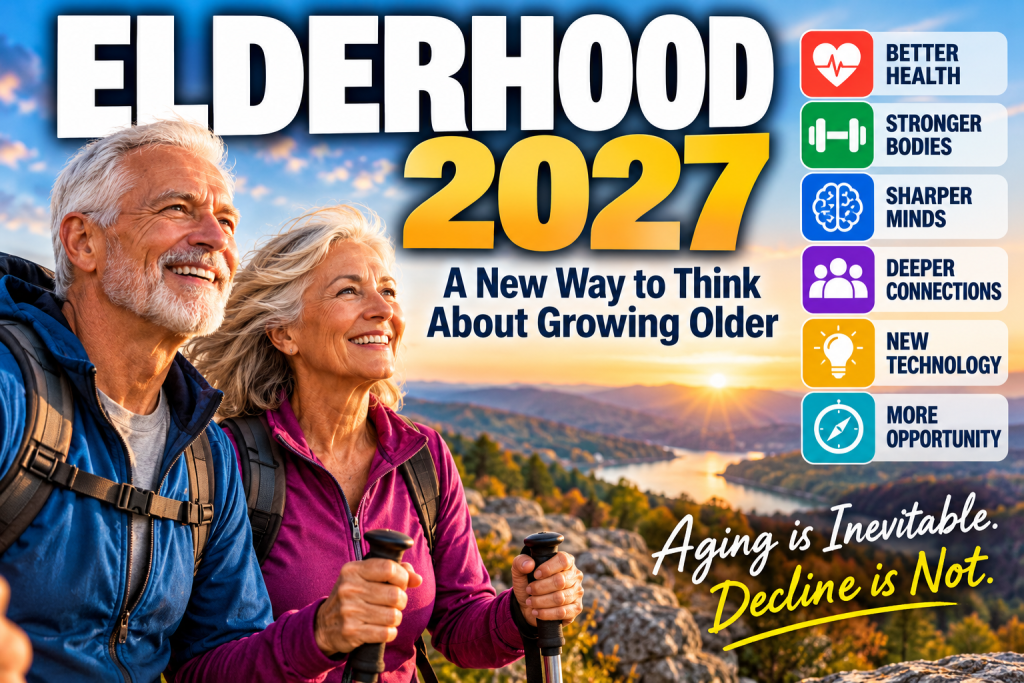
That idea is at the heart of Elderhood.
Aging Is Inevitable. Decline Is Not Always Inevitable.
Nobody beats the calendar.
Every year we get one year older.
But chronological age does not tell us everything about how well we function.
Two people can both be 75 years old and have dramatically different levels of strength, mobility, independence, curiosity, and health.
That difference is one reason the World Health Organization defines healthy aging around functional ability—the ability to continue doing the things that matter in everyday life.
That is a much more useful way to think about aging.
Not:
“How old am I?”
But:
“What can I still do?”
Can I walk?
Can I get out of a chair easily?
Can I drive safely?
Can I manage my own affairs?
Can I carry groceries?
Can I travel?
Can I learn something new?
Can I remain connected to other people?
Can I make my own decisions?
That is why we say at Elderhood that Aging Is Inevitable. Decline Is Not.
The goal is not immortality.
The goal is capability.
2027 May Be the Beginning of a Different Kind of Elderhood
This generation is aging with tools previous generations never had.
We have access to better medical imaging.
Earlier disease detection.
More sophisticated cardiovascular care.
New cancer treatments.
Artificial intelligence.
Modern hearing aids.
Wearable technology.
Advanced joint replacement.
Better understanding of metabolic health.
And increasingly sophisticated research into Alzheimer’s disease and other age-related illnesses.
In 2025, for example, the FDA cleared the first blood test designed to aid in diagnosing Alzheimer’s disease in certain symptomatic adults 55 and older. That does not mean we now have a simple universal Alzheimer’s screening test for everyone. But it shows how quickly diagnosis is evolving.
This is exactly why we talk about staying healthy until the future gets here.
You cannot predict what medicine may be able to do five or ten years from now.
But you can improve your chances of being healthy enough to benefit from it.
Muscle May Be One of Your Most Valuable Retirement Assets
For decades, retirement planning centered around money.
How much did you save?
What is your Social Security income?
How large is your pension?
How much can you safely withdraw from your investments?
Those are still important questions.
But there is another retirement asset that deserves equal attention.
Muscle.
Why?
Because muscle is closely connected to independence.
You need muscle to get out of a chair.
Climb stairs.
Carry groceries.
Recover from a stumble.
Maintain balance.
Get up from the floor.
Move around your own home.
The National Institute on Aging emphasizes a combination of aerobic exercise, muscle-strengthening activity, and balance training for older adults. Strength training can improve physical function and help people remain independent in daily activities.
You do not have to become a bodybuilder.
Nobody is asking Grandpa to enter Mr. Olympia.
But resistance training matters.
So does walking.
So does balance work.
So does simply refusing to become unnecessarily sedentary.
This is one reason our article on the science of Elderhood focuses so heavily on maintaining physical capability.
Healthspan Matters More Than Lifespan
People love talking about living to 100.
I understand why.
One hundred sounds impressive.
But simply collecting birthdays is not enough.
Suppose one person lives to 95 but spends the last 15 years severely limited.
Another lives to 92 but remains mentally engaged, mobile, socially connected, and largely independent until near the end.
Which life would you rather have?
That is the difference between lifespan and healthspan.
Lifespan measures how long you live.
Healthspan asks how long you remain healthy enough to participate in life.
Our article What’s the Difference Between Healthspan and Lifespan? explores this idea in detail.
The objective is not simply more years.
It is more usable years.
Years when you can still choose.
Still move.
Still learn.
Still love.
Still contribute.
Still laugh.
And still annoy your children by refusing to follow their advice.
That counts too.
Your Brain Needs Maintenance Just Like Your Body
Healthy aging is not purely physical.
Your brain needs attention.
The National Institute on Aging notes that physical activity may support cognitive health and also recommends managing cardiovascular risks, staying mentally active, and maintaining social connection as part of healthy aging.
That means brain health is not just crossword puzzles.
It includes blood pressure.
Sleep.
Exercise.
Hearing.
Social interaction.
Nutrition.
Mental stimulation.
And managing conditions such as diabetes and cardiovascular disease.
One of the biggest mistakes in aging is treating every part of the body as though it lives in a separate apartment.
The heart affects the brain.
Sleep affects the brain.
Exercise affects the brain.
Hearing affects social connection.
Social connection affects emotional health.
Everything talks to everything else.
That is why healthy aging requires a system, not a miracle product.
Loneliness Is a Health Issue
One of the quiet dangers of later life is that the world can shrink.
Retirement may remove workplace relationships.
Friends move away.
Some friends die.
Driving may become harder.
Children may live hundreds or thousands of miles away.
And suddenly, a person who spent decades surrounded by people can spend far too much time alone.
Social connection is not optional decoration.
It is part of healthy aging.
The National Institute on Aging encourages older adults and families to deliberately maintain connection through calls, groups, volunteering, shared interests, and regular contact.
That does not mean everybody needs a packed social calendar.
Some of us need a little peace and quiet after 70 years of people asking us questions.
But isolation and solitude are not the same thing.
Solitude can be restorative.
Isolation can quietly shrink a life.
The goal is meaningful connection.
AI Will Become Part of Elderhood
Artificial intelligence may become one of the most important tools for older adults.
Not because AI knows everything.
It doesn’t.
And anyone who has spent ten minutes with technology knows it can occasionally behave like a brilliant nephew who confidently gives you the wrong directions.
But AI can help older adults understand complicated information.
Explain medical terminology.
Prepare questions for doctors.
Understand insurance documents.
Learn new subjects.
Write letters.
Research travel.
Understand technology.
Explore hobbies.
Organize information.
And remain intellectually curious.
The important word is tool.
AI should assist judgment, not replace it.
Important medical information should still be verified with qualified healthcare professionals and trusted sources.
But used intelligently, technology can expand independence rather than threaten it.
Our article The Age of Medical Discovery explores how new technology and medicine may shape the years ahead.
The Future of Aging Should Be Met With Hope — and Skepticism
There will be extraordinary discoveries.
There will also be extraordinary nonsense.
For every legitimate study, someone will sell a pill promising to reverse aging before breakfast.
For every serious medical advancement, there will be a website announcing that doctors “don’t want you to know” about a mysterious berry grown on one particular mountain.
That is why one of the most important skills of Elderhood may be hopeful skepticism.
Be curious.
But ask questions.
Look for evidence.
Follow legitimate science.
Be wary of guarantees.
Be especially wary when the cure comes with a countdown clock and a credit-card form.
Medical science is advancing rapidly.
That does not mean every headline will become a treatment.
Our article The Future Is Closer Than You Think looks more closely at that balance between optimism and hype.
Independence Is Bigger Than Living Alone
We often describe independence as whether someone can remain in their own house.
That is only one form of independence.
There is physical independence.
Financial independence.
Mental independence.
Personal independence.
And decision-making independence.
Sometimes accepting help actually preserves independence.
Using a hearing aid can preserve social independence.
Using a cane can preserve mobility.
Using grocery delivery can help someone remain at home.
Using technology can preserve connection.
Hiring someone to do dangerous maintenance does not make you dependent.
It may simply mean you finally became smart enough to stop climbing ladders at 82.
Independence is not refusing help.
It is retaining as much control over your own life as reasonably possible.
Your Future Self Is Depending on You
One of the central ideas behind Elderhood is simple.
You have somebody depending on you.
Your future self.
At 50, you are taking care of the 70-year-old you.
At 70, you are taking care of the 80-year-old you.
At 81, you may be taking care of the 91-year-old you.
The person you become tomorrow inherits what you do today.
Your future self inherits whether you exercised.
Whether you managed your blood pressure.
Whether you maintained relationships.
Whether you ignored your hearing.
Whether you kept learning.
Whether you saved money.
Whether you asked for help when you needed it.
This does not mean every outcome is under our control.
Life does not work that way.
Illness happens.
Genetics matter.
Accidents happen.
Luck matters.
But influence is not the same as control.
We may not control the future.
We can still prepare for it.
Watch the Elderhood Video Series
Some ideas are easier to understand when you see and hear them.
The Elderhood YouTube channel explores many of the same themes we discuss here: healthy aging, medical discovery, independence, longevity, brain health, curiosity, purpose, and what it means to live fully in the years ahead.
Topics include:
Stay Young. Die Old.
Aging Is Inevitable. Decline Is Not.
Stay Healthy Until the Future Gets Here.
The Future of Medicine and Aging.
Your Age Is Not Your Health.
What Are You Still Figuring Out?
Watch the latest videos and join the conversation on the Elderhood YouTube channel.
So What Should Elderhood Look Like in 2027?
It should not look like surrender.
It should look like adaptation.
Move your body.
Protect your muscle.
Challenge your balance.
Eat mostly real food.
Sleep.
Stay connected.
Get your hearing checked.
Take care of your teeth.
Manage your blood pressure.
Ask questions.
Keep learning.
Use technology.
Question miracle cures.
Stay curious about medicine.
Find something worth looking forward to.
And perhaps most importantly:
Do not decide that your future no longer matters simply because your past is longer than it used to be.
The World Health Organization’s view of healthy aging focuses on maintaining the functional abilities that allow people to continue doing what they value.
That may be the best definition of Elderhood we have.
Not trying desperately to be young again.
Not denying age.
Not pretending nothing changes.
But protecting the abilities that allow you to remain fully involved in your own life.
Welcome to Elderhood 2027
We are the first generation of elders to enter this stage of life with this combination of longevity, information, technology, medicine, and opportunity.
Nobody has handed us a perfect instruction manual.
We are writing some of it ourselves.
And maybe that is the larger truth about aging.
The larger truth of aging is adaptation.
The goal is not to defeat age.
The goal is to become exceptionally good at the age you are.
Stay interested.
Stay informed.
Stay connected.
Stay strong.
Stay skeptical.
Stay hopeful.
And stay healthy enough to see what happens next.
Because the future is still coming.
And you are still part of it.
Stay Young. Die Old.
Welcome to Elderhood.