
Healthy habits sound simple until real life walks into the room wearing muddy shoes.
Eat better. Walk more. Sleep on time. Drink more water. Reduce stress. Stop snacking at night. Stretch. Breathe. Cook at home. Read labels. Take care of your body.
Wonderful advice.
But if advice alone worked, every doctor’s office would be empty, every gym would be full, and cookies would need government protection as an endangered species.
The real problem is not usually knowing what to do. The real problem is sticking with it.
That is where health coaching may help.
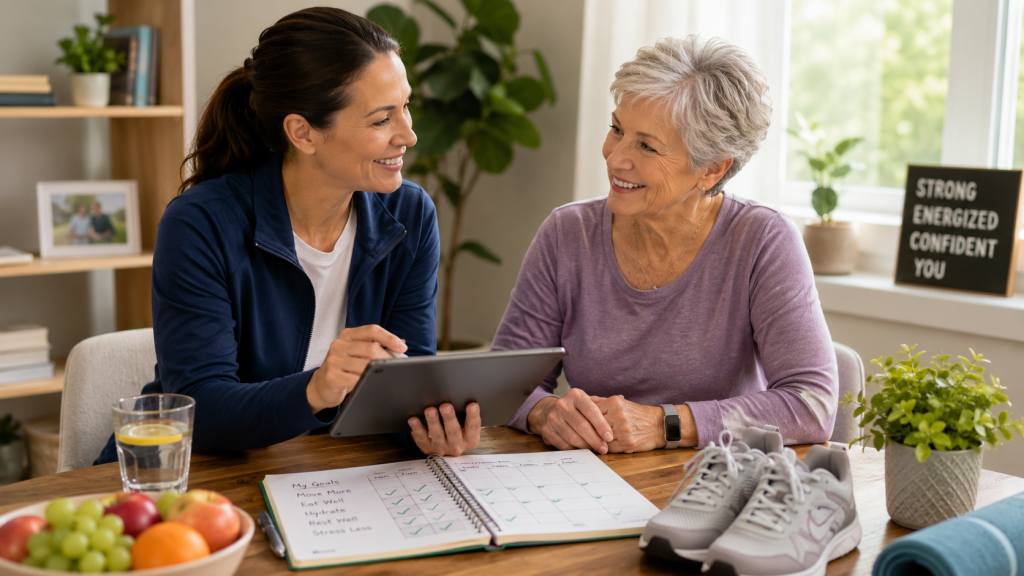
Health coaching is not magic. It is not someone waving a wellness wand over your head while you suddenly crave broccoli. A good health coach helps you turn good intentions into real habits by giving you structure, accountability, encouragement, and practical strategies that fit your actual life.
And in Elderhood, that matters.
Because by the time we reach this stage of life, we are not starting with a blank page. We have routines, preferences, medications, aches, family obligations, old habits, and sometimes a lifetime of “I’ll start Monday” behind us.
So the better question is not, “Can health coaching make me healthy?”
The better question is, “Can health coaching help me keep showing up for myself?”
For many people, the answer may be yes.
What Is Health Coaching?
Health coaching is a guided partnership that helps people make and maintain lifestyle changes.
A health coach may help with areas such as:
- Better eating habits
- Physical activity
- Sleep routines
- Weight management
- Stress reduction
- Blood sugar support
- Heart-health habits
- Medication routine support
- Confidence and motivation
- Planning around obstacles
The Centers for Disease Control and Prevention describes lifestyle coaches in its National Diabetes Prevention Program as trained people who help participants learn new skills, set and meet goals, stay motivated, and make healthy changes.
That is the heart of coaching: helping people move from “I know I should” to “Here is how I actually do it.”
A health coach is not usually a doctor. A coach should not diagnose disease, change medications, replace your physician, or pretend to cure medical problems. That is very important.
A good coach stays in their lane.
They help you build habits. They help you understand your goals. They help you plan. They help you follow through.
That may sound simple, but simple is not the same as easy.
Why Healthy Habits Are So Hard to Stick With
Most people fail at habits because they try to change too much at once.
They wake up one morning and announce, “That’s it. New life!”
Then they try to walk five miles, eat kale, drink eight glasses of water, stop sugar, meditate, lift weights, and go to bed at 9 p.m.
By Wednesday, they are exhausted and negotiating with a donut.
That is not weakness. That is poor strategy.
Behavior change works better when the healthy choice becomes easier to repeat. One review on healthy behavior change describes a core principle: make the healthy choice the easy choice.
That is where coaching can help.
A coach may help you shrink the goal.
Instead of “I’m going to get in shape,” the coach may ask:
“What can you realistically do three times this week?”
That might become:
“I will walk for 10 minutes after breakfast on Monday, Wednesday, and Friday.”
That is not dramatic. Nobody is making a movie about it.
But it is doable.
And doable beats dramatic almost every time.
Health Coaching and Elderhood
Healthy habits can be especially challenging in later life because the obstacles are different.
An older adult may be dealing with:
- Joint pain
- Balance concerns
- Fatigue
- Medication side effects
- Reduced appetite
- Loneliness
- Caregiving responsibilities
- Fixed income
- Sleep disruption
- Transportation limits
- Fear of injury
- Confusion from too much health advice
Research on behavior change in older adults emphasizes that aging is not just an individual matter. Behavior change is influenced by personal, community, and system-level factors.
That means telling an older adult, “Just exercise more,” may be useless if the person has knee pain, no safe place to walk, poor sleep, and no one encouraging them.
A good health coach looks at the real-world picture.
Not the fantasy version.
Not the Instagram version.
The real one.
A coach may ask:
“What gets in your way?”
“What has worked before?”
“What time of day do you have the most energy?”
“What foods do you actually enjoy?”
“Who supports you?”
“What feels too hard right now?”
That kind of questioning can help people stop blaming themselves and start designing a better plan.
The Power of Accountability
One of the biggest benefits of coaching is accountability.
Not scolding. Not nagging. Not someone acting like the food police.
Accountability simply means someone is helping you pay attention.
When you know you will check in with someone, you are more likely to notice your choices.
You may think twice before skipping the walk.
You may remember to track your sleep.
You may pause before eating straight from the cookie box like it insulted your family.
Accountability works because habits often fail in private. We drift. We forget. We rationalize.
“I’ll start tomorrow.”
“I walked to the mailbox. That counts.”
“This pie is practically fruit.”
A coach helps you return to the plan without shame.
That last part matters.
Shame is a terrible health strategy. It makes people hide, quit, and feel defeated.
A good coach helps you recover from setbacks.
Because setbacks are not failure. They are part of the process.
Health Coaching Helps Turn Big Goals Into Small Steps
Most health goals are too vague.
“I want to be healthier.”
Fine. But what does that mean at 7:30 tomorrow morning?
A coach helps turn vague goals into specific actions.
For example:
Instead of:
“I need to eat better.”
Try:
“I will add one protein food to breakfast three days this week.”
Instead of:
“I need to exercise.”
Try:
“I will walk for 10 minutes after lunch on Tuesday and Thursday.”
Instead of:
“I need to sleep better.”
Try:
“I will turn off the television 30 minutes earlier tonight.”
Instead of:
“I need less stress.”
Try:
“I will sit quietly and breathe for five minutes before checking the news.”
That is how real change starts.
Small enough to do.
Repeated enough to matter.
Coaching Can Help You Find Your Real Reason
People often choose health goals because someone else told them to.
The doctor says lose weight.
The adult children say walk more.
The internet says eat chia seeds, avoid seed oils, drink mushroom coffee, and sleep like a monk.
But lasting change usually needs a personal reason.
A coach may help you find your “why.”
Not a slogan. A real reason.
Maybe you want to:
- Stay independent
- Travel
- Dance
- Play with grandchildren
- Reduce fall risk
- Keep your mind sharp
- Feel steady
- Avoid becoming passive in your own life
- Have more energy
- Stay alive in your own life
That last one is powerful.
In Elderhood, healthy habits are not about vanity. They are about participation.
You are not trying to look like a 35-year-old fitness influencer doing pushups next to a smoothie.
You are trying to remain present, capable, and involved.
That is a much better reason.
The Science Is Promising, But Not Perfect
Health coaching has growing evidence behind it, but we should be honest.
It is not a guaranteed miracle.
A 2024 review described health and wellness coaching as a behavior change intervention with accumulating evidence of positive effects on health behaviors.
Some studies show coaching can improve self-management and patient activation in older adults, meaning people may become more confident and engaged in taking care of their health.
But research also shows mixed results in some areas. One review of nurse health coaching noted that past randomized trials have shown mixed outcomes for behavioral risk factors, which means coaching quality, methods, and follow-through matter.
That is the truth.
Health coaching can help. But not all coaching is equal.
A strong coach uses practical behavior-change tools such as goal-setting, problem-solving, planning, tracking, and motivation.
A weak coach gives vague pep talks.
You do not need a cheerleader with a water bottle. You need someone who helps you build a system.
What a Good Health Coach Should Do
A good health coach should help you:
- Clarify your goal
- Break it into small steps
- Identify obstacles
- Create a realistic plan
- Track progress
- Adjust when life changes
- Encourage consistency
- Coordinate with your healthcare team when needed
- Respect your limits
- Avoid shame and pressure
A good coach should not promise cures.
They should not tell you to stop medications.
They should not diagnose you.
They should not sell fear.
They should not make every answer a supplement, a detox, or a miracle protocol.
If every problem leads to the same expensive product, be careful. That is not coaching. That is a sales funnel wearing sneakers.
Questions to Ask Before Hiring a Health Coach
Before working with a coach, ask:
- What is your training or certification?
- Do you work with older adults?
- What areas do you specialize in?
- How do you handle medical conditions?
- Do you coordinate with doctors or dietitians when needed?
- What does a typical session look like?
- How do you help people stay accountable?
- Do you provide written plans?
- How much does it cost?
- Are you selling products?
The product question matters.
There is nothing wrong with a coach recommending tools, books, classes, or products when appropriate. But if the whole relationship turns into “buy this,” your wallet may lose weight faster than you do.
Health Coaching Works Best When You Start Small
If you are considering health coaching, do not begin with a complete life renovation.
Begin with one area.
For example:
- Better breakfast
- Walking three days a week
- Earlier bedtime
- Drinking more water
- Reducing evening snacking
- Strength training twice a week
- Planning meals
- Lowering stress
- Tracking blood pressure
- Improving balance
One habit can become the foundation for the next.
This is the boring but effective approach.
And yes, boring works.
You know what usually does not work? Grand declarations, complicated apps, and buying a drawer full of wellness gadgets that start collecting dust by Thursday.
Start with one habit.
Make it small.
Repeat it.
Then build.
Can Coaching Help With Motivation?
Yes, but not in the way people think.
Most people believe motivation comes first.
“I’ll start when I feel motivated.”
That is backwards.
Often, action creates motivation.
You take a 10-minute walk. You feel a little better. Then you want to do it again.
You prepare a better breakfast. You feel steadier. Then you begin believing change is possible.
A coach can help you get started when motivation is low.
They can help you create a plan so you are not relying on feelings.
Feelings are unreliable employees. They call in sick too often.
Systems are better.
The Elderhood View: Coaching Is Not About Perfection
In Elderhood, the goal is not to become perfect.
The goal is to become more consistent.
You will miss days.
You will eat the cake.
You will stay up too late.
You will have a week where life interrupts everything.
That does not mean the plan failed.
It means you are human.
A coach can help you return without turning one bad day into a bad month.
That may be the greatest value of coaching.
Not perfection.
Return.
The ability to come back to yourself.
Final Answer: Can Health Coaching Help?
Yes, health coaching can help many people stick to healthy habits, especially when the coaching is practical, respectful, and focused on small, repeatable actions.
It can help with accountability, planning, motivation, problem-solving, and confidence.
But it is not a substitute for medical care. It is not a miracle. And it should not be used to pressure you into expensive programs or products.
The best health coaching helps you build a life you can actually live.
Not a fantasy life.
Not a punishment plan.
A real life.
One where healthy habits become easier, steadier, and more connected to what matters most.
Because in Elderhood, health is not just about adding years.
It is about staying active in the years you have.
Staying present.
Staying capable.
Staying alive in your own life.
And sometimes, having the right person walk beside you can make all the difference.
Educational disclaimer: This article is for educational purposes only and is not medical advice. Health coaching does not replace care from a physician, registered dietitian, therapist, or other qualified healthcare professional. Always consult your healthcare provider before making major changes to your diet, exercise, medications, or health routine.