
Most people do not need another lecture about eating vegetables, walking more, sleeping better, or cutting back on sugar. We already know the basics. The problem is not always knowledge. The problem is follow-through.
That is where a health coach may help.
A health coach is not a magician, not a doctor, and not someone who waves a celery stick over your head and suddenly adds 12 years to your life. But a good health coach can help you build the daily habits that support a longer, stronger, healthier life.
And that matters, because longevity is not just about living longer. It is about living better longer. In Elderhood, that difference is everything.
What Does a Health Coach Actually Do?
A health coach helps you make realistic lifestyle changes and stay with them long enough for those changes to matter.
That may include improving your eating habits, increasing physical activity, managing weight, sleeping better, reducing stress, staying consistent with medications, preparing for doctor visits, or simply understanding what your doctor told you before you walked out of the office and forgot half of it.
The American Medical Association describes health coaching as a team-based approach that helps patients gain the knowledge, skills, and confidence to become active participants in their care. In plain English, a coach helps you stop being a passenger in your own health and start holding the steering wheel.
That is important because doctors are often rushed. You may get 10 or 15 minutes with a doctor, a handful of instructions, and a printed summary that looks like it was written by a committee of robots. A coach can help translate those instructions into daily action.
Can a Health Coach Add Years to Your Life?
Here is the honest answer: a health coach cannot guarantee that you will live longer.
Nobody can honestly promise that.
But a health coach may help you improve the habits that are strongly linked with longer life and better health.
Large studies have repeatedly connected lifestyle factors such as healthy eating, regular exercise, maintaining a healthy weight, not smoking, and moderate alcohol intake with longer life expectancy. A major Harvard-led study found that five healthy habits were associated with more than a decade of additional life expectancy. Those habits were a healthy diet, regular exercise, healthy body weight, not smoking, and moderate alcohol use.
The CDC also emphasizes that healthy eating, physical activity, avoiding tobacco, and managing chronic conditions can help prevent, delay, or manage major diseases such as heart disease and type 2 diabetes.
So the coach is not the source of the magic. The habits are.
The coach helps you do the habits.
That may sound simple, but simple is not the same as easy. If it were easy, America would not be drowning in obesity, diabetes, loneliness, stress, sleep problems, and preventable chronic disease.
The Real Value: Accountability
Most people do better when someone is paying attention.
That is not weakness. That is human nature.
A health coach gives you structure. They ask what you said you were going to do. They help you notice patterns. They help you recover when you fall off track. They remind you that one bad day does not mean the whole plan is ruined.
This is especially important for older adults because health changes can feel overwhelming. Maybe your doctor says, “Lose weight.” Fine. How? What do you eat for breakfast? How do you shop? What do you do when your knees hurt? What if you live alone? What if you are caring for a spouse? What if you are on five medications and the last thing you want is another complicated plan?
A good coach takes the big idea and turns it into Tuesday morning.
That is where change happens.
Health Coaching and Chronic Disease
Many people in Elderhood are not starting with a blank slate. They may already have high blood pressure, diabetes, arthritis, heart disease, sleep problems, weight issues, or early memory concerns.
Health coaching can be especially useful when someone is trying to manage a chronic condition.
The CDC says self-management education programs can help people with chronic disease learn skills to manage symptoms, improve eating and sleeping habits, reduce stress, and maintain a healthier lifestyle.
The CDC’s National Diabetes Prevention Program includes trained lifestyle coaches who help participants learn new skills, set goals, stay motivated, and make healthy changes.
That is the key word: skills.
Health is not just information. Health is a skill set.
You learn how to shop.
You learn how to read labels.
You learn how to move safely.
You learn how to plan meals.
You learn how to ask better questions at the doctor’s office.
You learn how to recognize excuses before they take over the day.
A health coach can help you build those skills one step at a time.
The Coach Does Not Replace Your Doctor
This point is important.
A health coach should not diagnose you, prescribe medication, tell you to stop medication, or override your doctor. If someone calling themselves a coach starts giving medical orders like they are running a hospital from their kitchen table, be careful.
A health coach should work alongside your medical care, not replace it.
Think of it this way:
Your doctor may tell you what needs to improve.
Your health coach helps you figure out how to live it.
That difference matters.
If your doctor says your blood pressure is too high, the coach may help you reduce sodium, create a walking routine, track home blood pressure readings, manage stress, and prepare questions for your next appointment.
If your doctor says you are prediabetic, the coach may help you understand meals, portion sizes, weight loss goals, walking after meals, and how to avoid the “I’ll start Monday” trap.
If your doctor says you need to strengthen your body, the coach may help you build a safe routine and encourage you to talk with a physical therapist or fitness professional if needed.
The doctor gives medical direction.
The coach helps with daily behavior.
What Kind of Person Benefits Most From a Health Coach?
A health coach may be especially helpful if you say things like:
“I know what to do, but I don’t do it.”
“I start strong, then quit.”
“My doctor told me to change my diet, but I don’t know where to begin.”
“I need someone to keep me accountable.”
“I feel overwhelmed by all the health advice online.”
“I want to age better, but I need a plan.”
That last one is especially important.
Aging better usually does not happen by accident. You need a plan. Not a fantasy plan. Not a 42-step plan created by someone who thinks everyone owns a personal chef and a home gym. A real plan.
A coach can help you create something that fits your actual life.
Health Coaching Is Really Habit Coaching
The reason coaching can work is that most longevity factors are built from habits.
You do not get stronger from thinking about exercise.
You get stronger from doing it repeatedly.
You do not improve your diet from reading one article.
You improve your diet by changing what you buy, cook, eat, and repeat.
You do not sleep better because someone says “get more sleep.”
You sleep better when you change your evening routine, reduce late caffeine, manage screen time, and keep regular sleep hours.
Habits compound.
A 10-minute walk today may not look impressive. But a 10-minute walk after dinner for a year is a different story. That is not glamour. That is biology doing bookkeeping.
Health coaching helps turn good intentions into repeated actions.
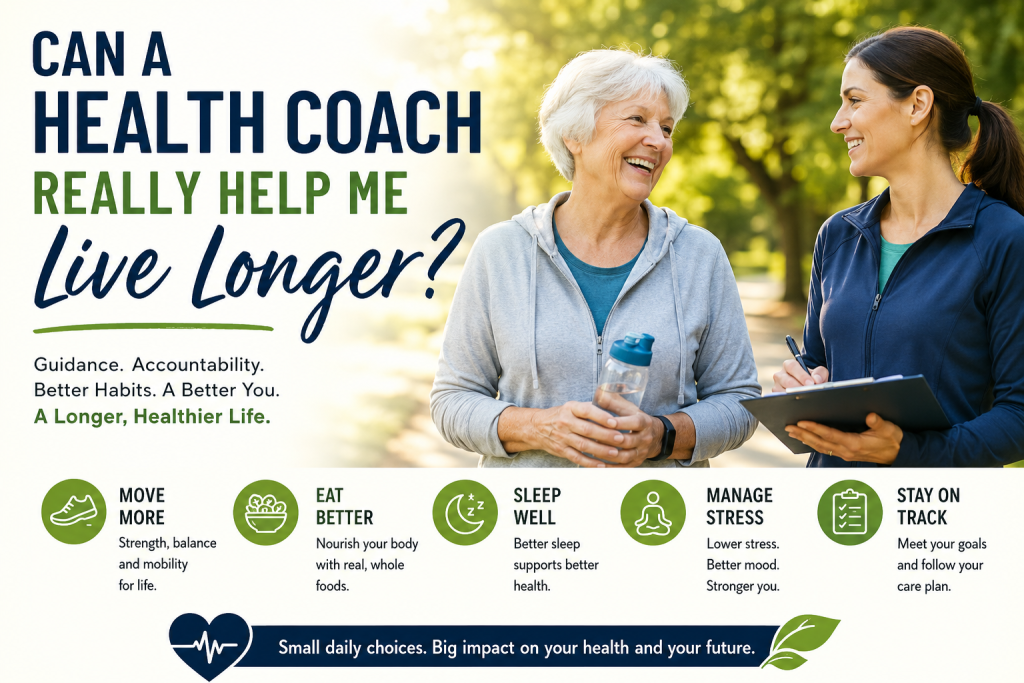
The Big Five Areas a Health Coach Can Help With
1. Movement
Exercise is one of the strongest tools for healthy aging.
It supports heart health, blood sugar control, muscle strength, balance, brain health, mood, and independence. For older adults, the goal is not to become a bodybuilder. The goal is to keep the body useful.
Walking, light strength training, stretching, balance exercises, and physical therapy-guided movement can all matter.
A coach can help you start where you are instead of where you wish you were.
2. Food
Food is where many people get confused.
One article says eat more protein. Another says eat less meat. One expert says low-carb. Another says Mediterranean. Then someone on the internet tells you that bananas are dangerous, and now breakfast feels like a legal problem.
A coach can help simplify eating.
For many older adults, that may mean more protein, more fiber, fewer ultra-processed foods, fewer sugary drinks, better hydration, and more consistent meals.
Not perfect eating. Better eating.
3. Weight
Weight is not just about appearance. It can affect mobility, blood pressure, blood sugar, sleep apnea, joint pain, and overall quality of life.
But weight loss in Elderhood must be handled carefully. Losing muscle is not the goal. Crash dieting is not the answer. A good coach should focus on sustainable habits, adequate protein, safe movement, and medical guidance when needed.
The goal is not to become smaller at any cost. The goal is to become stronger, steadier, and healthier.
4. Sleep and Stress
Sleep is not laziness. Sleep is repair work.
Poor sleep can affect mood, appetite, memory, energy, and chronic disease management. Stress can also push people into poor eating, inactivity, isolation, and worse health decisions.
A coach can help you identify patterns: late-night eating, too much caffeine, irregular bedtime, worry loops, too much news, or lack of daylight and movement.
Sometimes the answer is not complicated. It is just hard to do alone.
5. Medical Follow-Through
This may be one of the most underrated benefits.
Many people leave the doctor’s office with instructions they barely understand. A coach can help you write down questions, track symptoms, organize goals, and prepare for follow-up visits.
That does not sound dramatic. But it can be powerful.
A person who understands their care plan is more likely to follow it.
Be Careful: Not Every Health Coach Is Qualified
Here is where we need to be honest.
The health and wellness world has plenty of good people. It also has plenty of nonsense wrapped in pretty packaging.
Be cautious if a coach:
Promises you will live a certain number of years longer
Tells you to stop medication
Pushes expensive supplements as the main solution
Claims one secret food cures everything
Uses fear to sell
Refuses to work with your doctor
Makes you feel ashamed instead of supported
Has no real training or certification
Acts like every problem has the same solution
A good coach should be practical, respectful, and honest. They should help you build habits, not sell you miracles.
Questions to Ask Before Hiring a Health Coach
Before working with a health coach, ask:
What training or certification do you have?
Do you have experience working with older adults?
Do you coordinate with doctors or medical providers when appropriate?
What is your approach to nutrition and exercise?
Do you sell products or supplements?
How do you measure progress?
What happens if I have medical limitations?
How often do we meet?
What does it cost?
Do not be shy. You are not buying a toaster. You are trusting someone with your health habits.
So, Can a Health Coach Really Help You Live Longer?
A health coach may help you live longer by helping you do the things that support a longer life.
That is the honest answer.
The coach does not add years by magic. The coach helps you build consistency with the habits that matter: movement, food, sleep, stress control, weight management, chronic disease self-management, and medical follow-through.
For many people, that support can be the difference between knowing what to do and actually doing it.
And in Elderhood, that difference can shape the quality of your years.
Final Thought
Living longer is not only about medicine. It is also about daily choices.
But daily choices are hard when life is busy, confusing, lonely, stressful, or overwhelming. A good health coach can help turn the mountain into steps.
Not a miracle.
Not a guarantee.
Not a magic wand.
Just guidance, accountability, and a better chance of doing what you already know your body needs.
And sometimes, that is exactly what helps a person move from decline to direction.
This article is for educational purposes only and should not be considered medical advice. Always consult with a qualified healthcare professional before making changes to your diet, exercise routine, medication, or treatment plan.