
Most people do not think about balance until the day balance makes a rude announcement.
One minute you are walking across the kitchen.
The next minute the rug, the dog, the chair, and gravity have formed a conspiracy.
And gravity always wins.
In elderhood, balance is not a small thing. It is not just about standing on one foot like a flamingo at a senior yoga class.
Balance is independence.
Balance is confidence.
Balance is the difference between moving freely and becoming afraid of your own living room.
For older adults, protecting balance may be one of the most practical health goals of all.
Falls Are More Common Than Many Seniors Realize
Falls are not rare. They are one of the biggest safety risks for older adults.
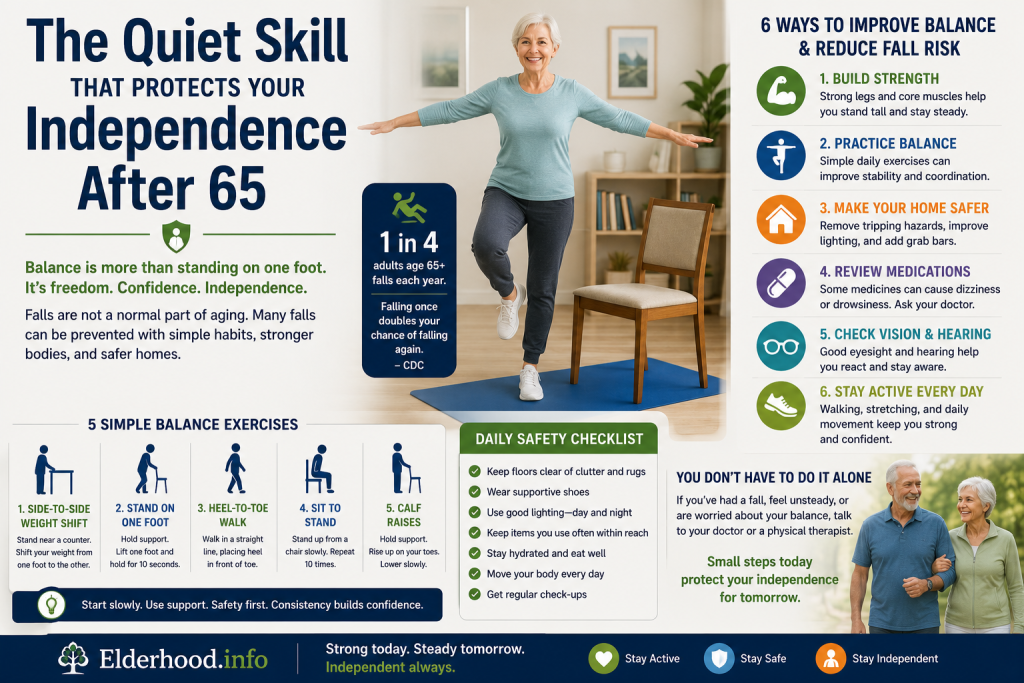
The CDC reports that more than one in four adults age 65 and older falls each year, and falling once doubles the chance of falling again.
That is not meant to scare people. It is meant to wake us up.
A fall can lead to broken bones, hospitalization, loss of confidence, reduced mobility, and fear of activity. The National Institute on Aging notes that falls can be especially dangerous for older adults and may lead to fractures, disability, or hospitalization.
But here is the encouraging part:
Falls are not always “just part of aging.”
Many falls can be reduced with better habits, safer homes, stronger legs, better balance, medication review, and attention to vision and hearing.
Balance Is a Skill, Not a Personality Trait
Some people say, “I’ve always been clumsy.”
Maybe so.
But balance can still be trained.
Balance is not just one thing. It involves your muscles, joints, eyes, inner ear, nerves, feet, brain, and reaction time.
That means balance can decline gradually without you noticing.
You may start holding onto furniture.
You may avoid uneven sidewalks.
You may stop using stairs.
You may walk more slowly.
You may feel nervous stepping into the shower.
Those are signals. Not reasons for shame.
Your body is saying, “Let’s work on this before it becomes a bigger problem.”
And for once, the body may be giving excellent advice.
The Legs Are the Foundation
Balance starts with strength.
Weak legs make balance harder. Stronger legs make daily movement safer.
You do not need to become a gym warrior. You do not need to start flipping tractor tires in the driveway unless you want the neighbors to call your children.
Simple strength exercises can help.
Sit-to-stands from a chair.
Heel raises while holding a counter.
Gentle wall pushups.
Step-ups if safe.
Resistance band exercises.
Short walks done consistently.
The goal is not showing off.
The goal is getting out of a chair, climbing steps, walking to the mailbox, and moving through life with more confidence.
Balance Exercises Belong in Elderhood
The World Health Organization recommends that older adults include varied physical activity that emphasizes balance and strength as part of weekly activity.
That does not mean you need a complicated routine.
It means balance should be treated like brushing your teeth.
A small daily habit.
Try simple moves near a sturdy counter or chair:
Stand with feet close together.
Shift weight gently from side to side.
Stand on one foot while holding support.
Walk heel-to-toe along a safe hallway.
Rise from a chair without using your hands if safe.
Start slowly. Safety first.
No one gets extra points for falling while practicing not falling.
Your Home Can Help Or Hurt You
Many falls happen at home.
That makes sense. Home is where we relax. It is also where we leave shoes, cords, rugs, laundry baskets, pets, and random objects that seem harmless until they launch a surprise attack.
A safer home does not have to look like a hospital.
It just needs fewer traps.
Remove loose throw rugs.
Improve lighting.
Add night lights.
Keep walkways clear.
Use grab bars in the bathroom.
Wear supportive shoes or slippers.
Keep frequently used items within reach.
Avoid climbing on chairs.
The bathroom deserves special attention. Wet floors and hard surfaces are a terrible combination.
A grab bar is not a sign of weakness.
It is a sign that you are smarter than the tile.
Medications Can Affect Balance
Some medications can cause dizziness, sleepiness, low blood pressure, or slower reaction time.
That does not mean you should stop taking medication on your own. Do not do that.
But it does mean you should ask your doctor or pharmacist to review your medications if you feel lightheaded, unsteady, drowsy, or more prone to falls.
This is especially important if you take multiple prescriptions.
Sometimes the problem is not aging.
Sometimes the problem is chemistry.
And chemistry does not care that you have errands to run.
Vision And Hearing Matter More Than People Think
Balance depends partly on your ability to understand your environment.
If your vision is blurry, depth perception is off, or glasses are outdated, your fall risk can increase.
Hearing also matters because it helps with awareness of surroundings. Poor hearing may affect orientation and reaction time.
Regular eye exams and hearing checks are not vanity.
They are safety tools.
Being able to see the step is not a luxury.
It is basic survival.
Fear Of Falling Can Become Its Own Trap
After a fall, many older adults become afraid of falling again.
That fear is understandable.
But here is the trap: fear can lead to less movement. Less movement can lead to weaker muscles. Weaker muscles can increase fall risk.
So the fear creates the very danger it is trying to avoid.
The answer is not reckless confidence. The answer is careful rebuilding.
Start with safe movement.
Use support.
Ask for physical therapy if needed.
Practice balance gradually.
Improve the home environment.
Walk with someone if that helps.
Confidence returns through evidence.
The body needs proof.
Small Daily Movement Adds Up
You do not have to fix balance in one heroic afternoon.
In elderhood, the boring little habits win.
A few minutes of strength work.
A short walk.
Standing up from a chair several times.
Practicing balance near the kitchen counter.
Stretching the calves.
Checking the floor before walking at night.
That may not sound exciting.
Good.
Exciting is overrated when it comes to falling.
We want steady, boring, repeatable, safe progress.
When To Ask For Help
Talk to a healthcare professional if you:
Have fallen recently
Feel dizzy or lightheaded
Feel unsteady when walking
Are afraid of falling
Use furniture for support
Have numbness in your feet
Have trouble getting up from a chair
Take medications that make you sleepy
Have vision changes
Need help making your home safer
A physical therapist can often help build strength, gait, balance, and confidence.
There is no award for pretending everything is fine.
That award usually comes with a bruise.
The Elderhood Message
Elderhood is not about accepting decline without a fight.
It is about paying attention.
Balance is one of those quiet skills that protects your freedom.
It protects your ability to shop, travel, dance, garden, visit friends, climb steps, walk the neighborhood, and live in your own home.
That is not small.
That is life.
So do not wait until a fall forces the issue.
Train balance before you need it.
Build strength before you lose it.
Make your home safer before the rug declares war.
Because independence is not protected by wishful thinking.
It is protected by daily habits.
And sometimes by a good pair of shoes.
FAQ
Why is balance important after 65?
Balance helps protect independence, mobility, confidence, and safety. Poor balance can increase the risk of falls, injuries, and fear of movement.
Are falls a normal part of aging?
Falls become more common with age, but they are not something seniors should simply accept. Many fall risks can be reduced with strength training, balance exercises, home safety changes, medication review, and vision checks.
How common are falls among older adults?
More than one in four adults age 65 and older falls each year, according to the CDC. Falling once also increases the chance of falling again.
What exercises help improve balance?
Simple exercises may include sit-to-stands, heel raises, standing on one foot with support, side stepping, gentle walking, and strength exercises. A physical therapist can provide a safe plan for individual needs.
Can walking improve balance?
Walking can help maintain mobility, endurance, and leg strength, but balance-specific and strength exercises are also important.
How can I make my home safer?
Remove loose rugs, improve lighting, clear walkways, add bathroom grab bars, use night lights, wear supportive footwear, and avoid climbing on unstable chairs or stools.
Can medication affect balance?
Yes. Some medications may cause dizziness, drowsiness, or lightheadedness. Ask your doctor or pharmacist to review your medications if you feel unsteady.
When should I talk to a doctor about falls?
Talk to a doctor if you have fallen, feel unsteady, feel dizzy, fear falling, have foot numbness, or notice changes in walking, vision, or strength.
Read Other Blog :- Read Now