
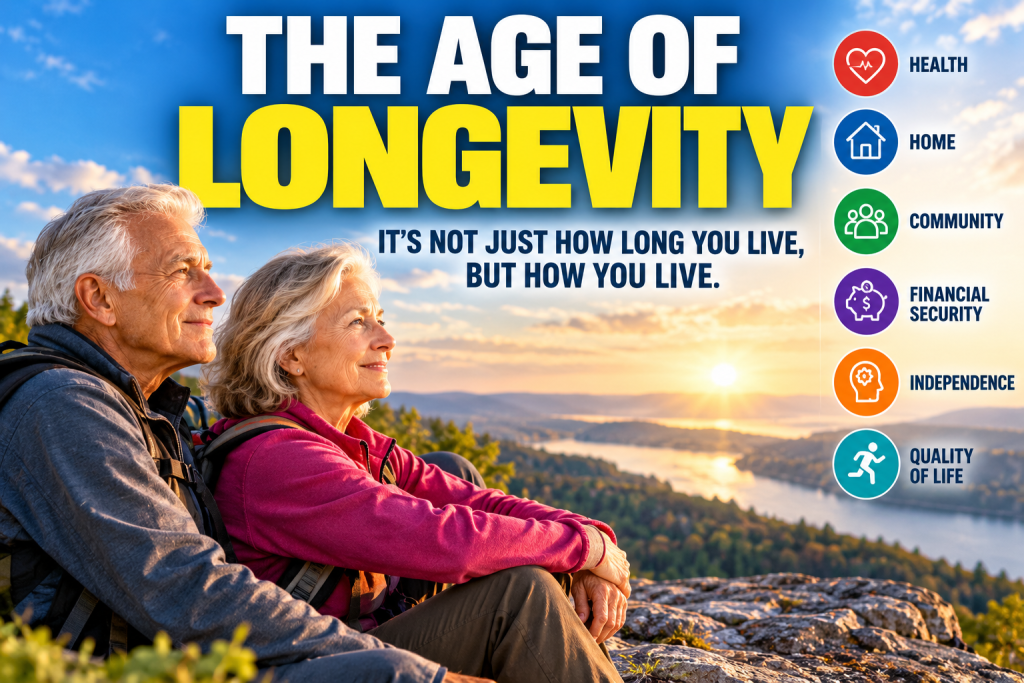
We have entered a new age.
Not simply old age.
Not simply retirement.
The Age of Longevity.
People are living longer than previous generations ever expected. That is one of the greatest achievements of modern medicine, public health, nutrition, sanitation, and technology.
But living longer creates a new question.
For most of history, people worried about dying too soon.
Today, more people also have to think about something different:
What happens if life continues, but independence changes?
That question reaches far beyond medicine.
It touches housing.
Transportation.
Money.
Family.
Caregiving.
Technology.
Community.
And perhaps most of all, personal control.
At Elderhood.info, that is the conversation we want to have.
Not how to avoid aging.
Not how to pretend aging does not exist.
But how to live intelligently in a world where longer life is becoming more common.
Longevity Is Good News
It is easy to become cynical about aging.
Every advertisement seems to promise younger skin, stronger joints, sharper memory, or some magical way to turn back the clock.
But there is another way to look at it.
Aging is evidence that you are still here.
That may sound obvious, but it matters.
Modern medicine has changed the course of many diseases.
Heart attacks that once killed people may now be survived.
Cancer treatments are improving.
Joint replacement allows many people to walk again.
Cataract surgery restores vision.
Hearing technology is improving.
Stroke rehabilitation can restore function.
Diabetes can be managed more effectively.
Conditions that once ended life can now become chronic conditions people live with for years.
That is extraordinary.
But there is a second side to that success.
If people live longer, they also have more years in which mobility, memory, strength, hearing, vision, and independence may change.
That is not pessimism.
It is arithmetic.
Retirement Planning May Be Too Narrow
For decades, retirement planning has focused on money.
How much have you saved?
What will Social Security provide?
How much can you safely withdraw?
Will your portfolio last?
Those are important questions.
But longevity suggests that we may need to expand the conversation.
A person can have enough money and still face serious problems.
Who helps if they stop driving?
Who steps in after a stroke?
Who notices if something changes?
Who manages medications?
Who handles financial decisions if memory declines?
Can the house still work if mobility becomes limited?
What happens if a spouse dies?
What happens if an adult child lives three states away?
That is why retirement planning may need to become life planning.
Money is part of the answer.
But not the entire answer.
Independence Is One of Our Greatest Assets
Most people do not think of independence as an asset.
We think of assets as houses, savings accounts, pensions, investments, and property.
But independence may be more valuable than all of them.
The ability to drive.
The ability to cook.
The ability to choose where you live.
The ability to make your own decisions.
The ability to leave the house when you want.
The ability to manage your own money.
These things feel ordinary when we have them.
Then one day, one of them disappears.
That is when we realize what it was worth.
This is why Elderhood should not be defined simply by age.
It should be defined by awareness.
The awareness that independence deserves to be protected, supported, and planned for.
The House You Love May Become a Problem
Many older adults say the same thing:
“I am staying in this house forever.”
That desire is understandable.
Home contains history.
Memories.
Neighbors.
Familiar routines.
Comfort.
But a house that worked beautifully at age 55 may not work as well at age 85.
Stairs matter more.
Bathrooms matter more.
Distance from doctors matters more.
Transportation matters more.
Even something as simple as carrying groceries from the car can become difficult.
So the question is not:
Do I love my home?
The question is:
Can my home continue to support the life I want?
That may mean grab bars.
Better lighting.
A bedroom on the main floor.
Removing trip hazards.
Wider doorways.
Transportation alternatives.
Delivery services.
Technology.
Or, eventually, moving.
Aging in place can be wonderful.
But aging in place should not mean becoming trapped in place.
Driving Is More Than Transportation
For many older adults, driving represents freedom.
You can go where you want, when you want.
Nobody has to schedule your life.
The day driving becomes unsafe can therefore feel like a loss far greater than transportation.
It can feel like a loss of identity.
That is why people often resist giving up the keys.
But there is a better way to think about it.
Do not wait until driving ends to think about transportation.
Build alternatives before you need them.
Local senior transportation.
Friends.
Family.
Ride services.
Community programs.
Delivery services.
Medical transportation.
The goal is not to take away freedom.
The goal is to preserve it in another form.
Technology May Be One of the Great Tools of Aging
Technology is often presented as something for young people.
That is nonsense.
Older adults may benefit from technology as much as anyone.
A smartphone can connect someone instantly to family.
A smart watch may detect a fall.
A video call can reduce isolation.
A medication dispenser can provide reminders.
Voice assistants can help someone with limited mobility.
Telehealth can bring a clinician into the home.
Home cameras and sensors can help families monitor safety.
Artificial intelligence can help explain paperwork, prepare questions for doctors, organize information, and simplify complex subjects.
Technology will not replace human connection.
But it can make independent living safer and easier.
That may become one of the biggest changes in elderhood over the next decade.
Living Alone Is Not the Same as Being Alone
More older adults are living alone.
Some never married.
Some are widowed.
Some are divorced.
Some have adult children who live far away.
Living alone can be a perfectly satisfying way to live.
The problem is not solitude.
The problem is lack of a support system.
Ask yourself:
If I did not answer the phone for two days, who would notice?
If I were taken to the hospital, who would come?
If I needed help for six weeks, who would be available?
If I could not make decisions, who would speak for me?
Those are uncomfortable questions.
They are also practical questions.
Solo aging does not have to mean unsupported aging.
But support usually has to be built intentionally.
Your Social Network Is Part of Your Health
We often think of health in terms of blood pressure, cholesterol, weight, exercise, and medications.
But social connection matters too.
As people age, social circles can shrink.
Friends move.
Friends die.
People stop driving.
Hearing loss makes conversation harder.
Mobility problems make outings more difficult.
Little by little, a full life can become smaller.
That is why staying connected matters.
A church.
A senior center.
A walking group.
A hobby club.
Volunteer work.
Neighbors.
Friends.
Community activities.
The point is not to stay busy for the sake of staying busy.
The point is to remain connected to other people.
Connection creates meaning.
It also creates safety.
Strength Matters More Than Appearance
For younger people, exercise is often about appearance.
For older adults, exercise becomes something more important.
Function.
Can you get out of a chair?
Can you climb stairs?
Can you carry groceries?
Can you recover from a stumble?
Can you walk far enough to remain independent?
Muscle is not cosmetic.
Muscle is functional insurance.
That is why strength training, walking, balance exercises, and regular movement become increasingly important with age.
You do not need to become an athlete.
You need enough strength to live the life you want.
That is a much more practical goal.
Planning Is Not Pessimism
Some people resist aging conversations because they feel negative.
They say:
“I do not want to think about that.”
Fair enough.
Nobody enjoys thinking about losing mobility or needing help.
But planning does not make something happen.
Planning creates options if it does.
We insure our homes without expecting a fire.
We carry auto insurance without expecting an accident.
We create wills without expecting to die tomorrow.
Planning for aging should be viewed the same way.
You are not predicting disaster.
You are protecting your future choices.
Five Questions Worth Asking Now
You do not need a complicated plan.
Start with five questions.
Where do I want to live if my health changes?
Who would help me if I needed assistance?
How would I pay for care?
Who would make decisions if I could not?
What matters most to me as I grow older?
Those five questions can lead to conversations that prevent enormous confusion later.
And they are best answered before a crisis.
The Goal Is Not to Live Forever
Longevity sometimes gets marketed as if the goal is simply more years.
But more years are not automatically better years.
The real goal should be healthspan along with lifespan.
More years with mobility.
More years with curiosity.
More years with purpose.
More years with relationships.
More years with independence.
And when independence changes, more years with dignity and control.
That is a much richer definition of successful aging.
Elderhood Is a New Stage of Life
For most of human history, people did not have a long period between retirement and the end of life.
Today, many do.
That stage deserves its own identity.
That is what Elderhood represents.
Not decline.
Not invisibility.
Not simply “being old.”
It is a stage of life with its own challenges, opportunities, decisions, and responsibilities.
You may have more time.
More perspective.
More experience.
More freedom.
But you may also need to adapt.
And adaptation is not failure.
It is intelligence.
The Future of Aging Will Look Different
A generation from now, many things we accept as normal today may look primitive.
Homes may be designed differently.
Transportation may become more automated.
Artificial intelligence may assist with daily living.
Remote monitoring may become commonplace.
Medical treatments may delay or prevent some forms of decline.
Community models may change.
Housing may change.
Caregiving may change.
We do not know exactly what elderhood will look like in the future.
But we can be certain of one thing:
It will not look exactly like it does today.
That is why curiosity matters.
The person who keeps learning will be better prepared to adapt.
The Bottom Line
We have entered the Age of Longevity.
That is worth celebrating.
But longer life changes the questions we need to ask.
It is no longer enough to ask:
How long might I live?
We should also ask:
How do I want to live?
How do I preserve my independence?
Who is part of my support system?
What happens if my abilities change?
What choices do I want to protect?
Those are not depressing questions.
They are empowering ones.
At Elderhood.info, our goal is to explore those questions honestly.
No hype.
No pretending aging does not exist.
And no assumption that decline is inevitable simply because another birthday arrives.
Aging is inevitable.
How we prepare for it is not.
And perhaps that is the real opportunity of longevity:
Not simply adding more years to life.
But learning how to put more life into those years.