
For most of our lives, heart medicine has been associated with what happens after something goes wrong.
A heart attack.
A blocked artery.
A stent.
Bypass surgery.
A trip to the emergency room nobody had scheduled.
Modern cardiology has become remarkably good at rescuing people once heart disease announces itself.
But an even bigger revolution may be underway.
Instead of asking:
“How do we treat the heart attack?”
medicine is increasingly asking:
“How do we prevent the heart attack from happening in the first place?”
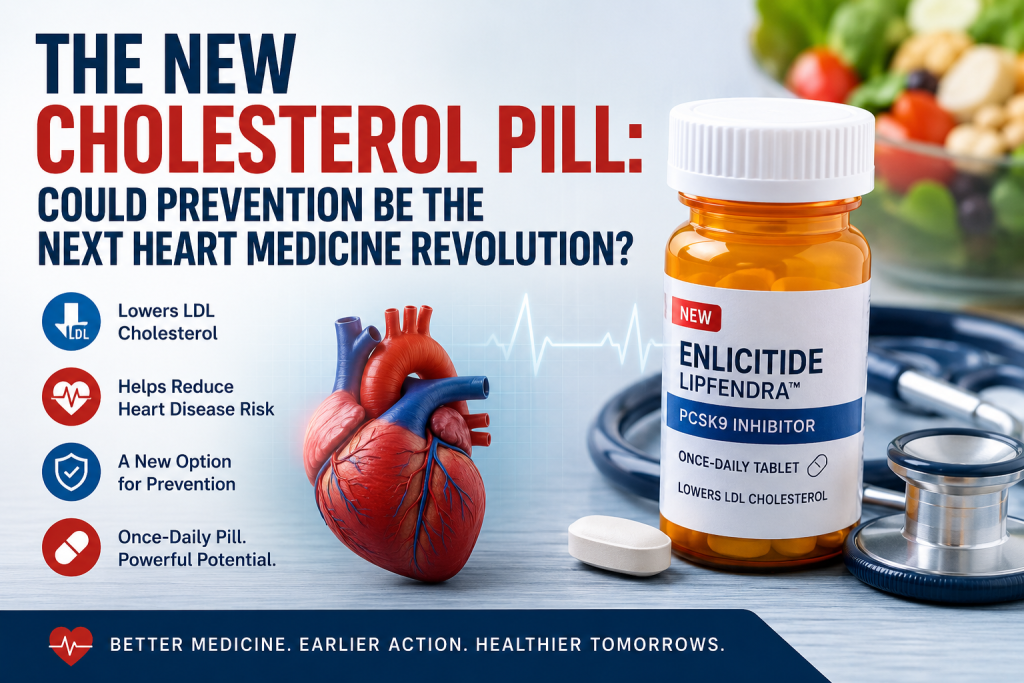
And one of the newest examples arrived in July 2026, when the U.S. Food and Drug Administration approved Lipfendra, or enlicitide, the first oral medication that blocks a cholesterol-related protein called PCSK9.
That may sound like another pharmaceutical announcement.
It is potentially much more interesting than that.
First, What Exactly Happened?
On July 17, 2026, the FDA announced the approval of Lipfendra as a once-daily pill used along with diet and exercise to lower LDL cholesterol in adults with high cholesterol, including people with a genetic form called heterozygous familial hypercholesterolemia.
The important words are:
once-daily pill.
PCSK9 inhibition is not new.
Doctors have had powerful PCSK9-lowering treatments for years, but those therapies have primarily required injections.
This is the first time the FDA has approved an oral PCSK9 inhibitor.
That could make a powerful cholesterol-lowering strategy considerably easier for some patients to use.
What Is PCSK9?
Fortunately, you do not need to remember what PCSK9 stands for.
Nobody is going to quiz you at breakfast.
What matters is what it does.
Your liver has receptors that remove LDL cholesterol from your bloodstream.
Think of those receptors as little garbage collectors picking excess LDL out of circulation.
PCSK9 interferes with those receptors.
Block PCSK9, and more LDL receptors remain available to remove cholesterol from the blood.
That can produce a substantial reduction in LDL.
The American Heart Association explains that PCSK9 inhibitors help the liver remove more LDL cholesterol from circulation.
And lowering LDL matters because LDL cholesterol contributes to the buildup of plaque inside arteries.
Over time, plaque can narrow blood vessels.
If plaque becomes unstable and ruptures, a blood clot can form.
That can produce a heart attack or stroke.
The frightening thing is that high cholesterol generally does not hurt.
Your arteries do not send you a text message saying:
“Bill, we’re getting a little crowded in here.”
You can feel perfectly healthy while plaque is quietly developing.
That is why prevention becomes so important.
How Powerful Is the New Pill?
The FDA based its approval on two randomized, placebo-controlled clinical trials involving more than 3,200 adults with elevated cholesterol who were already receiving the maximum statin therapy they could tolerate.
The results were impressive.
In patients who already had atherosclerotic cardiovascular disease or were at high risk of developing it, enlicitide lowered LDL cholesterol by an average of approximately 56% compared with placebo after 24 weeks.
In patients with heterozygous familial hypercholesterolemia, the average reduction was approximately 59%.
That is not a minor change.
If someone has LDL cholesterol that remains much higher than their doctor wants despite taking a statin, cutting LDL roughly in half can dramatically change the number on the laboratory report.
But here is where we need to distinguish between an exciting result and an exaggerated headline.
Does the New Pill Prevent Heart Attacks?
This is where the answer needs to be precise.
The new medication has clearly demonstrated that it can lower LDL cholesterol substantially.
But the FDA approval announcement centered on LDL reduction—not proof from completed cardiovascular-outcome trials that this particular pill itself reduces heart attacks, strokes, or cardiovascular deaths.
That distinction matters.
LDL cholesterol is a well-established cardiovascular risk factor, and lowering LDL is a central strategy in preventing atherosclerotic cardiovascular disease.
But whenever a new medicine arrives, we should avoid jumping from:
“It lowers an important risk factor”
to:
“We have proven exactly how many heart attacks this drug will prevent.”
Those longer-term outcome questions require additional evidence.
That is not criticism of the drug.
It is how responsible medicine works.
Statins Are Not Going Away
Whenever a shiny new drug appears, there is a tendency to declare yesterday’s medicine obsolete.
That would be a mistake here.
Statins remain the foundation of cholesterol-lowering drug therapy.
The 2026 American College of Cardiology and American Heart Association guideline continues to emphasize healthy lifestyle habits and statin therapy as the foundation of cardiovascular risk reduction.
Statins have decades of evidence behind them.
They are widely available.
Many are inexpensive generics.
And they have demonstrated cardiovascular benefits in millions of patients.
The new oral PCSK9 medicine is more likely to become another tool available when LDL remains too high despite existing treatment or when an individual needs more aggressive cholesterol lowering.
Think of the medicine cabinet as a toolbox.
You don’t throw away the hammer because somebody invented a very good electric screwdriver.
You simply have another tool.
The Cholesterol Toolbox Is Getting Bigger
Until fairly recently, many people thought cholesterol treatment basically meant:
“Take a statin.”
Today, the choices are much broader.
There are statins.
There is ezetimibe, which reduces cholesterol absorption in the intestine.
There is bempedoic acid, another oral cholesterol-lowering medicine.
There are injectable monoclonal antibody PCSK9 inhibitors.
There is inclisiran, an injectable treatment that affects the production of PCSK9.
And now there is an oral PCSK9 inhibitor.
This matters because people respond differently to medications.
Some people reach their cholesterol targets easily with a statin.
Some don’t.
Some experience side effects.
Some have inherited cholesterol disorders that make controlling LDL much harder.
Some already have cardiovascular disease and need much lower LDL levels.
More options give physicians more ways to individualize treatment.
And that is where heart medicine appears to be heading:
personalized prevention.
Cholesterol Targets Are Becoming More Aggressive
Another important development happened before the new pill was even approved.
In March 2026, the American College of Cardiology and American Heart Association issued updated cholesterol-management guidelines that emphasize lowering exposure to harmful cholesterol earlier and for longer periods of life.
For people at borderline or intermediate risk who are being treated for primary prevention, the guideline identifies an LDL goal below 100 mg/dL.
For people at high risk, the goal may be below 70.
And for some people who already have cardiovascular disease and are considered at very high risk, the goal can be below 55 mg/dL.
Years ago, numbers that low might have seemed extreme.
Today, cardiology increasingly recognizes that for people at substantial risk:
lower LDL for longer generally means less exposure of the arteries to plaque-producing cholesterol.
That is a major philosophical change.
The Real Revolution Is Prevention
Think about the history of heart disease.
For generations, medicine waited until people became symptomatic.
Then we developed better cardiac intensive care.
Better bypass operations.
Better stents.
Better blood thinners.
Better emergency treatment.
Those advances saved millions of lives.
But imagine going one step further.
What if fewer people ever needed the stent?
What if fewer people ever needed bypass surgery?
What if we could identify the person headed toward a heart attack ten or twenty years earlier and aggressively reduce the forces creating the disease?
That is the prevention revolution.
And cholesterol is only one part of it.
The 2026 guidelines encourage a much more complete evaluation of cardiovascular risk.
Your LDL Number May Not Tell the Entire Story
For years, many of us received a cholesterol report and looked at four numbers.
Total cholesterol.
LDL.
HDL.
Triglycerides.
Medicine is becoming more sophisticated.
The new guideline recommends measuring lipoprotein(a), or Lp(a), at least once during adulthood because high levels are largely inherited and can significantly increase cardiovascular risk.
Doctors may also use a test called apolipoprotein B, or apoB, in certain patients to better understand the number of potentially harmful cholesterol-containing particles circulating in the blood.
And when the treatment decision remains uncertain, doctors may selectively use a coronary artery calcium scan to look for evidence of plaque already developing in the arteries of the heart.
This is very different from simply being told:
“Your cholesterol is 210. See you next year.”
The future is about understanding your actual risk.
Heart Prevention Is Becoming Personalized
Two people can have identical LDL cholesterol numbers and very different risks.
One may have:
No diabetes.
Normal blood pressure.
No family history.
No smoking history.
No coronary calcium.
The other may have:
Diabetes.
Kidney disease.
High blood pressure.
A strong family history of premature heart disease.
And significant coronary calcium.
The laboratory number may look similar.
The patient is not.
That is why modern cardiovascular medicine is moving away from treating a laboratory result in isolation.
The question is increasingly:
What does this number mean for this particular person?
The updated guidelines now use a risk calculator called PREVENT to estimate both 10-year and 30-year cardiovascular risk in appropriate adults.
That longer view matters.
If you’re 50 and your short-term heart-attack risk isn’t dramatic, that does not mean spending the next thirty years with elevated cholesterol is harmless.
Cardiovascular disease develops over time.
What About People in Their 70s and 80s?
This question is particularly important for Elderhood.
At some point, people hear the phrase “preventive medicine” and assume the opportunity has passed.
It hasn’t necessarily.
A healthy person at 75 may have many years ahead.
An 80-year-old may still benefit from reducing the risk of a heart attack or stroke depending on overall health, existing cardiovascular disease, medications, frailty, personal preferences, and life expectancy.
But treatment becomes increasingly individualized.
More medicine is not automatically better medicine.
The goal should not be to make every laboratory result look like it belongs to a 25-year-old.
The goal is to determine whether treatment is likely to meaningfully improve the individual’s health and independence.
That is a conversation worth having with your physician.
What About Side Effects?
According to the FDA, adverse reactions with enlicitide were generally similar to placebo in one major trial.
Among patients with familial hypercholesterolemia, diarrhea and dizziness occurred more often with the drug than with placebo. Discontinuation because of adverse effects was similar between treatment and placebo groups across the studies.
That is encouraging.
But the medicine is new.
Longer experience in the broader population will teach physicians more.
Every drug needs to be judged not simply by what it does to a laboratory number, but by its overall balance of benefits, risks, interactions, convenience, and cost.
And Then There Is the Big Question: Price
This may determine how revolutionary the new pill actually becomes.
Powerful injectable PCSK9 medicines have historically been much more expensive than generic statins.
If an oral PCSK9 medicine is priced high, insurance coverage and prior authorization could limit how easily patients obtain it.
If competition eventually pushes prices lower, the story could become much bigger.
The medical breakthrough is only half of the equation.
The other half is:
Can ordinary people get it?
At Elderhood, that question matters.
A $1-million cure that exists somewhere is scientifically fascinating.
A treatment people can actually receive is medically transformative.
Lifestyle Did Not Become Obsolete
There is another danger whenever we discuss a powerful new cholesterol medicine.
People think:
“Wonderful. Now I can have the cheeseburger and let the pill deal with it.”
Unfortunately, the human body did not negotiate that agreement.
The American Heart Association continues to emphasize physical activity, healthy weight, avoiding tobacco, adequate sleep, and healthier eating as the first foundation of cardiovascular prevention.
Medication is sometimes necessary because genetics and biology are powerful.
But a pill does not make exercise irrelevant.
It does not control your blood pressure automatically.
It does not make smoking harmless.
It does not protect muscle.
It does not replace sleep.
And it certainly doesn’t create social connection or purpose.
Health is still a package deal.
That is part of the broader Elderhood philosophy behind Stay Healthy Until the Future Gets Here.
The medicine of tomorrow works best when we take care of ourselves today.
What Should You Ask Your Doctor?
You don’t need to walk into your next appointment and demand the newest drug on television.
A better conversation might begin with:
What is my LDL cholesterol?
Based on my overall health, what should my LDL goal be?
What is my 10-year and longer-term cardiovascular risk?
Should I have my lipoprotein(a) checked?
Would an apoB test tell us anything useful?
Would a coronary calcium scan help clarify my risk?
Am I getting enough benefit from my current cholesterol medication?
If my LDL remains high, what additional treatments should we consider?
Those questions turn a cholesterol test into a prevention conversation.
The Bigger Story: Stop Waiting for the Heart Attack
The approval of the first oral PCSK9 inhibitor is important.
But I believe the larger story is even more important.
Medicine is getting better at identifying risk before catastrophe.
Better cholesterol drugs.
Better blood-pressure treatment.
Better diabetes medicines.
GLP-1 medications that can reduce cardiovascular risk in certain patients.
Coronary calcium scans.
Genetic information.
Lp(a).
ApoB.
Artificial intelligence.
Better prediction models.
All of these tools are pointing in the same direction:
Find cardiovascular disease earlier.
Identify the people at greatest risk.
Intervene sooner.
And perhaps prevent an emergency that otherwise might have occurred ten years later.
That is a very different model of medicine.
The Elderhood Takeaway
The new cholesterol pill is not a miracle.
It does not make statins obsolete.
It does not eliminate the need for exercise, good nutrition, blood-pressure control, or other cardiovascular prevention.
And we still need longer-term evidence about cardiovascular outcomes specifically with this new oral therapy.
But don’t miss what has happened.
A powerful biological approach to lowering cholesterol that previously required injections can now be delivered as a daily pill.
At the same time, cardiovascular guidelines are becoming more aggressive about identifying risk earlier and reducing lifelong exposure to harmful cholesterol.
Put those developments together, and we can see where heart medicine may be headed.
For much of our lives, cardiology became famous for saving people during heart attacks.
The next great achievement may be something less dramatic:
Helping millions of people never have the heart attack at all.
There will be no ambulance.
No flashing lights.
No emergency room.
No cardiologist running down the hallway.
Nothing will happen.
And that may be the greatest success of all.
At Elderhood, our message remains:
Stay healthy until the cavalry arrives.
But in cardiovascular medicine, something interesting is happening.
The cavalry isn’t only coming to rescue us after the battle anymore.
It is starting to arrive before the battle begins.