
Your DNA is talking.
Until recently, scientists needed considerable time, expensive laboratory equipment, and enormous computing power to interpret what our genetic material was saying.
That is beginning to change.
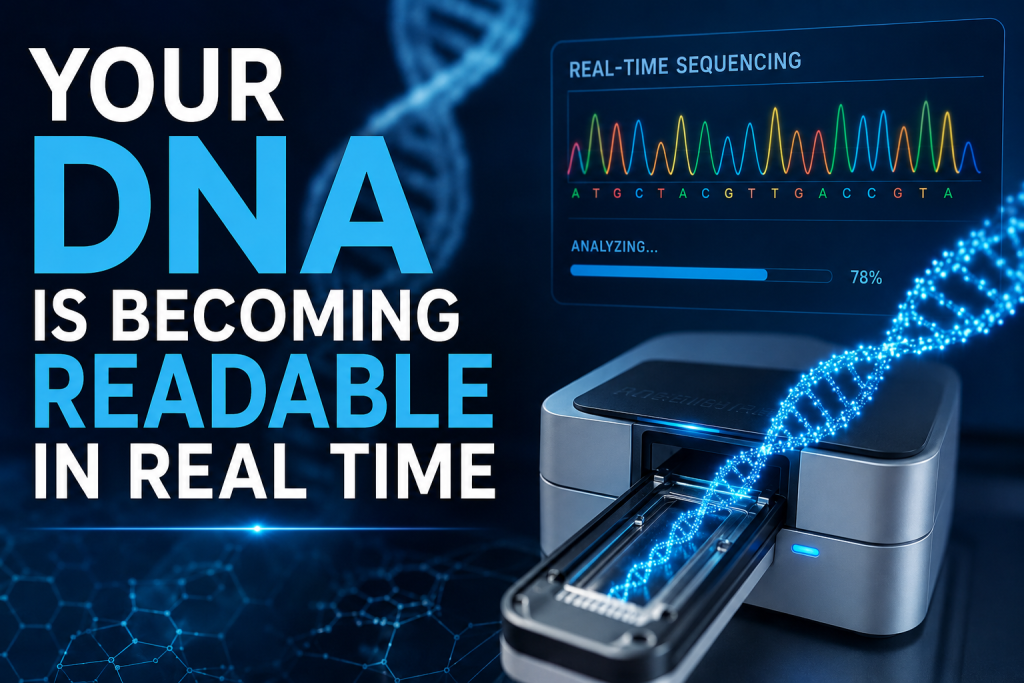
New sequencing technologies can analyze DNA while the molecules are moving through a testing device. Instead of collecting an entire genetic sample, processing everything, and waiting until the end to see the results, researchers can begin receiving information almost immediately.
The data can appear while the sequencing is still underway.
That is what scientists mean when they talk about real-time DNA sequencing.
No, your doctor cannot yet wave a device over you like something from Star Trek and announce every disease you may develop during the next 20 years. We are not there.
But we are moving toward a future in which genetic information can be read faster, more completely, and possibly closer to the patient than ever before.
For older adults, this could eventually change how doctors diagnose infections, investigate rare disorders, select cancer treatments, and monitor whether a disease is returning.
The medical chart of the future may not simply describe what has already happened to your body. It may increasingly reveal what is happening at the molecular level right now.
What Does It Mean to “Read” DNA?
DNA is often described as the body’s instruction manual.
That comparison is useful, but it is not perfect.
An instruction manual stays the same. The human body does not. Our cells age, divide, repair themselves, suffer damage, respond to the environment, and sometimes develop mutations.
Your inherited DNA generally remains stable, but the biological activity surrounding it is constantly changing. Researchers are therefore interested in more than the genetic sequence you received at birth.
They are also studying:
- Mutations that develop in tumors
- Genetic material released into the bloodstream
- Changes in how genes are activated or silenced
- DNA patterns associated with infection
- Chemical markers attached to DNA
- The effects of aging and environmental exposure
This is one reason modern genomic medicine is becoming so powerful. Scientists are not merely reading a permanent family blueprint. They are looking for molecular evidence of what may be taking place inside the body.
How Real-Time DNA Sequencing Works
One of the technologies driving this change is called nanopore sequencing.
The basic idea sounds as though it was invented by someone after too much coffee, but it works.
A strand of DNA passes through an extremely tiny opening called a nanopore. As different sections of the DNA move through that opening, they cause measurable changes in an electrical current. Computer software interprets those changes and identifies the genetic sequence.
Most importantly, the information can be analyzed as it is produced.
Researchers do not always have to wait for the entire sequencing run to finish.
Nanopore systems can also read relatively long stretches of DNA. Long-read sequencing may reveal structural changes and complicated genetic variations that can be difficult to detect using technologies that divide DNA into many short pieces.
A 2025 clinical validation study found that long-read sequencing could identify a broad range of genetic variation in a unified testing approach, although implementation, accuracy standards, cost, and clinical interpretation remain important considerations.
Think of traditional short-read sequencing as trying to reconstruct a newspaper after it has been cut into thousands of small pieces.
Long-read sequencing gives you larger sections of the page.
There is still work involved, but at least you are not trying to assemble the entire story one syllable at a time.
Why Speed Matters in Medicine
In ordinary circumstances, waiting several days for a test result may be frustrating.
In critical care, waiting can be dangerous.
A genetic diagnosis may influence decisions about surgery, medication, intensive care, or whether a treatment is likely to help. Traditional genetic testing can sometimes require multiple separate tests and weeks of waiting.
Recent clinical work has shown that nanopore long-read genome sequencing can produce genome-wide findings within days and may support urgent decision-making in critically ill patients. In one reported clinical implementation involving a relatively small group, researchers were able to make diagnoses that affected patient care, although larger studies and continued validation are still needed.
Speed may also matter when doctors are trying to identify an infection.
A 2025 study of suspected bacterial meningitis reported that real-time nanopore sequencing substantially reduced the time needed to identify pathogens compared with conventional cultures. Some genetic signals were detectable shortly after sequencing began, although the complete clinical process still required more time, and rapid sequencing does not eliminate the need for proper sample preparation and medical interpretation.
That distinction is important.
“Real time” does not necessarily mean an instant diagnosis.
The machine may start generating DNA data quickly, but someone still has to obtain the sample, prepare it, control for contamination, analyze the information, confirm the findings, and decide what they mean for the patient.
A fast answer is only valuable when it is also a reliable answer.
A New Era for Cancer Testing
One of the most promising applications involves liquid biopsies.
Tumors can release fragments of genetic material into the bloodstream. A liquid biopsy uses a blood sample to search for this circulating tumor DNA rather than relying only on tissue removed through surgery or a needle biopsy.
The U.S. Food and Drug Administration explains that liquid biopsies may provide information about genetic changes associated with cancer. Certain FDA-approved tests already analyze cell-free DNA to help determine whether some cancer patients may benefit from particular targeted treatments.
Researchers are also studying whether liquid biopsies can:
- Detect cancer earlier
- Monitor how a tumor responds to treatment
- Identify emerging drug resistance
- Find molecular evidence that cancer remains after surgery
- Detect recurrence before it becomes visible on imaging
In January 2026, the FDA described research evaluating tumor-informed whole-genome liquid-biopsy approaches for detecting minimal residual disease after cancer treatment. These tests compare DNA found in the bloodstream with mutations identified in a patient’s tumor.
This does not mean a routine blood draw can now reliably find every hidden cancer.
It cannot.
A tumor may release only a tiny amount of DNA. Some detected mutations may come from age-related changes in blood cells rather than from a dangerous tumor. False alarms and missed cancers remain legitimate concerns.
Liquid biopsy is a powerful developing tool—not a crystal ball.
DNA Can Reveal More Than Mutations
Scientists are also examining DNA methylation.
Methylation involves chemical markers attached to DNA. These markers help regulate whether certain genes are active or quiet. Their patterns can change with age, disease, lifestyle, and environmental exposure.
Researchers hope methylation patterns may improve cancer detection and help distinguish among different biological conditions. Nanopore sequencing is especially interesting because it may detect some of these chemical modifications directly while reading the DNA molecule, without requiring several additional laboratory steps.
This moves us beyond asking:
“What genes do you have?”
Toward asking:
“What is happening to those genes?”
That may eventually help doctors understand biological aging more accurately.
But consumers should be cautious about commercial tests claiming to calculate an exact “biological age.” Different tests measure different markers and can produce different estimates. A number printed on a wellness report is not the same as a medically proven forecast of how long you will live.
The calendar may be blunt, but a fancy DNA report can also be confidently wrong.
What This Could Mean for Older Adults
Older adults are more likely to face cancer, complicated medication decisions, unusual infections, and multiple chronic conditions. Faster genomic information could therefore be particularly valuable later in life.
Possible future applications include:
Faster infection identification
Doctors may be able to determine more quickly which bacterium, virus, or fungus is causing a serious illness and whether it carries genetic signs of drug resistance.
Better cancer treatment selection
A tumor’s mutations may help determine whether a targeted medication is likely to work. This is already happening in selected cancers through approved companion diagnostic tests.
Less invasive monitoring
A blood test may sometimes provide useful molecular information without repeatedly removing tumor tissue.
Answers for previously unexplained illnesses
Long-read sequencing may detect complicated rearrangements or repeated sections of DNA that older testing methods can miss.
More individualized medicine
Genetic information may eventually be combined with laboratory results, medical history, imaging, medications, lifestyle, and continuous health data to create more individualized treatment strategies.
That does not mean DNA will replace the physician.
It means the physician may have a much sharper instrument.
Your DNA Is Not Your Destiny
This is where people frequently misunderstand genetics.
A genetic risk is not a guaranteed outcome.
Some mutations strongly influence disease, but many common conditions result from complicated interactions among genes, age, behavior, environment, medical care, and plain old luck.
You cannot blame every health problem on your ancestors.
Grandpa may have given you his hairline, but he did not personally put the cookies in your kitchen.
Your daily habits still matter.
Protecting muscle, staying active, eating a sensible diet, managing blood pressure, sleeping adequately, avoiding tobacco, maintaining social connection, and receiving appropriate preventive care remain essential. You can read more about protecting independence in The Muscle Loss Trap After 60 and explore the difference between simply living longer and living well in What’s the Difference Between Healthspan and Lifespan?.
Genomics adds information. It does not cancel basic biology.
The Privacy Question Nobody Should Ignore
As our DNA becomes easier to read, it may also become easier to collect, store, share, and misuse.
Genetic information is unusually personal.
You can change your password. You cannot change your genome.
Before agreeing to genetic testing, consumers should ask:
- Who owns the sample?
- Will the sample be destroyed?
- Where will the data be stored?
- Can the information be sold or shared?
- Will it be used for research?
- Can consent be withdrawn?
- Does the test have demonstrated clinical value?
- Who will explain unexpected findings?
- Could the result reveal information about family members?
A cheerful advertisement promising to reveal your perfect diet, hidden ancestry, ideal exercise routine, and future medical risks deserves more than cheerful acceptance.
Read the privacy agreement.
Yes, it may be longer than War and Peace. Read the important parts anyway.
The Risk of Too Much Information
Better testing can reveal valuable answers.
It can also uncover findings nobody expected.
A person may learn about a risk that cannot yet be prevented or treated. A test may identify a “variant of uncertain significance,” meaning scientists do not know whether the genetic difference is harmful or harmless.
That uncertainty can produce anxiety, unnecessary follow-up testing, and medical bills.
More information is not automatically better information.
The real goal is actionable information—results accurate enough to influence a sensible medical decision.
This is why genomic tests should be interpreted in context, preferably with qualified physicians and genetic counselors. Ordering a complicated test without a plan for understanding the result is like buying a cockpit instrument without knowing how to fly the airplane.
It may look impressive right up until the trouble starts.
The Elderhood View: Stay Ready for the Future
Real-time DNA sequencing represents something larger than a new laboratory technique.
It represents a shift from medicine that reacts to visible disease toward medicine that may detect molecular changes earlier.
The technology is not perfect.
It will not replace exercise, nutrition, sleep, medical judgment, or common sense. It will not tell us everything. It may create new privacy, ethical, financial, and emotional problems.
But it is another sign that the future of aging may look very different from the past.
At Elderhood, we believe chronological age is becoming less important than adaptability. Modern science is steadily challenging old assumptions about what aging must look like, as discussed in Modern Science Is Challenging What We Were Told About Aging.
We may be the first generation of elders who must prepare not only for getting older, but for continually changing medicine.
The objective is not to become obsessed with every new test.
It is to remain informed enough to ask good questions.
Is the test clinically validated?
Will the result change my treatment?
What are the risks?
Who controls my genetic data?
Will insurance cover it?
What happens if the result is unclear?
Those questions will become increasingly important as DNA sequencing moves from specialized research centers into more hospitals, clinics, and perhaps eventually physicians’ offices.
Your DNA has always contained an extraordinary amount of information.
What is changing is our ability to hear it.
The message may not always be simple. It may not always be certain. And it may occasionally tell us something we would rather not know.
But for the first time, science is beginning to read portions of that message while the biological story is still unfolding.
The future is not merely looking at your medical history.
It may soon be watching your biology write its next chapter.