
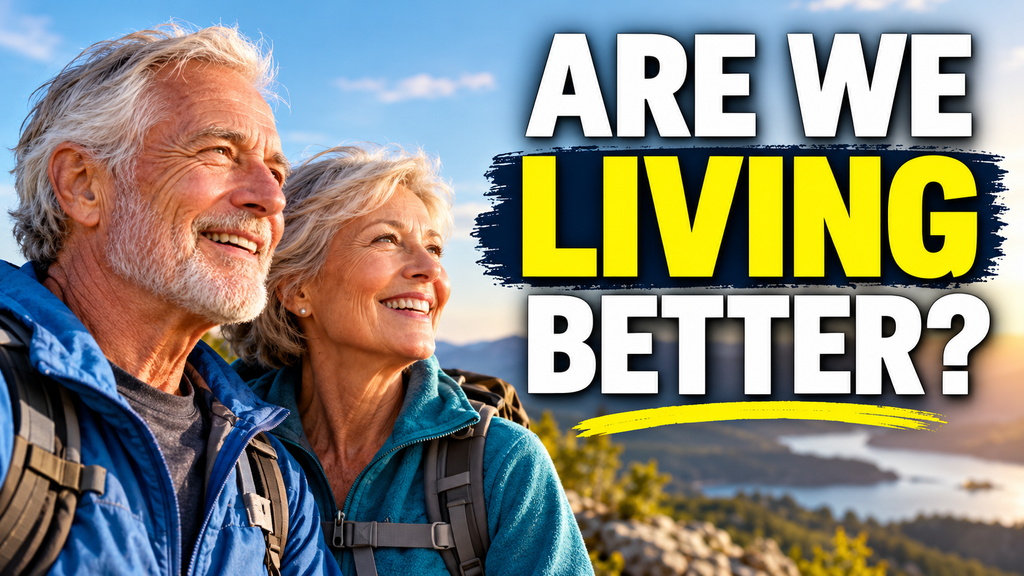
We hear it all the time.
People are living longer.
That sounds like good news.
And it is.
But there is another question we probably should be asking:
What are we doing with those extra years?
Because living longer and living better are not automatically the same thing.
You can add years to life.
The real challenge is adding life to those years.
That is where Elderhood begins.
We Have Entered the Age of Longevity
Something remarkable has happened in our lifetime.
More people are reaching their seventies, eighties, nineties, and beyond.
Medicine is better.
Emergency care is better.
Heart disease is treated more effectively.
Cancer treatment is changing rapidly.
Joint replacements can restore mobility.
Hearing aids are improving.
Technology can connect us instantly with family, doctors, information, transportation, entertainment, and the rest of the world.
We are living through what may be one of the most important social changes in human history.
Millions of people are living long enough to enter an entirely new stage of life.
Not childhood.
Not middle age.
Not simply “old age.”
Elderhood.
And Elderhood can last a very long time.
The Old Definition of Aging No Longer Fits
For generations, aging was often described as a slow withdrawal from life.
You worked.
You retired.
You slowed down.
Eventually, you sat on the sidelines.
That picture no longer fits millions of older adults.
People in their seventies and eighties are traveling.
Working.
Dating.
Starting businesses.
Learning technology.
Volunteering.
Creating videos.
Taking classes.
Riding bicycles.
Going to the gym.
Starting completely new chapters of their lives.
We are becoming what I like to call:
the new young old people.
That does not mean pretending we are 35.
Our knees would probably file a formal complaint.
It means recognizing that age does not automatically determine what we can still learn, contribute, enjoy, or become.
The Goal Is Not to Stay Young
This is important.
The goal of aging should not be to spend our lives desperately trying to become young again.
That battle is already lost.
And frankly, being young was not always that wonderful.
We were broke.
We worried about jobs.
We raised children.
We made mistakes.
We had very little idea what we were doing.
One advantage of getting older is that we finally know a few things.
The goal is not youth.
The goal is function.
Can you move?
Can you think clearly?
Can you make decisions?
Can you stay connected?
Can you participate in your own life?
Can you keep doing things that give your life meaning?
Those questions matter far more than the number of candles on your birthday cake.
Protect Your Ability to Move
One of the greatest threats to independence is not simply disease.
It is losing physical function.
When walking becomes difficult, the world starts getting smaller.
You stop going certain places.
You avoid stairs.
You travel less.
You become more dependent on others.
That is why movement matters so much as we age.
You do not need to become an athlete.
You do need to keep using your body.
Walk.
Stretch.
Strengthen your legs.
Work on balance.
Use light resistance.
Get out of the chair.
Keep moving.
Muscle is not just for looking good at the beach.
At this stage of life, muscle helps us get out of bed, climb stairs, carry groceries, avoid falls, and remain independent.
That is a pretty good return on investment.
Protect Your Curiosity
There is another kind of aging that has nothing to do with our joints.
It happens when we stop being curious.
“I don’t understand technology.”
“I don’t travel anymore.”
“I don’t need to learn that.”
“That’s for younger people.”
Those sentences can quietly shrink a person’s world.
Curiosity keeps the door open.
You do not need to understand everything.
Nobody does.
But keep asking questions.
Try the new phone.
Learn how Zoom works.
Experiment with artificial intelligence.
Take a class.
Read something completely outside your normal interests.
Talk to someone younger.
Talk to someone older.
Visit a place you have never been.
Curiosity may be one of the most powerful anti-aging tools we have.
Not because it changes the number of years we have lived.
Because it keeps us engaged with the world we are still living in.
Stay Connected
Human beings are social creatures.
We need conversation.
We need laughter.
We need somebody to complain to about the price of groceries.
Isolation can quietly become part of aging.
Friends move away.
People die.
Families scatter.
Driving becomes harder.
Retirement removes the daily social contact that work once provided.
That means connection may have to become intentional.
Call someone.
Join something.
Attend a class.
Volunteer.
Go dancing.
Use video calls.
Meet for coffee.
Talk to your neighbors.
Community does not always arrive at our front door.
Sometimes we have to go looking for it.
Keep Participating
One of the biggest mistakes society makes is assuming that older people have finished contributing.
Experience has value.
Perspective has value.
Wisdom has value.
And sometimes the person who has lived through six recessions, three careers, two mortgages, family crises, wars, technological revolutions, and fifty years of change may know something worth hearing.
Elderhood should not be a waiting room.
We should continue participating.
Mentoring.
Creating.
Helping.
Teaching.
Building.
Learning.
Voting.
Traveling.
Questioning.
Laughing.
Being useful.
There is enormous dignity in remaining part of the world.
Technology Can Expand Elderhood
Technology can be frustrating.
Passwords alone may eventually be classified as a medical condition.
But technology can also make aging easier.
We can order groceries.
Talk to doctors.
Take classes.
Work from home.
Stay connected with family.
Use maps.
Call a ride.
Translate languages.
Monitor health information.
Learn almost anything.
And now artificial intelligence can help explain complicated subjects, answer questions, organize information, and help people learn new skills.
The important thing is not to master every piece of technology.
It is to avoid allowing technology to leave us behind.
Your World Should Not Keep Getting Smaller
This may be the most important idea of all.
As we age, life naturally takes some things away.
Certain people.
Certain abilities.
Certain opportunities.
That is unavoidable.
But we should resist shrinking our lives unnecessarily.
Keep adding something.
A new friend.
A new skill.
A new place.
A new idea.
A new hobby.
A new piece of technology.
A new reason to get up in the morning.
Aging does not have to mean constantly closing doors.
Sometimes it means discovering doors we never had time to open before.
We Are Writing the Rules
There has never been a generation quite like today’s older adults.
We are living longer.
We have access to extraordinary medicine.
We have technology that would have looked like science fiction when many of us were children.
And we are still learning what it means to live well through an extended lifespan.
That means there is no perfect road map.
We are creating it as we go.
Maybe that is what Elderhood really is.
Not simply getting older.
But continuing to adapt.
Continuing to participate.
Continuing to learn.
Continuing to care.
Continuing to become.
We have entered the Age of Longevity.
Now we have to decide what we are going to do with it.
Welcome to Elderhood
At Elderhood.info, we explore how to live longer, healthier, more independent, more connected, and more interesting lives.
Because the goal is not simply to add more years.
It is to make those years count.
Please like, subscribe, and share our videos and articles with your friends and family.
Visit Elderhood.info and join us as we explore this new stage of life together.