There is an old saying: “You are what you eat.”
But maybe we need a senior version:
“You are what you keep in the pantry.”
Because let’s tell the truth. Most of us do not lose control in the produce aisle. Nobody ever said, “I was doing fine until I walked past the broccoli and lost my mind.”
The real trouble usually starts at home. Late at night. Sitting in the recliner. Television on. Kitchen nearby. Pantry door whispering like an old friend with bad intentions.
“Come here. Just one cookie. Nobody has to know.”
And that is why losing weight is not just about willpower. It is about environment.
You can have the best intentions in the world, but if your pantry looks like a convenience store had a nervous breakdown, you are asking too much of yourself. Chips, cookies, crackers, candy, soda, sugary cereals, frozen desserts, and “snack cakes” that somehow survive longer than some household appliances — these are not harmless decorations. They are decisions waiting to happen.
So here is the real message:
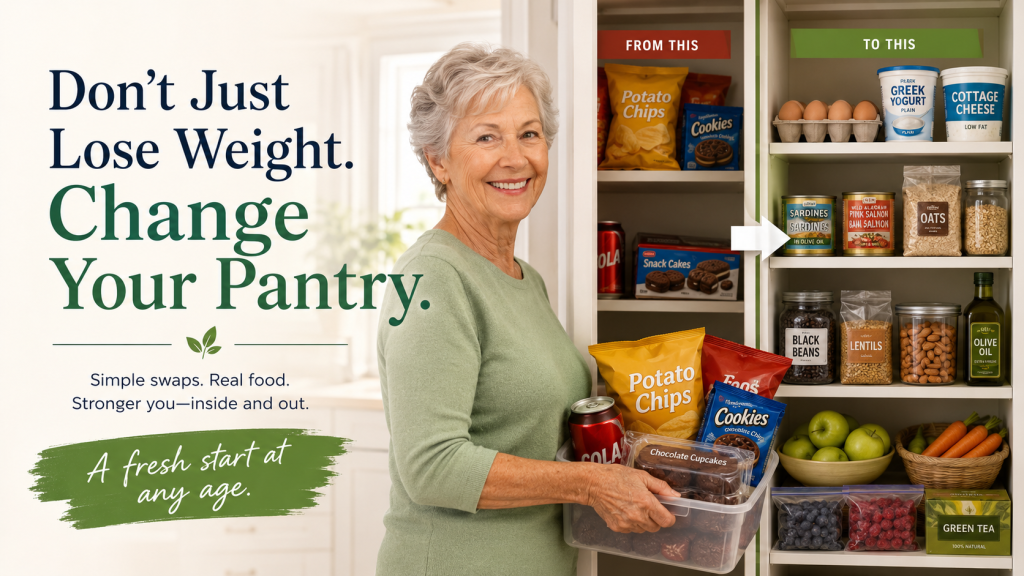
Don’t just lose weight. Change your pantry.
Because the pantry you live with every day may matter more than the diet you promise yourself every Monday morning.
Weight Loss Is Not the Finish Line
Many people think losing weight is the goal.
It is not.
Keeping your health is the goal. Keeping your strength is the goal. Keeping your independence is the goal. Feeling better, moving better, sleeping better, and giving your body a fighting chance — that is the goal.
Weight loss can be part of that. But weight loss alone is not enough.
Plenty of people lose weight and then regain it. Not because they are weak. Not because they are failures. Not because they lack character. Often, it happens because the old environment is still sitting there waiting for them.
Same pantry. Same habits. Same snacks. Same soda. Same “just this once.”
That is why the real question is not only, “How do I lose weight?”
The better question is:
What kind of home am I building for the person I want to become?
If the answer is “a home filled with potato chips, soda, cookies, and emergency ice cream,” then we may have a problem.
And by emergency ice cream, I mean the kind we buy “just in case.”
Just in case what?
A vanilla shortage?
Your Pantry Is Your Daily Vote
Every day, your pantry votes.
It votes for your health or against it.
It votes for energy or sluggishness.
It votes for stable blood sugar or a roller coaster ride.
It votes for better aging or faster decline.
That may sound dramatic, but food is not just something that fills the belly. Food is information. Food tells the body what to do. It can help build muscle, support the brain, protect the heart, feed the gut, calm cravings, and reduce the constant urge to snack.
Or it can do the opposite.
Ultra-processed foods are designed to be easy to overeat. That is not an accident. They are often salty, sweet, crunchy, soft, creamy, and convenient all at once. They go down fast. They do not keep you full for long. And somehow, the bag says “about 11 servings,” but your hand says, “That sounds like a personal challenge.”
This is why the pantry matters.
You do not rise to the level of your hopes. You often fall to the level of what is available at 9:30 at night.
The GLP-1 Lesson: Don’t Just Shrink the Body, Rebuild the Routine
Today, many people are using weight-loss medications such as Wegovy, Ozempic, Zepbound, and similar GLP-1 medications. For some people, these drugs can be a powerful tool when prescribed and monitored by a doctor.
But here is the part that deserves more attention:
The medication may help reduce appetite, but it does not automatically teach you how to eat for the rest of your life.
That part still has to be learned.
If someone loses weight while eating smaller portions of the same old foods, what happens when the medicine stops, changes, becomes too expensive, or no longer works the same way?
That is where the pantry comes in.
The medication may quiet the hunger. But the pantry teaches the habit.
And that is the secret sauce.
Not just less food.
Better food.
Not just a smaller body.
A stronger routine.
Not just weight loss.
A new way of living.
If you are taking one of these medications, this is the time to rebuild your kitchen. This is the time to learn protein. Learn fiber. Learn easy meals. Learn better snacks. Learn what keeps you full. Learn what gives you energy. Learn what helps you maintain muscle.
Because when the appetite comes back — and for many people it does — you do not want to return to the same pantry that helped create the problem in the first place.
That is like fixing a leaky roof and then storing buckets in the living room forever.
The Pantry Audit: What Is Really in There?
Here is a simple exercise.
Open your pantry and ask one question:
Is this food helping the future me or hurting the future me?
Do not make it complicated. You do not need a degree in nutrition. You need honesty.
Look at the shelves.
Do you see foods that support health?
Or do you see foods that call your name when you are tired, bored, lonely, stressed, or watching television?
Common troublemakers include:
Chips
Cookies
Crackers that pretend to be healthy
Sugary cereals
Candy
Soda
Sweetened drinks
Instant pastries
Snack cakes
Highly processed frozen foods
“Low-fat” foods packed with sugar
“Sugar-free” foods that still keep the sweet craving alive
Now, nobody is saying you can never have a treat. We are adults. We have earned a cookie now and then.
But there is a big difference between having a treat and living inside a snack trap.
If the food is in the house, it becomes an option.
If it is not in the house, you have to make a real decision. You have to get dressed, find the keys, drive to the store, and explain to yourself why you are going on a midnight cookie mission.
That pause matters.
That pause may save you.
Healthy Food Is Not Always More Expensive
One of the biggest myths is that junk food is cheap and healthy food is expensive.
Sometimes that is true. But not always.
A bag of chips is not cheap anymore. Soda is not cheap. Cookies are not cheap. Candy is not cheap. Fast food is definitely not cheap once you count the cost to your body.
Now compare that with simple foods:
Eggs
Oatmeal
Greek yogurt
Cottage cheese
Frozen berries
Canned sardines or salmon
Beans
Lentils
Apples
Carrots
Cabbage
Peanut butter
Tuna
Frozen vegetables
Olive oil
Green tea
These are not fancy foods. They are not celebrity foods. They do not need a commercial with a person doing yoga on a cliff.
They are basic. Affordable. Useful.
A dozen eggs can give you several meals. A tub of Greek yogurt can become breakfast, snack, or dessert. Frozen blueberries do not spoil in three days like fresh berries sometimes do. Beans and lentils are inexpensive and loaded with fiber. Canned fish may not win a beauty contest, but neither do most of us first thing in the morning.
The point is simple:
Healthy eating does not have to mean luxury eating.
Sometimes the healthiest foods are sitting right there in plain sight, waiting for us to stop being distracted by the shiny junk.
The New Pantry: Build It Like a Health Account
Think of your pantry like a health account.
Every day, you make deposits or withdrawals.
A soda and chips dinner? Withdrawal.
Greek yogurt with berries? Deposit.
Eggs and vegetables? Deposit.
Cookies at midnight? That may be an overdraft fee.
The goal is not perfection. The goal is to make the easy choice a better choice.
A good pantry should have foods that help you build meals quickly. Because when people are hungry, tired, or rushed, they do not want a lecture. They want something easy.
So make healthy easy.
Keep protein ready.
Protein helps protect muscle, especially as we age. And if you are losing weight, protecting muscle is not optional. You do not want to lose weight and become weaker. That is not success. That is just becoming a smaller version of tired.
Good pantry and refrigerator protein choices include eggs, Greek yogurt, cottage cheese, tuna, sardines, salmon, chicken, turkey, beans, lentils, and protein-rich soups.
Keep fiber ready.
Fiber helps you feel full, supports digestion, and helps control blood sugar. Fiber is one of the quiet heroes of healthy aging. It does not wear a cape, but it does important work.
Good fiber choices include oatmeal, beans, lentils, vegetables, berries, apples, chia seeds, nuts, and whole grains.
Keep better snacks ready.
This is where many people win or lose.
You need snacks that do not turn into a food emergency.
Try Greek yogurt with berries. Cottage cheese with cinnamon. A boiled egg. Apple slices with peanut butter. Carrots with hummus. A handful of nuts. A cup of green tea. A small bowl of oatmeal. Tuna on whole grain crackers.
Simple. Filling. No drama.
The Soda Problem
Soda deserves its own paragraph because soda is sneaky.
Regular soda is loaded with sugar. Sugar-free soda may not have the same calories, but it can still keep the sweet habit alive. For some people, it becomes a bridge back to cravings.
And let’s be honest. Soda does not nourish you. It does not build muscle. It does not feed the brain. It does not help your joints. It does not give your body the tools it needs.
It is liquid entertainment.
And if you are drinking it every day, that entertainment may be charging you a very high admission price.
Better choices include water, sparkling water, unsweetened iced tea, green tea, or water with lemon, cucumber, or berries.
No, water is not as exciting as soda.
Neither is brushing your teeth, but most of us figured out that it was worth doing.
Do Not Deprive Yourself — Upgrade Yourself
This is important:
Changing your pantry should not feel like punishment.
You are not depriving yourself of joy.
You are adding years of better living.
You are adding energy.
You are adding strength.
You are adding better choices.
You are adding a future.
That is a very different mindset.
This is not about saying, “I can never have anything good again.”
It is about saying, “I am going to stop letting fake food run my life like a tiny dictator in a potato chip bag.”
Real food can taste good. A bowl of Greek yogurt with blueberries can be delicious. Eggs with vegetables can be satisfying. Oatmeal with cinnamon and nuts can feel like comfort food. Sardines with olive oil and whole grain toast can be a powerful small meal. Soup with beans and vegetables can be filling and inexpensive.
Healthy food does not have to be boring.
It just has to stop pretending to be a carnival.
Start With One Shelf
Do not make this too big.
You do not have to become a new person by Tuesday.
Start with one shelf.
Remove the foods that cause the most trouble. Replace them with foods that help.
Then do one drawer in the refrigerator.
Then one freezer shelf.
Then one shopping list.
This is how change happens. Not with drama. Not with guilt. Not with a giant announcement to the family that “Grandpa is now a wellness influencer.”
Just one shelf.
One choice.
One better snack.
One better breakfast.
One less soda.
One more walk.
One small victory stacked on top of another.
The Most Important Question
Before you buy something, ask:
Will this help me after 8 o’clock at night?
That is when many of us struggle.
Not at breakfast. Not when we are being sensible. Not when we are fresh and rested.
The danger zone is often evening. The body is tired. The mind wants comfort. The television is on. The pantry is nearby.
So prepare for that moment before it arrives.
Do not wait until you are tired to make a wise decision.
Make the decision at the grocery store.
Because once the cookies are in the house, the cookies get a vote.
And cookies are very persuasive.
Final Thought: Change the Pantry, Change the Future
Losing weight is wonderful.
But changing your pantry is powerful.
Because the pantry is where weight loss becomes maintenance. It is where a diet becomes a lifestyle. It is where a temporary effort becomes a new routine.
Especially for seniors, this matters.
We are not just trying to look better in a photograph. We are trying to stay independent. We are trying to keep muscle. We are trying to protect the brain. We are trying to reduce risk. We are trying to enjoy the years ahead with more strength and less struggle.
So do not just ask, “How much weight did I lose?”
Ask, “What did I learn?”
Ask, “What did I change?”
Ask, “What foods now live in my home?”
Because the scale may tell you what happened.
But the pantry tells you what is likely to happen next.
So here is the takeaway:
Don’t just lose weight. Change your pantry.
Your future self may thank you.
And your potato chips may file a missing persons report.