
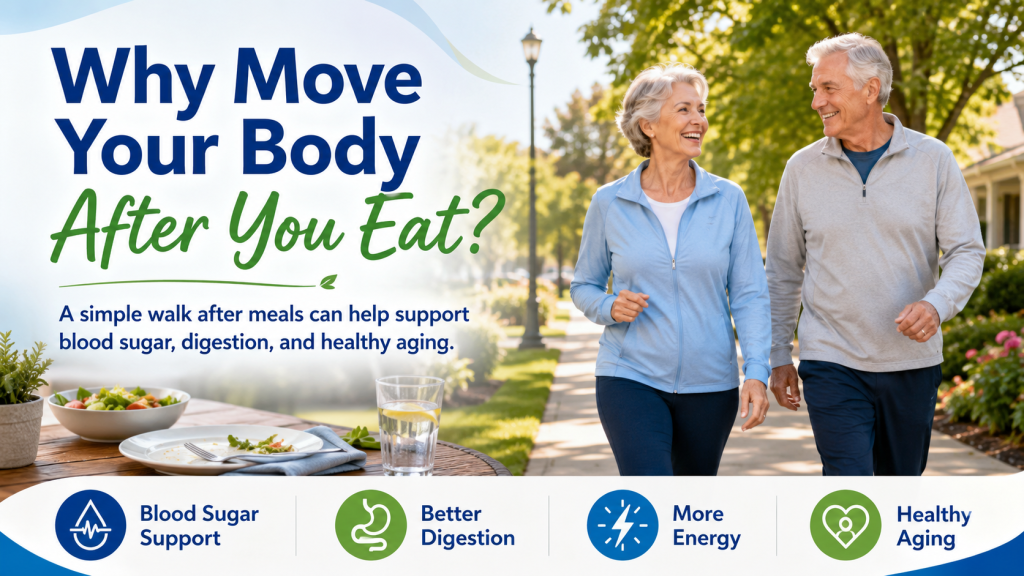
Most people were taught to do one thing after a meal: sit down and relax.
Eat breakfast, sit down. Eat lunch, sit down. Eat dinner, sit down. Maybe even announce, “I’m letting my food settle,” as if the food needs a quiet retirement community inside your stomach.
But what if one of the simplest health habits has been hiding in plain sight?
What if moving your body for just five to ten minutes after eating could help your body handle blood sugar better, support healthier aging, and reduce some of the stress that food places on your metabolism?
This is not about becoming an athlete. It is not about joining a gym, buying fancy equipment, or marching around the block like you are training for the Senior Olympics. It is much simpler than that.
It is about not parking your body immediately after you eat.
A short walk, a few gentle movements, some light housework, standing and moving around the kitchen, doing wall push-ups, or slowly stepping in place can help your body use the energy from your meal more effectively.
And here is the important point: this is not mainly about burning calories.
That is where many people get it wrong.
Moving after a meal is mostly about helping your body control blood sugar.
What Happens After You Eat?
Every time you eat, especially when you eat carbohydrates, your body breaks food down into glucose, which is a form of sugar your body uses for energy.
That glucose enters your bloodstream. Your body then has to move that glucose out of the blood and into your cells, where it can be used or stored.
Insulin is the hormone that helps make this happen. You can think of insulin like the key that helps open the door so glucose can enter the cells.
When you are younger and healthier, the system may work fairly smoothly. You eat, blood sugar rises, insulin does its job, and blood sugar comes back down.
But as we age, and especially if we gain weight, lose muscle, become less active, or develop insulin resistance, the system may not work as smoothly. Blood sugar may rise higher after meals and stay elevated longer. The body may need to produce more insulin to get the same job done.
That is not a small issue.
Over time, frequent high blood sugar spikes can put extra stress on the body. They may contribute to insulin resistance, inflammation, fatigue, cravings, weight gain, and increased risk of type 2 diabetes and heart disease.
This is why what happens after a meal matters.
Why Sitting After Meals Can Be a Problem
Sitting after eating is common. It is also understandable.
After a meal, people feel relaxed, full, and maybe a little sleepy. The couch starts whispering your name. The recliner says, “Come here, old friend.” The television remote suddenly looks like a medical device.
But when you sit still after a meal, your muscles are not doing much. That means they are not helping much with glucose uptake.
Your body still has to deal with the sugar from the meal, but now it must rely more heavily on insulin. If your muscles are inactive and your body is already insulin resistant, blood sugar may stay higher for longer.
This does not mean sitting after one meal will ruin your health. Let’s not get dramatic. One meal is not the villain in a black hat.
The issue is repetition.
If a person eats three meals a day and sits immediately after each one, that may be three missed opportunities every day. Multiply that by weeks, months, and years, and suddenly a small daily pattern becomes a major lifestyle habit.
Healthy aging is often shaped by the little things we do repeatedly.
Your Muscles Are Glucose Sponges
Here is the simple way to understand it: your muscles can act like glucose sponges.
When you move your muscles, they need energy. After a meal, glucose is available in the bloodstream. Light movement encourages your muscles to take up some of that glucose and use it.
That helps reduce the amount of sugar floating around in the blood after eating.
This is why a short walk after a meal can be so powerful. You are not walking to “burn off” the meal. You are walking to help guide the energy from the meal into your muscles.
That is a very different idea.
Most people think exercise is only about weight loss. But movement also helps with blood sugar control, circulation, digestion, mood, balance, joint stiffness, and long-term independence.
After-meal movement is one of the simplest examples of how small movement can create a real metabolic benefit.
It Does Not Take Much
One of the best parts of this habit is that it does not require much time.
For many people, five to ten minutes of gentle movement after a meal can be a useful place to start. Some may do better with ten to fifteen minutes, especially after larger meals or meals higher in carbohydrates.
But the key is not perfection. The key is doing something.
You do not have to sprint. You do not have to sweat. You do not have to put on special exercise clothing unless you enjoy looking like you are about to be sponsored by a sneaker company.
You just have to move.
A slow walk around the house counts. Walking outside counts. Doing dishes counts if you keep moving. Folding laundry while standing counts. Gentle marching in place counts. Light stretching counts. Wall push-ups count. Standing and doing heel raises counts.
The goal is to wake up the muscles and avoid going completely still right after eating.
Start With the Biggest Meal
If doing this after every meal feels like too much, start with one meal.
Dinner is often the best place to begin because it is usually the largest meal of the day. It is also the meal most likely to be followed by sitting in front of the television for hours.
A simple rule can help:
After dinner, move for ten minutes before you sit down.
That is it.
Do not make it complicated. Do not turn it into a military operation. Just move before you park yourself.
Walk around the house. Step outside. Clean the kitchen. Take out the trash. Walk up and down the hallway. Do a few gentle exercises while holding onto the counter.
The body does not need a speech. It needs action.
Why This Matters for Seniors
This habit is especially important for seniors because aging changes how the body handles food, muscle, blood sugar, and energy.
As we get older, muscle mass tends to decline unless we actively protect it. This matters because muscle is one of the main places where glucose is stored and used.
Less muscle can mean less capacity to handle glucose well.
That is one reason maintaining muscle is not just about strength or appearance. It is also about metabolism.
A person who preserves muscle may have a better chance of maintaining blood sugar control, balance, mobility, and independence.
Movement after meals is not a full replacement for strength training, but it is a practical habit that supports the same general goal: keep the body active, responsive, and involved.
The old idea was, “I ate, now I rest.”
The healthier aging idea is, “I ate, now I help my body use that food.”
That is a big shift.
This Is Not About Punishing Yourself for Eating
This point matters.
Moving after a meal should not feel like punishment. It should not be, “I ate bread, now I must pay for my sins.”
That kind of thinking is miserable, and nobody needs more misery.
Food is not the enemy. The problem is when we eat and then do absolutely nothing, over and over again, year after year.
After-meal movement is not punishment. It is assistance.
You are helping your body do its job.
Think of it like helping someone carry groceries into the house. You are not angry at the groceries. You are just making the work easier.
Your body receives food. Movement helps deliver that energy where it belongs.
Practical Ways to Move After Eating
Here are simple options that most people can adapt to their ability level:
Take a slow walk around the block.
Walk inside your home for five to ten minutes.
Stand up and clean the kitchen.
Do gentle marching in place.
Do wall push-ups.
Do light counter squats while holding the counter for balance.
Walk up and down a hallway.
Do seated leg lifts if standing is difficult.
Use light hand weights for simple arm movements.
Water plants, tidy a room, or fold laundry while standing.
The goal is not intensity. The goal is motion.
For people with balance problems, dizziness, heart conditions, neuropathy, severe arthritis, or a history of falls, safety comes first. Use support, move slowly, and speak with your doctor before starting a new activity routine.
Healthy habits should help you, not send you flying into the coffee table.
What About Digestion?
Some people were taught that walking after eating is bad for digestion. For most people, light movement after a meal is not a problem and may actually feel helpful.
The key word is light.
A gentle walk is different from heavy exercise. You do not want to eat a large meal and then start doing intense workouts, heavy lifting, or fast running. That can cause discomfort for some people.
But easy walking or light movement is usually reasonable for many adults.
If you feel pain, nausea, shortness of breath, dizziness, chest pressure, or unusual discomfort, stop and seek medical advice. Do not try to be heroic. Heroic is overrated when your body is clearly telling you to stop.
The Blood Sugar Connection
After a meal, blood sugar naturally rises. That is normal.
The question is how high it rises and how long it stays elevated.
Short movement after meals can help reduce the spike and support better glucose control. This can matter for people with prediabetes, type 2 diabetes, weight concerns, metabolic syndrome, or anyone trying to age in a healthier way.
Again, this does not mean walking after meals cures diabetes. It does not replace medication. It does not replace a doctor. It does not give anyone permission to eat a mountain of cake and then walk to the mailbox like everything is solved.
But it is a useful tool.
And simple tools matter.
Many people look for complicated answers while ignoring the obvious ones. Sometimes the body does not need a miracle. It needs a routine.
Combine Movement With Better Meals
Moving after eating works best when combined with smarter meals.
A meal built around protein, fiber, healthy fats, and slower-digesting carbohydrates is usually easier on blood sugar than a meal loaded with sugar and refined starches.
That means more foods like eggs, fish, chicken, yogurt, cottage cheese, beans, vegetables, salads, berries, nuts, olive oil, and whole grains when appropriate.
It also means being careful with large portions of bread, pasta, rice, sweets, sugary drinks, pastries, and processed snacks.
You do not have to eat perfectly. But the combination of better food plus light movement is powerful.
Think of it this way:
Food quality determines how much glucose enters the bloodstream.
Movement helps your body use that glucose.
That is a simple partnership.
The Compounding Effect
The real power of this habit is not one walk.
It is the accumulation.
If you move five to ten minutes after breakfast, lunch, and dinner, that becomes fifteen to thirty minutes of extra movement per day. Over a week, that becomes meaningful. Over a year, it becomes a lifestyle change.
Small habits compound.
This is where many people underestimate the power of simple actions. They think if it is not dramatic, it does not matter.
Wrong.
Brushing your teeth is not dramatic, but try skipping it for ten years and see how that works out.
Movement after meals is the same kind of idea. It is a small maintenance habit. It supports the system. It keeps things working better.
A New Rule for Healthy Aging
Here is a simple rule worth remembering:
Don’t park your body after a meal. Move it.
That does not mean you can never sit and enjoy life. Of course you can. Sit. Relax. Watch your show. Read your book. Talk with your family.
Just move a little first.
Give your body a chance to handle the meal.
This is one of those habits that is almost too simple, which is why people ignore it. We tend to believe health has to be complicated, expensive, or difficult.
But sometimes the most powerful changes are simple, no-cost, and hiding right in front of us.
Final Takeaway
Moving your body after eating may be one of the easiest healthy aging habits to start.
It does not require a gym membership. It does not require special equipment. It does not require athletic ability. It does not require perfection.
It simply requires a decision.
After you eat, move for a few minutes.
Help your muscles absorb glucose. Help your body manage blood sugar. Help your digestion. Help your circulation. Help your independence.
This is not about burning calories. It is about using your body the way it was designed to be used.
A meal gives your body energy. Movement tells your body where to send it.
So the next time you finish eating, do not let the recliner win immediately.
Stand up. Walk a little. Move around. Give your body a helping hand.
Simple food. Simple movement. A healthier tomorrow.