
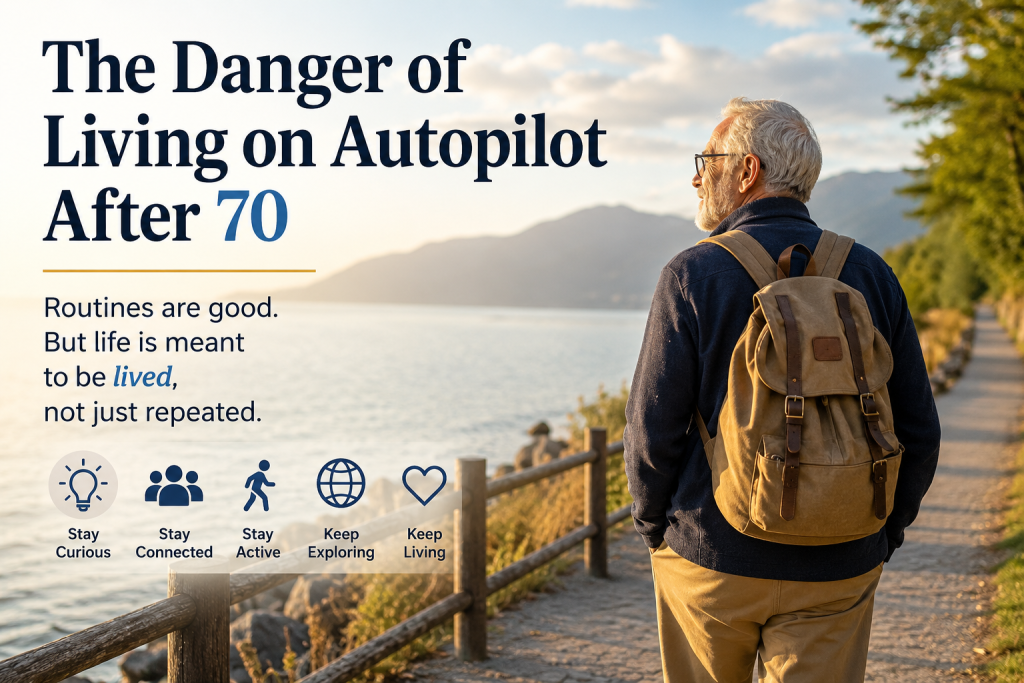
There is something that can quietly happen as we get older.
Our lives become efficient.
We know where we shop. We know what we eat. We know what television programs we like. We know which chair is ours, what time we go to bed, and which route we take to the supermarket.
Nothing is particularly wrong with any of that.
In fact, after decades of dealing with work, raising families, paying bills, fighting traffic, and trying to remember where we left the car keys, a little predictability can feel wonderful.
But there is a difference between having routines and living on autopilot.
And that difference may become more important as we age.
Living longer isn’t simply about keeping the heart beating.
It’s about continuing to participate in life.
The danger is not that we become old.
The danger is that our world becomes smaller without us noticing.
When Every Day Starts Looking the Same
Think about the last seven days.
How many of them were genuinely different?
Did you meet anyone new?
Go somewhere unfamiliar?
Learn something?
Try something you hadn’t done before?
Have a conversation that surprised you?
Or could Tuesday have easily been Thursday?
There is nothing wrong with routine.
Routine helps us exercise regularly, take medications correctly, eat better, sleep consistently, and keep life organized.
But routine can slowly become confinement.
The house becomes more comfortable than going out.
The familiar restaurant becomes easier than trying a new one.
The same television programs replace conversation.
And eventually, we can start arranging our lives around avoiding inconvenience.
That’s when comfort begins charging us rent.
Comfort Is Wonderful — Until It Becomes a Cage
One of the privileges of getting older is that we don’t have to prove ourselves anymore.
We don’t have to climb every mountain.
We don’t have to attend every event.
We don’t have to impress everybody.
But there is a danger in becoming too comfortable.
When we were younger, life forced novelty upon us.
New schools.
New jobs.
Marriage.
Children.
Career changes.
Moving.
Problems.
Deadlines.
Bills.
Sometimes we would have happily accepted a little boredom.
Then retirement arrives, the children leave, work obligations disappear, and suddenly nobody is forcing change upon us anymore.
We have to create some of it ourselves.
That’s a major shift.
For perhaps the first time in decades, curiosity becomes a responsibility.
Your Brain Likes Something New
Researchers have long studied the relationship between activity, learning, social connection, and healthy aging.
The National Institute on Aging encourages older adults to stay mentally and socially engaged, pointing to evidence that meaningful activities and social interaction may support cognitive health and overall well-being.
That does not mean you need to spend retirement doing calculus.
Thank goodness.
It means your brain benefits from being asked to participate.
Learn a language.
Take a dance class.
Try photography.
Join a discussion group.
Visit a museum.
Learn how artificial intelligence works.
Cook something you’ve never eaten.
Take a different walking route.
Call somebody you haven’t spoken with in years.
The particular activity matters less than the fact that your brain has to wake up and say:
“Hold on. What’s this?”
That little moment of uncertainty may be good for us.
Curiosity Has No Retirement Age
One of the most damaging ideas about aging is that eventually we become finished products.
We’re not.
At 70, 80, or 90, you can still encounter things that change your opinion.
You can still develop new interests.
You can still meet someone who becomes important to you.
You can still discover music you love.
You can still begin something.
That doesn’t mean pretending to be 30.
There is nothing admirable about denying your age.
The goal isn’t to become younger.
The goal is to remain engaged.
Aging well isn’t about desperately hanging onto youth.
It’s about refusing to become absent from your own life.
The Shrinking World Problem
The world often gets physically smaller as people age.
Maybe driving at night becomes uncomfortable.
Maybe long trips are more tiring.
Friends move away.
Some friends die.
Children live in other states.
Mobility may change.
Money may become tighter.
These are real issues.
But the world can shrink psychologically too.
That’s the part we have more influence over.
You can be home and still explore.
You can watch lectures from universities around the world.
You can join communities online.
You can learn history.
You can take virtual museum tours.
You can video chat with grandchildren thousands of miles away.
You can learn to use tools that didn’t exist ten years ago.
Technology can be irritating.
Sometimes extraordinarily irritating.
Anyone who has spent 20 minutes looking for a password they know they wrote down somewhere understands this.
But technology can also keep the world open.
The trick is not allowing frustration to convince us that something “isn’t for people our age.”
That’s one of the fastest ways to become old.
Say Yes Occasionally
As we age, saying no gets easier.
Want to go out tonight?
No.
Want to try this restaurant?
No.
Want to take a class?
No.
Want to travel?
Too much trouble.
Want to meet some new people?
I’m fine.
And sometimes “no” is exactly the correct answer.
You have earned the right to say it.
But if the answer is always no, eventually invitations stop arriving.
That is worth thinking about.
Maybe a useful rule is this:
Occasionally say yes before you’ve had enough time to invent a reason to say no.
Go to the lecture.
Take the dancing lesson.
Try the restaurant.
Attend the neighborhood event.
You don’t have to love it.
You can always go home.
One of the great benefits of being older is that nobody can ground you.
Movement Breaks Autopilot
Exercise is another powerful way to interrupt routine.
And it doesn’t require becoming an athlete.
Walking somewhere new instead of walking the same route can change the experience completely.
Try a park.
Walk along the river.
Visit a nearby town.
Take a beginner dance class.
Ride a bicycle if you’re able.
The Centers for Disease Control and Prevention recommends regular physical activity for older adults because it can support strength, balance, independence, mood, and overall health.
But movement can offer something beyond physical fitness.
Movement gets you out into the world.
The treadmill is useful.
Sometimes the sidewalk is better.
People Are Part of the Medicine
One of the easiest ways to fall into autopilot is isolation.
You wake up.
Eat breakfast.
Watch television.
Run an errand.
Come home.
Eat dinner.
Go to bed.
Do that often enough and life can become astonishingly quiet.
Human beings need other human beings.
Not hundreds of them.
Sometimes one or two genuine relationships matter more than a large social circle.
But conversation forces us out of ourselves.
Other people bring news.
Ideas.
Problems.
Humor.
Disagreement.
Surprises.
They interrupt our routines.
And that is often healthy.
The U.S. Surgeon General and other public-health organizations have drawn increasing attention to the health consequences associated with loneliness and social isolation.
Social connection isn’t merely entertainment.
It is part of living well.
Don’t Wait Until You Feel Like It
This may be one of the most important lessons.
Motivation often comes after action, not before it.
If you wait until you “feel like” going out, exercising, learning something, or meeting people, you may wait a long time.
Sometimes you go first.
Then enthusiasm catches up.
Most people have experienced this with exercise.
You don’t particularly want to take the walk.
You take it anyway.
Twenty minutes later you’re glad you did.
Life can work the same way.
Give Yourself Something to Anticipate
One simple defense against autopilot is having something on the calendar.
It doesn’t have to be a cruise around the world.
Lunch next Thursday.
A movie.
A museum trip.
A dance class.
Dinner with a friend.
A weekend away.
A lecture.
A new book arriving.
Something.
Anticipation gives shape to time.
When every day is empty, days can disappear surprisingly quickly.
But when something is coming, even something small, the week feels different.
There is a reason children count the days until birthdays.
Adults need things to look forward to as well.
We just pretend we don’t.
Reinvention Doesn’t Have an Age Limit
Perhaps the biggest misconception about aging is that reinvention belongs to younger people.
Why?
There is no rule saying you get one identity.
You may have spent 40 years as an accountant and discover painting at 73.
You might begin traveling at 75.
Learn tango at 78.
Start writing at 80.
Build a website at 81.
Why not?
You don’t need to become world-class.
You don’t even need to become good.
You merely need to become interested.
Interest is underrated.
Interest makes tomorrow matter.
The Question Worth Asking
Every once in a while, ask yourself:
“When was the last time I did something for the first time?”
If you can’t remember, perhaps it’s time.
Nothing reckless.
Nothing foolish.
Just something unfamiliar enough to make life feel slightly larger again.
Take a different road.
Eat something different.
Introduce yourself to somebody.
Read a subject you know nothing about.
Go somewhere alone.
Go somewhere with somebody.
Learn something your grandchildren think you can’t possibly understand.
Especially that one.
Growing Older Without Becoming Old
Growing older is unavoidable.
Becoming rigid is not.
There is nothing wrong with routines.
Keep the morning coffee.
Keep your favorite chair.
Keep the restaurant where everybody knows your name.
But leave a little space for surprise.
The goal of Elderhood isn’t to tell people to behave as though they’re young.
It’s to recognize something much more important:
You are still here.
And as long as you’re here, life can still contain beginnings.
Maybe aging well is partly about resisting the temptation to become completely predictable.
Keep moving.
Keep learning.
Keep talking.
Keep asking questions.
Keep finding something that interests you.
And every now and then, turn off the autopilot.
You might be surprised where you end up.
The Elderhood Takeaway
A comfortable life is good.
A life that becomes so comfortable that nothing new ever happens is another matter.
We don’t need constant excitement.
At this age, frankly, we’ve probably had enough excitement for several lifetimes.
What we need is engagement.
Something to do.
Someone to talk with.
Something to learn.
Something to look forward to.
And occasionally, something that makes us say:
“Well, I’ve never done that before.”
Those may be six of the healthiest words in the English language.
Growing older doesn’t mean your world has to get smaller.
Keep the door open.
There’s still plenty outside.