
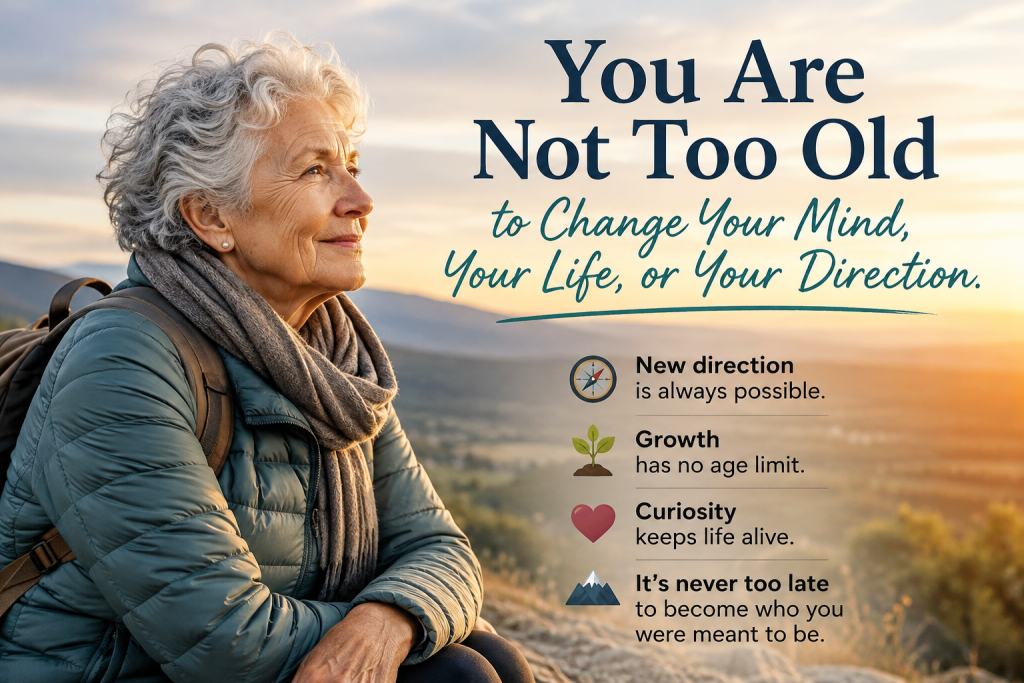
One of the strangest things about growing older is how easily the world begins to expect you to become finished.
Finished changing.
Finished learning.
Finished experimenting.
Finished starting over.
By the time you reach your seventies or eighties, people may quietly assume your life has already taken its final shape.
You have your routines.
Your opinions.
Your friends.
Your habits.
Your favorite chair.
And apparently, according to some unwritten rule, you are now supposed to leave everything exactly where it is until further notice.
That may be comfortable.
It may also be one of the fastest ways to become old before your time.
One of the great opportunities of elderhood is realizing that you are still allowed to change your mind.
You are still allowed to change direction.
You are still allowed to say:
“I don’t want to live like this anymore.”
And then do something about it.
Age Does Not Make Every Decision Permanent
When we are younger, changing direction is considered normal.
A 30-year-old changes careers.
Nobody is shocked.
A 40-year-old moves across the country.
People call it a new beginning.
A 50-year-old learns a new skill.
People admire the ambition.
But when an 80-year-old says, “I think I want to do something different,” suddenly everybody starts asking whether it is wise.
Why?
The calendar did not confiscate your right to reconsider your life.
If anything, age can give you more reason to make thoughtful changes because you understand something younger people sometimes do not.
Time matters.
You begin to appreciate the cost of spending years doing things you no longer enjoy merely because they are familiar.
Familiarity is comfortable.
But comfortable and meaningful are not always the same thing.
The Danger of Becoming Too Set in Your Ways
Routine can be wonderful.
A morning walk.
Coffee at the same little restaurant.
Dinner with friends on Thursdays.
The television program you never miss.
There is nothing wrong with routine.
Routine can provide stability, especially as life becomes more unpredictable.
The danger begins when routine becomes rigidity.
When “This is how I do things” quietly turns into “This is the only way I can do things.”
That difference matters.
The mind likes familiar patterns because familiar patterns require less effort.
But learning something new forces the brain to pay attention.
Taking a new route.
Learning a dance.
Trying a new restaurant.
Using a new piece of technology.
Talking with someone you normally would not approach.
Reading about something you never thought interested you.
These little acts of novelty keep us engaged with the world.
And perhaps more importantly, they remind us that life is still happening.
Curiosity Is One of the Best Anti-Aging Tools We Have
Curiosity is not simply an intellectual quality.
It is a way of remaining alive to the world.
Curious people continue asking:
“What is that?”
“How does that work?”
“Why do people enjoy this?”
“Could I learn it?”
“What would happen if I tried?”
There is something youthful about curiosity, but it does not belong exclusively to the young.
A curious 85-year-old can sometimes seem far younger than a bored 55-year-old.
Curiosity keeps the world from becoming small.
And the world can become small very easily as we age.
Retirement removes the workplace.
Children may live far away.
Friends may move, become ill, or die.
Driving may become more difficult.
The circle of daily life can gradually contract.
Curiosity pushes back against that contraction.
It gives you reasons to go somewhere.
Reasons to talk to someone.
Reasons to learn.
Reasons to stay involved.
Changing Your Mind Is Not Weakness
There is another strange idea many of us carry through life.
We think consistency is always a virtue.
Once we have announced an opinion, a goal, a lifestyle, or a plan, we feel somehow obligated to defend it forever.
But wisdom should make us more willing to change our minds, not less.
You are supposed to know more at 80 than you did at 40.
So why would every opinion remain exactly the same?
Experience should change us.
Loss changes us.
Love changes us.
Travel changes us.
Illness changes us.
Success changes us.
Failure certainly changes us.
Changing your mind because you have learned something is not inconsistency.
It is evidence that you are still thinking.
You May Outgrow People Too
This can be uncomfortable to admit.
Sometimes the relationships that fit one chapter of life do not fit the next.
That does not always mean somebody did something wrong.
People change.
Priorities change.
Energy changes.
Values change.
You may reach a point where certain relationships leave you more exhausted than fulfilled.
At the same time, you may meet new people later in life who bring enthusiasm, humor, companionship, or ideas you were missing.
There is no rule that says all of your closest relationships must come from childhood, work, or your old neighborhood.
Elderhood can be a time of forming new friendships.
Sometimes very meaningful ones.
The obstacle is often not opportunity.
It is the belief that making new friends is something young people do.
That belief can become a self-fulfilling prophecy.
You Are Still Allowed to Reinvent Yourself
Reinvention sounds dramatic.
It does not have to be.
You do not have to sell everything, move to Portugal, learn the accordion, and open a seaside café.
Although if that is your dream, I suppose somebody has to sell the coffee.
Reinvention can be simple.
Becoming someone who exercises in the morning.
Becoming someone who takes dance lessons.
Becoming someone who finally learns to cook.
Becoming someone who volunteers.
Becoming someone who travels alone.
Becoming someone who starts writing.
Becoming someone who uses technology rather than avoiding it.
Becoming someone who calls people instead of waiting for them to call.
The important word is becoming.
You are still becoming something.
That is very different from simply waiting.
Small Changes Can Produce Large Differences
We often think life change requires some dramatic moment.
Usually it does not.
A new life can begin with something surprisingly small.
One phone call.
One class.
One invitation accepted.
One habit changed.
One walk around the block.
One application submitted.
One conversation with a stranger.
One decision to stop saying “maybe someday.”
Small changes accumulate.
Walking ten minutes becomes twenty.
One dance class becomes a weekly routine.
One online conversation becomes a friendship.
One short trip gives you confidence to take a longer one.
We often overestimate the power of dramatic decisions and underestimate the power of repeated small ones.
The latter usually matter more.
Do Not Let Other People Decide How Old You Are
One of the more irritating parts of aging is how many people suddenly become experts on what you should or should not be doing.
“You’re still working?”
“You still travel alone?”
“You still dance?”
“You’re learning that now?”
“You bought a bicycle?”
The hidden question is:
“At your age?”
There comes a point where you have to stop allowing other people’s expectations to define your possibilities.
Their caution may come from love.
But it is still their caution.
You have to live inside your own life.
Of course, good judgment matters.
Bodies change.
Balance changes.
Health changes.
Risk has to be considered.
But reasonable caution is very different from surrender.
Do not confuse the two.
Adaptation Is More Important Than Youth
The goal is not to pretend you are 40.
That would be exhausting.
The goal is to remain adaptable at 70, 80, 90, and beyond.
Adaptation means saying:
“I cannot do that the way I used to, so how can I do it now?”
That is one of the most useful questions in elderhood.
Maybe you cannot run anymore.
You can walk.
Maybe you cannot travel the way you did at 30.
You can travel differently.
Maybe you cannot hear as well.
You can use hearing technology.
Maybe you cannot dance all night.
You can dance for an hour.
Maybe you cannot work full-time.
You can consult, mentor, volunteer, or create.
The mistake is assuming that because the old version is gone, the activity must disappear completely.
Adaptation keeps life open.
Identity Can Become a Trap
Many people define themselves through roles.
I am a teacher.
I am a business owner.
I am a mother.
I am a husband.
I am an executive.
I am a nurse.
I am a mechanic.
Then retirement, widowhood, divorce, illness, or changing circumstances remove the role.
And suddenly the question becomes:
Who am I now?
That can be deeply unsettling.
But it can also be liberating.
You were never only your job.
You were never only someone’s spouse.
You were never only a parent.
Those were chapters.
Important chapters.
But not the entire book.
Elderhood gives us the chance to ask a different question.
What part of myself have I never had time to explore?
Maybe you always wanted to paint.
Maybe you wanted to travel.
Maybe you wanted to study history.
Maybe you wanted to write.
Maybe you simply wanted mornings that belonged to you.
There can be unexpected freedom in no longer having to be the person everyone expected you to be.
Do Something You Are Bad At
This may sound like strange advice.
Try something you are bad at.
Most adults avoid this.
We prefer activities where we already feel competent.
But beginners experience something important.
They improve.
And improvement creates energy.
Take a dance lesson and stumble through the steps.
Learn a language and pronounce half the words incorrectly.
Try painting and produce something your grandchildren politely describe as “interesting.”
Who cares?
Being bad at something new can be far healthier than being bored with something familiar.
It brings humility.
Laughter.
Challenge.
Progress.
And occasionally surprise.
You may discover abilities you never knew you had.
You Have Less Time — Which Makes Time More Valuable
There is no point pretending otherwise.
At 80, there are fewer years ahead than there were at 30.
That is not pessimism.
It is arithmetic.
But that reality can sharpen your priorities.
If you have twenty years left, how do you want to spend them?
If you have ten?
Five?
Nobody knows.
That uncertainty is exactly why postponing everything becomes increasingly foolish.
The younger version of you could say:
“Maybe someday.”
The older version should ask:
“If not now, when?”
Make the phone call.
Take the trip.
Apologize.
Forgive.
Quit the activity you hate.
Join the activity you have been curious about.
Tell someone you love them.
Learn the thing.
Start the project.
Wear the ridiculous hat.
At some point, worrying about appearing foolish becomes a much bigger waste of time than actually appearing foolish.
You Are Still in the Story
This may be the most important point.
Your life is not over simply because most of it is behind you.
Those are two completely different ideas.
A football game can be decided in the fourth quarter.
A book can change completely in its final chapters.
A conversation can become meaningful in its final minutes.
Why should a life be any different?
The later years are not simply the epilogue.
They are still part of the story.
And sometimes they are the part where you finally understand what the story was about.
The Bottom Line
You are allowed to change.
You are allowed to change your opinion.
Your habits.
Your friendships.
Your goals.
Your routines.
Your surroundings.
Your priorities.
Even your idea of who you are.
Growing older does not require becoming fixed.
In fact, adaptability may be one of the most valuable skills we can carry into elderhood.
You do not have to become younger.
You simply have to remain open.
Open to learning.
Open to people.
Open to ideas.
Open to changing direction.
Open to becoming a slightly different version of yourself tomorrow than you were yesterday.
Because the real danger of aging is not that the calendar keeps moving.
The real danger is deciding that you no longer have to.
You are still here.
That means you are still becoming.
And that may be one of the greatest privileges of growing older.