
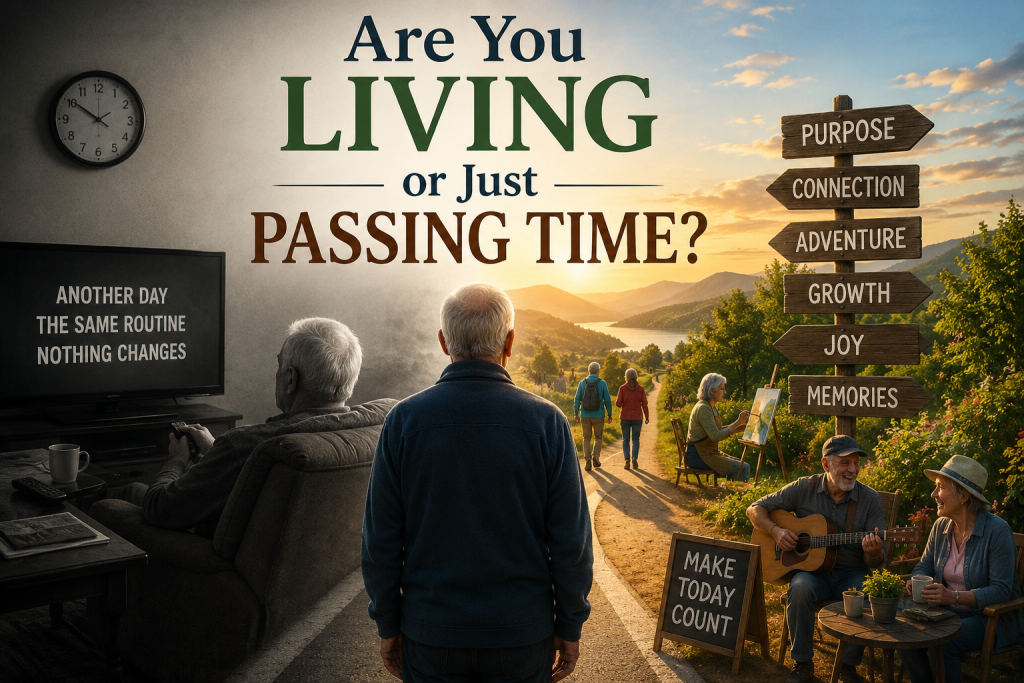
There is a peculiar thing about getting older.
When we’re young, we worry about not having enough time.
Later in life, we may discover an entirely different problem:
Having time isn’t the same as using it.
You can wake up every morning, eat breakfast, check the news, answer a few messages, watch television, run an errand, eat dinner, go to bed—and repeat the whole performance tomorrow.
Nothing is necessarily wrong.
But something may be missing.
You are existing.
You are functioning.
You are getting through the day.
But are you living?
That may be one of the most important questions we can ask ourselves as we enter elderhood.
Not, “How old am I?”
Not even, “How many years do I have left?”
But:
Am I still participating in my own life?
When Life Quietly Becomes Routine
Routine isn’t the enemy.
We need routines.
They help us exercise, take medications, eat reasonably well, pay bills, maintain our homes and get through life without having to reinvent Tuesday every Tuesday.
The danger begins when routine becomes our entire existence.
Monday starts looking like Wednesday.
Wednesday starts looking like Saturday.
Months go by surprisingly quickly.
Eventually we say something nearly every older person has said:
“Where did the year go?”
Well, the year went where every year goes.
The real question is whether anything happened while it was passing.
There is a difference between time passing through your life and you actually participating in that time.
That distinction becomes especially important after retirement.
For decades, much of our structure was supplied by other people.
Get up because you have to go to work.
Attend the meeting.
Pick up the children.
Pay the mortgage.
Meet the deadline.
Take the business trip.
Get everybody where they need to be.
Then one day, much of that disappears.
At first, freedom can feel wonderful.
No alarm clock.
No boss.
No commute.
No Monday morning meeting.
Then comes an unexpected question:
What gets me out of bed now?
Retirement solves the problem of work.
It doesn’t automatically solve the problem of purpose.
Living Doesn’t Require a Bucket List
Whenever people talk about “living life to the fullest,” somebody inevitably produces a photograph of a 73-year-old jumping out of an airplane.
Apparently, no meaningful retirement is complete until you’ve terrified yourself at 10,000 feet.
That’s nonsense.
You don’t have to climb Mount Everest.
You don’t have to travel around the world.
You don’t need a motorcycle, a tattoo or a sudden desire to swim with sharks.
Living is not about constantly doing spectacular things.
It is about remaining engaged with life.
Maybe that means gardening.
Taking a class.
Writing.
Learning Spanish.
Going dancing.
Starting a small business.
Volunteering.
Cooking dinner for somebody.
Taking your grandchild fishing.
Reading something that changes your mind.
Calling an old friend.
Making a new one.
Or sitting in a coffee shop having a conversation that you didn’t know you were going to have that morning.
The activity itself is almost secondary.
The important question is whether something still captures your attention.
Curiosity May Be One of Our Internal Vital Signs
One warning sign that we may be passing time rather than living it is the gradual loss of curiosity.
Nothing interests us anymore.
Nothing surprises us.
Nothing needs to be explored because we’ve supposedly seen everything.
That can be dangerous territory.
We explored this from another angle in The Danger of Growing Old and Set in Your Ways. The greatest danger isn’t that the world changes. The danger is deciding we no longer need to change with it.
Curiosity keeps a small door open to tomorrow.
What’s that?
How does that work?
Who is that person?
Where have they been?
What’s happening in the world?
Could I learn that?
Could I try that?
Those are little questions, but they contain something enormous:
They assume there is still something ahead worth discovering.
And there almost always is.
The Difference Between Being Alone and Becoming Disconnected
There is nothing wrong with solitude.
Some people genuinely enjoy spending considerable time alone.
But solitude and isolation are not the same thing.
The National Institute on Aging notes that loneliness and social isolation are associated with increased risks for health problems including heart disease, depression and cognitive decline.
The World Health Organization has gone even further, identifying social connection as an important public-health issue. Its Commission on Social Connection reported in 2025 that about one in six people worldwide experiences loneliness.
That doesn’t mean everyone needs twenty friends and a dinner engagement every night.
It means human connection matters.
And connection becomes something we may have to work at as we grow older.
Friends move.
People die.
Children establish their own lives.
We retire from workplaces that once provided daily human contact.
Neighborhood gathering places disappear.
If we simply allow our social world to shrink without replacing any part of it, eventually the walls can get surprisingly close.
That’s why Why Friendship Matters More as We Grow Older isn’t merely about having somebody to go to lunch with.
Friendship helps keep us connected to the larger world.
Something to Look Forward To
Here’s a simple question worth asking:
What are you looking forward to?
Not someday.
Not theoretically.
What is actually on the horizon?
Dinner with somebody Friday?
A dance next week?
A trip next month?
A grandchild visiting?
Finishing a project?
Planting the garden?
Watching the Yankees finally stop leaving men on base?
It doesn’t have to be profound.
Anticipation itself matters because it turns our attention toward the future.
One of the quiet dangers of later life is becoming entirely retrospective.
We begin living mostly in sentences that start with:
“I remember when…”
There is nothing wrong with remembering.
Memory is one of the great gifts of a long life.
But the past should be somewhere we visit, not somewhere we move permanently.
We still need sentences that begin with:
“Next week I’m going to…”
Your Body Is Part of the Equation
Participation in life also requires maintaining whatever physical capacity we reasonably can.
Again, this isn’t about becoming an Olympic athlete at 78.
The Centers for Disease Control and Prevention says regular physical activity can help older adults maintain independence and quality of life, while helping prevent or manage chronic disease.
Walking counts.
Dancing counts.
Gardening counts.
Swimming counts.
Strength training counts.
Movement keeps us capable of doing other things we value.
That’s an important distinction.
Exercise doesn’t have to become the purpose of life.
Exercise can help preserve our ability to have a life.
There is considerable evidence that staying socially and mentally engaged matters too. The National Institute on Aging reports that participating in enjoyable activities and maintaining social connections are associated with better well-being in older adults.
The point isn’t to turn life into a health program.
The point is to protect our ability to participate.
Have You Stopped Beginning Things?
Another internal vital sign is whether we still begin things.
At some point, people can unconsciously develop a strange rule:
“I’m too old to start that.”
Too old to learn piano.
Too old to travel.
Too old to write.
Too old to date.
Too old to make new friends.
Too old to start a business.
Too old to change.
But there is a problem with that logic.
You’re still alive.
If something interests you and you’re capable of doing it, why should your birthday make the decision?
That’s one of the ideas behind The Courage to Begin Again.
Starting something does not guarantee we’ll finish it.
But beginning sends a powerful message to ourselves:
I still expect something from tomorrow.
That’s living.
Maybe We Have Enough Stuff
There is another shift that can happen as we grow older.
For much of life, we’re accumulating.
A house.
Furniture.
Cars.
Clothes.
Investments.
Possessions.
Then eventually many of us discover an interesting truth:
We don’t need another toaster.
We may not even need the three toasters we already own.
The emphasis can begin moving from possessions toward experiences, relationships and time.
That’s the idea behind The Freedom of Needing Less.
Less clutter.
Less competition.
Less concern about impressing people.
Less energy spent proving something.
That can free up room for what matters now.
And what matters at 75 may be very different from what mattered at 35.
That’s not failure.
That’s perspective.
Check Your Internal Vital Signs
Doctors measure blood pressure, heart rate, weight and laboratory results.
Maybe we need a few internal vital signs too.
Ask yourself occasionally:
Am I curious about anything?
Am I looking forward to anything?
Am I connected to anyone?
Am I learning anything?
Am I contributing anything?
Am I beginning anything?
Am I laughing?
When did I last do something that made me lose track of the time?
And perhaps the most revealing question:
When was the last time I felt genuinely alive?
Not entertained.
Not occupied.
Alive.
Maybe it was dancing.
Maybe it was sitting beside the ocean.
Maybe it was building something.
Helping somebody.
Having a wonderful conversation.
Falling in love.
Teaching.
Traveling.
Creating.
Laughing so hard you couldn’t finish the sentence.
Whatever it was, pay attention.
Your life may be telling you something.
You Don’t Need to Reinvent Your Entire Life
This isn’t an argument for blowing up everything tomorrow morning.
Sometimes one small change is enough.
One invitation accepted instead of declined.
One class.
One walk.
One telephone call.
One new restaurant.
One volunteer opportunity.
One conversation with someone you don’t know.
One project you’ve been postponing.
One afternoon spent somewhere other than the usual chair.
Small things change the texture of life.
And living well is not measured by how impressive your activities look to somebody else.
A quiet life can be extraordinarily rich.
A busy life can be remarkably empty.
The question isn’t how much you’re doing.
The question is whether what you’re doing still means something to you.
Life Is Still Happening
There is a temptation as we grow older to believe that the important part of life happened earlier.
Education.
Career.
Marriage.
Children.
Achievement.
Those were important chapters.
But they don’t own the entire book.
The World Health Organization emphasizes that meaningful social activities can improve life satisfaction and quality of life among older adults.
Perhaps that’s where we should place our attention.
Not simply adding years.
Not desperately trying to remain young.
Not pretending aging isn’t happening.
But remaining engaged with the life that is happening now.
Because eventually every one of us runs out of time.
That’s not pessimism.
That’s the deal.
The tragedy wouldn’t be reaching the end.
The tragedy would be discovering that we stopped living long before we got there.
So every once in a while, ask yourself:
Am I living—or am I just passing time?
And if you don’t like the answer, don’t waste energy regretting yesterday.
Do something with tomorrow.
Better yet…
do something with today.