
For most of our lives, medicine has worked something like this:
You develop symptoms.
You go to the doctor.
The doctor runs tests.
Then you find out what is wrong.
But medical science is beginning to turn that process around.
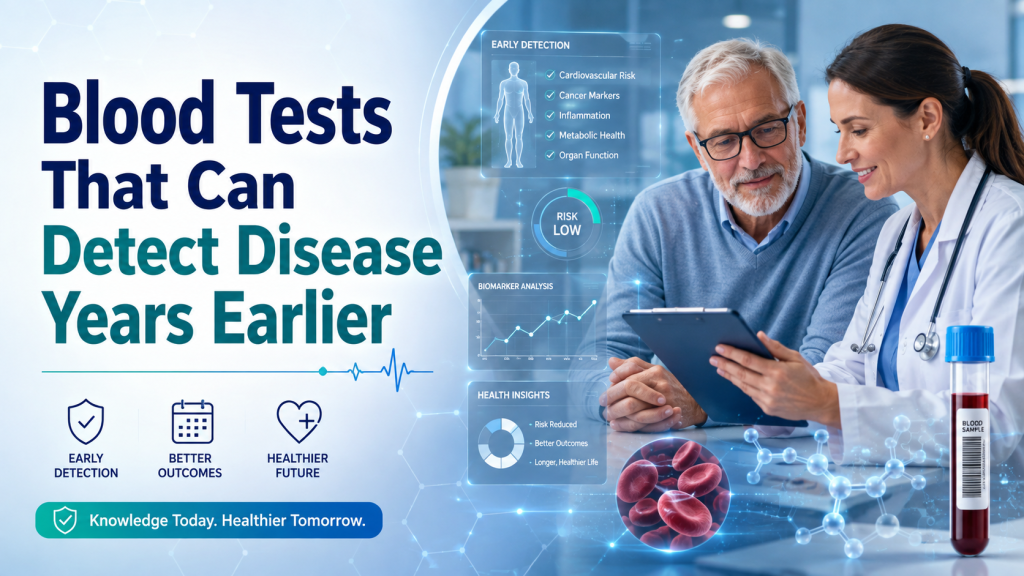
Instead of waiting until disease becomes obvious, researchers are developing blood tests capable of detecting biological changes months—or sometimes years—before serious symptoms appear.
That could represent one of the biggest changes in preventive medicine.
Imagine finding evidence of Alzheimer’s disease before significant memory loss.
Detecting tiny traces of cancer before a tumor becomes large enough to cause symptoms.
Identifying an increased risk of heart disease years before a heart attack.
Or discovering that cancer may be returning before it appears on a conventional scan.
The idea is simple:
The earlier we can see trouble coming, the more time we may have to do something about it.
But there is also an important warning.
A blood test that can detect a biological abnormality is not necessarily the same thing as a test that has been proven to improve health or extend life.
That’s the distinction seniors need to understand.
Blood Is Becoming a Window Into the Body
Your blood carries much more than red and white blood cells.
It contains proteins, hormones, fats, inflammatory markers, fragments of DNA and countless other biological signals.
Some of those signals change when disease begins developing.
Until relatively recently, many were too difficult or too faint to measure.
That’s changing.
Modern laboratory technology can detect extraordinarily small concentrations of proteins and genetic material.
Artificial intelligence can then analyze enormous combinations of those measurements looking for patterns associated with disease.
The result is an emerging generation of what are often called biomarkers.
A biomarker is simply something measurable in the body that can provide information about what’s happening biologically.
Some biomarkers have been used for decades.
Blood glucose can help identify diabetes.
Cholesterol can help estimate cardiovascular risk.
PSA can provide information related to prostate cancer.
But the new generation of tests goes considerably further.
Alzheimer’s Disease May Leave Clues in the Blood
One of the most important developments involves Alzheimer’s disease.
For years, confirming Alzheimer’s-related changes in the brain often required specialized imaging such as PET scans or testing cerebrospinal fluid obtained through a lumbar puncture.
Now blood testing is entering the picture.
In 2025, the FDA cleared the first blood test designed to help diagnose Alzheimer’s disease. The test measures the relationship between two blood biomarkers—pTau217 and beta-amyloid 1-42—to help determine whether amyloid plaques associated with Alzheimer’s are likely to be present in the brain.
That is an extraordinary development.
Alzheimer’s biology can begin developing long before dementia becomes obvious.
The ability to detect some of those changes through a routine blood sample could eventually make evaluation easier and more accessible.
But there is a crucial limitation.
The FDA says this particular test is not intended to be used as a general screening test or as a stand-alone diagnosis. It is intended to be interpreted along with other clinical information. False positive and false negative results are possible.
That distinction matters.
A healthy person shouldn’t simply order an Alzheimer’s blood test and assume the result predicts their future.
The real clinical value may be in helping doctors evaluate people who are already showing signs of cognitive decline and determining who might need additional testing.
For more on the changing Alzheimer’s landscape, see our Elderhood coverage of The Future of Alzheimer’s Disease.
Can One Blood Test Detect Several Cancers?
Perhaps no new blood-testing technology has generated more excitement than multi-cancer detection tests.
The dream is remarkable.
Take one vial of blood.
Search for biological signals released by tumors.
Potentially detect several different cancers at once—even cancers for which we currently have no routine screening program.
Researchers often look for fragments of DNA, abnormal DNA methylation patterns, proteins or other signals associated with cancer.
This field is often referred to as liquid biopsy or multi-cancer detection.
The National Cancer Institute says these tests have the potential to identify multiple cancer types using a blood sample, including cancers that currently lack established screening tests.
That could be revolutionary.
Think about pancreatic cancer.
Ovarian cancer.
Certain liver cancers.
Many of these diseases can be difficult to detect early because symptoms may not appear until the disease has progressed.
If a blood test could reliably identify them earlier, treatment might begin at a stage when the disease is more manageable.
But here’s the reality as of 2026:
Researchers are still trying to establish whether using multi-cancer detection tests to screen healthy people actually reduces cancer deaths and whether the benefits outweigh possible harms.
The National Cancer Institute’s Cancer Screening Research Network launched the Vanguard Study, which is enrolling up to 24,000 people to help design a much larger randomized study of these tests.
So while you may already see commercially available cancer blood tests advertised, the science of widespread population screening is still developing.
That’s an important distinction between promising technology and proven screening medicine.
Why False Positives Matter
At first glance, detecting more disease sounds automatically better.
It isn’t always that simple.
Suppose a blood test says you may have cancer.
Now what?
You may undergo:
CT scans.
MRI scans.
PET scans.
Biopsies.
Specialist consultations.
Possibly even surgery.
If cancer is actually present, that investigation may save your life.
But if the original result was a false alarm, you may experience anxiety, expense and potentially unnecessary medical procedures.
There’s also something called overdiagnosis.
Some abnormalities may technically meet the definition of disease but might never have caused symptoms or shortened a person’s life.
This becomes particularly important as we grow older.
Finding something is not always the same thing as needing to treat it.
The challenge of future screening won’t simply be detecting more abnormalities.
It will be determining which abnormalities actually matter.
Liquid Biopsies Are Already Changing Cancer Care
Blood-based testing may also help people who have already been diagnosed with cancer.
Tumors can release tiny fragments of DNA into the bloodstream.
This is called circulating tumor DNA, or ctDNA.
Scientists can analyze these fragments for genetic mutations and other characteristics.
The FDA describes liquid biopsies as tests that analyze cell-free DNA circulating in the bloodstream, a small fraction of which may come from tumor cells.
One particularly exciting application is detecting minimal residual disease.
Suppose someone has surgery to remove a cancer.
Scans may show no remaining tumor.
But microscopic cancer cells could still remain somewhere in the body.
Researchers are studying whether ctDNA in the blood can detect signs of those remaining cells before conventional imaging can see them.
The FDA reported in 2026 that ctDNA analysis has shown promise for tracking minimal residual disease after surgery in patients with some early-stage cancers.
If this approach proves reliable across more cancers, it could change how doctors determine who needs additional chemotherapy or other treatment after surgery.
Instead of treating everyone the same way, doctors might someday be able to say:
“We can still detect molecular traces of your cancer, so additional treatment makes sense.”
Or:
“We don’t detect evidence of remaining disease, so perhaps aggressive additional treatment isn’t necessary.”
That’s the direction of precision medicine.
Heart Disease Can Leave Warnings Years Before a Heart Attack
Not all early-detection blood tests involve futuristic technology.
We already have blood markers that can help identify cardiovascular risk long before someone experiences a heart attack or stroke.
Traditional cholesterol testing remains extremely important.
But researchers and physicians are increasingly paying attention to other markers, including:
Lipoprotein(a), or Lp(a)
Apolipoprotein B, or ApoB
High-sensitivity C-reactive protein, or hs-CRP
Lp(a) is largely determined by genetics and can increase cardiovascular risk even in some people whose standard cholesterol results don’t appear alarming.
ApoB provides information about the number of cholesterol-carrying particles capable of contributing to plaque formation.
And hs-CRP measures low levels of inflammation associated with cardiovascular risk.
Research has shown that elevated Lp(a) is associated with increased cardiovascular events independently of other inflammatory measures.
High-sensitivity CRP has also been extensively studied as a predictor of cardiovascular events.
These tests don’t tell you:
“You will have a heart attack in five years.”
That’s not how risk testing works.
But they can reveal hidden risks before catastrophe occurs.
And that’s exactly where preventive medicine becomes powerful.
If your risk is identified earlier, you and your physician may have time to address blood pressure, cholesterol, smoking, diabetes, weight, exercise and other factors.
Waiting for the heart attack is a lousy screening program.
Diabetes Is Another Example of Early Warning
Type 2 diabetes doesn’t usually appear overnight.
Blood sugar can gradually become abnormal over many years.
The A1C blood test estimates average blood glucose levels over the previous several months.
It can identify prediabetes before a person reaches the threshold for diabetes.
That’s enormously valuable because prediabetes is a warning—not necessarily a destiny.
Weight reduction, physical activity, dietary changes and, in some cases, medication can significantly influence what happens next.
This represents the broader philosophy behind early detection.
You don’t want medicine to simply tell you what’s already happened.
You want information early enough that your behavior or treatment can still change what happens next.
The Future May Be a Blood Test Dashboard
Now take all these technologies and imagine where we could be heading.
Your annual physical might someday include a blood sample that examines hundreds or thousands of biomarkers.
An artificial-intelligence system could compare:
Your proteins.
Your DNA fragments.
Inflammatory markers.
Metabolic markers.
Immune-system activity.
Cancer-related signals.
Cardiovascular risk.
And possibly markers associated with neurological disease.
Instead of merely reporting whether your cholesterol is high, the system might identify patterns indicating that several biological systems are beginning to change.
Medicine could move from:
“You have a disease.”
to:
“You’re beginning to move toward a disease.”
That’s a fundamentally different approach.
You can read more about this changing model in The Future of Preventive Medicine.
But Don’t Buy Every Test You See Online
This emerging field is going to create tremendous opportunity.
It’s also going to create tremendous marketing.
Companies already sell blood tests claiming to measure biological age, cancer risk, inflammation, longevity and dozens of other conditions.
Some may provide useful information.
Others may produce numbers without providing useful medical answers.
Before spending money on a new blood test, ask a few basic questions:
Has this test been clinically validated?
Has it received appropriate regulatory authorization for the way it’s being used?
Does knowing the result change what my doctor would actually do?
Could the test produce false positives?
What happens if the result is abnormal?
Will Medicare or my insurance cover the follow-up testing?
And perhaps the most important question:
Has finding this disease earlier been shown to improve outcomes?
That’s the question advertising usually leaves out.
Earlier Isn’t Always Better—Unless We Can Act on It
There’s an old assumption in medicine:
The earlier you find something, the better.
Often that’s true.
But not always.
Early detection is most valuable when there is something meaningful we can do with the information.
Finding high cardiovascular risk may allow us to intervene.
Finding prediabetes may allow lifestyle changes.
Finding certain cancers earlier may allow curative surgery.
Finding Alzheimer’s-related biomarkers may increasingly matter as treatments become available that work best earlier in the disease process.
But detecting a disease years before symptoms when there is no effective intervention can also create anxiety without necessarily changing the outcome.
This is why good medicine requires more than a sensitive laboratory test.
It requires judgment.
The Real Revolution Is Time
Perhaps the greatest thing these blood tests can give us isn’t simply information.
It’s time.
Time to change our behavior.
Time to begin treatment.
Time to investigate further.
Time to monitor something closely.
Time to make decisions before a disease becomes a crisis.
For seniors, that is particularly important.
As we grow older, our margin for error becomes smaller.
A heart attack at 45 and a heart attack at 85 are not the same event.
Cancer discovered early and cancer discovered after it has spread are not the same disease.
Preventing or delaying serious illness can preserve something enormously valuable:
independence.
That’s why the future of medicine may increasingly focus on finding trouble before trouble finds us.
The technology isn’t perfect.
Some of it isn’t ready yet.
Some of the promises will undoubtedly be exaggerated.
But the direction is becoming clear.
Blood is becoming one of medicine’s most powerful early-warning systems.
And in the coming years, a simple vial of blood may tell doctors things about our future health that previous generations could only discover after they became sick.
That’s not science fiction anymore.
The future is arriving.
And perhaps the best medicine of all will eventually be the disease we discover early enough to prevent from becoming a serious disease in the first place.