
For most of our lives, the word vaccine has meant preventing an infectious disease.
Polio. Measles. Flu. COVID.
But scientists are now asking a remarkable question:
Could we someday vaccinate people against cancer?
The answer is more complicated—and more exciting—than it may first appear.
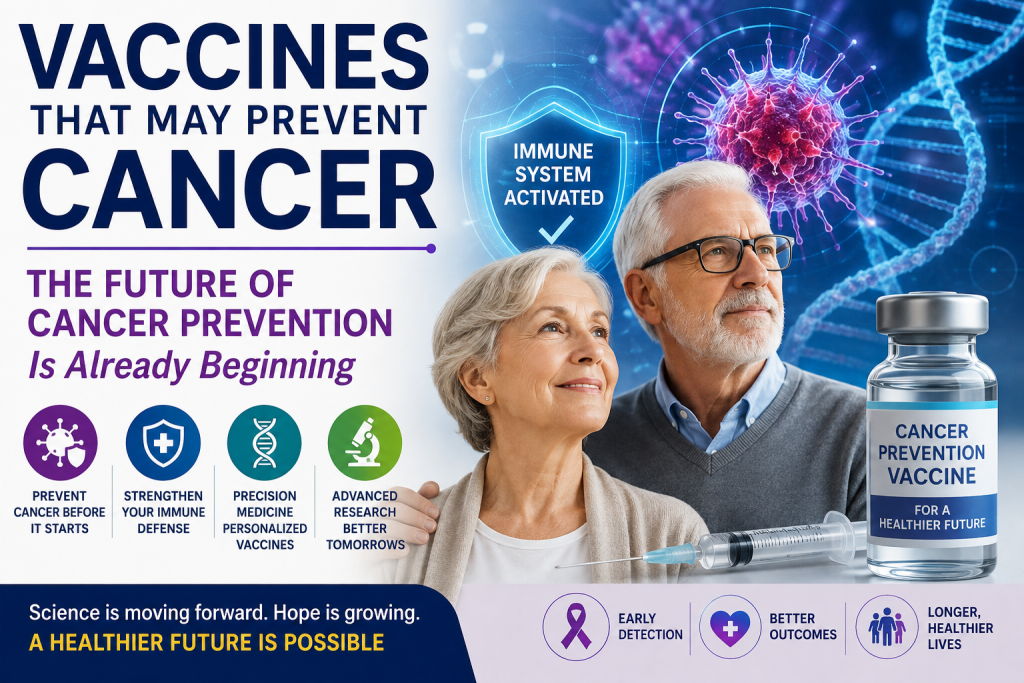
In fact, vaccines already prevent some cancers today. Researchers are also developing a new generation of vaccines designed to train the immune system to recognize cancer cells, destroy microscopic cancer left behind after surgery, and perhaps one day stop certain cancers before they fully develop.
That does not mean we are about to receive one universal “cancer shot” at the pharmacy.
Cancer is far too complicated for that.
But the idea of using vaccines to prevent cancer, prevent its return, or attack it at its earliest stages has moved from science fiction into serious medical research.
And that makes cancer vaccines another example of why the future of medicine is arriving faster than many older adults realize.
We Already Have Vaccines That Prevent Cancer
This may surprise many people, but cancer-prevention vaccines are not entirely futuristic.
They already exist.
The human papillomavirus, or HPV, can cause cervical cancer as well as cancers of the throat, anus, penis, vagina, and vulva.
The HPV vaccine prevents infection with the types of HPV responsible for most HPV-related cancers. The National Cancer Institute estimates that HPV vaccination can prevent up to 90% of cancers caused by HPV infection.
There is another example.
Chronic hepatitis B infection can increase the risk of liver cancer. Vaccination against hepatitis B prevents the infection and therefore helps prevent cancers that may eventually result from chronic infection. The National Cancer Institute recognizes both HPV and hepatitis B vaccines as approved cancer-prevention vaccines in the United States.
This connects with another remarkable medical story we have discussed at Elderhood: how hepatitis C went from a lifetime disease to a curable infection.
There still is no hepatitis C vaccine, but today’s antiviral medications can cure most hepatitis C infections. That matters because chronic hepatitis C can also contribute to liver cancer.
The larger lesson is important.
Sometimes preventing cancer does not begin by attacking the cancer itself.
It begins by eliminating something that causes the cancer.
But Can We Vaccinate Against Cancer Itself?
This is where medicine gets especially interesting.
Normal vaccines teach the immune system to recognize a foreign invader—a virus or bacterium.
Cancer presents a harder problem.
Cancer cells began as our own cells.
That means they often look enough like normal tissue that the immune system does not recognize them as dangerous.
Cancer is rather like a criminal who has stolen someone else’s identification card.
The immune system looks at the identification and says, “Everything seems to be in order.”
Researchers are trying to change that.
Cancer cells frequently develop mutations that cause them to produce unusual proteins called neoantigens.
Those neoantigens can act like tiny identification flags that distinguish a cancer cell from a healthy cell.
Scientists are learning how to build vaccines that show those flags to the immune system.
The hope is that immune cells will then recognize cancer carrying those markers and attack it.
The National Cancer Institute describes cancer treatment vaccines as a form of immunotherapy designed to strengthen the body’s ability to recognize and destroy cancer cells.
Personalized Cancer Vaccines: A Vaccine Made Just for You
Perhaps the most fascinating development is the personalized cancer vaccine.
Instead of manufacturing exactly the same vaccine for millions of people, scientists can analyze an individual patient’s tumor.
They sequence its genetic material.
They identify mutations unique to that tumor.
Computer systems help predict which mutations might produce the strongest immune response.
Then researchers manufacture a vaccine specifically designed around that patient’s cancer.
Think about how different this is from traditional medicine.
For generations, two people with the same type of cancer might have received essentially the same treatment.
Now we are entering the era of precision medicine, where the treatment may increasingly be designed around the biology of the individual patient’s disease.
That is why our Elderhood discussion of How Precision Medicine Is Replacing One-Size-Fits-All Care is so important.
Cancer vaccines are a perfect example.
Instead of saying, “You have pancreatic cancer, therefore everyone gets exactly the same treatment,” medicine is beginning to ask:
What is unique about your cancer?
mRNA Is Playing a Major Role
Many people first heard the term mRNA during the COVID-19 pandemic.
But scientists had been studying mRNA technology for years, including its possible use against cancer.
mRNA acts like a temporary set of instructions.
A personalized mRNA cancer vaccine can carry instructions corresponding to specific tumor mutations. The immune system learns to recognize those targets and may then seek out cancer cells carrying them.
Researchers have reported encouraging immune responses in several cancers.
A 2025 Nature study found that individualized mRNA vaccines could produce durable T-cell immune responses in patients with triple-negative breast cancer.
Researchers have also studied personalized RNA vaccines after surgery for pancreatic cancer. Longer-term follow-up has shown that vaccine-induced T cells can persist for years in some patients, although larger randomized trials are still needed to prove how much this improves survival.
That last point is important.
Promising does not mean proven.
Elderhood should never confuse the two.
Cancer Vaccines May Be Especially Useful After Surgery
Imagine that surgeons remove everything they can see of a cancer.
Scans show no obvious tumor.
But perhaps a few thousand or even a few million cancer cells remain somewhere in the body.
That sounds like an enormous number, but in medical imaging terms, it can still be microscopic.
Those remaining cells may eventually grow into a recurrence.
One strategy being studied is to vaccinate the patient after surgery.
The vaccine teaches the immune system what the original cancer looked like.
Then immune cells may patrol the body looking for remaining cells carrying the same targets.
In other words, the vaccine becomes a kind of biological neighborhood watch.
This is currently one of the most realistic uses of cancer vaccines.
In melanoma, pancreatic cancer, kidney cancer, colorectal cancer, breast cancer, and other cancers, researchers are studying whether vaccination after conventional treatment can lower the chance of recurrence.
An early trial involving patients with high-risk kidney cancer found strong immune responses after personalized vaccination; researchers have called the findings promising, although larger controlled trials are necessary before anyone can conclude that the approach prevents recurrence.
Could Vaccines Stop Cancer Before It Starts?
Now we come to the truly futuristic possibility.
Could doctors vaccinate people who do not yet have cancer?
Researchers are beginning to investigate exactly that.
One particularly interesting area involves people with Lynch syndrome.
Lynch syndrome is an inherited genetic condition that substantially increases the risk of colorectal and several other cancers.
Because scientists understand some of the abnormal proteins that can appear as Lynch-related cells progress toward cancer, researchers have been testing vaccines designed to teach the immune system to recognize those abnormalities early.
The National Cancer Institute has sponsored clinical trials evaluating preventive cancer vaccines in people with Lynch syndrome, including the experimental Nous-209 vaccine and another vaccine strategy targeting proteins associated with precancerous and cancerous cells.
This is still experimental research.
But consider what it represents.
Medicine is no longer asking only:
How do we treat cancer once somebody has it?
Researchers are asking:
Can we identify people at unusually high risk and train their immune system before cancer develops?
That is an enormous change in thinking.
The Future May Combine Vaccines With Early Detection
Cancer vaccines will probably not develop in isolation.
Another medical revolution is happening at the same time: increasingly sophisticated blood tests and genetic tests designed to detect disease earlier.
We have discussed this in Elderhood’s coverage of blood tests that may detect disease years earlier.
Now imagine combining the two technologies.
A blood test detects a molecular warning sign long before a tumor becomes large enough to cause symptoms.
Doctors identify the abnormal proteins associated with those cells.
Then a vaccine or another immune therapy is used to attack them.
That combination—earlier detection plus earlier intervention—could be far more important than simply discovering another drug for late-stage cancer.
The best cancer treatment may eventually be preventing a dangerous cancer from ever becoming a large tumor in the first place.
Why Isn’t There One Universal Cancer Vaccine?
Unfortunately, cancer is not one disease.
There are hundreds of forms of cancer.
And even two people diagnosed with the same cancer can have tumors with very different genetic characteristics.
Cancer also changes.
As cancer cells reproduce, new mutations develop.
Some cells may be destroyed by treatment while others evolve ways to escape.
That is why developing a universal vaccine against all cancers remains extraordinarily difficult.
Researchers are therefore pursuing several strategies:
vaccines against viruses that cause cancer,
vaccines targeting mutations shared by groups of cancers,
personalized vaccines targeting one person’s unique cancer,
and preventive vaccines for people with inherited high-risk conditions.
The ultimate future may involve several of these approaches rather than one magical shot that eliminates every form of cancer.
What Does This Mean for Today’s Senior?
If you are 65, 75, or 85 years old, it is reasonable to ask:
“Will any of this happen soon enough to matter to me?”
Nobody can promise that.
Medical research does not operate on our preferred timetable.
Some promising treatments fail.
Some take decades.
Others arrive much faster than expected.
That is why Elderhood continually returns to one idea:
Stay healthy enough to benefit from tomorrow’s discovery.
Maintain your strength.
Keep moving.
Get appropriate cancer screenings.
Do not smoke.
Discuss vaccines with your healthcare provider.
Pay attention to changes in your health.
Take care of conditions such as diabetes, hypertension, and obesity.
And remain interested in what medicine is discovering.
We cannot control when the next breakthrough arrives.
But we can improve our chances of being around—and healthy enough—to benefit from it.
Hope Without Hype
Cancer vaccines deserve excitement.
They also deserve perspective.
Today, HPV and hepatitis B vaccines already prevent cancers caused by those infections.
Personalized cancer vaccines are showing encouraging results in early and mid-stage research.
Vaccines designed to reduce cancer recurrence are being actively studied.
And scientists are even testing vaccines intended to prevent certain cancers in people who are genetically predisposed to develop them.
But most experimental cancer vaccines are not yet routine treatments.
They still have to prove that they safely improve meaningful outcomes in larger clinical trials.
That distinction matters.
At Elderhood, optimism should never require exaggeration.
The real science is exciting enough.
The Future Is Arriving
Think about how medicine has changed during one lifetime.
Diseases that once killed millions are now prevented by vaccines.
Hepatitis C can now usually be cured.
Some cancers that once carried grim prognoses can now be controlled for years with targeted treatments and immunotherapy.
Genetic sequencing can identify the mutations inside an individual tumor.
Artificial intelligence can help scientists analyze enormous quantities of medical information.
And now researchers are teaching the immune system to recognize cancer with vaccines designed around the biology of the disease—or even the biology of the individual patient.
We are not yet at the point where people routinely receive a vaccine and stop worrying about cancer.
But the direction of medicine is becoming clear.
Find disease earlier.
Understand it more precisely.
Target it more intelligently.
And whenever possible:
Prevent it before it becomes dangerous.
For older adults, that is a powerful reason to remain optimistic about the years ahead.
The cavalry has not completely arrived.
But you can hear the horses coming.
And cancer vaccines may become one more reason that tomorrow’s medicine looks very different from the medicine we grew up with.