
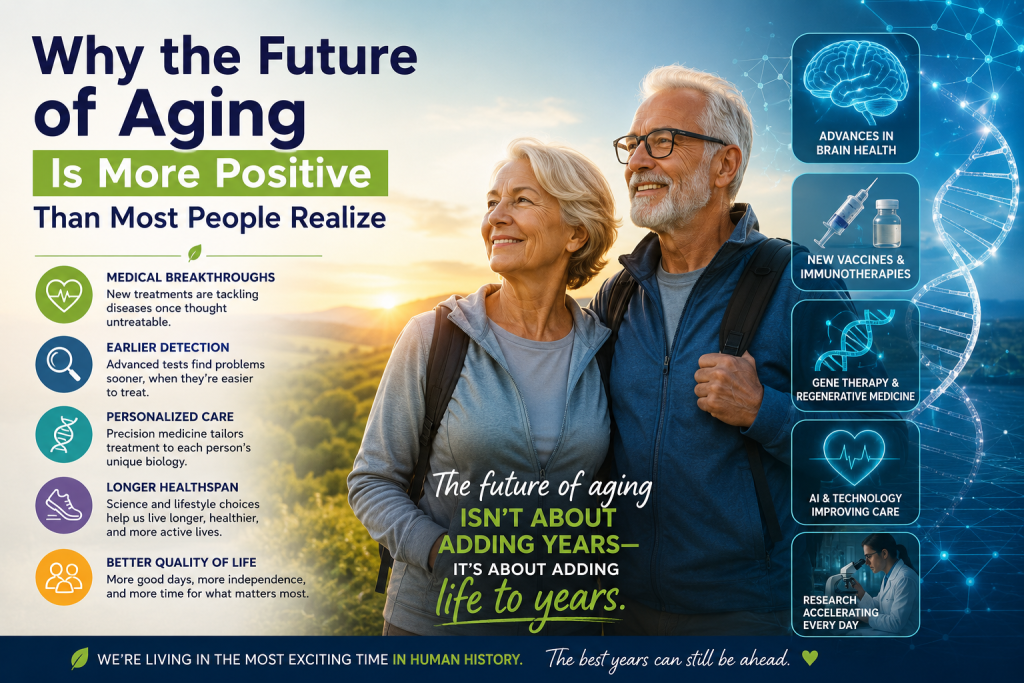
Why the Future of Aging Is More Positive Than Most People Realize
Optimistic Aging Is Not Wishful Thinking
For most of human history, growing older meant accepting a fairly predictable list of losses.
Joints wore out. Vision weakened. Heart disease arrived. Cancer became harder to treat. Memory problems were diagnosed only after they had become obvious. Doctors did what they could, but much of aging was approached as an unavoidable decline.
That old picture has not disappeared entirely. Aging remains real, illness remains real, and no responsible person should promise immortality or a future without disease.
But something remarkable is happening.
We are living through an age of medical discovery in which researchers can read the genetic instructions inside a tumour, detect signs of disease in a tube of blood, help the immune system attack cancer, repair certain faulty genes and use artificial intelligence to recognise patterns that human eyes may miss.
Aging today is not the same experience it was for our parents or grandparents.
The future is more positive than many people realise—not because aging has been defeated, but because medicine is becoming earlier, more precise, more preventive and, in some cases, regenerative.
That is why optimistic aging is not wishful thinking.
It is informed hope based on genuine scientific progress.
We Are the First Generation to Age With These Tools
Older adults living today occupy a unique place in history.
We are the first generation entering Elderhood with access to advanced imaging, wearable heart monitors, genetic testing, targeted cancer drugs, joint replacements, robotic surgery, modern vaccines and medications capable of controlling diseases that were once rapidly fatal.
Even more important, we can see the next generation of treatments approaching.
The National Institute on Aging is supporting a field known as geroscience, which studies how the biological processes of aging contribute to multiple chronic diseases. The goal is not simply to treat heart disease, diabetes, dementia and frailty separately, but to understand the aging mechanisms that may help drive several of them at once.
This represents an enormous change in medical thinking.
Instead of asking only, “How do we treat this disease after it appears?” researchers are increasingly asking:
- Can we detect it sooner?
- Can we delay it?
- Can we interrupt the biological process causing it?
- Can we preserve function before serious disability occurs?
- Can we repair some of the damage?
That is the foundation of the age of medical discovery.
For a broader explanation of this changing philosophy, read The Science of Elderhood, which focuses on preserving movement, clarity, connection and purpose rather than merely adding years to the calendar.
Earlier Detection Is Changing the Odds
Many serious diseases do not begin when the symptoms appear.
Cancer may grow quietly for years. Alzheimer’s-related brain changes can develop long before severe memory problems. Artery disease accumulates before the first heart attack. Kidney damage may advance without causing obvious pain.
Historically, medicine often waited until the body sounded the alarm.
Today, researchers are learning to find the smoke before the entire building catches fire.
One example is Alzheimer’s disease. In 2025, the FDA cleared the first blood test intended to help doctors diagnose Alzheimer’s in people showing signs of cognitive decline. It measures blood markers associated with amyloid changes in the brain and may reduce the need for some patients to begin with more invasive or expensive testing. This is not a general screening test for every healthy older adult, but it represents a major step toward more accessible diagnosis.
Cancer detection is also moving into the bloodstream. Liquid-biopsy technology looks for DNA fragments and other signals released by tumours. Some blood tests are already used to guide treatment after cancer has been diagnosed, while researchers are investigating whether future tests could identify several cancers before symptoms begin.
These technologies are not perfect. False alarms, missed disease and unnecessary follow-up remain serious concerns.
But the direction is clear.
The earlier medicine can recognise meaningful biological change, the more time doctors may have to intervene.
As discussed in The Future Is Closer Than You Think, the medical future is arriving through many smaller advances rather than one dramatic miracle.
Cancer Is Becoming More Personal
For generations, cancer treatment was based largely on where the tumour began.
Breast cancer was treated as breast cancer. Lung cancer was treated as lung cancer. Colon cancer was treated as colon cancer.
Today, location still matters—but doctors can also examine the molecular machinery driving the tumour.
Two people may have cancer in the same organ but carry completely different mutations. One may respond to a targeted medicine, while the other may need a different treatment.
This is precision medicine.
Doctors can now test some tumours for genes, proteins and other biomarkers that help determine whether a targeted treatment or immunotherapy is likely to work. Instead of giving the same drug to every patient and waiting for the result, medicine is slowly improving its ability to match the treatment to the biology of the disease.
Personalised cancer vaccines are also being studied. These experimental vaccines can be designed around mutations found in an individual patient’s tumour, essentially giving the immune system a wanted poster describing the cancer cells it should attack.
Most of these personalised vaccines remain investigational. They are not universal cures, and they may eventually work best alongside surgery, targeted drugs or immunotherapy.
Nevertheless, the idea that a vaccine could be created from the genetic fingerprint of one person’s tumour would have sounded like science fiction not very long ago.
Now it is part of serious medical research.
Gene Therapy Has Crossed the Line From Theory to Treatment
Gene therapy may be one of the clearest signs that medicine has entered a different age.
Some diseases begin with an error in a person’s genetic instructions. Traditional treatment manages the damage produced by that error. Gene therapy attempts to add a working instruction, silence a harmful gene or edit the DNA itself.
The FDA approved the first CRISPR-based treatment in 2023 for certain patients with sickle cell disease. The treatment involves removing a patient’s blood-forming stem cells, editing them in a specialised laboratory and returning them to the body.
This is not a simple injection. It involves intensive treatment, risk and long-term monitoring.
But the principle has been proven:
Doctors can treat certain diseases by changing the biological instructions behind them.
Gene-based treatments are also being used or studied for inherited blindness, blood disorders, spinal muscular atrophy, cancer and rare metabolic diseases.
These treatments will not cure ordinary aging. Aging involves thousands of interacting changes and cannot be reduced to one defective gene.
But gene therapy may eventually help repair particular diseases that become more common or more damaging as people age.
The future may not eliminate aging.
It may repair more of what goes wrong during aging.
Artificial Intelligence Is Giving Doctors Another Set of Eyes
Artificial intelligence is already becoming part of healthcare.
The FDA reported in early 2025 that it had authorised more than 1,000 AI-enabled medical devices, and its public list continues to expand. Many of these systems involve medical imaging, heart monitoring and clinical decision support.
AI can help analyse X-rays, scans, retinal photographs and heart rhythms. It can search long medical records for patterns, compare new results with old ones and flag information that deserves a doctor’s attention.
This does not mean the computer should replace the physician.
AI can also be wrong, biased or confidently misleading. Medical decisions still require human judgement, physical examination, patient history and an understanding of what matters to the individual.
The best future is not doctor versus computer.
It is doctor plus computer—with the qualified professional still responsible for the decision.
For older patients with decades of test results, medications and specialist notes, that assistance could be enormously valuable. Important clues may no longer remain buried on page 147 of a medical record that nobody had time to read.
Arthritis May Eventually Become a Repairable Disease
Arthritis has long been treated as a one-way road.
Cartilage wears away. Pain increases. Doctors recommend therapy, medication and injections. When the joint becomes badly damaged, it is replaced.
Joint replacement can be life-changing, but researchers are now exploring something more ambitious: stimulating the joint to repair itself.
Scientists are investigating biological scaffolds, controlled-release injections, gene therapies and molecular switches that may reactivate cartilage-producing cells.
Animal studies and laboratory work using human cartilage have produced encouraging results, but there is not yet a widely approved injection that reliably regrows cartilage destroyed by ordinary osteoarthritis.
This is where informed optimism matters.
The research is real.
The guaranteed cartilage-regrowth advertisements are not.
Older adults must avoid paying thousands of dollars to clinics that turn early laboratory findings into promises of a new knee by Friday afternoon.
Yet the larger idea is no longer ridiculous.
Cartilage regeneration has moved from “impossible” to “scientifically plausible but still unproven in routine human care.”
That is progress.
Alzheimer’s Research Has Finally Moved Beyond Helplessness
No disease frightens older adults more than Alzheimer’s.
For decades, approved medications treated symptoms without clearly changing the underlying course of the disease.
Newer anti-amyloid drugs can modestly slow decline in certain carefully selected people with early Alzheimer’s disease. They are not cures, do not restore lost memory and can cause serious brain swelling or bleeding.
Still, they represent a milestone.
For the first time, doctors have treatments intended to alter part of the disease process rather than only manage symptoms.
Researchers are also studying tau, inflammation, brain-cell resilience, vascular health, immune activity and combination treatment.
Progress may arrive the same way it arrived in heart disease and cancer—not through one magical cure, but through earlier diagnosis, better patient selection, several treatments working together and steadily improved prevention.
The proper attitude is neither despair nor celebration.
It is informed hope.
Healthy Aging Is Also Something We Can Influence
Medical discovery matters, but the future is not being built only inside laboratories.
The strongest evidence for healthy aging still includes remarkably ordinary actions:
- Avoid tobacco.
- Move regularly.
- Preserve muscle and balance.
- Control blood pressure, blood sugar and cholesterol.
- Treat hearing loss and sleep problems.
- Eat mostly nutritious food.
- Maintain relationships.
- Continue learning.
- Keep a reason to get up in the morning.
These habits do not guarantee a disease-free life.
They improve the odds.
They also preserve the physical and mental capacity needed to benefit from future treatments.
Elderhood’s guide to lifestyle changes with the biggest impact on lifespan explains why small actions repeated consistently can become powerful over time.
This is not about trying to become young again.
It is about staying capable.
Walk if you can walk. Cycle if you can cycle. Dance if you can dance. Use resistance bands, lift manageable weights or practise standing from a chair.
Movement tells the body:
“We are still using this equipment.”
Healthspan Is the Real Goal
Living longer is valuable.
Living longer with strength, clarity, independence, connection and purpose is the greater prize.
That is the difference between lifespan and healthspan.
A person can have arthritis, high blood pressure or another managed condition and still enjoy a strong healthspan if they remain active, involved and able to make their own choices.
The goal is not medical perfection.
The goal is useful life.
Read What’s the Difference Between Healthspan and Lifespan? for a deeper look at why healthy aging should be measured by function and quality of life—not merely birthdays.
Optimism Is Not Denial
Positive aging does not mean pretending everything will be fine.
It does not mean ignoring symptoms, trusting every medical headline or buying every supplement labelled “anti-aging.”
Real optimism asks hard questions.
Was the research performed in humans or only in mice?
Was the treatment tested in a controlled clinical trial?
Is it FDA-approved or still experimental?
Does it improve how people feel and function, or does it merely change a laboratory number?
What are the risks?
What does it cost?
Will ordinary people be able to obtain it?
Optimism without scepticism becomes gullibility.
Scepticism without optimism becomes paralysis.
We need both.
The Future Belongs to Those Who Remain in the Game
No one can guarantee that the next medical breakthrough will arrive in time for a particular person.
But we can improve our chances of being here—and being healthy enough to benefit when it does.
That means keeping up with preventive care, using proven treatments, maintaining strength, protecting sleep, staying socially connected and refusing to surrender to the phrase, “I’m too old.”
As Modern Science Is Challenging What We Were Told About Aging explains, aging is not simply something that happens to us. We participate in it through the choices, habits and adaptations we make.
We are not promised immortality.
We are being given better tools.
Tools to detect disease earlier.
Tools to target the biology behind illness.
Tools to replace, repair or regenerate damaged parts of the body.
Tools to help doctors make better decisions.
And tools to help older adults remain independent longer.
The Elderhood Takeaway
The future of aging is more positive than most people realise.
Not because old age has been cured.
Not because every research headline will become a treatment.
And certainly not because a capsule sold online can reverse the clock.
The future is positive because medicine has changed direction.
It is moving from late diagnosis toward earlier detection.
From one-size-fits-all treatment toward precision care.
From managing symptoms toward modifying disease.
From replacing damaged tissue toward attempting regeneration.
From treating each age-related illness separately toward studying the biology connecting them.
At the same time, older adults have more access to health information, preventive care, technology and practical strategies than any previous aging generation.
This is the age of medical discovery.
Our responsibility is to meet it with open eyes.
Stay curious.
Stay active.
Question exaggerated claims.
Use proven medicine.
Protect muscle, mobility and mental engagement.
Remain connected to other people.
And never assume that chronological age alone determines what is still possible.
Optimistic aging is not wishful thinking.
It is recognising that the old story of inevitable decline is incomplete.
Aging brings change. It may bring limitations. But it also brings adaptation, knowledge, new treatments and possibilities that did not exist even a decade ago.
The cavalry is not fully here.
But we can hear it coming.
Our job is to stay healthy until the future arrives—and then be ready to use it.